Air quality across Singapore remains in unhealthy range新加坡各地的空气质量仍然处于不健康水平。
The 24-hour PSI readings entered the unhealthy range across Singapore at noon on Wednesday and remained there overnight into Thursday morning.
The 24-hour PSI readings entered the unhealthy range across Singapore at noon on Wednesday and remained there overnight into Thursday morning.
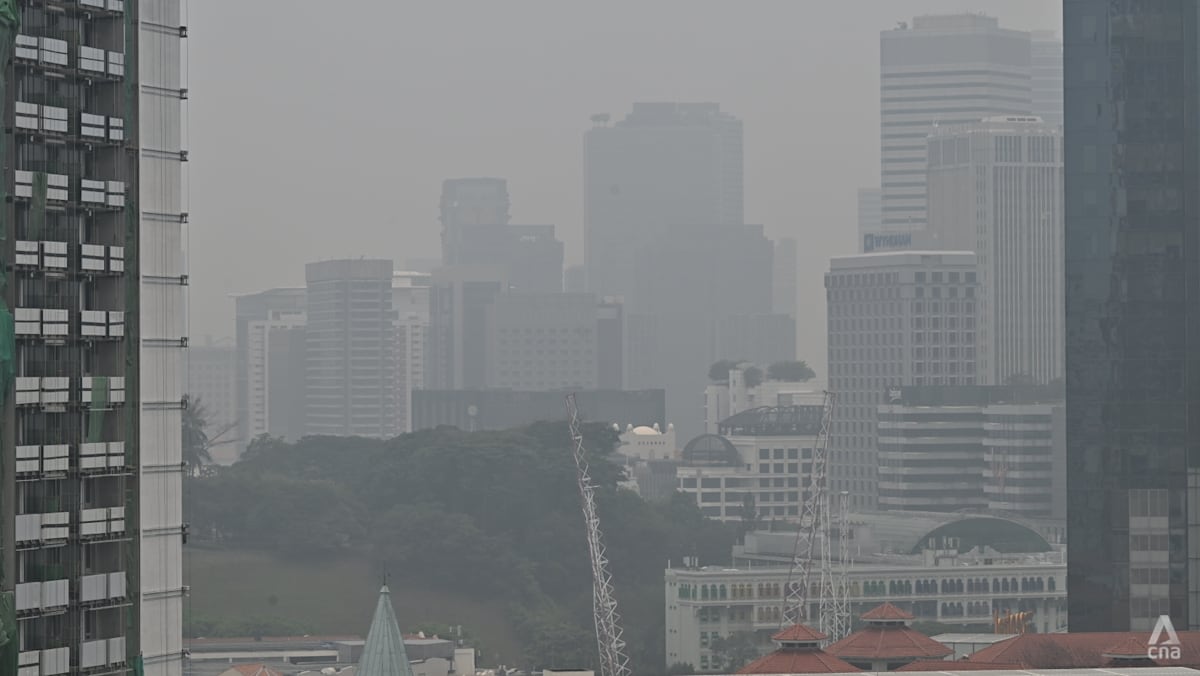
Haze conditions from the Upper Cross Street area overlooking Bras Basah Road on Oct 7, 2026. (Photo: CNA/Raydza Rahman)
This audio is generated by an AI tool.
SINGAPORE: Air quality across all five regions of Singapore remained in the unhealthy range on Thursday (Oct 8), with the west recording a 24-hour Pollutant Standards Index (PSI) reading of 160 at 10am.
As of 10am, the 24-hour PSI was 143 in the central region,123 in the east, 114 in the south and 112 in the north.
The 1-hour PM2.5 readings were in the elevated band in central and western Singapore, while readings in the other regions were in the normal band.
CNA Games Guess Word Crack the word, one row at a time Buzzword Create words using the given letters Mini Sudoku Tiny puzzle, mighty brain teaser Mini Crossword Small grid, big challenge Word Search Spot as many words as you can Show More Show Less On Wednesday, the 1-hour PM2.5 reading in the west rose to 152 at 4pm, entering the "high" band for the first time this haze season, before falling back into the elevated band an hour later. In its latest update on Thursday morning, the National Environment Agency (NEA) said moderate transboundary smoke haze was covering parts of Singapore, Peninsular Malaysia, Kalimantan, Sarawak and Sumatra's southern and central parts. Moderate to dense smoke plumes were also observed from hotspot clusters detected in large parts of Kalimantan, as well as central and southern areas in Sumatra. While there were scattered hotspots detected in Kalimantan and Sumatra, only a few were observed elsewhere in southern ASEAN, said NEA. However, the full extent of the situation could not be determined because of thick smoke haze and cloud cover, the agency said. Dry conditions are expected to continue over most of southern ASEAN, except over Borneo's northern areas, as well as parts of Sumatra and Peninsular Malaysia where showers are forecast. "The hotspot and smoke haze situation may improve in areas experiencing showers but also continue to stay elevated in areas experiencing prolonged periods of dry weather, with a continued risk of transboundary haze occurrence," said NEA. "On the other hand, wet weather is expected to persist over the northern ASEAN region, which helps to keep the hotspot and smoke haze situation subdued."
On Wednesday, the 1-hour PM2.5 reading in the west rose to 152 at 4pm, entering the "high" band for the first time this haze season, before falling back into the elevated band an hour later.
In its latest update on Thursday morning, the National Environment Agency (NEA) said moderate transboundary smoke haze was covering parts of Singapore, Peninsular Malaysia, Kalimantan, Sarawak and Sumatra's southern and central parts.
Moderate to dense smoke plumes were also observed from hotspot clusters detected in large parts of Kalimantan, as well as central and southern areas in Sumatra.
While there were scattered hotspots detected in Kalimantan and Sumatra, only a few were observed elsewhere in southern ASEAN, said NEA.
However, the full extent of the situation could not be determined because of thick smoke haze and cloud cover, the agency said.
Dry conditions are expected to continue over most of southern ASEAN, except over Borneo's northern areas, as well as parts of Sumatra and Peninsular Malaysia where showers are forecast.
"The hotspot and smoke haze situation may improve in areas experiencing showers but also continue to stay elevated in areas experiencing prolonged periods of dry weather, with a continued risk of transboundary haze occurrence," said NEA.
"On the other hand, wet weather is expected to persist over the northern ASEAN region, which helps to keep the hotspot and smoke haze situation subdued."
When planning outdoor activities for the next 24 hours, the public is advised to use the 24-hour PSI forecast and health advisories.
When 1-hour PM2.5 levels are elevated, healthy people are advised to reduce strenuous outdoor activity for the next hour, while the elderly, pregnant women, children and people with chronic heart or lung conditions should avoid such activity.
The 24-hour PSI is Singapore's indicator of daily air quality and forms the basis of NEA's daily health advisories. It is calculated using six air pollutants - PM2.5, PM10, ozone, sulphur dioxide, nitrogen dioxide and carbon monoxide - and reflects the average air quality of the past 24 hours.
The 1-hour PM2.5 reading, on the other hand, is the hourly average of the PM2.5 pollutant levels. PM2.5 is fine particulate matter with a diameter of 2.5 micrometres or shorter, and is the dominant pollutant during haze that causes harm to health.
A 24-hour PSI reading is considered "unhealthy" when it is in the 101 to 200 range, "very unhealthy" when it is within the 201-300 range and "hazardous" when it goes over 300.
The hourly PM2.5 reading is classified in four bands: normal, elevated, high and very high. It is considered elevated when it ranges from 56 to 150. The "high" band ranges from 151 to 250, and readings above that are classified as "very high".
Get our pick of top stories and thought-provoking articles in your inbox
Stay updated with notifications for breaking news and our best stories
Join our channel for the top reads for the day on your preferred chat app
周三中午,新加坡全境24小时空气污染指数(PSI)读数进入不健康范围,并持续到周四早上。
2026年10月7日,从上十字街一带俯瞰勿拉士峇沙路的雾霾情况。(图片:CNA/Raydza Rahman)
这段音频由人工智能工具生成。
新加坡:周四(10 月 8 日),新加坡所有五个地区的空气质量仍处于不健康范围,其中西部地区上午 10 点的 24 小时污染物标准指数 (PSI) 读数为 160。
截至上午 10 点,中部地区的 24 小时 PSI 为 143,东部为 123,南部为 114,北部为 112。
新加坡中部和西部地区的 1 小时 PM2.5 读数处于较高水平,而其他地区的读数则处于正常水平。
CNA游戏 猜词游戏 逐行破解单词 流行词游戏 用给定的字母组成单词 迷你数独 小小的谜题,强大的脑力挑战 迷你填字游戏 小方格,大挑战 单词搜索 尽可能多地找出单词 显示更多 显示更少 周三,西部地区1小时PM2.5读数在下午4点升至152,首次进入本雾霾季的“高”浓度区间,随后一小时后回落至“中”浓度区间。国家环境局(NEA)在周四上午的最新通报中表示,中度跨境烟霾覆盖了新加坡、马来西亚半岛、加里曼丹、砂拉越以及苏门答腊南部和中部部分地区。在加里曼丹大部分地区以及苏门答腊中部和南部地区也观测到了中度至重度的烟雾。国家环境局表示,虽然在加里曼丹和苏门答腊观测到了零星的热点区域,但在东盟南部其他地区仅观测到少数热点区域。国家环境局表示,由于浓厚的烟霾和云层覆盖,目前尚无法确定局势的全貌。预计东盟南部大部分地区将持续干燥,婆罗洲北部地区以及苏门答腊和马来半岛部分地区除外,这些地区预计将有降雨。国家环境局指出:“降雨地区的热点和烟霾情况可能会有所改善,但持续干旱地区的热点和烟霾情况仍将居高不下,跨境烟霾的风险依然存在。另一方面,东盟北部地区预计将持续降雨,这将有助于缓解热点和烟霾情况。”
周三下午 4 点,西部地区的 1 小时 PM2.5 读数升至 152,这是本雾霾季首次进入“高”水平,一小时后又回落到“中”水平。
国家环境局(NEA)周四上午发布的最新通报称,中度跨境烟雾笼罩了新加坡、马来西亚半岛、加里曼丹、沙捞越以及苏门答腊岛南部和中部的部分地区。
在加里曼丹岛大部分地区以及苏门答腊岛中部和南部地区,还观测到热点聚集区冒出中等至浓密的烟雾。
国家环境局表示,虽然在加里曼丹和苏门答腊发现了零星的热点地区,但在东盟南部其他地区只观察到少数热点地区。
该机构表示,由于浓烟和云层覆盖,无法确定情况的全部严重程度。
预计东盟南部大部分地区将持续干燥天气,但婆罗洲北部地区以及苏门答腊和马来西亚半岛部分地区预计将有阵雨。
国家环境局表示:“在有降雨的地区,热点和烟霾情况可能会有所改善,但在持续干旱的地区,情况仍将居高不下,跨境烟霾发生的风险依然存在。”
“另一方面,预计东盟北部地区将持续降雨,这将有助于缓解热点地区和烟霾情况。”
建议公众在计划未来 24 小时的户外活动时,参考 24 小时 PSI 预报和健康建议。
当 1 小时 PM2.5 水平升高时,建议健康人群在接下来的一个小时内减少剧烈的户外活动,而老年人、孕妇、儿童以及患有慢性心脏或肺部疾病的人应避免此类活动。
24小时空气污染指数(PSI)是新加坡衡量每日空气质量的指标,也是国家环境局(NEA)每日健康建议的基础。它使用六种空气污染物——PM2.5、PM10、臭氧、二氧化硫、二氧化氮和一氧化碳——计算得出,反映了过去24小时的平均空气质量。
另一方面,1 小时 PM2.5 读数是 PM2.5 污染物浓度的小时平均值。PM2.5 是直径为 2.5 微米或更短的细颗粒物,是雾霾期间造成健康危害的主要污染物。
24 小时 PSI 读数在 101 到 200 范围内被认为是“不健康的”,在 201 到 300 范围内被认为是“非常不健康的”,超过 300 时被认为是“危险的”。
PM2.5 每小时读数分为四个等级:正常、偏高、高和非常高。当读数在 56 至 150 之间时,被视为偏高;“高”等级的范围为 151 至 250;高于此范围的读数则被归类为“非常高”。
订阅我们的邮件,即可获取精选热点新闻和引人深思的文章。
订阅通知,第一时间获取突发新闻和精彩报道。
加入我们的频道,即可在您常用的聊天应用上获取当日热门文章。