Merging Cat A and B, rebates based on car value among proposed changes to COE system拟议的拥车证制度改革包括合并A类和B类车辆,以及根据车辆价值提供折扣。
LTA proposes merging COE car categories and a fee rebate-surcharge system to widen the gap between mass-market and luxury cars. Read more at straitstimes.com.
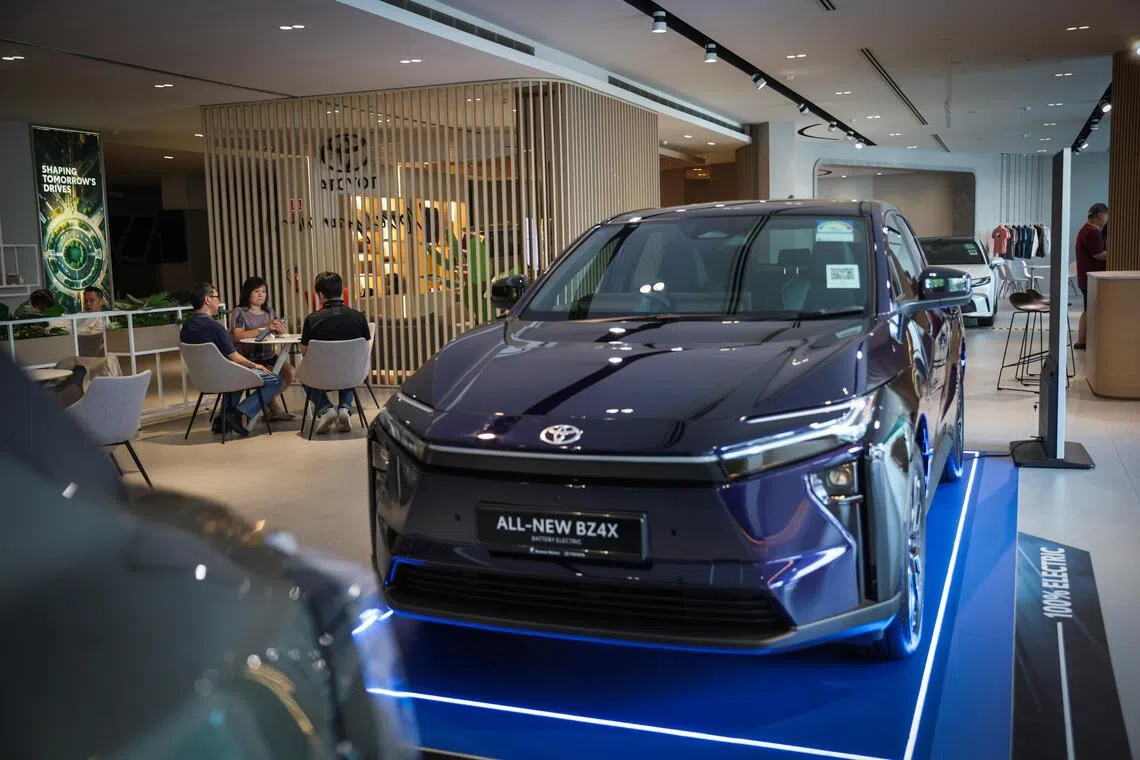
Under the proposal, the COE price will depend on the car cost and not the engine size or horsepower.
Published Oct 08, 2026, 05:00 PM
Updated Oct 08, 2026, 05:00 PM
LTA proposes merging COE car Categories A and B into one, with a “feebate” system of rebates or surcharges based on car value.
The aim is to keep mass-market cars cheaper than luxury models, while leaving overall COE prices to supply and demand.
LTA is also reviewing Category E and renewal rules, with public feedback open until Nov 2.
SINGAPORE – The authorities have proposed merging the two certificate of entitlement (COE) car categories into a single category, as part of several changes aimed at better differentiating the price of mass market cars from higher-end models.
Besides combining categories A and B, the Land Transport Authority (LTA) mooted a tiered system with rebates or surcharges to the prevailing COE premium, based on a car’s value.
The LTA unveiled its preliminary proposal for public feedback on Oct 8 after reviewing the COE system . The review, announced in March, was prompted by the narrowing gap between Category A and B premiums.
In the current system, the two car categories are based on engine size and power output, or only power output for an electric car.
However, car manufacturers often now adjust vehicle specifications for higher-end cars to fit within the engine power thresholds for Category A vehicles, LTA said.
It has thus proposed what it termed as a “feebate” system, which uses rebates and surcharges to ensure that buyers of higher-value cars pay a higher premium than buyers of mass-market cars.
The LTA has suggested two options – one with three bands and another with five.
Under the three-band option, cars with open market value (OMV) – the price before taxes – that fall in the lowest band would get a rebate of $15,000. Cars that fall in the middle band will pay the full COE price without rebate or surcharge.
Cars with OMVs above the middle band will incur a $15,000 surcharge.
The five-band option “would allow for smaller adjustments”, by adding two bands with a rebate or surcharge of $7,500 respectively.
In a consultation paper published on Oct 8, the LTA said having rebates and surcharges will maintain a “meaningful difference” in the amount paid by buyers of mass-market and luxury cars, even though they bid in the same category.
The objective of the review “is not to influence overall COE prices, which will continue to be determined by demand and the available COE supply”, LTA added.
Since late 2024, the price of a Category A COE, meant for mass-market models, has closed in on that of Category B, which is used for larger, more powerful cars and luxury models.
The Category A premium has exceeded that of Category B thrice between February and June 2026.
At the Oct 7 exercise, the difference was $99 with the Category A premium closing at $130,001 and the Category B price at $130,100.
Using median OMV to determine rebates, surcharges
The OMV is a good starting point to determine whether a car model gets a rebate or surcharge, said the LTA, noting however that the value can fluctuate because of exchange rate movements, changes to supply chains and how cars are brought to Singapore, for instance by parallel importers or authorised dealers.
It therefore suggested using the median OMV of a car model based on past data, or – in the case of a new model – the OMV of the specific car, to determine which band it falls into.
There are no changes to the COE bidding process, vehicle taxes and other fees.
This will be the fourth time car categories are being tweaked since the COE system was rolled out 36 years ago.
Focus groups and dialogue sessions were held between April and May with more than 200 people, including academics and car industry representatives, LTA said.
The authority said it will take into account historical price gaps between Category A and B COEs in formulating the “appropriate” rebate and surcharge amounts.
It added that the bands assigned to car models will be reviewed every year to keep up with changes in the car market and new models.
Based on 2025 registration figures, about half of all cars will either get a fee rebate or no extra COE charge, while the remaining cars will attract a surcharge , said LTA.
LTA said it will publish details of the COE rebate or surcharge for each car model for buyers to refer to.
Examples of mass-market cars named in the paper include the BYD E6, Honda Freed and Toyota Sienta. Cars that will incur a surcharge include models like the BMW iX2, Honda Civic Type R, Tesla Model Y RWD and Toyota Alphard.
LTA added that imported used cars will not be factored into calculations of the median OMV.
Car COEs are valid for 10 years, and can be renewed by either five or 10 years.
COE renewals are based on the prevailing quota premium or PQP, which is the rolling average price of the COE in that category.
LTA has also asked for views on whether the proposed rebate-surcharge system should apply to COE renewals.
It said this may not be necessary, given that the renewal cost is similar for both categories of cars with Category A and B prices converging in recent years.
But the LTA acknowledged that the shift to a single car category could affect existing owners differently, and said it will consider transitional arrangements for those who wish to renew their COEs if the proposed changes are implemented.
How to adjust Category E
Besides seeking views on its proposed changes to COE categorisation, the LTA is also asking for feedback on adjusting the Open Category – or Category E – which can be used to register any vehicle type other than motorcycles.
Bidders tend to use these COEs to register vehicles in the category with the highest COE price, which in recent years has been Category B.
A Category E COE can be transferred to another person before it is used to register a vehicle, which caters to buyers who are in urgent need of a car and do not want to wait for the next COE tender.
One option is to do away entirely with the category, while another is to exclude motorcycles and commercial vehicles, and use open categories COEs for only cars.
Commenting on the changes, transport observers said it is unclear what impact the proposed changes would have on the price of car COEs.
MP Edward Chia (Holland-Bukit Timah GRC), who floated a similar proposal to LTA’s during a Parliament sitting in March, said overall COE prices will still depend on market demand, the available supply as well as buyers’ willingness and ability to pay.
“We should therefore be careful about assuming that the proposed changes will necessarily reduce the overall clearing price,” he said.
Samuel Chng, head of the Urban Psychology Lab at the Lee Kuan Yew Centre for Innovative Cities, noted that it would establish a difference of $30,000 between buyers who get the largest rebate and those who have to pay the largest surcharge.
In its paper, the LTA also explained why it did not take up various suggestions that were floated during its dialogue sessions.
On allocating COEs based on family needs, LTA said doing so requires judgment about whose needs should receive greater priority.
Setting aside more COEs for families with young children would mean fewer COEs for other groups such as caregivers and multi-generational households, it said, noting the difficulty of administering such a system fairly over the lifespan of a COE as household circumstances change over time.
Other ideas raised include adopting a pay-as-you-bid system for COEs, creating a separate category for private-hire cars, and imposing a surcharge on owners of multiple cars.
For people who wish to bid directly for COEs instead of going through motor dealers, LTA said it is working on allowing them to submit initial bids online, instead of using the automated teller machine or ATM.
LTA said it is also looking into improving the transparency of vehicle prices published by motor dealers, such as publishing unbundled car prices without COEs.
Most car prices today are listed with the cost of securing the COEs, additional discounts and financing schemes packaged together.
The consultation exercise will close at 11.59pm on Nov 2, and the review is expected to be completed by first-half of 2027, LTA said.
Anyone who wishes to give feedback can go to https://go.gov.sg/coe-pcd-feedback .
The public consultation paper is available on https://go.gov.sg/coe-public-consult .
Lee Nian Tjoe is senior transport correspondent at The Straits Times, where he also oversees the Motoring section.
Esther Loi is a journalist at The Straits Times, where she covers transport issues.
Electric and hybrid vehicles
根据该提案,拥车证价格将取决于汽车价格,而不是发动机排量或马力。
发布于2026年10月8日下午5:00
更新于2026年10月8日下午5:00
陆路交通管理局提议将拥车证A类和B类汽车合并为一类,并根据汽车价值实行“费用返还”制度,给予折扣或附加费。
目标是让大众市场汽车的价格低于豪华车型,同时让拥车证(COE)的整体价格由供求关系决定。
陆路交通管理局 (LTA) 正在审查 E 类签证和续签规则,公众意见征集截止日期为 11 月 2 日。
新加坡——当局提议将两种拥车证(COE)汽车类别合并为一个类别,这是旨在更好地区分大众市场汽车和高端车型价格的几项改革措施之一。
除了将 A 类和 B 类合并外,陆路交通管理局 (LTA) 还提出了分级制度,根据汽车的价值,对现行的拥车证溢价给予回扣或附加费。
陆路交通管理局在对拥车证制度进行审查后,于10月8日公布了初步方案,征求公众意见。此次审查于3月宣布,起因是A类和B类拥车证溢价差距的缩小。
在目前的分类体系中,汽车的两大类别是根据发动机排量和功率输出来划分的,而电动汽车则仅根据功率输出来划分。
陆路交通管理局表示,汽车制造商现在经常调整高端汽车的车辆规格,以符合 A 类车辆的发动机功率阈值。
因此,它提出了所谓的“费用返还”制度,即通过返还和附加费来确保购买高价值汽车的买家支付比购买大众市场汽车更高的溢价。
陆路交通管理局提出了两种方案——一种是三个频段,另一种是五个频段。
根据三段式定价方案,公开市场价值(OMV,即税前价格)处于最低档的车辆可获得 15,000 美元的回扣。处于中间档的车辆将支付全额拥车证价格,不享受任何回扣或附加费。
OMV(车辆市场价值)高于中间档位的车辆将被征收 15,000 美元的附加费。
五频段选项“允许进行更小的调整”,通过增加两个频段,分别需要支付 7,500 美元的退款或附加费。
陆路交通管理局在 10 月 8 日发布的一份咨询文件中表示,即使大众市场汽车和豪华汽车的买家竞标的是同一类别,但通过给予回扣和附加费,仍能保持两者支付金额之间的“实质性差异”。
陆路交通管理局补充说,此次审查的目的“并非影响拥车证的整体价格,拥车证价格仍将由需求和可用的拥车证供应量决定”。
自 2024 年底以来,面向大众市场车型的 A 类拥车证价格已经接近面向更大、更强劲的汽车和豪华车型的 B 类拥车证价格。
2026年2月至6月期间,A类保费三次超过B类保费。
10 月 7 日的行权价为 99 美元,A 类溢价收于 130,001 美元,B 类价格收于 130,100 美元。
利用市场市场价值中位数来确定回扣和附加费
陆路交通管理局表示,OMV 是确定某款车型是否可获得回扣或附加费的良好起点,但同时指出,由于汇率波动、供应链变化以及汽车进入新加坡的方式(例如通过平行进口商或授权经销商),该价值可能会波动。
因此,它建议使用基于过去数据的汽车型号的中位数 OMV,或者——如果是新型号——使用特定汽车的 OMV,来确定它属于哪个区间。
拥车证竞标流程、车辆税及其他费用均无变化。
这将是拥车证制度推出 36 年来第四次对汽车类别进行调整。
陆路交通管理局表示,4月至5月期间,他们举办了焦点小组讨论会和对话会,有超过200人参加,其中包括学者和汽车行业代表。
该机构表示,在制定“适当”的回扣和附加费金额时,将考虑A类和B类拥车证之间的历史价格差距。
该公司还补充说,分配给汽车型号的等级每年都会进行审查,以跟上汽车市场的变化和新车型的推出。
陆路交通管理局表示,根据 2025 年的注册数据,大约一半的汽车将获得费用回扣或免除额外的拥车证费用,而其余的汽车将被征收附加费。
陆路交通管理局表示,将公布每款车型拥车证回扣或附加费的详情,供购车者参考。
文中列举的大众市场车型包括比亚迪E6、本田Freed和丰田Sienta。而需要缴纳附加费的车型则包括宝马iX2、本田思域Type R、特斯拉Model Y后驱版和丰田埃尔法等。
陆路交通管理局补充说,进口二手车将不计入中位OMV的计算中。
汽车拥车证有效期为10年,可续期5年或10年。
拥车证续期价格以现行配额溢价或 PQP 为准,PQP 是该类别拥车证的滚动平均价格。
陆路交通管理局还征求了公众意见,询问拟议的回扣附加费制度是否应适用于拥车证续期。
报告称,鉴于A类和B类汽车的更新成本相似,且近年来价格趋于一致,因此可能没有必要这样做。
但陆路交通管理局承认,转向单一汽车类别可能会对现有车主产生不同的影响,并表示如果拟议的变更得以实施,将考虑为希望续签拥车证的人制定过渡安排。
如何调整E类
除了就拥车证分类的拟议变更征求意见外,陆路交通管理局还就调整开放类别(或 E 类)征求反馈意见,该类别可用于注册除摩托车以外的任何类型的车辆。
竞标者倾向于使用这些拥车证将车辆注册为拥车证价格最高的类别,近年来这一类别通常是 B 类。
E类拥车证可以在用于注册车辆之前转让给其他人,这满足了急需用车且不想等待下一次拥车证招标的买家的需求。
一种选择是完全取消拥车证类别,另一种选择是排除摩托车和商用车,只对汽车使用开放式拥车证类别。
交通运输观察人士在评论这些变化时表示,目前尚不清楚拟议的变化会对汽车拥车证的价格产生什么影响。
国会议员谢永康(荷兰-武吉知马集选区)在3月份的国会会议上提出了与陆路交通管理局类似的提案,他表示,拥车证价格总体上仍将取决于市场需求、可用供应以及买家的支付意愿和能力。
“因此,我们应该谨慎对待‘拟议的改革必然会降低整体清算价格’这一假设,”他说道。
李光耀创新城市中心城市心理学实验室主任张先生指出,这将导致获得最高回扣的买家与支付最高附加费的买家之间产生 3 万美元的差额。
陆路交通管理局在文件中还解释了为什么没有采纳对话会议期间提出的各种建议。
陆路交通管理局表示,根据家庭需求分配拥车证需要判断哪些家庭的需求应该得到更优先考虑。
报告指出,为有幼儿的家庭预留更多住房券意味着其他群体(如照护者和多代同堂家庭)的住房券数量会减少,并指出随着家庭情况随时间变化,在住房券的整个生命周期内公平管理此类制度存在困难。
其他提出的想法包括对拥车证采用竞价付费制度、为私召车设立单独类别以及对拥有多辆车的车主征收附加费。
陆路交通管理局表示,对于那些希望直接竞标拥车证(COE)而不是通过汽车经销商的人,他们正在努力允许他们在线提交初始竞标,而不是使用自动取款机(ATM)。
陆路交通管理局表示,他们也在研究如何提高汽车经销商公布的车辆价格的透明度,例如公布不包含拥车证的汽车单独价格。
如今大多数汽车价格都包含了拥车证费用、额外折扣和融资方案。
陆路交通管理局表示,此次咨询活动将于11月2日晚上11点59分结束,预计审查工作将于2027年上半年完成。
任何想要提供反馈意见的人都可以访问 https://go.gov.sg/coe-pcd-feedback 。
公众咨询文件可在以下网址获取:https://go.gov.sg/coe-public-consult 。
李念祖是《海峡时报》的高级交通记者,同时负责汽车版块。
埃丝特·罗伊是《海峡时报》的记者,主要报道交通运输问题。
电动和混合动力汽车