CNA Explains: Why are Singapore bank shares falling after a record run?CNA解读:新加坡银行股在创纪录上涨后为何下跌?
Singapore bank stocks tumbled for the second day in a row after a Citi report downgraded OCBC to a “sell” rating, saying it expected the bank's third-quarter earnings to be flat from a year earlier.
Singapore bank stocks tumbled for the second day in a row after a Citi report downgraded OCBC to a “sell” rating, saying it expected the bank's third-quarter earnings to be flat from a year earlier.
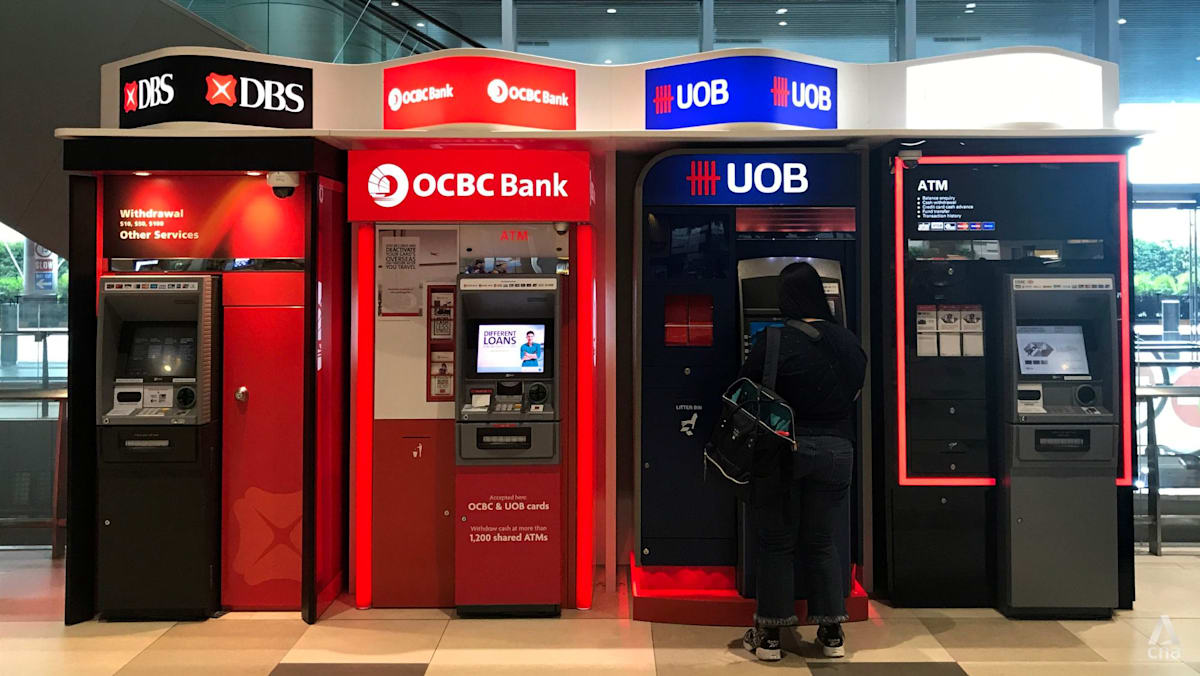
A row of ATMs in Singapore. (File photo: CNA/Jeremy Long)
This audio is generated by an AI tool.
SINGAPORE: Singapore bank stocks tumbled for the second straight day on Thursday (Oct 8), extending a sell-off sparked by a Citi downgrade of OCBC.
The Citi report cut its rating on OCBC to “sell” from a “neutral”, saying it expected the bank's third-quarter earnings to be flat from a year earlier.
Shares of OCBC fell 4.29 per cent or S$1.30 to S$29 on Thursday. This followed a decline of more than 5 per cent the previous day, which wiped more than S$8 billion off the bank’s market capitalisation.
UOB also fell on Thursday, declining 5.16 per cent or S$2.19 to S$40.25. DBS slid 4.7 per cent or S$3.64 to S$73.85.
CNA Games Guess Word Crack the word, one row at a time Buzzword Create words using the given letters Mini Sudoku Tiny puzzle, mighty brain teaser Mini Crossword Small grid, big challenge Word Search Spot as many words as you can Show More Show Less The declines come after the share prices of all three banks hit fresh record highs this year. So why are investors turning cautious even after the banks’ record run , and what could determine how the sector performs going into next year? Why are investors pulling back? Analysts attributed this week’s pullback to a combination of profit-taking by investors after the sector’s strong performance, rising bond yields, as well as concerns about the potentially higher funding costs banks may face due to rising interest rates. Investors may be selling bank stocks this week to rake in profits while they can after the banks’ fresh record prices this year, Macquarie Equity Research’s head of ASEAN equity research Jayden Vantarakis told CNA, noting that investors are becoming more risk averse. Similarly, Jefferies’ ASEAN research analyst Joanna Cheah noted that Singapore banks had been trading at historically elevated valuations. OCBC in particular had an exceptionally strong second quarter this year, she pointed out. Investors are now questioning whether that performance can be repeated, she told CNA. With OCBC priced for good news after gaining about 60 per cent this year, there was little room for disappointment, said Glenn Thum, research manager at Phillip Securities Research. Citi’s forecast that OCBC's third-quarter profit would be flat from a year earlier – after growing 22 per cent in the second quarter – challenged the growth story that had helped drive the stock higher. Higher interest rates would typically be positive for banks, allowing them to earn more from lending. But analysts said the benefit could take time to materialise, while banks face higher funding costs in the near term. As interest rates rise, banks may have to pay more to attract deposits, increasing the cost of funding their loans. Mr Thum said banks are already competing for fixed deposits. Loans also take time to reprice at higher rates, meaning margins could remain under pressure for another quarter or two before improving. In its report, Citi also said the market could be overestimating how much OCBC would benefit from higher interest rates and stronger loan growth. CGS International research analyst Tay Wee Kuang similarly said higher funding costs could temper expectations for improvements in banks’ net interest margins. Competition for quality loans could also limit how much banks can charge borrowers, making higher asset yields unlikely in the near term, he said.
The declines come after the share prices of all three banks hit fresh record highs this year.
So why are investors turning cautious even after the banks’ record run , and what could determine how the sector performs going into next year?
Why are investors pulling back?
Analysts attributed this week’s pullback to a combination of profit-taking by investors after the sector’s strong performance, rising bond yields, as well as concerns about the potentially higher funding costs banks may face due to rising interest rates.
Investors may be selling bank stocks this week to rake in profits while they can after the banks’ fresh record prices this year, Macquarie Equity Research’s head of ASEAN equity research Jayden Vantarakis told CNA, noting that investors are becoming more risk averse.
Similarly, Jefferies’ ASEAN research analyst Joanna Cheah noted that Singapore banks had been trading at historically elevated valuations. OCBC in particular had an exceptionally strong second quarter this year, she pointed out.
Investors are now questioning whether that performance can be repeated, she told CNA.
With OCBC priced for good news after gaining about 60 per cent this year, there was little room for disappointment, said Glenn Thum, research manager at Phillip Securities Research.
Citi’s forecast that OCBC's third-quarter profit would be flat from a year earlier – after growing 22 per cent in the second quarter – challenged the growth story that had helped drive the stock higher.
Higher interest rates would typically be positive for banks, allowing them to earn more from lending. But analysts said the benefit could take time to materialise, while banks face higher funding costs in the near term.
As interest rates rise, banks may have to pay more to attract deposits, increasing the cost of funding their loans.
Mr Thum said banks are already competing for fixed deposits. Loans also take time to reprice at higher rates, meaning margins could remain under pressure for another quarter or two before improving.
In its report, Citi also said the market could be overestimating how much OCBC would benefit from higher interest rates and stronger loan growth.
CGS International research analyst Tay Wee Kuang similarly said higher funding costs could temper expectations for improvements in banks’ net interest margins.
Competition for quality loans could also limit how much banks can charge borrowers, making higher asset yields unlikely in the near term, he said.
Why are analysts divided?
Analysts have markedly different calls on the three Singapore banks, reflecting differing views on their valuations and how much they stand to benefit from the changing interest-rate environment.
Citi downgraded OCBC from “neutral” to “sell” with a target price of S$27.50. It maintained its “buy” rating on DBS and reiterated its “sell” rating on UOB, although it still preferred UOB over OCBC due to relative valuations and positioning.
Other brokerages were more bullish.
In an Oct 1 report, Macquarie Equity Research’s Vantarakis said that while all three banks would benefit from higher Singapore rates, UOB had the most to gain.
About 43 per cent of UOB’s loans are denominated in Singapore dollars, compared with 37 per cent to 38 per cent for DBS and OCBC. UOB also has a higher proportion of revenue coming from net interest income, at 66 per cent, compared to about 58 per cent for its two peers, he said.
RHB took a more bullish view of the sector. In its Oct 7 report, the brokerage gave a “buy” rating to all three banks, naming OCBC as its top pick and giving the bank a target price of S$33.70.
“OCBC is our sector top pick on all-round balance sheet strength and earnings momentum,” RHB said.
The brokerage ranked UOB as its second pick, followed by DBS.
Rising rates may boost Singapore banks’ growth, with OCBC and UOB likely to benefit more, RHB said, although DBS remained a core pick for dividend safety and yields.
“The rising benchmark rates may provide the operating income of the Singapore banks … with another leg for growth, which has predominantly been carried by non-interest income in recent quarters,” it added.
Who should investors believe?
Rather than focusing solely on analysts’ “buy” or “sell” calls, investors should assess the key drivers of the banks’ earnings, experts said.
“Analysts largely agree on the fundamentals and differ mainly on how much to pay for them, so investors should look at the reasoning behind each call and not just the rating,” said Mr Thum.
One factor to watch is the Singapore Overnight Rate Average (SORA), and whether it continues to rise alongside US interest rates.
Investors should also consider the economic outlook and what it could mean for loan growth and borrowers’ ability to repay their debts, Mr Tay said.
Another question is whether continued inflows into wealth management can sustain the banks’ growth in fee income.
Taken together, these factors help determine whether the banks can generate enough earnings growth to justify their valuations.
For long-term investors, a dividend yield of about 4 per cent backed by strong balance sheets would still make the banks worth holding, said Mr Thum.
What is the outlook for Singapore banks?
Despite the recent sell-off, analysts generally remain positive on the banking sector and expect earnings to continue growing next year, supported by factors that include improving margins, loan growth and fee income.
“We expect earnings to keep growing in 2027, albeit at a slower pace than this year's strong rebound,” said Mr Thum.
Jefferies’ Ms Cheah also said the brokerage remained constructive on the banking sector in 2027, supported by various drivers such as healthy loan growth, continued wealth-management expansion and resilient asset quality.
“While stabilising margins should support net interest income, the more important structural driver in our view is the growing contribution from wealth and recurring fee income, which improves both earnings diversification and quality,” she said.
Singapore banks have also demonstrated their ability to generate attractive returns while maintaining exceptionally low credit losses through economic cycles, Ms Cheah said.
Still, risks remain.
Mr Thum pointed to higher credit costs and rising bond yields, which could weigh on banks’ capital.
Mr Tay, meanwhile, said a weaker economic outlook in 2027 could revive asset-quality concerns and offset some of the benefit from higher net interest income.
Want an issue or topic explained? Email us at digitalnews [at] mediacorp.com.sg . Your question might become a story on our site.
Our chief editor shares analysis and picks of the week's biggest news every Saturday.
Get our pick of top stories and thought-provoking articles in your inbox
Stay updated with notifications for breaking news and our best stories
Join our channel for the top reads for the day on your preferred chat app
新加坡银行股连续第二天暴跌,此前花旗银行发布报告,将华侨银行的评级下调至“卖出”,并表示预计该行第三季度盈利将与去年同期持平。
新加坡的一排自动取款机。(资料照片:CNA/Jeremy Long)
这段音频由人工智能工具生成。
新加坡:周四(10 月 8 日),新加坡银行股连续第二天暴跌,此前花旗集团下调了华侨银行的评级,引发了抛售潮。
花旗银行的报告将华侨银行的评级从“中性”下调至“卖出”,称预计该行第三季度的盈利将与去年同期持平。
周四,华侨银行股价下跌4.29%,即1.30新元,收于29新元。此前一天,该股已下跌超过5%,导致该行市值蒸发超过80亿新元。
周四,大华银行股价也下跌,下跌5.16%或2.19新元,至40.25新元。星展银行股价下跌4.7%或3.64新元,至73.85新元。
CNA游戏 猜词游戏 逐行破解单词 流行词游戏 用给定的字母组成单词 迷你数独 小谜题,脑力挑战 迷你填字游戏 小方格,大挑战 单词搜索 尽可能多地找出单词 显示更多 显示更少 在这三家银行的股价今年均创下历史新高之后,股价出现了下跌。那么,为什么在银行股创纪录上涨之后,投资者反而变得谨慎起来?明年银行股板块的走势又将取决于哪些因素?投资者为何要撤资?分析师将本周的回调归因于多种因素,包括投资者在银行股板块强劲表现后获利了结、债券收益率上升,以及对银行可能因利率上升而面临更高融资成本的担忧。麦格理证券研究公司东盟股票研究主管杰登·范塔拉基斯告诉CNA,投资者本周可能正在抛售银行股,以在银行股今年创下历史新高后趁机获利,并指出投资者正变得越来越厌恶风险。同样,杰富瑞(Jefferies)东盟研究分析师乔安娜·谢(Joanna Cheah)指出,新加坡银行的估值一直处于历史高位。她特别强调,华侨银行(OCBC)今年第二季度的业绩表现尤为强劲。她告诉亚洲新闻台(CNA),投资者现在质疑这种业绩能否重现。菲利普证券研究(Phillip Securities Research)研究经理格伦·图姆(Glenn Thum)表示,华侨银行今年股价已上涨约60%,市场对其利好消息的预期很高,因此不太可能出现令人失望的情况。花旗集团预测华侨银行第三季度利润将与去年同期持平——此前该行第二季度利润增长了22%——这一预测对推动股价上涨的增长前景提出了挑战。通常情况下,利率上升对银行有利,因为银行可以从贷款中获得更多收益。但分析师表示,这种利好可能需要一段时间才能显现,而银行在短期内将面临更高的融资成本。随着利率上升,银行可能需要支付更高的费用来吸引存款,从而增加贷款融资成本。图姆先生表示,各家银行已经在争夺定期存款。贷款利率上涨后需要时间重新定价,这意味着利润率可能在未来一到两个季度内仍将面临压力,之后才会有所改善。花旗银行在其报告中也指出,市场可能高估了华侨银行从利率上涨和贷款增长加速中获益的程度。CGS国际研究分析师郑伟光也表示,更高的融资成本可能会抑制人们对银行净息差改善的预期。他还指出,优质贷款的竞争也可能限制银行向借款人收取的利率,从而导致短期内资产收益率不太可能上升。
今年以来,这三家银行的股价均创下历史新高,随后股价出现下跌。
那么,为什么在银行股创纪录上涨之后,投资者却变得谨慎起来?明年银行股行业的表现又将受到哪些因素的影响?
投资者为何撤资?
分析师将本周的回调归因于投资者在板块强劲表现后获利了结、债券收益率上升,以及对银行可能因利率上升而面临更高融资成本的担忧。
麦格理证券研究公司东盟股票研究主管杰登·范塔拉基斯告诉亚洲新闻台,投资者本周可能会抛售银行股,趁着银行股今年屡创新高之际趁机获利,并指出投资者正变得越来越厌恶风险。
同样,杰富瑞东盟研究分析师乔安娜·谢赫指出,新加坡银行的估值一直处于历史高位。她特别指出,华侨银行今年第二季度的业绩尤为强劲。
她告诉亚洲新闻台,投资者现在质疑这种业绩能否重现。
菲利普证券研究公司研究经理格伦·瑟姆表示,华侨银行今年股价上涨了约 60%,市场已预期会有利好消息,因此不太可能出现令人失望的情况。
花旗银行预测华侨银行第三季度利润将与去年同期持平(此前第二季度增长了 22%),这给此前推动该行股价上涨的增长前景带来了挑战。
通常情况下,利率上升对银行有利,因为这能让它们从贷款中获得更多收益。但分析师表示,这种好处可能需要一段时间才能显现,而银行在短期内将面临更高的融资成本。
随着利率上升,银行可能需要支付更多费用来吸引存款,从而增加其贷款融资成本。
Thum先生表示,各银行已经在争夺定期存款。贷款利率上调也需要时间,这意味着利润率可能在未来一到两个季度内仍将面临压力,之后才会有所改善。
花旗银行在报告中还表示,市场可能高估了华侨银行从更高的利率和更强劲的贷款增长中获益的程度。
CGS International 研究分析师 Tay Wee Kuang 也表示,更高的融资成本可能会抑制人们对银行净息差改善的预期。
他还表示,对优质贷款的竞争也可能限制银行向借款人收取的费用,因此短期内不太可能出现更高的资产收益率。
分析师们为何意见分歧?
分析师对新加坡三家银行的看法截然不同,反映出他们对这三家银行的估值以及它们能从不断变化的利率环境中获益多少的看法存在分歧。
花旗将华侨银行的评级从“中性”下调至“卖出”,目标价为27.50新元。花旗维持对星展银行的“买入”评级,并重申对大华银行的“卖出”评级,但由于相对估值和市场定位,花旗仍然更倾向于大华银行而非华侨银行。
其他券商则更为乐观。
麦格理股票研究公司的 Vantarakis 在 10 月 1 日的一份报告中表示,虽然新加坡利率上升将使这三家银行都受益,但大华银行获益最大。
大华银行约43%的贷款以新加坡元计价,而星展银行和华侨银行的这一比例分别为37%至38%。他还表示,大华银行的净利息收入占比也更高,达到66%,而星展银行和华侨银行的这一比例约为58%。
RHB对该行业持更为乐观的看法。在其10月7日的报告中,该券商给予这三家银行“买入”评级,并将华侨银行列为首选,目标价为33.70新元。
RHB表示:“华侨银行凭借其全面的资产负债表实力和盈利势头,是我们行业首选的股票。”
该券商将大华银行列为第二选择,星展银行紧随其后。
RHB表示,利率上升可能会提振新加坡银行业的增长,华侨银行和大华银行可能会从中受益更多,但星展银行仍然是股息安全和收益率方面的核心选择。
报告还补充道:“基准利率上升可能会为新加坡银行业营业收入带来新的增长动力……而近几个季度以来,营业收入的增长主要依靠非利息收入。”
投资者应该相信谁?
专家表示,投资者不应仅仅关注分析师的“买入”或“卖出”建议,而应评估银行盈利的关键驱动因素。
“分析师们对基本面基本一致,分歧主要在于应该为这些基本面支付多少钱,因此投资者应该关注每次评级背后的理由,而不仅仅是评级本身,”Thum先生说。
值得关注的一个因素是新加坡隔夜平均利率(SORA),以及它是否会继续与美国利率同步上涨。
Tay先生表示,投资者还应考虑经济前景及其对贷款增长和借款人偿还债务能力的影响。
另一个问题是,持续流入财富管理领域的资金能否维持银行手续费收入的增长。
综合来看,这些因素有助于判断银行能否产生足够的盈利增长来支撑其估值。
Thum先生表示,对于长期投资者而言,约4%的股息收益率加上强劲的资产负债表,仍然会让银行股值得持有。
新加坡银行业的前景如何?
尽管近期出现抛售,但分析师普遍看好银行业,并预计在利润率提高、贷款增长和手续费收入等因素的支撑下,明年银行业盈利将继续增长。
“我们预计2027年盈利将继续增长,尽管增速会低于今年强劲反弹的势头,”Thum先生表示。
杰富瑞的谢女士还表示,该券商对2027年银行业仍持乐观态度,这得益于健康的贷款增长、财富管理业务的持续扩张以及稳健的资产质量等多种因素。
她表示:“虽然稳定的利润率应该能够支撑净利息收入,但我们认为更重要的结构性驱动因素是财富管理和经常性费用收入的贡献不断增长,这既提高了收入的多元化程度,也提高了收入的质量。”
谢女士表示,新加坡银行业也已证明,它们能够在经济周期中保持极低的信贷损失,同时还能创造可观的回报。
然而,风险依然存在。
Thum 先生指出,信贷成本上升和债券收益率上升可能会对银行资本造成压力。
与此同时,Tay先生表示,2027年疲软的经济前景可能会重新引发对资产质量的担忧,并抵消净利息收入增加带来的部分好处。
想了解某个问题或话题?请发送邮件至 digitalnews [at] mediacorp.com.sg。您的提问可能会成为我们网站上的报道内容。
我们的主编每周六都会分享对本周重大新闻的分析和精选。
订阅我们的邮件,即可获取精选热点新闻和引人深思的文章。
订阅通知,第一时间获取突发新闻和精彩报道。
加入我们的频道,即可在您常用的聊天应用上获取当日热门文章。