‘No boom is forever’: Singapore must seize AI opportunity before correction, says PM Wong黄循财总理表示,“繁荣不会永远持续”:新加坡必须在人工智能领域抓住机遇,以免出现回调。
Speaking at the Forbes Global CEO Conference, Prime Minister Lawrence Wong also touched on how countries should deal with the risk of powerful and autonomous artificial intelligence (AI) systems going rogue.
Speaking at the Forbes Global CEO Conference, Prime Minister Lawrence Wong also touched on how countries should deal with the risk of powerful and autonomous artificial intelligence (AI) systems going rogue.
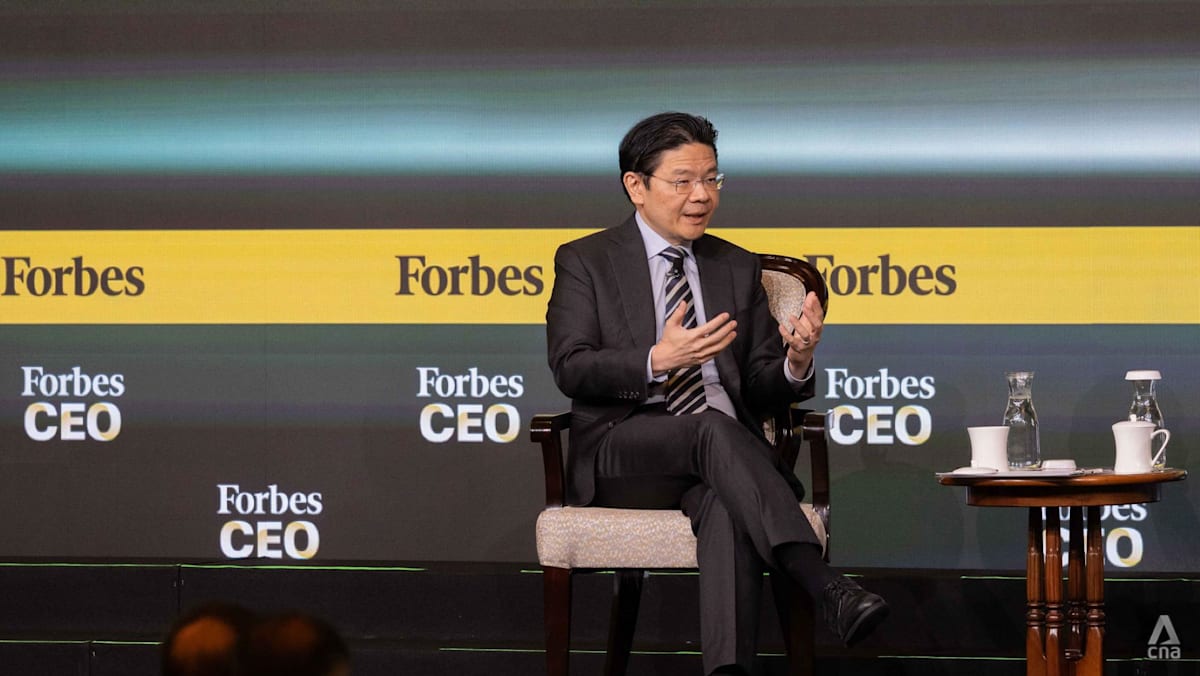
Prime Minister Lawrence Wong, and Forbes Media chairman and editor-in-chief Steve Forbes during the Forbes Global CEO conference at Shangri-La on Oct 8, 2026. (Photo: CNA/Ili Mansor)
This audio is generated by an AI tool.
SINGAPORE: The artificial intelligence (AI) boom that has benefitted Singapore economically will not last forever, and the country's approach is to make good use of this window of opportunity to build new capabilities and create better jobs for Singaporeans, said Prime Minister Lawrence Wong on Thursday (Oct 8).
"No boom is forever. At some point, there will be a correction. And we don't know when it will happen, or how it will happen, we don't know who the casualties will be when it happens,” said Mr Wong, who is also finance minister.
“So our approach is to make good use of this window of opportunity now, where there is external demand, capitalise on it, build new capabilities and create better jobs for Singaporeans.”
He was speaking during a dialogue with Forbes Media chairman and editor-in-chief Steve Forbes at the Forbes Global CEO Conference held at the Shangri-La Singapore.
CNA Games Guess Word Crack the word, one row at a time Buzzword Create words using the given letters Mini Sudoku Tiny puzzle, mighty brain teaser Mini Crossword Small grid, big challenge Word Search Spot as many words as you can Show More Show Less Mr Wong said the current AI boom has benefited Singapore’s semiconductor industry and related industries, with positive spillovers in sectors such as logistics and professional services. “We don't make the most advanced AI chips, but we have major firms here like GlobalFoundries, Micron, and they make memory chips and specialty chips, which are in demand now with the AI boom,” he said. He added that Singapore has also built a semiconductor ecosystem that includes the precision engineering industry and equipment suppliers.
Mr Wong said the current AI boom has benefited Singapore’s semiconductor industry and related industries, with positive spillovers in sectors such as logistics and professional services.
“We don't make the most advanced AI chips, but we have major firms here like GlobalFoundries, Micron, and they make memory chips and specialty chips, which are in demand now with the AI boom,” he said.
He added that Singapore has also built a semiconductor ecosystem that includes the precision engineering industry and equipment suppliers.
INTERNATIONAL AI SAFEGUARDS
Mr Wong said that no country can deal alone with the risk of powerful and autonomous AI systems going rogue, or by rogue actors misusing AI to cause harm.
While it is good that the United States has appointed a task force to oversee this space, the rules and standards for frontier AI development will eventually have to be international, he said.
“It cannot be just confined to a single country, so ideally international safeguards are put in place, perhaps under the auspices of the United Nations. But that will take time,” he said.
AI safety requirements will also depend on the needs and applications of various sectors, such as healthcare, finance and advanced manufacturing, said Mr Wong.
“I think that the requirements will vary from sector to sector, and the decisions every sector regulator will have to make will be what sort of decisions ought to remain within human control, where is the human in the loop, and what kind of safeguards do you have for your sector,” he said.
Such safeguards are already taking shape in areas such as finance and transport.
Mr Wong cited newly published guidelines by the Monetary Authority of Singapore on the use of AI in finance, and the testing of autonomous cars on Singapore roads – with a pilot by autonomous driving company Waymo letting the authorities test the technology and understand safety requirements before a broader rollout under some regulatory oversight.
Turning to AI’s impact on workers and the jobs market, Mr Wong said Singapore’s approach is “not to protect the job, but to protect every worker”. This is done through close cooperation between the government, employers, and unions over the decades, he said.
NAVIGATING GEOPOLITICS
During the dialogue, Mr Wong also highlighted the impact of tariffs on the economy and called for free trade and freedom of navigation globally.
“We are concerned that what's happening in Hormuz may set a precedent for elsewhere, because if a critical international waterway can be weaponised or arbitrary tolls imposed on shipping through something like Hormuz, then countries may be tempted to do the same elsewhere,” he said.
He drew comparisons with the Strait of Malacca and Strait of Singapore, which he called a “critical maritime chokepoint” in this part of the world.
Mr Wong said he has discussed this issue with his counterparts in the other littoral states – Malaysian Prime Minister Anwar Ibrahim and Indonesian President Prabowo Subianto – and they are fully aligned on the principle that “international waterways must remain open, freedom of navigation and the right of transit passage has to be respected”.
“Even if you may hear rhetoric to the contrary, the leaders are aligned. We will defend these principles strongly, and we will work with partners to uphold these principles,” he said.
Mr Wong said Singapore has “not been able to understand” the tariffs imposed by the US, but that it cannot do anything. “The right tariff should be zero,” he said.
He added that other countries are also putting up more trade barriers, amid increasing concern about competition.
“There's concern that exports from other countries will impact local industries, will impact jobs. So you can see the pendulum shifting,” he said.
While this does not mean trade will stop, the global economy will become more fragmented by regions, he added.
Noting the importance of trade to Singapore, Mr Wong said the country cannot afford to turn inwards, as it “will get poor very quickly” if it does so.
It therefore aims to accelerate the integration in ASEAN, adding that it will have initiatives to do more on that front when it takes the chair of the regional bloc next year, he said.
“We will step up our connections with existing partners, and I think there are also opportunities with new regions like Latin America, Africa and the Middle East, which we hope to do more,” he said, adding that Singapore hopes to be a connector across different regions.
Get our pick of top stories and thought-provoking articles in your inbox
Stay updated with notifications for breaking news and our best stories
Join our channel for the top reads for the day on your preferred chat app
在福布斯全球CEO大会上,总理黄循财也谈到了各国应该如何应对强大且自主的人工智能(AI)系统失控的风险。
2026年10月8日,总理黄循财与福布斯传媒董事长兼总编辑史蒂夫·福布斯在香格里拉酒店出席福布斯全球CEO大会。(图片:CNA/Ili Mansor)
这段音频由人工智能工具生成。
新加坡:新加坡总理黄循财周四(10月8日)表示,人工智能(AI)热潮给新加坡经济带来的益处不会永远持续下去,新加坡的做法是充分利用这一机遇窗口,培养新的能力,并为新加坡人创造更好的就业机会。
“任何繁荣都不会永远持续下去。总有一天,市场会迎来调整。我们不知道调整何时发生,也不知道调整会以何种方式发生,更不知道调整发生时谁会成为受害者,”同时也是财政部长的黄之锋说道。
“因此,我们的做法是充分利用当前外部需求带来的机遇,抓住机遇,培养新的能力,为新加坡人创造更好的就业机会。”
他在新加坡香格里拉大酒店举行的福布斯全球CEO大会上,与福布斯传媒董事长兼总编辑史蒂夫·福布斯进行了对话。
CNA游戏 猜词游戏 逐行破解单词 流行词游戏 用给定的字母组成单词 迷你数独 小谜题,脑力挑战 迷你填字游戏 小方格,大挑战 单词搜索 尽可能多地找出单词 显示更多 显示更少 黄先生表示,当前的AI热潮惠及了新加坡的半导体产业及相关产业,并对物流和专业服务等领域产生了积极的溢出效应。“我们虽然不生产最先进的AI芯片,但我们这里有像GlobalFoundries和Micron这样的大型企业,他们生产存储芯片和专用芯片,这些芯片在AI热潮的推动下需求旺盛,”他说道。他还补充说,新加坡也已经建立了一个包括精密工程产业和设备供应商在内的半导体生态系统。
黄先生表示,目前人工智能的蓬勃发展使新加坡的半导体产业及相关产业受益,并对物流和专业服务等行业产生了积极的溢出效应。
他说:“我们虽然不生产最先进的人工智能芯片,但我们这里有像 GlobalFoundries、Micron 这样的大型公司,他们生产内存芯片和专用芯片,随着人工智能的蓬勃发展,这些芯片现在需求量很大。”
他还补充说,新加坡也已建立了一个半导体生态系统,其中包括精密工程行业和设备供应商。
国际人工智能保障措施
黄先生表示,任何国家都无法独自应对强大且自主的人工智能系统失控的风险,也无法独自应对不法分子滥用人工智能造成伤害的风险。
他表示,虽然美国任命了一个工作组来监督这一领域是件好事,但前沿人工智能发展的规则和标准最终必须是国际性的。
“这不能仅仅局限于一个国家,所以理想情况下应该建立国际保障机制,或许可以在联合国的主持下进行。但这需要时间,”他说。
黄先生表示,人工智能安全要求还将取决于各个行业的需求和应用,例如医疗保健、金融和先进制造业。
“我认为不同行业的具体要求会有所不同,每个行业监管机构都必须做出的决定是:哪些决策应该由人来控制,人在哪里参与决策,以及你的行业有哪些保障措施,”他说。
此类保障措施已经在金融和交通等领域初见成效。
黄先生援引了新加坡金融管理局新发布的关于在金融领域使用人工智能的指导方针,以及在新加坡道路上测试自动驾驶汽车的情况——自动驾驶公司 Waymo 的试点项目让当局能够在更广泛的推广之前,在一定的监管监督下测试这项技术并了解安全要求。
谈及人工智能对劳动者和就业市场的影响,黄先生表示,新加坡的做法是“不是为了保护就业岗位,而是为了保护每一位劳动者”。他指出,这是通过政府、雇主和工会几十年来密切合作实现的。
驾驭地缘政治
在对话中,黄先生还强调了关税对经济的影响,并呼吁在全球范围内实行自由贸易和航行自由。
他说:“我们担心霍尔木兹海峡发生的事情可能会为其他地方树立先例,因为如果一条重要的国际水道可以被武器化,或者可以对通过霍尔木兹海峡的船只征收任意通行费,那么各国可能会试图在其他地方也这样做。”
他将此地与马六甲海峡和新加坡海峡进行了比较,称其为世界这一地区的“关键海上咽喉要道”。
黄先生表示,他已与马来西亚总理安瓦尔·易卜拉欣和印度尼西亚总统普拉博沃·苏比安托等其他沿岸国家的领导人讨论过这个问题,他们在“国际水道必须保持开放,航行自由和过境通行权必须得到尊重”这一原则上完全一致。
他说:“即便你们听到一些相反的言论,但领导人的立场是一致的。我们将坚定捍卫这些原则,并将与合作伙伴共同维护这些原则。”
黄先生表示,新加坡“无法理解”美国征收的关税,但对此也无能为力。“合理的关税应该是零,”他说。
他还补充说,由于对竞争的担忧日益加剧,其他国家也在设置更多的贸易壁垒。
他说:“人们担心来自其他国家的出口会影响当地产业,影响就业。所以你可以看到风向正在转变。”
他补充说,虽然这并不意味着贸易会停止,但全球经济将变得更加区域化。
黄先生指出贸易对新加坡的重要性,并表示新加坡不能走内向路线,否则“很快就会变得贫穷”。
因此,该组织旨在加快东盟一体化进程,并表示明年担任区域集团轮值主席国后,将在这方面采取更多举措。
“我们将加强与现有合作伙伴的联系,我认为在拉丁美洲、非洲和中东等新地区也存在机遇,我们希望在这些地区开展更多合作,”他说道,并补充说新加坡希望成为连接不同地区的桥梁。
订阅我们的邮件,即可获取精选热点新闻和引人深思的文章。
订阅通知,第一时间获取突发新闻和精彩报道。
加入我们的频道,即可在您常用的聊天应用上获取当日热门文章。