DBS, OCBC and UOB shares extend losses星展银行、华侨银行和大华银行股价跌幅扩大
Shares of DBS, OCBC and UOB extend losses as investors weigh earnings expectations, bond market volatility and profit-taking. Read more at straitstimes.com.
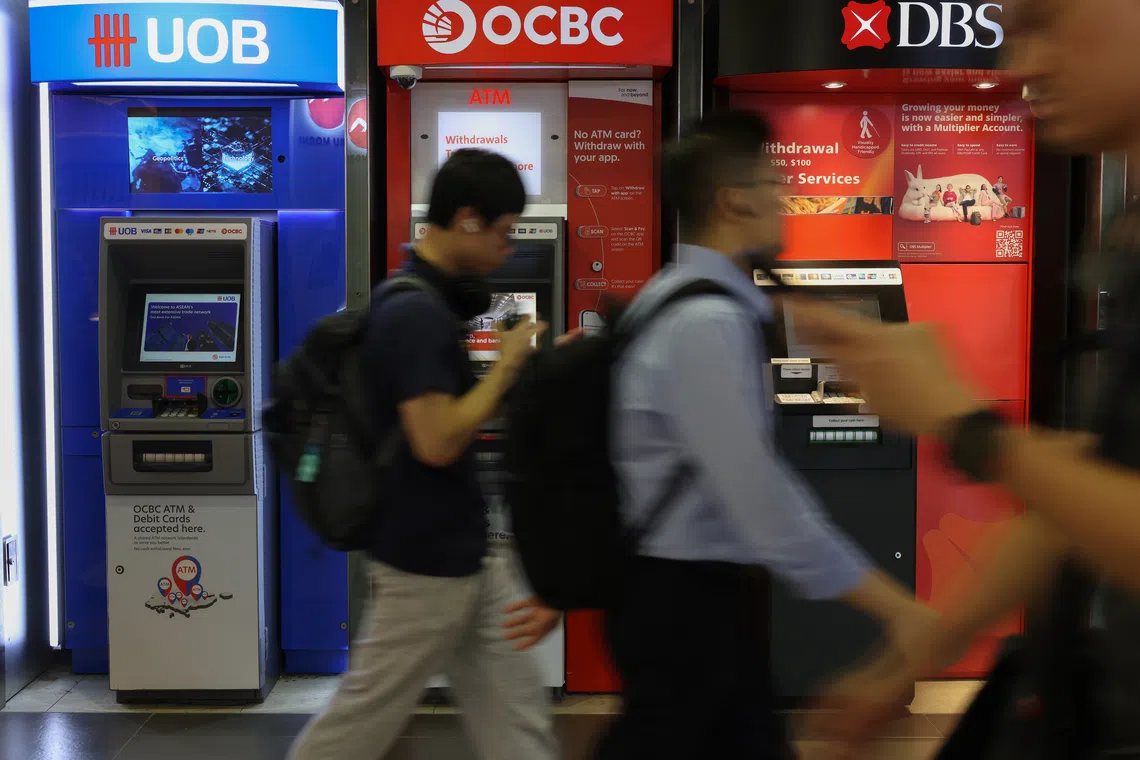
All three lenders were down more than 4% by midday on Oct 8.
PHOTO: THE BUSINESS TIMES
Published Oct 08, 2026, 02:20 PM
Updated Oct 08, 2026, 07:27 PM
- DBS, OCBC and UOB shares fell again on Oct 8, after earlier losses, as investors took profits and worried about earnings and global bond market volatility.
- Citi downgraded OCBC to “sell” on Oct 7, citing softer third-quarter 2026 earnings expectations and doubts about Singapore-dollar rates and wealth income.
- Analysts said near-term volatility may continue, but strong capital and dividends limit downside; a recovery needs resilient NIM, stable fees and controlled credit costs.
SINGAPORE – Shares of Singapore’s three local banks extended their losses on Oct 8 following declines the day before.
At the midday trading break, OCBC shares were down 4.29% to $29, with more than 14.9 million shares changing hands.
DBS shares fell 4.48% to $74.02, with more than 9.6 million shares traded, while UOB declined 4.92% to $40.35, with 4.14 million shares changing hands.
Charu Chanana, chief investment strategist at Saxo, said the continued weakness in Singapore bank shares appears to reflect profit-taking, concerns over earnings expectations and broader volatility in global bond markets.
Citi on Oct 7 cited softer-than-expected third-quarter 2026 earnings expectations for OCBC and downgraded the stock to “sell”.
The downgrade also raised questions about whether market expectations for Singapore-dollar interest rates are too optimistic, and whether the banks can sustain their strong wealth-related income from the first half of the year.
Higher global bond yields are also adding pressure, as they could weigh on credit demand, bond portfolios and investor appetite for dividend stocks.
Still, the recent declines are not expected to be the start of a prolonged downturn across the banking sector, given the lenders’ strong capital positions and dividend support.
“In the near term, further volatility is possible as investors reassess earnings expectations and valuations,” said Chanana.
“A more sustained recovery would likely depend on third-quarter earnings showing that net interest margins (NIM) remain resilient and recurring fee income can offset any normalisation in wealth-related revenue.”
NIM is the core profitability metric for banks. It measures how much money a bank makes on its loans and investments compared with the interest it pays on deposits and borrowings.
James Ooi, market strategist at Tiger Brokers, said higher Singapore-dollar interest rates may not necessarily benefit banks, as rising funding costs could offset the higher returns earned on loans and other assets.
“For banks, what matters is not just where rates are going, but whether asset yields can keep pace with rising funding costs to defend net interest margins,” he said.
Ooi added that the upcoming earnings season in about a month should provide a clearer picture of whether these concerns are reflected in the banks’ financial results.
Eugene Koh, sales trader at CMC Markets Singapore, said DBS has the strongest profitability among the three banks, but its premium valuation means that earnings meeting expectations may not be enough to support its share price.
Investors will be watching whether OCBC’s strong fee, trading and insurance income in the first half of the year can be sustained, while UOB faces the risk of higher credit costs eating into revenue growth despite its less demanding valuation.
Koh expects trading to remain volatile ahead of the banks’ results in November, although their strong profitability and capital buffers suggest that a “balance-sheet crisis” is unlikely.
“A sustained recovery needs resilient underlying earnings, controlled credit costs and reassurance that capital-return commitments hold. Better sentiment alone will not be enough,” he said.
Share prices of the three Singapore banks recently hit record highs – DBS’ and OCBC’s in early September, and UOB’s in July.
They were among 11 stocks selected for the board lot size reduction and saw immediate trades in the smaller trade quantities on Oct 5, according to the Singapore Exchange.
From Oct 5, for stocks priced between $10 and $100 a share, the minimum trading quantity was cut from 100 units to 10.
SGX said the 10-share lot has been the most common trade size for DBS, OCBC and UOB since the smaller board lots were introduced on Oct 5.
For DBS, 10-share trades were the most common on Oct 8, while for OCBC, they narrowly outnumbered 100-share trades on Oct 7. The 10-share lot has also been the most popular trade size for UOB since Oct 5.
At market close on Oct 8, OCBC shares fell 4.29% to $29, with 25.3 million shares changing hands. DBS declined 4.7% to $73.85, with 18.6 million shares traded, while UOB shed 5.16% to $40.25, with 8.8 million shares changing hands.
Timothy Goh is a business correspondent at The Straits Times. He covers commodities and currencies, with occasional forays into listed companies.
截至 10 月 8 日中午,这三家贷款机构的股价均下跌超过 4%。
图片来源:《商业时报》
发布于2026年10月8日下午2:20
更新于2026年10月8日晚上7:27
- 10 月 8 日,星展银行、华侨银行和大华银行的股价继早盘下跌后再次下跌,原因是投资者获利了结,并担忧企业盈利和全球债券市场波动。
- 10 月 7 日,花旗银行将华侨银行的评级下调至“卖出”,理由是 2026 年第三季度盈利预期疲软,以及对新加坡元汇率和财富收入的担忧。
分析师表示,短期波动可能持续,但强劲的资本和股息限制了下行空间;复苏需要稳健的净息差、稳定的费用和可控的信贷成本。
新加坡——继前一天下跌之后,新加坡三大本地银行的股票在10月8日继续下跌。
午间交易休市时,华侨银行股价下跌 4.29% 至 29 美元,成交量超过 1490 万股。
星展银行股价下跌 4.48% 至 74.02 美元,成交量超过 960 万股;大华银行股价下跌 4.92% 至 40.35 美元,成交量为 414 万股。
盛宝银行首席投资策略师查鲁·查纳纳表示,新加坡银行股持续疲软似乎反映了获利回吐、对盈利预期的担忧以及全球债券市场更广泛的波动。
花旗银行于 10 月 7 日表示,由于对华侨银行 2026 年第三季度的盈利预期低于预期,因此将该股评级下调至“卖出”。
此次评级下调也引发了人们对市场对新加坡元利率预期是否过于乐观,以及银行能否维持上半年强劲的财富相关收入的疑问。
全球债券收益率上升也加剧了压力,因为这可能会抑制信贷需求、债券投资组合以及投资者对分红股票的兴趣。
不过,鉴于各银行雄厚的资本实力和股息支持,近期的下跌预计不会是银行业长期低迷的开始。
“短期内,随着投资者重新评估盈利预期和估值,市场可能出现进一步波动,”查纳纳表示。
“更持久的复苏可能取决于第三季度的盈利情况,即净息差 (NIM) 保持韧性,并且经常性费用收入能够抵消财富相关收入的任何正常化。”
净息差是银行的核心盈利指标。它衡量的是银行从贷款和投资中获得的收益与支付给存款和借款人的利息之间的差额。
老虎证券市场策略师 James Ooi 表示,新加坡元利率上升未必有利于银行,因为不断上升的融资成本可能会抵消贷款和其他资产获得的更高回报。
“对银行而言,重要的不仅是利率走向,还有资产收益率能否跟上不断上涨的融资成本,以捍卫净息差,”他说道。
Ooi补充说,大约一个月后即将到来的财报季应该能更清楚地看出这些担忧是否反映在银行的财务业绩中。
CMC Markets Singapore 的销售交易员 Eugene Koh 表示,星展银行是这三家银行中盈利能力最强的,但其溢价估值意味着,即使盈利达到预期,也可能不足以支撑其股价。
投资者将关注华侨银行上半年强劲的手续费、交易和保险收入能否持续,而大华银行尽管估值要求较低,但仍面临信贷成本上升侵蚀收入增长的风险。
Koh预计,在各银行11月公布业绩之前,交易仍将保持波动,尽管它们强劲的盈利能力和资本缓冲表明“资产负债表危机”不太可能发生。
他表示:“持续复苏需要稳健的基本盈利能力、可控的信贷成本以及对资本回报承诺的保证。仅仅提振市场情绪是不够的。”
新加坡三家银行的股价最近都创下了历史新高——星展银行和华侨银行的股价在9月初创下历史新高,大华银行的股价在7月份创下历史新高。
据新加坡交易所称,它们是 11 只被选中进行交易单位缩减的股票之一,并在 10 月 5 日立即以较小的交易量进行交易。
从 10 月 5 日起,股价在每股 10 美元至 100 美元之间的股票,最低交易量从 100 股减少到 10 股。
新加坡交易所表示,自 10 月 5 日推出较小单位的股票交易以来,10 股单位一直是星展银行、华侨银行和大华银行最常见的交易单位。
对于星展银行而言,10月8日最常见的交易单位是10股;而对于华侨银行而言,10月7日10股的交易量略高于100股的交易量。自10月5日以来,10股也是大华银行最受欢迎的交易单位。
10月8日收盘时,华侨银行(OCBC)股价下跌4.29%,至29美元,成交量为2530万股;星展银行(DBS)股价下跌4.7%,至73.85美元,成交量为1860万股;大华银行(UOB)股价下跌5.16%,至40.25美元,成交量为880万股。
Timothy Goh是《海峡时报》的商业记者,主要报道大宗商品和货币,偶尔也关注上市公司。