Around 500 new jobs to be created as ST Engineering opens new aircraft maintenance facility新科工程公司开设新的飞机维修设施,预计将创造约500个新的就业岗位。
The Changi Creek facility will use drones and autonomous mobile robots to support operations.
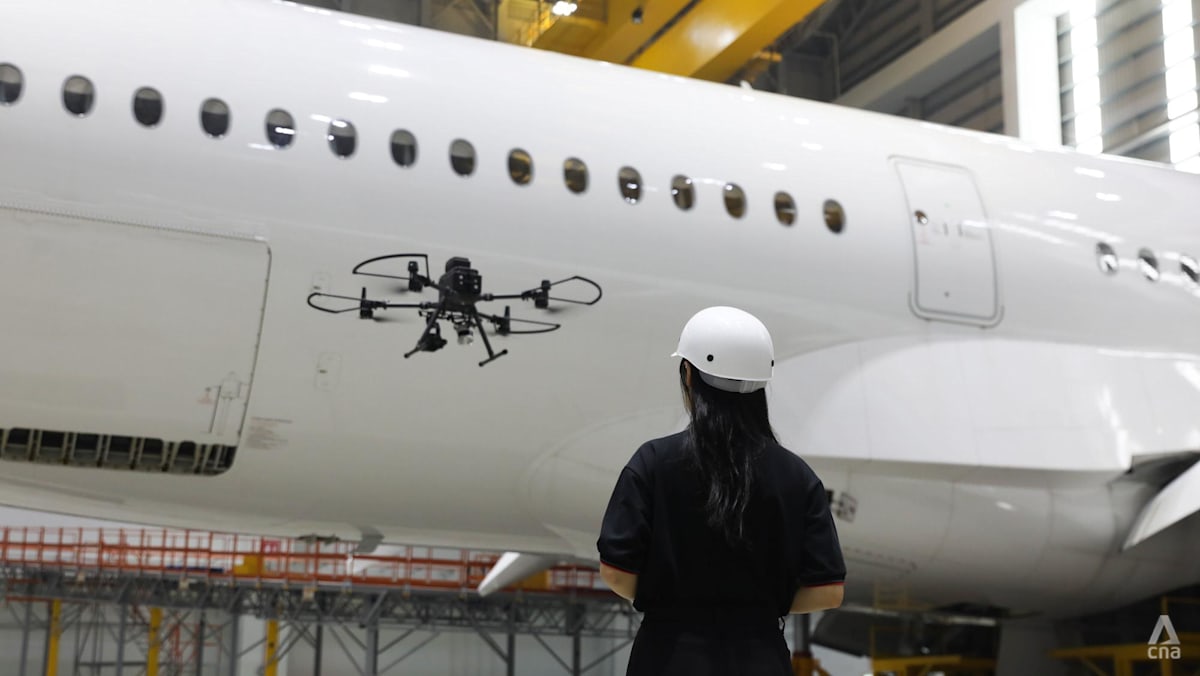
The Changi Creek facility will use drones and autonomous mobile robots to support operations.
A drone conducting visual inspections on an aircraft at ST Engineering’s newest airframe maintenance, repair and overhaul facility along Changi Creek Way on Oct 9, 2026. (Photo: CNA/Mak Jia Kee)
This audio is generated by an AI tool.
SINGAPORE: ST Engineering officially opened its fourth aircraft maintenance facility in Singapore on Friday (Oct 9), a site that will use drones and autonomous mobile robots and employ over 500 people when fully operational.
Most of the jobs will be newly created, including licensed aircraft engineers, planning and production control specialists, mechanics, and warehouse and logistics personnel.
The S$170 million (US$133 million) Changi Creek facility began operations in May and will ramp up over the coming year. It will be ST Engineering’s second-largest aerospace facility in Singapore, with four widebody aircraft bays at the 84,000 sq m site.
The facility adds 40 per cent capacity to the company’s widebody airframe maintenance, repair and overhaul (MRO) network in Singapore, potentially allowing 100 more widebody aircraft to be serviced each year.
ST Engineering said this gives customers greater flexibility and assured access to maintenance slots as airline fleets expand and aircraft stay in service longer.
President of commercial aerospace Kevin Chow said the facility reflects the company's confidence in Singapore as an air hub.
“We're investing in the future and we are serving the growth of the market through Singapore. This is not just another hangar,” he said, pointing to the technology-enabled operations.
Globally, airframe MRO demand is growing 1 to 2 per cent a year, but ST Engineering is seeing “multiples of that”, he said.
CNA Games Guess Word Crack the word, one row at a time Buzzword Create words using the given letters Mini Sudoku Tiny puzzle, mighty brain teaser Mini Crossword Small grid, big challenge Word Search Spot as many words as you can Show More Show Less
AI powered humanoid robot used to move items for delivery at ST Engineering’s newest airframe MRO facility on Oct 9, 2026. (Photo: CNA/Mak Jia Kee)
ST Engineering's AI-VET, an automated robotic arm equipped with a camera, inspecting aircraft components on Oct 9, 2026. (Photo: CNA/Mak Jia Kee)
The facility is a testbed for new technologies, with the company aiming to raise productivity by 25 per cent in the long term.
Drones will carry out visual inspections of the top of aircraft with greater speed and precision, said ST Engineering. This removes the need for technicians to reach the top of an aircraft by scaffolding or lifts, which is more dangerous for staff and risks damaging the aircraft.
Artificial intelligence models help to identify corrosion, paint defects and surface dents.
A camera mounted on a robotic arm is also used to inspect landing gear, reducing inspection time by up to 83 per cent.
Airlines can order 3D-printed aircraft parts designed and developed by ST Engineering, which cuts wait times and improves operational efficiency.
“Some of our customers tell us when they want to order parts from the original equipment manufacturer, the lead time, the wait time, is just too long,” said Mr Chow.
Customers need the aircraft out the door in 10 days, so 3D-printed parts can help to fill a gap, he said.
3D-printed aircraft components displayed alongside an original component (top right) at ST Engineering’s newest airframe MRO facility along Changi Creek Way on Oct 9, 2026. (Photo: CNA/Mak Jia Kee)
To track the progress of maintenance work, the company has been using an AI-powered monitoring platform for about six months. Previously, teams relied on pen and paper, and the situation could change before the data was compiled.
The facility will also automate the movement of aircraft parts, tools and materials from storage to the hangar floor.
Humanoid robots will retrieve the items needed for each maintenance project and transfer them to autonomous mobile robots for delivery, while larger autonomous guided vehicles can move heavier items of up to 500kg around the hangar.
By reducing the need for workers to manually handle these items, the systems are expected to free up about 7,800 manhours per year.
ST Engineering hopes to scale the new technology solutions to other facilities, including those overseas, after they have been trialed.
“Once something has been tested and proven here, we can scale to our global operations in one to two years,” said Mr Chow.
Get our pick of top stories and thought-provoking articles in your inbox
Stay updated with notifications for breaking news and our best stories
Join our channel for the top reads for the day on your preferred chat app
樟宜溪设施将使用无人机和自主移动机器人来支持运营。
2026年10月9日,一架无人机在新加坡科技工程公司位于樟宜溪路(Changi Creek Way)的最新飞机机身维护、修理和大修设施内对飞机进行目视检查。(图片:CNA/麦嘉琪)
这段音频由人工智能工具生成。
新加坡:新加坡科技工程公司于周五(10 月 9 日)正式启用其在新加坡的第四个飞机维修设施。该设施将使用无人机和自主移动机器人,全面运营后将雇用 500 多名员工。
大部分工作岗位都是新设立的,包括持证飞机工程师、计划和生产控制专家、机械师以及仓库和物流人员。
位于樟宜溪的这座耗资1.7亿新元(1.33亿美元)的设施于5月开始运营,并将在未来一年内逐步扩大产能。它将成为新科工程在新加坡的第二大航空航天设施,占地8.4万平方米,拥有四个宽体飞机停机坪。
该设施使公司在新加坡的宽体飞机机身维护、修理和大修 (MRO) 网络产能增加了 40%,每年可能可以维修 100 多架宽体飞机。
新科工程表示,随着航空公司机队规模扩大和飞机服役时间延长,这将为客户提供更大的灵活性和更有保障的维修服务。
商业航空航天总裁周凯文表示,该设施体现了公司对新加坡作为航空枢纽的信心。
“我们正在投资未来,并通过新加坡服务于市场增长。这不仅仅是另一个机库,”他指着技术赋能的运营说道。
他表示,全球飞机机身维修需求每年增长 1% 至 2%,但 ST Engineering 看到的增长速度是这个数字的“数倍”。
CNA游戏 猜词游戏 逐行破解单词 流行词游戏 用给定的字母组成单词 迷你数独 小小谜题,挑战你的大脑 迷你填字游戏 小方格,大挑战 单词搜索 尽可能多地找出单词 显示更多 显示更少
2026年10月9日,在新加坡科技工程公司最新的飞机机身维修厂,人工智能驱动的人形机器人正在搬运待交付的物品。(图片:CNA/麦嘉琪)
2026年10月9日,新加坡科技工程公司(ST Engineering)的AI-VET——一款配备摄像头的自动化机械臂——正在检测飞机部件。(图片:中央社/麦嘉琪)
该设施是新技术试验场,公司目标是从长远来看将生产力提高 25%。
新科工程表示,无人机将以更高的速度和精度对飞机顶部进行目视检查。这省去了技术人员搭建脚手架或使用升降机到达飞机顶部的需要,从而避免了对工作人员造成更大的危险,并可能损坏飞机。
人工智能模型有助于识别腐蚀、油漆缺陷和表面凹痕。
安装在机械臂上的摄像头也用于检查起落架,可将检查时间缩短高达 83%。
航空公司可以订购由新加坡科技工程公司设计和开发的 3D 打印飞机零部件,从而缩短等待时间并提高运营效率。
周先生说:“我们的一些客户告诉我们,当他们想从原设备制造商那里订购零件时,交货时间和等待时间太长了。”
他说,客户需要在 10 天内交付飞机,因此 3D 打印部件可以帮助填补这一缺口。
2026年10月9日,在新加坡科技工程公司位于樟宜溪道(Changi Creek Way)的最新飞机机身维修中心,3D打印的飞机部件与原装部件(右上)一同展出。(图片:CNA/麦嘉琪)
为了跟踪维护工作的进展情况,该公司已使用人工智能监控平台约六个月。此前,团队依靠纸笔记录,数据汇总之前情况可能已经发生变化。
该设施还将实现飞机零部件、工具和材料从仓库到机库地面的自动化运输。
人形机器人将取回每个维护项目所需的物品,并将其转移到自主移动机器人进行运送,而更大的自主导引车可以在机库内移动重达 500 公斤的物品。
通过减少工人手动处理这些物品的需求,这些系统预计每年可节省约 7800 工时。
新加坡科技工程希望在试用之后,将这项新技术解决方案推广到其他设施,包括海外设施。
周先生说:“一旦某项技术在这里经过测试和验证,我们就可以在一到两年内将其推广到全球运营。”
订阅我们的邮件,即可获取精选热点新闻和引人深思的文章。
订阅通知,第一时间获取突发新闻和精彩报道。
加入我们的频道,即可在您常用的聊天应用上获取当日热门文章。