Proposed S$15,000 COE surcharge too low to deter luxury car buyers, some dealers say部分经销商表示,拟议的1.5万新元拥车证附加费太低,不足以阻止豪华车买家。
Some prospective buyers of mass-market cars are holding off on purchases as the Land Transport Authority conducts a public consultation on merging COE categories A and B.
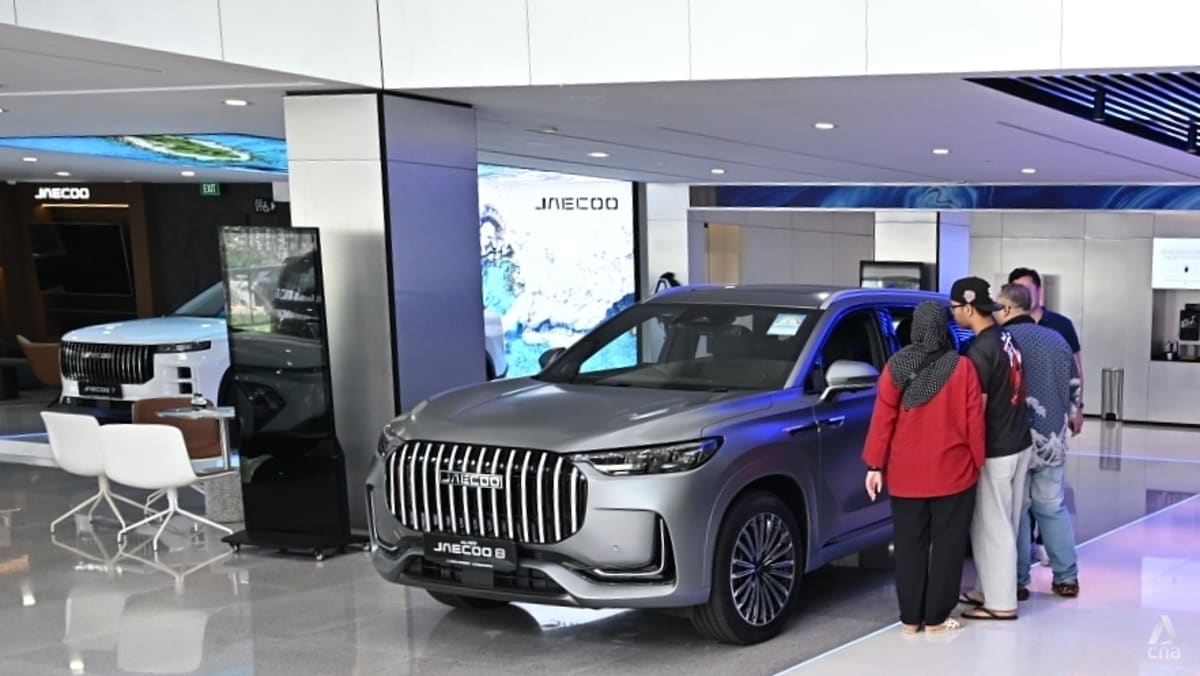
Some prospective buyers of mass-market cars are holding off on purchases as the Land Transport Authority conducts a public consultation on merging COE categories A and B.
A family looking at a car at the iCAUR showroom in Ubi on Oct 9, 2026. (Photo: CNA/Raydza Rahman)
This audio is generated by an AI tool.
SINGAPORE: A proposed S$15,000 (US$12,000) surcharge on the Certificate of Entitlement (COE) for more expensive cars may be too low to distinguish luxury from mass-market models, some car dealers said.
Well-heeled buyers of luxury cars costing upwards of S$400,000 are unlikely to feel the surcharge, they added, a day after the Land Transport Authority (LTA) mooted the proposal on Thursday (Oct 8).
Car showrooms in Ubi were quiet on Friday afternoon, with some would-be buyers saying they would wait and see before committing to a purchase.
LTA proposed merging categories A and B , which classify cars by engine size and power, into a single COE category, and introducing fees and rebates for different car models based on their open market value.
CNA Games Guess Word Crack the word, one row at a time Buzzword Create words using the given letters Mini Sudoku Tiny puzzle, mighty brain teaser Mini Crossword Small grid, big challenge Word Search Spot as many words as you can Show More Show Less The aim is to better distinguish high-end and mass-market vehicles as Category A and B prices have been converging. After fees and rebates, the maximum COE price difference between cars on opposite ends of the spectrum would be S$30,000. Dealers expressed support for merging the categories. The A and B classification had become “meaningless” as larger electric cars competed with smaller, more affordable cars for COEs in the same category, said Mr Raymond Tang, first vice-president of the Singapore Vehicle Traders Association. Combined with the rebate on lower-value models, the merger could bring relief to buyers of smaller cars, Mr Tang and other dealers said.
The aim is to better distinguish high-end and mass-market vehicles as Category A and B prices have been converging. After fees and rebates, the maximum COE price difference between cars on opposite ends of the spectrum would be S$30,000.
Dealers expressed support for merging the categories. The A and B classification had become “meaningless” as larger electric cars competed with smaller, more affordable cars for COEs in the same category, said Mr Raymond Tang, first vice-president of the Singapore Vehicle Traders Association.
Combined with the rebate on lower-value models, the merger could bring relief to buyers of smaller cars, Mr Tang and other dealers said.
LTA’s proposal is open for public consultation until Nov 2. The authority will release its findings and recommendations by the first half of 2027.
EFFECT ON DEMAND AND PRICES
Mr Anson Lee, managing director of Euro Performance Asia, expected COE prices to drop over the next six months as buyers take a wait-and-see approach, before rising again as demand for cars continues.
The dealer, who mostly sells high-end European cars, said a S$15,000 surcharge was not high enough to put off consumers with the spending power for luxury models.
At its current level, the proposed surcharge would therefore not lower the average COE premium and make cars more affordable for families and caregivers who need private transport, he said, suggesting that a S$25,000 surcharge might better achieve this.
LTA has said COE prices will continue to be determined by demand, and that the review does not look at the supply of COEs.
Analysts have said the fees and rebates can guarantee a price gap between luxury and mass-market cars, but not a lower average premium. For example, buyers could put their expected savings from rebates towards their bids.
Mr Tang, managing director of Yong Lee Seng Motor, which mostly sells family cars, similarly said the surcharge had to be higher for consumers to feel the difference between more and less expensive models.
He did not expect the rebate to directly affect appetite for mass-market cars, as most buyers leave the bidding to dealers and may not understand the implications for COE prices.
But CarTimes Group chief operating officer Benjamin Loo expected buyers to gravitate towards mass-market cars. These would become more affordable through the rebate and less competition for COEs from luxury car buyers, he said.
A COE surcharge on top of the new Additional Registration Fee tier for luxury cars, introduced in 2022, would make high-end models much more expensive, he added.
"This would increase demand for high-end pre-owned vehicles for customers who still want to enjoy the luxuries provided by these cars whilst increasing demand for new mass market cars," he said.
He also expected more demand for mass-market parallel imported cars, which have benefited from low open market values due to the weakening Japanese yen.
Cars lined up at the Automobile Megamart in Ubi on Oct 9, 2026. (Photo: CNA/Raydza Rahman)
IMPACT ON CAR MODEL MIX
Mr Tang said that unlike engine specifications, which manufacturers can adjust to qualify for Category A, a car's open market value is harder to shape to fit a rebate band. It would require lowering the overall cost of production, he said.
One likely consequence is a different mix of car models being brought into Singapore.
Mr Loo said his dealership would look at bringing in different mass-market cars to benefit from the rebate.
Premium cars whose engine power was capped to qualify for Category A would no longer enjoy that category's lower COE, and would face surcharges as high-end models, he noted.
"This might make it more feasible to buy a full specification high-end vehicle as the savings might no longer be as significant as before," he said.
Independent car broker Steven Lim did not expect the proposed system to fundamentally change how consumers choose a car.
Buyers will still look at what they can afford, perhaps paying more attention to the open market value to avoid a surcharge or obtain a rebate, he said.
A man looks at a car at the iCAUR showroom in Ubi on Oct 9, 2026. (Photo: CNA/Raydza Rahman)
Most showrooms CNA visited in Ubi on Friday afternoon were empty, except for one electric vehicle showroom. Salespeople said weekday afternoons are typically quieter and that the market was currently slow.
Prospective buyer Ng Yong Hua, 39, said his first thought on hearing of the proposal was how COE prices would change.
The finance manager had his eye on a Jaecoo 6, which has both Category A and B variants. Mr Ng said he would have to “rethink his options” if he had to pay a surcharge – but eventually decided to buy the car that day due to other factors.
“The saleslady told me the interest rate for the car financing is going to go up today … So I'm also looking to obviously keep my financing as cheap as possible,” he said.
Retiree Steven Chen, who is looking to buy an electric car, said he would wait and see how the reforms play out if adopted.
His decision depends on the final package a salesperson can offer, and dealers could “absorb” the S$15,000 surcharge in early-bird or year-end sales, for example, the 59-year-old said.
“For us, we can't control anything because the bidding is all by agent. So how much they bid, we don't care. Our thinking is, as long as this is the right price, we'll buy,” he said.
Others, like IT professional Andy Ho, 51, felt the proposed reform was “not exciting” as strong demand for cars means COE prices will remain high.
“It's just a kind of ‘change the soup, but the ingredients are the same’,” he said, adding that he will wait and see how the reforms unfold as his current car has three years left on its COE. Car owner Roy See bought his Zeekr 7X, a Category B premium EV, for S$236,000 in 2025. He would not make the same purchase today if he faced a S$15,000 surcharge on prevailing COE prices.
Mr See, 47, said he benefited from higher EV adoption rebates and incentives and lower COE prices last year. COE classification was not foremost in his mind then – he liked his car’s premium positioning and was prepared to pay Category B prices.
Since then, EV adoption rebates and incentives have tapered down, while COE prices have generally risen. A S$15,000 surcharge would be felt more keenly now and be enough to sway his decision, he said.
Lecturer Gerard Joseph Lim, 39, also said he would wait to see how the proposal plays out, in case rebates that make cars more affordable drive up demand and COE premiums instead.
Dr Lim, who is in the market for an affordable Japanese-made car, said the rebate may influence his choice of model, but that the deciding factor is whether he needs a car for his family or personal use.
“If it is a necessity, then I would aim for a lower open market value car since that is what I understand the categorisation is going to be based on,” he said.
Get our pick of top stories and thought-provoking articles in your inbox
Stay updated with notifications for breaking news and our best stories
Join our channel for the top reads for the day on your preferred chat app
由于陆路交通管理局正在就合并拥车证A类和B类进行公众咨询,一些大众市场汽车的潜在买家正在推迟购买。
2026年10月9日,一家人在乌美(Ubi)的iCAUR展厅看车。(图片:CNA/Raydza Rahman)
这段音频由人工智能工具生成。
新加坡:一些汽车经销商表示,拟议对更昂贵的汽车征收 15,000 新元(12,000 美元)拥车证 (COE) 附加费,可能太低,无法区分豪华车和大众市场车型。
他们补充说,购买价值超过 40 万新元的豪华汽车的富裕买家不太可能感受到附加费,此前一天,陆路交通管理局 (LTA) 于周四(10 月 8 日)提出了这项提案。
周五下午,乌美(Ubi)的汽车展厅一片冷清,一些潜在买家表示,他们会再观望一下,然后再决定是否购买。
陆路交通管理局提议将按发动机排量和功率对汽车进行分类的 A 类和 B 类合并为一个单一的拥车证类别,并根据不同车型的公开市场价值引入费用和回扣。
CNA游戏 猜词游戏 逐行破解单词 流行词游戏 用给定的字母组成单词 迷你数独 小小的谜题,强大的脑力挑战 迷你填字游戏 小方格,大挑战 单词搜索 尽可能多地找出单词 显示更多 显示更少 此次合并旨在更好地区分高端和大众市场车型,因为A类和B类车型的价格一直在趋同。扣除费用和回扣后,价格两端车型之间的拥车证价格差异最大为3万新元。经销商们表示支持合并A类和B类车型。新加坡汽车贸易商协会第一副会长雷蒙德·唐先生表示,由于大型电动汽车与价格更低的小型汽车在同一类别中争夺拥车证,A类和B类车型的分类已经变得“毫无意义”。唐先生和其他经销商表示,如果再加上对低价车型的回扣,合并可以为小型汽车的买家带来优惠。
此举旨在更好地区分高端车型和大众市场车型,因为A类和B类车型的价格一直在趋同。扣除各项费用和折扣后,价格区间两端车型之间的拥车证价格差异最大可达3万新元。
经销商们表示支持合并A类和B类车型。新加坡汽车贸易商协会第一副会长雷蒙德·唐先生表示,随着大型电动汽车与小型、价格更实惠的汽车在同一类别中争夺拥车证,A类和B类车型的分类已经变得“毫无意义”。
唐先生和其他经销商表示,加上对低价车型的折扣,此次合并可能会给小型车买家带来优惠。
陆路交通管理局的提案将公开征求公众意见,截止日期为11月2日。该局将于2027年上半年公布其调查结果和建议。
对需求和价格的影响
Euro Performance Asia 的董事总经理 Anson Lee 先生预计,由于买家采取观望态度,拥车证价格将在未来六个月内下降,然后随着汽车需求的持续增长而再次上涨。
这家主要销售高端欧洲汽车的经销商表示,15000 新元的附加费并不足以吓退那些有能力购买豪华车型的消费者。
他表示,目前的附加费水平并不会降低平均拥车证保费,也不会让需要私人交通工具的家庭和护理人员更容易负担得起汽车,并建议 25,000 新元的附加费或许能更好地实现这一目标。
陆路交通管理局表示,拥车证价格将继续由需求决定,此次审查不涉及拥车证的供应。
分析人士指出,这些费用和折扣可以确保豪华车和大众车之间存在价格差距,但并不能降低平均溢价。例如,购车者可能会将预期从折扣中节省的钱用于竞价。
杨利成汽车公司(Yong Lee Seng Motor)的总经理唐先生也表示,附加费必须更高,消费者才能感受到价格更高和价格更低的车型之间的差异。杨利成汽车公司主要销售家用轿车。
他预计回扣不会直接影响大众市场汽车的需求,因为大多数买家将竞价交给经销商,可能并不了解这对拥车证价格的影响。
但CarTimes集团首席运营官Benjamin Loo预计,消费者会更倾向于大众市场车型。他表示,由于补贴政策以及豪华车买家对拥车证(COE)竞争的减少,这些车型的价格会更加亲民。
他补充说,如果在2022年推出的针对豪华车的新增注册费基础上再加收拥车证附加费,高端车型的价格将会更加昂贵。
“这将增加对高端二手车的需求,以满足那些仍然希望享受这些汽车所提供的奢华体验的客户的需求,同时也会增加对大众市场新车的需求,”他说。
他还预计,由于日元贬值导致公开市场价格走低,大众市场平行进口汽车的需求将会增加。
2026年10月9日,汽车在乌美汽车城(Automobile Megamart)外排起长队。(图片:CNA/Raydza Rahman)
对汽车车型组合的影响
唐先生表示,与制造商可以调整以符合A类补贴标准的发动机规格不同,汽车的公开市场价值更难调整以符合补贴范围。他说,这需要降低整体生产成本。
一个可能的后果是,进入新加坡市场的汽车车型组合将发生变化。
卢先生表示,他的经销店将考虑引进不同的大众市场车型,以享受退税优惠。
他指出,发动机功率被限制在 A 类的高级汽车将不再享受该类别较低的拥车证价格,并将作为高端车型面临附加费。
“这或许会让购买高配高端车型变得更加可行,因为节省的费用可能不再像以前那么显著了,”他说。
独立汽车经纪人史蒂文·林并不认为拟议的系统会从根本上改变消费者选择汽车的方式。
他说,买家仍然会考虑自己能够负担得起的价格,可能会更加关注公开市场价值,以避免支付附加费或获得退款。
2026年10月9日,一名男子在乌美(Ubi)的iCAUR展厅观看汽车。(图片:CNA/Raydza Rahman)
周五下午,CNA记者走访了乌美(Ubi)的大部分汽车展厅,发现除了一家电动汽车展厅外,其余展厅都空无一人。销售人员表示,工作日下午通常比较冷清,目前市场行情不佳。
39岁的潜在买家吴永华表示,他听到这个提议后的第一反应是拥车证价格会如何变化。
财务经理看中了一款Jaecoo 6,这款车有A类和B类两种配置。吴先生表示,如果需要支付附加费,他将不得不“重新考虑”他的选择——但最终由于其他因素,他还是决定当天买下这辆车。
“销售员告诉我,汽车贷款的利率今天就要上涨了……所以我当然也想尽可能降低贷款成本,”他说。
退休人士史蒂文·陈(Steven Chen)正打算购买一辆电动汽车,他说他会观望一下,看看如果改革措施获得通过,将会产生怎样的影响。
这位 59 岁的男子表示,他的决定取决于销售人员最终能提供的方案,例如,经销商可以在早鸟优惠或年末促销活动中“承担”这 15,000 新元的附加费。
“对我们来说,我们什么都控制不了,因为竞价都是由代理人进行的。所以他们出价多少,我们并不在意。我们的想法是,只要价格合适,我们就买,”他说。
另一些人,例如 51 岁的 IT 专业人士 Andy Ho,则认为拟议的改革“并不令人兴奋”,因为汽车的强劲需求意味着拥车证价格将保持高位。
“这就好比‘换汤,但配料没变’,”他说道,并补充说他会观望改革的进展,因为他目前的车还有三年拥车证有效期。车主Roy See在2025年以23.6万新元的价格购买了他的Zeekr 7X,这是一款B类高端电动汽车。如果现在要在拥车证价格的基础上加收1.5万新元,他就不会再买这辆车了。
47岁的See先生表示,去年他受益于更高的电动汽车推广补贴和奖励以及更低的拥车证价格。当时他并没有太在意拥车证的分类——他喜欢自己车的高端定位,也愿意支付B类拥车证的价格。
他表示,自那以后,电动汽车推广补贴和奖励逐渐减少,而拥车证价格普遍上涨。现在,1.5万澳元的附加费会让他感觉更加明显,足以影响他的决定。
39岁的讲师杰拉德·约瑟夫·林也表示,他会观望一下这项提议的最终结果,以免让汽车价格更亲民的回扣反而推高需求和拥车证溢价。
林医生正在寻找价格适中的日本产汽车,他说回扣可能会影响他对车型的选择,但决定性因素是他需要这辆车是供家庭使用还是个人使用。
他说:“如果这是必要的,那么我会选择一辆公开市场价值较低的汽车,因为据我了解,分类将以此为依据。”
订阅我们的邮件,即可获取精选热点新闻和引人深思的文章。
订阅通知,第一时间获取突发新闻和精彩报道。
加入我们的频道,即可在您常用的聊天应用上获取当日热门文章。