SME association says Budget 2027 offers support, but warns of ‘cumulative’ cost pressures中小企业协会表示,2027年预算案提供了支持,但警告称成本压力将“累积”增加。
KUALA LUMPUR, Oct 10 — The Small and Medium Enterprises (SME) Association of Malaysia has welcomed the government’s Budget 2027 initiatives aimed at bolstering domestic...
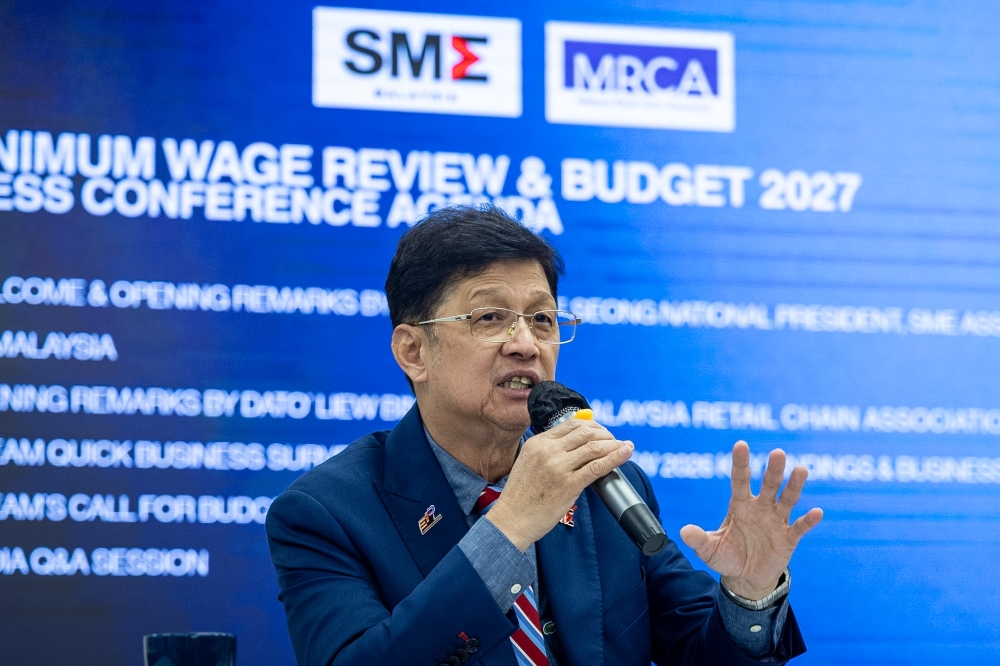
The Small and Medium Enterprises (SME) Association of Malaysia has expressed support for the government's Budget 2027 initiatives, which focus on enhancing domestic consumption and investments, but emphasizes the need to address ongoing challenges related to business costs.
President Chin Chee Seong highlighted the importance of implementing policies that produce tangible improvements in SME cash flow, productivity, and competitiveness.
He pointed out concerns with the minimum wage increase and corporate tax reductions, suggesting these measures might not sufficiently alleviate operational costs.
Chin also stressed the need for more effective financing access, AI and automation investment, and vocational training alignment with industry needs, advocating for a thorough assessment of cumulative SME costs and regulatory impacts.
KUALA LUMPUR, Oct 10 — The Small and Medium Enterprises (SME) Association of Malaysia has welcomed the government’s Budget 2027 initiatives aimed at bolstering domestic consumption and promoting investment but cautioned that the cumulative cost of doing business remains the sector's most significant hurdle.
The association's president Chin Chee Seong said that while the Budget introduces various measures to support businesses, the government must ensure these initiatives deliver measurable improvements to SME cash flow, productivity and competitiveness.
“SMEs are not asking simply for more money. We are asking for policies that deliver real and measurable results,” Chin told Malay Mail following the Budget announcement yesterday.
“Judge the Budget by actual outcomes, not the amount of money allocated. We must look at how many SMEs genuinely benefit, how many jobs are sustained, and whether Malaysian businesses become more productive, resilient, and competitive.”
Regarding the minimum wage increase from RM1,700 to RM2,000, Chin welcomed the exemption for micro, small and medium enterprises (MSMEs) with annual sales below RM50 million.
However, he warned that smaller businesses would still face indirect cost pressures through supply chains.
“The 17.6 per cent wage increase could affect business margins, hiring, consumer prices, and employment.
“Higher wages must not come at the expense of jobs, business survival, and competitiveness,” he said, calling for a phased, sector-sensitive implementation supported by productivity improvements.
On the corporate tax reduction, Chin noted that the one-percentage-point cut provides limited relief, with maximum annual savings of RM6,000 — equivalent to RM500 monthly — which he argued does little to offset rising operating expenses.
“SMEs need direct operating-cost relief and better cash flow, not just lower taxes,” he added.
Chin also addressed the funding allocated for artificial intelligence (AI) and automation, as well as technical and vocational education and training (TVET).
While appreciative of the RM30 million allocation for 4,000 SMEs for AI and automation, he suggested the average allocation of RM7,500 per enterprise might be insufficient for meaningful transformation.
“AI success must be measured by actual cost savings, efficiency improvements, and productivity gains, not adoption numbers alone,” he stated.
Similarly, regarding the RM8 billion TVET allocation, he urged the government to allow businesses to participate directly in curriculum design and practical training to ensure the output matches industry needs in sectors such as electrical and electronics, precision manufacturing and logistics.
The association also raised concerns regarding financing.
While welcoming the increase in total loans and financing guarantees from RM50 billion to RM57 billion, Chin pointed out that strict eligibility requirements and slow approvals remain persistent barriers.
“Financing availability means little if SMEs cannot access it when needed. We urge the government to strengthen SJPP and CGC guarantees, simplify applications, and accelerate approvals,” he said.
Ultimately, Chin stressed that the business community faces simultaneous pressures from rising costs in utilities, rental, logistics and compliance.
He proposed that the government conduct a “cumulative SME cost and regulatory impact assessment” before implementing future major policy changes.
Chin also called for stronger enforcement against non-compliant foreign e-commerce sellers, including checks on import declarations, tax payments, SIRIM compliance and product safety standards to safeguard local businesses.
“We welcome foreign competition, but Malaysian SMEs must compete on a level playing field,” he said.
Zara Qairina’s mum disputes diary entries expressing ‘hate’ towards her, says handwriting not daughter’s
Fourteen remanded as police probe death of 18-year-old found by Gurun roadside
Budget 2027: Grab aims to raise gig workers’ earnings without increasing fares
马来西亚中小企业协会表示支持政府的 2027 年财政预算案,该预算案旨在促进国内消费和投资,但同时强调需要解决与企业成本相关的持续挑战。
总统陈志成强调了实施能够切实改善中小企业现金流、生产力和竞争力的政策的重要性。
他指出,提高最低工资和降低企业税存在问题,认为这些措施可能不足以缓解运营成本。
Chin 还强调需要更有效的融资渠道、人工智能和自动化投资,以及与行业需求相符的职业培训,并倡导对中小企业的累计成本和监管影响进行全面评估。
吉隆坡,10 月 10 日讯——马来西亚中小企业协会对政府旨在提振国内消费和促进投资的 2027 年财政预算案举措表示欢迎,但同时警告称,累计经营成本仍然是该行业面临的最大障碍。
该协会主席陈志成表示,虽然预算案推出了一系列支持企业的措施,但政府必须确保这些举措能够切实改善中小企业的现金流、生产力和竞争力。
“中小企业并非仅仅要求更多资金。我们要求的是能够带来切实可衡量结果的政策,”陈先生在昨天预算案公布后告诉《马来邮报》。
“评判预算案应该看实际结果,而不是拨款金额。我们必须关注有多少中小企业真正受益,有多少就业岗位得以维持,以及马来西亚企业是否变得更有生产力、更有韧性、更有竞争力。”
关于最低工资从 1700 令吉提高到 2000 令吉,陈先生对年销售额低于 5000 万令吉的微型、小型和中型企业 (MSME) 的豁免表示欢迎。
但他警告说,小型企业仍将面临供应链带来的间接成本压力。
“17.6% 的工资增长可能会影响企业利润率、招聘、消费价格和就业。
他表示,“提高工资绝不能以牺牲就业、企业生存和竞争力为代价”,并呼吁分阶段、因行业而异地实施工资上涨政策,同时提高生产力。
关于企业所得税减免,陈先生指出,一个百分点的减免幅度有限,每年最多只能节省 6,000 令吉(相当于每月 500 令吉),他认为这不足以抵消不断上涨的运营成本。
他补充说:“中小企业需要的是直接的运营成本减免和更好的现金流,而不仅仅是降低税收。”
秦还谈到了人工智能(AI)和自动化以及技术和职业教育与培训(TVET)的资金分配情况。
他虽然赞赏政府拨款 3000 万令吉用于 4000 家中小企业的人工智能和自动化,但他认为平均每家企业 7500 令吉的拨款可能不足以实现有意义的转型。
他表示:“衡量人工智能的成功必须以实际的成本节约、效率提升和生产力提高为标准,而不仅仅是采用数量。”
同样,关于80亿令吉的职业技术教育拨款,他敦促政府允许企业直接参与课程设计和实践培训,以确保产出符合电气电子、精密制造和物流等行业的行业需求。
该协会还对融资问题表示担忧。
尽管对贷款和融资担保总额从 500 亿令吉增加到 570 亿令吉表示欢迎,但 Chin 指出,严格的资格要求和缓慢的审批仍然是持续存在的障碍。
“如果中小企业在需要时无法获得融资,那么融资渠道的畅通就毫无意义。我们敦促政府加强SJPP和CGC的担保力度,简化申请流程,并加快审批速度。”他说道。
最后,秦强调,商界同时面临着公用事业、租金、物流和合规成本上涨的压力。
他建议政府在实施未来重大政策变化之前,进行“中小企业累计成本和监管影响评估”。
Chin还呼吁加强对不合规外国电子商务卖家的执法力度,包括检查进口申报、纳税情况、SIRIM合规性和产品安全标准,以保护本地企业。
“我们欢迎外国竞争,但马来西亚中小企业必须在公平的竞争环境中竞争,”他说。
Zara Qairina的母亲否认日记中表达了对她的“仇恨”,称笔迹并非女儿所写。
警方调查古伦路边发现的18岁男子死亡事件,14人被还押候审。
2027年财政预算案:Grab计划在不提高车费的情况下提高零工经济从业者的收入