S’porean lawyer wins global award for parliamentary work, advocacy for groups like migrant workers新加坡律师因其议会工作和为外籍劳工等群体争取权益而荣获全球奖项
After nine years as a legislative assistant to an MP, she hopes to find her own voice. Read more at straitstimes.com.
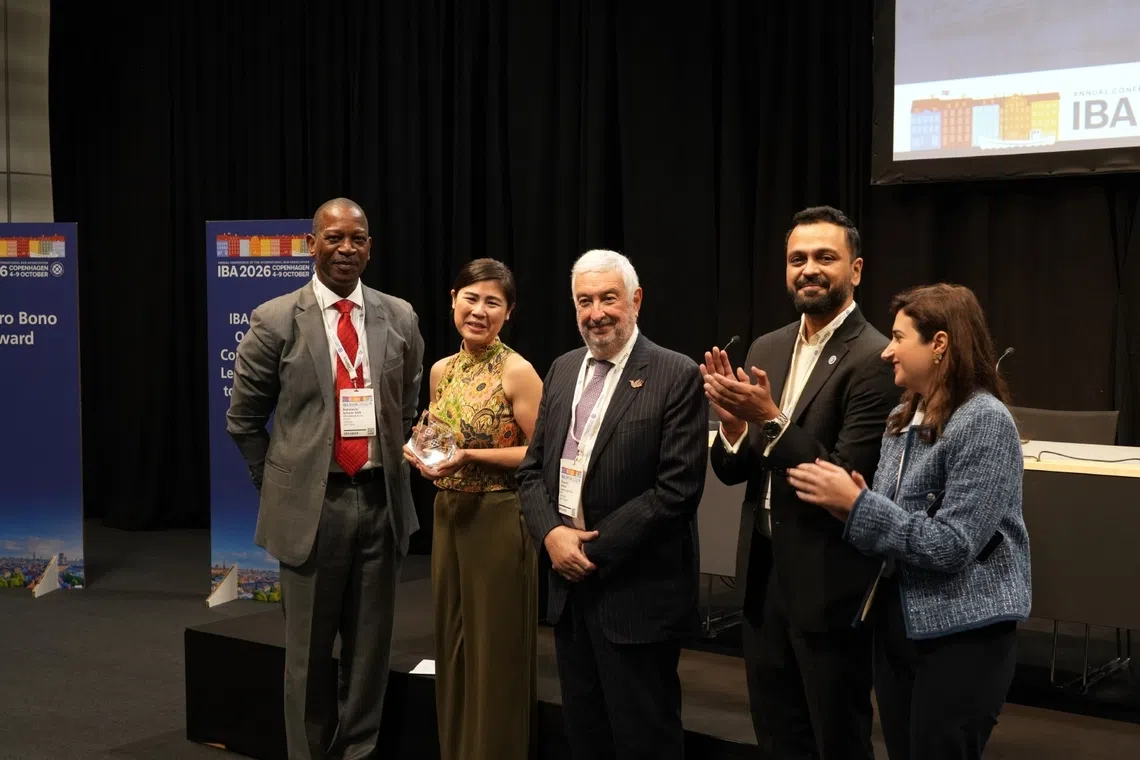
Lawyer Charmaine Yap received the International Bar Association’s Outstanding Young Lawyer of the Year Award in Copenhagen, Denmark, on Oct 8.
PHOTO: INTERNATIONAL BAR ASSOCIATION
Published Oct 10, 2026, 12:00 PM
Updated Oct 10, 2026, 12:00 PM
SINGAPORE – For two consecutive birthdays, lawyer Charmaine Yap spent most of the day hunched over a laptop poring over lines of legislation.
As legislative assistant to former Nee Soon GRC MP Louis Ng, she played a key role in drafting the Good Samaritan Food Donation Act, one of Singapore’s rare laws tabled by backbenchers rather than the authorities.
The Act, which protects food donors from certain civil and criminal liabilities, subject to safeguards, had been years in the making. Ng first mooted the need for such legislation in Parliament in 2020 , and the Bill was eventually introduced in July 2024 and passed unanimously the following month.
Yap’s parliamentary work and advocacy for vulnerable groups such as migrant workers and refugees earned her the International Bar Association’s Outstanding Young Lawyer of the Year Award on Oct 8.
The 32-year-old is the second Singaporean to receive the award, which recognises young lawyers for professional excellence and contributions to the legal profession and wider community. The first was lawyer Remy Choo, who won it in 2016.
The whole process of coming up with the food donation laws stood out to Yap as she reflected on her award, as it showed her that MPs and their teams could go beyond raising issues in Parliament to develop policy.
“There’s so much more space and tools that they can use to advance the work in Parliament,” she said, pointing to surveys, public consultations and discussions with civil servants that went into developing policy proposals.
For those two years, Yap cut her work weeks to four days at her then employer, law firm Drew & Napier, taking a 20% pay cut.
This gave her more time to draft the law, on top of her other duties as a legislative assistant, which included drafting speeches for Ng, who spoke on 269 Bills over his two terms in Parliament.
The hours spent studying legislation and preparing for parliamentary debates was demanding, but the alternative – letting legislation pass without proper scrutiny – was harder to accept.
“I just felt that that’s the role of Parliament,” she said. “I would feel quite aggrieved if a legislation comes through Parliament and gets passed without any debate at all.”
Former deputy speaker of Parliament Charles Chong, who supported her nomination, highlighted in a letter the extra mile that Yap has gone in her advocacy work.
“Most lawyers in Singapore who do public interest work do so at the margins of a conventional career, a compromise Charmaine refused,” wrote Chong, a seven-term MP. They met in 2018 through non-governmental organisation ASEAN Parliamentarians for Human Rights.
He added that Yap has shown that legal excellence and service to justice are not in tension, including through her advocacy for migrant workers, refugees, single parents and other vulnerable groups.
In Nee Soon, she organised activities for migrant cleaners, visited their families in Dhaka and wrote letters of support for visa applications to help some reunite with their wives or children in Singapore.
Law Society of Singapore president Tan Cheng Han said Yap’s recognition on the world stage shows what the country’s young lawyers are capable of.
“We hope her achievement will inspire the new generation of Singapore lawyers to build careers of meaning and impact, and to treat access to justice as part of what it means to practise law,” he added.
More than drafting speeches
Yap’s foray into parliamentary work began in 2016 when she met Ng while interning at animal welfare group ACRES and urged the newly elected MP to speak up for migrant workers.
Ng suggested that she join his legislative team to raise those issues from within Parliament – which she promptly did, and stayed till Ng retired from politics in 2025.
During the nine years, one of her key contributions was to help the public and civil society groups understand parliamentary processes and how to raise their concerns through questions and motions.
Behind all of what Ng raised in the House were hours of consultations and research by his legislative team, said Yap.
For the food donation act, they consulted hotels, restaurants, supermarkets, bakeries and food charities and the public. These engagements also show Singaporeans that they could help shape legislation, she added.
Yap, who returned to Singapore in June after completing a master’s degree in law at Columbia University, said she does not plan to take up another legislative assistant role.
She wants to find her own voice, she said. “I feel that I’ve done all that I can to push for those issues in another person’s voice in Parliament. I should be finding my own way of contributing.”
She has resumed volunteering with migrant worker advocacy group Transient Workers Count Too.
She is also examining more practical alternatives to transporting migrant workers on lorries and whether catered meals delivered to migrant workers comply with food-safety requirements.
She hopes to get illegal employment kickbacks – where employers collect money from migrant workers in exchange for jobs or continued employment – to be treated as seriously as corruption offences.
Yap researched the issue at Columbia and is seeking to publish her findings.
Under the Employment of Foreign Manpower Act, a person who collects employment kickbacks can be jailed for up to two years and fined $30,000, compared with five years’ jail and a $100,000 fine for a general corruption offence under the Prevention of Corruption Act.
But without the “convening power” of an MP’s office, she said she now has to find new ways to bring people together to effect change.
Still, her years working with Ng has taught her that change does not always require reaching the most senior decision-maker.
A fan of organisational charts, Yap frequently consulted the Singapore Government Directory to identify who was responsible for different decisions.
“What’s more helpful is to understand who the decision-makers are and what levels decisions are being made at, and try and figure out – if you want to change something – at what point of the process do you have to engage with,” she said.
Asked if she would consider joining politics having seen first-hand how it can achieve change, Yap said she had mulled over the possibility and did not rule it out.
For now, she wants to try to see through policy changes in the causes she cares about from outside Parliament.
“(But) anyone who wants to do work that involves policy change must seriously consider joining politics since it’s one way of changing things.”
10月8日,律师Charmaine Yap在丹麦哥本哈根荣获国际律师协会年度杰出青年律师奖。
图片来源:国际律师协会
发布于2026年10月10日下午12:00
更新于2026年10月10日中午12:00
新加坡——律师 Charmaine Yap 连续两个生日,几乎一整天都伏在笔记本电脑前,仔细研读法律条文。
作为前义顺集选区议员吴路易的立法助理,她在起草《好撒玛利亚人食物捐赠法》中发挥了关键作用,该法是新加坡为数不多的由后座议员而非当局提出的法律之一。
该法案旨在保护食物捐赠者免于承担某些民事和刑事责任,并设有相应的保障措施,其酝酿已久。吴先生于2020年首次在国会提出制定此类立法的必要性,该法案最终于2024年7月提交国会,并在次月获得一致通过。
叶女士在议会的工作以及对移民工人、难民等弱势群体的倡导,使她于 10 月 8 日荣获国际律师协会年度杰出青年律师奖。
这位32岁的律师是第二位获得该奖项的新加坡人。该奖项旨在表彰年轻律师在专业领域的卓越表现以及对法律界和更广泛社区的贡献。第一位获奖者是律师雷米·朱(Remy Choo),他于2016年获此殊荣。
在回顾自己获奖的经历时,叶女士对制定食品捐赠法的整个过程印象深刻,因为这让她意识到,议员及其团队不仅可以在议会提出问题,还可以制定政策。
“他们可以利用更多的空间和工具来推进议会的工作,”她说道,并指出在制定政策提案的过程中,他们进行了调查、公众咨询,并与公务员进行了讨论。
在那两年里,叶女士将她在当时的雇主——德鲁·纳皮尔律师事务所的工作时间减少到每周四天,收入减少了20%。
这让她有更多的时间来起草法律,同时她还要履行立法助理的其他职责,包括为吴先生起草演讲稿。吴先生在国会的两届任期内,曾就 269 项法案发表过演讲。
研究立法和准备议会辩论所花费的时间虽然很辛苦,但另一种选择——让立法未经适当审查就通过——更难以接受。
“我只是觉得这就是议会的职责,”她说。“如果一项法案未经任何辩论就在议会获得通过,我会感到非常愤慨。”
支持叶女士提名的国会前副议长张志贤在一封信中强调了叶女士在倡导工作中付出的额外努力。
“在新加坡,大多数从事公益工作的律师都是在传统职业生涯的边缘地带进行工作,而夏尔曼拒绝接受这种妥协,”曾七次当选国会议员的庄文强写道。她们于2018年通过非政府组织“东盟议员人权组织”相识。
他还补充说,叶女士已经证明,卓越的法律才能与维护正义并不矛盾,包括她为移工、难民、单亲父母和其他弱势群体所做的倡导工作。
在义顺,她为外来清洁工组织活动,探望他们在达卡的家人,并为他们撰写签证申请支持信,帮助一些人与在新加坡的妻子或孩子团聚。
新加坡律师协会主席陈清汉表示,叶在国际舞台上获得的认可,展现了该国年轻律师的能力。
“我们希望她的成就能够激励新一代新加坡律师建立有意义、有影响力的职业生涯,并将获得司法公正视为法律实践的一部分,”他补充道。
不仅仅是撰写演讲稿
叶女士于 2016 年开始涉足议会工作,当时她在动物福利组织 ACRES 实习期间结识了吴女士,并敦促这位新当选的议员为外籍劳工发声。
吴建议她加入他的立法团队,以便在国会内部提出这些问题——她立即照做了,并一直待到吴于 2025 年从政坛退休。
在她任职的九年间,她的主要贡献之一是帮助公众和民间社会团体了解议会程序,以及如何通过质询和动议提出他们的关切。
叶表示,吴在国会提出的所有建议背后,都有他的立法团队进行了数小时的咨询和研究。
为了制定食物捐赠法案,他们咨询了酒店、餐厅、超市、面包店、食物慈善机构以及公众的意见。她补充说,这些交流也向新加坡人表明,他们可以参与立法过程。
叶女士于今年6月从哥伦比亚大学获得法学硕士学位后返回新加坡,她表示不打算再担任立法助理一职。
她说,她想找到属于自己的声音。“我觉得我已经尽我所能,以其他人的身份在议会里推动这些议题。我应该找到自己贡献力量的方式。”
她已恢复在移民工人权益倡导组织“Transient Workers Count Too”担任志愿者。
她还在研究用货车运送外来务工人员之外的更实际的替代方案,以及向外来务工人员提供的餐饮是否符合食品安全要求。
她希望对非法雇佣回扣(即雇主向外籍劳工收取金钱以换取工作或继续雇佣)采取与腐败犯罪同等的严厉惩罚措施。
Yap在哥伦比亚大学对该问题进行了研究,并正在寻求发表她的研究成果。
根据《雇用外籍人力法》,收取雇佣回扣的人可被判处最高两年监禁并罚款 30,000 美元,而根据《防止贪污法》,一般贪污罪行可被判处五年监禁并罚款 100,000 美元。
但她表示,由于失去了议员办公室的“召集力”,她现在必须找到新的方法来团结人们,从而带来改变。
不过,多年与吴共事的经历让她明白,变革并不总是需要最高决策者的参与。
叶先生酷爱组织结构图,他经常查阅新加坡政府名录,以确定不同决策的负责人。
“更有帮助的是了解决策者是谁,以及决策是在哪个层级做出的,并试着弄清楚——如果你想改变某些事情——你需要在流程的哪个阶段进行干预,”她说。
当被问及亲眼目睹政治如何带来变革后是否会考虑从政时,叶女士表示她已经仔细考虑过这种可能性,并且不排除这种可能性。
目前,她希望在议会之外,观察她所关心的事业的政策变化。
“(但是)任何想要从事政策变革工作的人都必须认真考虑从政,因为这是改变现状的一种途径。”