Tending to gardens and the elderly照料花园和老人
Preparing the soil is hard and bespoke work for plants to thrive. So it is for our elders. Read more at straitstimes.com.
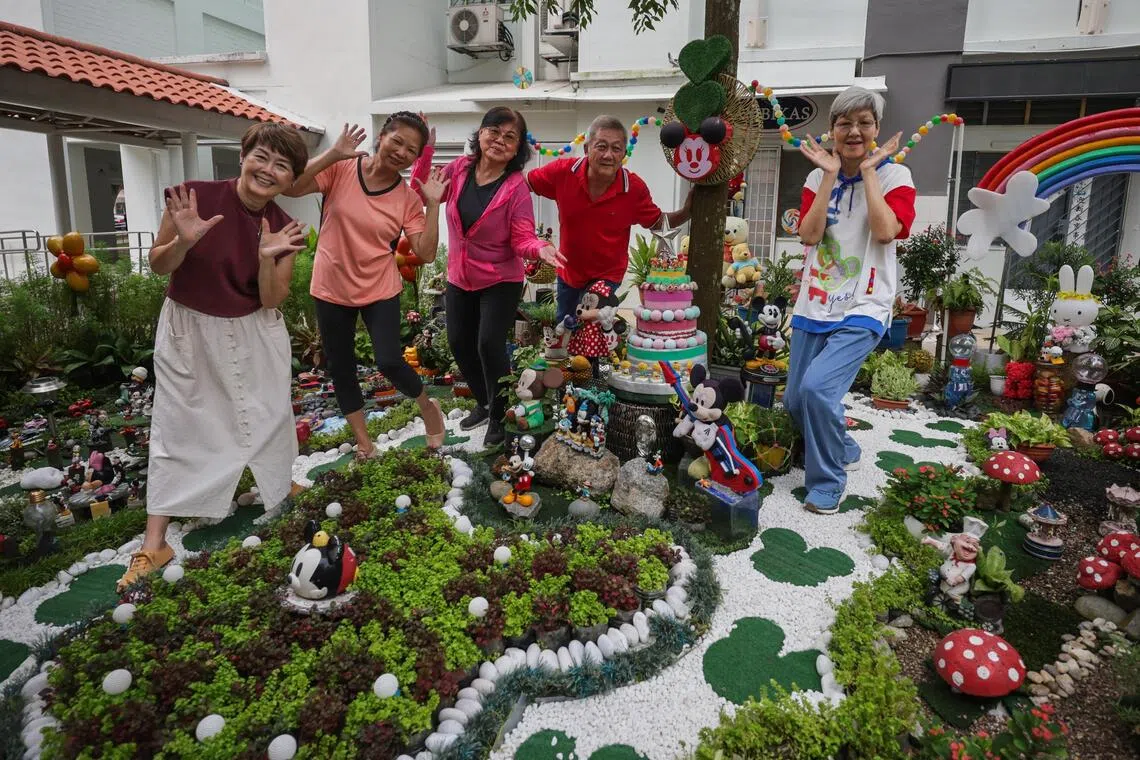
(From left) Retired florist Jasmine Tan, part-time cleaner Christina Koh, retired accountant Irene Oh, retired food caterer Clifford Leung and homemaker Eileen Ang at St Luke's ElderCare Active Ageing Centre on Sep 4.
Published Oct 11, 2026, 05:00 AM
Updated Oct 11, 2026, 05:00 AM
SINGAPORE – I always joke that my career trajectory has taken me on a journey from “womb to tomb”.
My earlier training was in obstetrics, but this has swung to the other end of the age spectrum, as chief executive officer of St Luke’s ElderCare.
It has been an interesting path, and it has given me an expanded and deeper appreciation of life.
I am also an aspiring gardener. I am often motivated by inspiring stories of horticultural success, and end up perspiring under the sun to make my garden work.
Alas, I do not have green fingers, and my plants invariably wither under my watch.
Perhaps I should care more than I watch.
Tending to the foundations
Preparing the soil is hard and bespoke work. ChatGPT tells me that healthy well-prepared soil is an essential foundation for strong productive plants; and my own failed experiments with cacti and other flowering plants show that not all soils are suitable for all plants.
So it is for our elders.
St Luke’s ElderCare is dedicated to enriching the lives of seniors in Singapore, offering a comprehensive suite of services islandwide.
These include community-based programmes that promote active ageing; centre-based offerings such as day care, rehabilitation and nursing; home-based services covering medical, nursing and therapy needs; and residential services for long-term care.
When we started with four senior care centres in 1999, our “soil” was basic and standard – four walls with a multi-purpose hall within a void deck. Each functioned as a gathering space and allowed for fast and frequent turn-arounds to accommodate changes in activities and programmes.
Much has changed since, and we have learnt to be more senior-centric in our facility planning and design.
Yet, the challenge remains, to transform each designed space into a desired place.
We need to curate authentic and relatable environments where our elders can flourish by doing what they love, and loving what they do.
Adapting to the seasons of life
Singapore has our own unique climate – our four “seasons” are wet, dry, hot and hazy.
We learn to live and let live, to adapt and make adaptations – to accept that the changing seasons and rhythms cannot and perhaps should not be changed.
They have seasons too and their life rhythms necessarily adapt as well.
Each season of independence is countered by periods of dependence, each season of activity is balanced by times of rest, and each season of company with friends may retreat into comfort of solitude and personal reflection.
These rhythms may accompany physical, cognitive, emotional and spiritual variations and changes over time. They need to be respected, embraced and nurtured with care.
Yet, the challenge remains to make each time-based activity meaningful.
In time-scarce Singapore, efficiency is premium; but in super-aged Singapore, rhythm is preferred. Good gardeners do not fight the seasons, they understand and work within them.
One of the most remarkable things about growth is that much of it happens unseen.
Recently, a colleague Kelvin Lim shared a story about 88-year-old Madam Kadariah.
She lives with dementia and rarely joined in the activities at our day centre despite Kelvin trying various ways to connect with her.
One day, he played the familiar folk song Chan Mali Chan, and Madam Kadariah’s face lit up – she began singing and dancing, revealing a side of her we had never seen before.
Then she said something to Kelvin which touched all of us: “ Hati sangat mulia (you have a noble heart).”
What had appeared dormant was very much alive. It was simply waiting for the right moment, the right connection and the right conditions to bloom.
Tending to gardens and lives entails hard work and work from the heart – as well as a fine balance between purposeful activity and contemplative anticipation.
I remain an avid gardener who has done much watching, and continue to plant some of my observations towards creating a conducive environment for elders to flourish with dignity, independence and joy.
Kenny Tan is the chief executive officer of St Luke’s ElderCare. A medical doctor by training, he has spent more than 15 years in healthcare and community care. He also serves as chairman of the Board of Eagles Mediation and Counselling Centre, adjunct associate professor at the Singapore Institute of Technology, and is a Justice of the Peace. An avid poet, Tan has published five collections of poetry in support of fund-raising efforts.
(从左至右)退休花艺师 Jasmine Tan、兼职清洁工 Christina Koh、退休会计师 Irene Oh、退休餐饮服务商 Clifford Leung 和家庭主妇 Eileen Ang 于 9 月 4 日在圣路加乐龄关怀中心合影。
发布于2026年10月11日 上午5:00
更新于2026年10月11日上午5:00
新加坡——我总是开玩笑说,我的职业生涯轨迹带我经历了一段从“出生到死亡”的旅程。
我早期的培训专业是妇产科,但现在我的工作重心已经转移到了年龄谱的另一端,我担任了圣卢克老年护理中心的首席执行官。
这是一段有趣的经历,它让我对生活有了更广阔、更深刻的感悟。
我也是一名有抱负的园丁。我常常被园艺成功的励志故事所激励,最终在烈日下挥汗如雨,努力让我的花园茁壮成长。
唉,我没有园艺天赋,我的植物总是在我照看下枯萎。
或许我应该多关心一些,而不是仅仅袖手旁观。
夯实基础
土壤准备是一项艰巨且需要根据具体情况而定的工作。ChatGPT告诉我,健康且准备充分的土壤是植物茁壮成长、高产的重要基础;而我自己在仙人掌和其他开花植物上的失败实验表明,并非所有土壤都适合所有植物。
我们的长辈也是如此。
圣路加长者关怀中心致力于丰富新加坡老年人的生活,在全岛范围内提供全面的服务。
这些服务包括促进积极老龄化的社区项目;日托、康复和护理等中心服务;涵盖医疗、护理和治疗需求的家庭服务;以及长期护理的住宿服务。
1999年我们刚起步时,只有四家老年护理中心,条件十分简陋——四面墙,中间有一个位于组屋底层的多功能厅。每家中心都兼具聚会场所的功能,可以快速灵活地调整布局,以适应活动和项目的变化。
此后很多事情都发生了变化,我们在设施规划和设计方面也学会了更加以老年人为中心。
然而,挑战依然存在,那就是如何将每个设计空间变成理想的场所。
我们需要营造真实且贴近生活的环境,让长者们能够做自己喜欢的事,并热爱自己所做的事,从而茁壮成长。
适应人生的四季
新加坡拥有自己独特的气候——我们的四个“季节”分别是雨季、旱季、热季和雾霾季。
我们学会了与他人和平共处,学会了适应和做出改变——接受季节和节奏的变化不能也不应该改变。
它们也有季节更替,它们的生活节奏也必然会随之调整。
每一次独立之后都会有一段依赖的时期,每一次活跃的时期都会有一段休息的时期,每一次与朋友相伴的时期都可能回归到独处和个人反思的舒适之中。
这些节奏可能伴随着生理、认知、情感和精神层面的变化。它们需要得到尊重、接纳和悉心呵护。
然而,如何使每一项基于时间的活动都具有意义,仍然是一个挑战。
在时间紧迫的新加坡,效率至关重要;但在老龄化严重的新加坡,节奏才是王道。优秀的园丁不会与季节对抗,而是理解并顺应季节变化。
成长最令人惊奇的一点是,它的大部分过程都是在看不见的情况下发生的。
最近,同事 Kelvin Lim 分享了一个关于 88 岁 Kadariah 女士的故事。
她患有痴呆症,尽管凯尔文尝试了各种方法与她交流,但她很少参加我们日间中心的活动。
有一天,他弹奏了熟悉的民歌《Chan Mali Chan》,卡达利亚夫人的脸上顿时绽放出笑容——她开始唱歌跳舞,展现了我们从未见过的她的一面。
然后她对凯尔文说了一句话,感动了我们所有人:“Hati sangat mulia(你有一颗高尚的心)。”
看似沉睡的事物其实生机勃勃,只是在等待合适的时机、合适的契机和合适的条件绽放光芒。
照料花园和生活需要辛勤的劳动和用心的付出,以及在有目的的行动和沉思的期待之间取得良好的平衡。
我仍然是一位热衷园艺的爱好者,我做了很多观察,并继续将我的一些观察成果融入到为老年人创造一个有利于他们有尊严、独立和快乐地生活的环境的努力中。
肯尼·陈是圣路加长者关怀中心的首席执行官。他是一位受过专业训练的医生,在医疗保健和社区服务领域工作超过15年。他同时也是雄鹰调解与辅导中心的董事会主席、新加坡理工大学的兼职副教授,以及太平绅士。陈先生热爱诗歌,曾出版五部诗集以支持筹款活动。