Still running: The many lives of Larry Peh仍在奔跑:白伟良的多重人生
Discover the inspiring life and resilient career of Larry Peh, Singaporean designer behind the iconic red carp plastic bag and twice President’s Design Award winner. Read more at straitstimes.com.
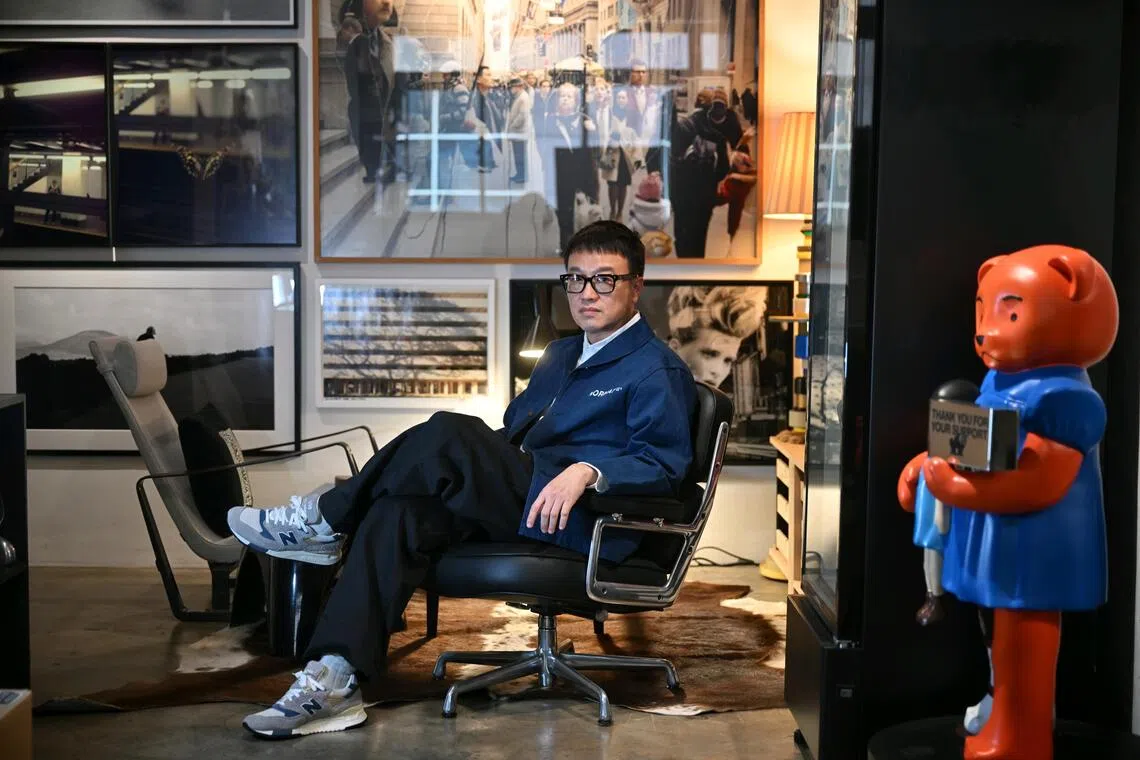
Larry Peh is a two-time President's Design Award winner, including Designer of the Year in 2014.
ST PHOTO: ARIFFIN JAMAR
Published Sep 06, 2026, 05:00 AM
Updated Sep 06, 2026, 05:00 AM
A red carp swims across the plastic bags found at wet markets and hawker centres across Singapore.
Few people carrying them home, filled with kangkong or char siew bao, know that the familiar design is the work of Larry Peh, a two-time President’s Design Award winner.
Yet the ubiquitous red carp may be one of the less remarkable chapters in Peh’s eventful life. The 49-year-old has survived a tennis ball-sized blood clot in his brain, come close to bankruptcy twice, experienced business failures, grappled with depression and faced death, not once but four times.
He recounts it all with a laugh and the candour of a man long accustomed to the turns his life can take.
The younger of two boys, Peh grew up with a sales engineer father who sold ships’ equipment and a housewife mother who passed on her fondness for “useless but beautiful” clutter.
He describes himself as a “weird child”, happiest drawing on the floor or taking teddy bears apart and putting them back together in new ways.
At Zhonghua Secondary School, he struggled. He was poor at maths and science, and painfully aware of his limited English.
At a British Council class, he once asked what the word “reef” meant, only to be mocked by the teacher in front of everyone. Stung, Peh spoke up. He told the teacher that he came from a poor family, had spent two hours getting there by bus because he wanted to improve his English, and did not expect to be humiliated for trying.
Rebuked, the teacher took him under his wing, while Peh began devouring the dictionary every day. Before long, he had become the best English speaker in his cohort, and the one his classmates turned to for help.
Another put-down, this time from a secondary school teacher, had a similar effect. “I’m wasting my time on you,” the teacher told him.
Peh asked what it would take to make him eat his words. “He said if I topped my class in the prelims, he would take them back and apologise.”
Fired up, Peh studied hard and went on to top his class in the O-level preliminary exams. The apology never came. But he had proved something to himself.
“If I set my heart and mind to something,” he says, “I will do it.”
Larry Peh with the plastic bags featuring the red carp he designed. PHOTO: LIANHE ZAOBAO FILE
Larry Peh with the plastic bags featuring the red carp he designed.
PHOTO: LIANHE ZAOBAO FILE
Art was the one area in which he never doubted himself. He won school competitions so often that teachers held up his work as an example, much to the annoyance of his classmates.
When he was seven, he entered a competition at the Science Centre Singapore with a watercolour of a rocket, painstakingly capturing its light and shadows. The judges thought it was too accomplished for a child and assumed an adult had helped him. They gave him nothing. It was a bitter lesson: Sometimes being too good is its own kind of punishment.
Peh’s real design education, he says, took place not in a classroom but at the Popular bookstore in Hougang. He found himself drawn – he still doesn’t quite know why – to fashion magazine Harper’s Bazaar, and specifically to its then creative director, the legendary Fabien Baron.
“I didn’t know it’s called typography,” he says of his adolescent fascination with “the letters with the big O and then the girl with the big hat next to it”.
He was also captivated by the magazine’s late editor Liz Tilberis. When Tilberis died from ovarian cancer in 1999 and Baron left the magazine not long after, Peh felt he had lost “my two idols”.
He studied visual communication at what is now Temasek Polytechnic, then housed at the old Stirling Road campus. There, he frequently clashed with his final-year mentor, respected design educator Lim Chong Jin.
Lim rejected idea after idea for Peh’s final-year project until, running out of options, the student stripped everything back. His campaign for Osram light bulbs was so spare it was almost design-less.
It became one of the standout projects of his cohort and drew praise from external examiners from the UK.
“Chong Jin loved it. The guy who rejected my idea also fought very hard to say I should be top student.”
Peh did not get the honour, but says he did not mind. What stayed with him was a more valuable lesson: When an idea gets too clever or complicated, strip it back to its essence.
That belief in simplicity would come to define Peh’s work, which balances restraint with creative expression, and shape the course of his career.
One of his first jobs was at Asylum, an agency where he was so unconcerned about money that he did not know his salary – a princely $2,000 – until his first payday. He rose quickly, handling entire accounts on his own. But he grew frustrated at being saddled with the corporate and banking jobs that paid the bills while others worked on more creative, award-chasing projects.
So when a friend offered him a salary well above market rate to start an agency together, he did not baulk. But the partnership failed. After selling his stake, he left for his honeymoon and a sabbatical and returned a couple of months later to a lot of rumours and questions about his integrity.
“Former clients avoided me. Some wouldn’t even wave when I saw them on the street,” he says.
Still, Peh started his own studio &Larry in 2005 with little money and zero clients. His first job ended disastrously. The UK client fired him and, on the same unhappy afternoon, Peh returned the favour.
By then, he says, he had sunk into depression, although he never sought a formal diagnosis.
“I felt like a lion with its mane shaved off; I was still pretending to be a lion while privately falling apart. I couldn’t sleep at night,” he says.
What pulled him through were small acts of kindness.
When he told a South Bridge Road landlord that he could afford only three months’ rent, she was so moved by his honesty that she lowered the rent and gave Peh his first proper office.
Then came a timely vote of confidence. His old schoolmate, film-maker Royston Tan, asked him to design the poster for 4:30, a quirky drama about an 11-year-old Chinese boy and the depressed Korean tenant in his mother’s HDB flat.
When the film was screened at the Berlin International Film Festival in 2006, the posters – of the boy emerging from a cheap plastic wardrobe – proved a big hit.
“Royston called me and said, ‘If you’re still doubting yourself, people are stealing your posters.”’
Another lifeline came when a PR agency vouched for him and recommended him to footwear company Crocs.
By the time he crossed paths with “The Devil Wears Prada of Singapore” – his nickname for a notoriously demanding executive at Takashimaya – he had built enough resilience to scream back at her and still get invited to lunch the next day.
They worked on a high-profile, multi-year campaign, which paired luxury brands with Singapore cultural figures. The shoots took Peh around the world, from Balenciaga’s historic home in France to the site of Dior’s first boutique. It remains one of his proudest achievements.
The accolades followed. He won the President’s Design Award’s Designer of the Year title in 2014, and Design of the Year in 2016 for his work with gifting brand Bynd Artisan, making him one of a handful of Singaporean designers to be recognised twice by the country’s highest design honour.
Larry Peh receiving the President's Design Award for Designer of the Year from former president Tony Tan in 2014. PHOTO: COURTESY OF LARRY PEH
Larry Peh receiving the President's Design Award for Designer of the Year from former president Tony Tan in 2014.
PHOTO: COURTESY OF LARRY PEH
But there were other trials, including a recent failed investment which forced him to sell possessions and borrow money to pay his staff. One by one, employees left, including some who had been with him for as long as 16 years.
“It almost killed me,” he says.
Ask Peh about resilience and he does not reach for business metaphors. He points instead to his own body.
As a young man, he fell from a carpark while climbing up to take photographs and spent the next three days vomiting. Not long after, he was hit by a bus while crossing the road on a green light.
The consequences surfaced during national service, when Peh began suffering blinding headaches. One day, during basic military training, he started foaming at the mouth and thrashing in his bunk. A scan revealed a blood clot in his brain the size of a tennis ball. The neurosurgeon was astonished that Peh was still conscious; a clot that large, he told him, would normally leave a patient in a coma.
Doctors found a blood clot in Larry Peh's brain when he was doing national service. PHOTO: COURTESY OF LARRY PEH
Doctors found a blood clot in Larry Peh's brain when he was doing national service.
He was given two options: surgery, or wait and hope the clot disappeared on its own. He chose to wait.
For six months, he endured the pain at home, returning for monthly scans as the clot slowly shrank and eventually vanished. During this period, he nicknamed himself “Batman” as the clot left him acutely sensitive to light and sound. He spent much of his time alone in the dark.
Decades later came another close call. In Japan in 2025, Peh was driving with his wife and two children when their car skidded on ice, spun 180 degrees and stopped inches from another vehicle.
Yet Peh says he resents none of it. “My life is like the Mario Brothers,” he says, referring to the computer game. “I have to clear one obstacle after another without knowing where the finishing line is.”
He also holds close a line from the late Colombian sculptor Fernando Botero, relayed by Botero’s son Fernando Botero Zea over dinner in Singapore: “A good artist looks for solutions; a great artist looks for problems.”
That he is turning 50 in November 2026 made Peh take stock. A co-founder of local menswear label Faculty and a collector “obsessed with nice things”, he began thinking about what he would leave behind.
Then he discovered the Swedish practice of dostadning, or death cleaning: clearing out your possessions so the next generation “does not have to deal with your s**t”.
He began selling his beloved watches, partly to fund what he thought might be his swansong: a retrospective marking 20 years of &Larry.
XX&L: 20 Years of Tom, Dick & Larry, which opened at Objectifs Chapel Gallery in January 2026, traced two decades of his work and experimentation. It was an expensive gamble. Costs ballooned and Peh spent months pouring money into the show, unsure whether anyone beyond the design community would care.
The reception reassured him.
“It’s proof that I know what I’m doing,” he says, although he remains wistful that such achievements often go unnoticed at home.
If &Larry was his great professional love, Peh’s newest obsession comes in a bottle.
In 2023, he co-founded Normat, a sake label produced with a brewery in Niigata, Japan. Breaking into Japan’s deeply traditional sake industry was difficult and Peh says many newcomers disappear almost as quickly as they arrive.
Normat's Against the Grain sake won major honours at the Kura Master France Sake Competition 2025 and the International Wine Challenge 2025 Sake Awards. PHOTO: NORMAT
Normat's Against the Grain sake won major honours at the Kura Master France Sake Competition 2025 and the International Wine Challenge 2025 Sake Awards.
“But I went all out and spent five years doing it. Everybody was telling me, ‘You just drink, you’ll never be able to make a sake, you will never survive.’”
Normat survived. Its Against the Grain sake went on to win major honours at the Kura Master France Sake Competition 2025 and the International Wine Challenge 2025 Sake Awards.
“The awards are the equivalents of Michelin stars for sake,” he says. “For now, Normat is the baby I most want to nurture.”
These days, Peh likens himself to Forrest Gump: always running, never quite knowing when he will stop.
“I’m very tired. I’ve gone through many wars,” he says.
But like the red carp he put on a plastic bag all those years ago, Peh is still moving and swimming against the current.
“I’m still running.”
Advertising and marketing
SME/Small and medium-sized enterprise
Larry Peh 曾两次获得总统设计奖,其中包括 2014 年的年度设计师奖。
圣路易斯照片:阿里芬·贾马尔
发布于 2026 年 9 月 6 日上午 5:00
更新于2026年9月6日上午5:00
一条红鲤鱼游过新加坡各地菜市场和小贩中心随处可见的塑料袋。
很少有人会拎着装满空心菜或叉烧包的包子回家,却不知道这种熟悉的设计出自两届总统设计奖得主白伟伦之手。
然而,在白伟玲跌宕起伏的人生中,这条随处可见的红鲤鱼或许只是其中最不引人注目的一章。这位49岁的男子曾从脑部网球大小的血栓中死里逃生,两次濒临破产,经历过生意失败,与抑郁症抗争,并且四次与死神擦肩而过。
他笑着讲述了这一切,语气坦率,仿佛早已习惯了人生中的种种变故。
佩是家中两个男孩中较小的一个,他的父亲是一名销售工程师,负责销售船舶设备,母亲是一名家庭主妇,她将自己对“无用但美丽”的杂物的喜爱传递给了他。
他自称是个“古怪的孩子”,最喜欢在地板上画画,或者把泰迪熊拆开,再用新的方式重新组装起来。
在中华中学,他学习很吃力。他的数学和科学都很差,而且他深知自己的英语水平有限。
在英国文化协会的一次英语课上,他问老师“reef”(礁石)这个词是什么意思,结果却被老师当着所有人的面嘲笑。佩被老师的冷落激怒了,他站出来告诉老师,他来自一个贫困家庭,为了提高英语水平,花了两个小时坐公交车才到这里,没想到会因为努力学习而受到如此羞辱。
老师批评了他之后,便对他悉心指导,而白则开始每天如饥似渴地研读字典。不久,他便成为同龄人中英语说得最好的人,同学们遇到问题都会向他请教。
另一次贬低,这次来自一位中学老师,也产生了类似的效果。“我浪费时间在你身上,”老师对他说。
白问他要怎样才能收回那些话。“他说如果我预考成绩名列前茅,他就收回那些话并向我道歉。”
受到鼓舞,白先生刻苦学习,最终在O水准预考中名列前茅。道歉始终没有到来。但他已经向自己证明了一些事情。
“如果我下定决心要做某件事,”他说,“我就会去做。”
拉里·佩赫手持印有他设计的红鲤鱼图案的塑料袋。(图片:联合早报档案)
Larry Peh 和他设计的印有红鲤鱼图案的塑料袋。
照片:联合早报档案
艺术是他唯一从未对自己产生过怀疑的领域。他屡次赢得学校比赛,以至于老师们经常把他的作品拿出来作为范例,这让他的同学们非常恼火。
七岁那年,他带着一幅火箭水彩画参加了新加坡科学馆的比赛,画中他一丝不苟地捕捉了火箭的光影。评委们认为这幅画对于一个孩子来说太过精湛,并推测他得到了成年人的帮助。他们没有给他任何奖项。这对他来说是一个苦涩的教训:有时候,太优秀本身就是一种惩罚。
Peh说,他真正的设计启蒙并非在课堂上,而是在后港的大众书局书店。他发现自己被时尚杂志《Harper's Bazaar》深深吸引——他至今也不太清楚原因——尤其是当时的创意总监,传奇人物Fabien Baron。
“我当时并不知道这叫做字体设计,”他谈到自己青少年时期对“带有大写字母 O 的字母,以及旁边戴着大帽子的女孩”的迷恋时说道。
他也非常欣赏该杂志已故主编莉兹·蒂尔贝里斯。1999年蒂尔贝里斯因卵巢癌去世,不久后巴伦也离开了该杂志,佩赫感觉自己失去了“我的两位偶像”。
他曾在现在的淡马锡理工学院学习视觉传达专业,当时该校位于老斯特灵路校区。在那里,他经常与他毕业那年的导师、受人尊敬的设计教育家林崇进发生冲突。
林老师否决了白老师毕业设计的一个又一个方案,直到走投无路,白老师才最终放弃了所有方案。他为欧司朗灯泡设计的宣传活动极其简洁,几乎没有任何设计元素。
它成为他那一届学生中最出色的项目之一,并赢得了英国外部考官的赞扬。
“崇进很喜欢。那个否决我提议的人也极力争取让我成为优秀学生。”
白伟文虽然没有获得这项荣誉,但他表示并不在意。真正让他铭记于心的是一个更宝贵的教训:当一个想法过于精妙或复杂时,要将其剥离至本质。
这种对简洁的信念定义了白虎的作品,他的作品在克制与创造性表达之间取得了平衡,并塑造了他的职业生涯轨迹。
他最早的工作之一是在Asylum广告公司,这家公司里他根本不在乎钱,直到第一次发工资那天才知道自己的薪水——高达2000美元。他晋升很快,能够独立负责整个客户账户。但他渐渐感到沮丧,因为他只能承担那些维持生计的企业和银行业务,而其他人却在从事更具创意、更能冲击奖项的项目。
所以,当一位朋友提出以远高于市场价的薪水与他合伙创办一家公司时,他并没有犹豫。但合伙关系最终失败了。卖掉股份后,他去度蜜月并休假,几个月后回来时,却面临着关于他诚信的诸多谣言和质疑。
“以前的客户都躲着我。有些人甚至在街上碰到我,都不会跟我打招呼。”他说。
尽管如此,Peh 还是在 2005 年创立了自己的工作室 &Larry,当时他资金匮乏,客户也寥寥无几。他的第一份工作以惨败告终。英国客户解雇了他,而就在同一个不愉快的下午,Peh 也以牙还牙,解雇了对方。
他说,那时他已经陷入了抑郁,尽管他从未寻求过正式的诊断。
“我感觉自己像一头被剃光鬃毛的狮子;我表面上仍然假装是一头狮子,内心却早已崩溃。我晚上睡不着觉,”他说。
让他挺过来的,是那些微小的善意之举。
当他告诉南桥路的一位房东他只能负担三个月的房租时,房东被他的诚实所感动,降低了房租,并给了白先生他的第一个正式办公室。
随后,他得到了及时的信任。他的老同学、电影制作人罗伊斯顿·谭邀请他为电影《4:30》设计海报。这是一部风格独特的剧情片,讲述了一个11岁的中国男孩和他母亲组屋里一位抑郁的韩国房客的故事。
2006 年,这部电影在柏林国际电影节上映时,海报——一个男孩从廉价的塑料衣柜里走出来——大受欢迎。
“罗伊斯顿打电话给我说:‘如果你还在怀疑自己,那就说明有人在偷你的海报。’”
另一条出路是,一家公关公司为他担保,并向鞋业公司 Crocs 推荐了他。
当他遇到“新加坡的穿普拉达的女王”(这是他对高岛屋一位出了名的苛刻高管的绰号)时,他已经练就了足够的韧性,可以对她大声吼叫,第二天仍然被邀请共进午餐。
他们参与了一项备受瞩目的多年期推广活动,将奢侈品牌与新加坡文化名人相结合。拍摄工作让白薇秀的足迹遍布全球,从巴黎世家位于法国的品牌发源地到迪奥首家精品店的所在地。这至今仍是他最引以为豪的成就之一。
随后赞誉纷至沓来。他于2014年荣获总统设计奖年度设计师称号,并于2016年凭借与礼品品牌Bynd Artisan的合作作品荣获年度设计奖,使他成为少数几位两次获得新加坡最高设计荣誉的新加坡设计师之一。
2014年,白立明从前总统陈庆炎手中接过总统年度设计师奖。照片:白立明提供
2014年,Larry Peh从前总统Tony Tan手中接过总统年度设计师奖。
照片:由白伟良提供
但他还遭遇了其他磨难,包括最近一次投资失败,迫使他变卖财产、借钱来支付员工工资。员工们一个接一个地离开,其中一些人甚至跟随他工作了长达16年。
“它差点要了我的命,”他说。
问及韧性,白伟玲并没有使用商业比喻,而是以自己的身体为例。
年轻时,他为了拍照爬上停车场,不慎从楼上摔了下来,接下来的三天都在呕吐。不久之后,他又在绿灯亮起时过马路,被一辆公交车撞倒。
服兵役期间,这些症状开始显现,佩赫开始出现剧烈头痛。一天,在基础军事训练期间,他突然口吐白沫,在床上翻来覆去。扫描结果显示,他的大脑里有一个网球大小的血栓。神经外科医生惊讶于佩赫竟然还保持清醒;医生告诉他,这么大的血栓通常会导致病人昏迷。
医生在白立志服兵役期间发现他脑部有血栓。照片:白立志本人提供
医生在白伟聪服兵役期间发现他脑部有血栓。
医生给了他两个选择:手术,或者等待血栓自行消失。他选择了等待。
六个月来,他忍受着病痛的折磨,每月都要去做检查,看着血栓慢慢缩小最终消失。在此期间,由于血栓使他对光线和声音异常敏感,他给自己起了个绰号叫“蝙蝠侠”。他大部分时间都独自待在黑暗中。
几十年后,又一次险些发生事故。2025年,在日本,白先生和妻子以及两个孩子开车时,汽车在冰面上打滑,旋转了180度,最终停在了距离另一辆车仅几英寸的地方。
然而,白先生却说他并不怨恨这一切。“我的生活就像马里奥兄弟游戏一样,”他指的是那款电脑游戏,“我必须一个接一个地克服障碍,却不知道终点线在哪里。”
他还牢记已故哥伦比亚雕塑家费尔南多·博特罗的一句话,这句话是博特罗的儿子费尔南多·博特罗·泽亚在新加坡的一次晚餐上转述的:“好的艺术家寻找解决方案;伟大的艺术家寻找问题。”
2026年11月即将年满50岁的佩赫开始反思自己的人生。作为本地男装品牌Faculty的联合创始人,同时也是一位“痴迷于美好事物”的收藏家,他开始思考自己会留下些什么。
然后他发现了瑞典的“死亡清理”习俗:清理你的遗物,这样下一代“就不用处理你的烂摊子了”。
他开始出售自己心爱的手表,部分原因是想筹集资金,以完成他认为可能是自己的绝唱:举办一场纪念 &Larry 成立 20 周年的回顾展。
《XX&L:汤姆、迪克和拉里二十年》展览于2026年1月在Objectifs Chapel画廊开幕,回顾了佩赫二十年来的创作和实验。这是一场代价高昂的豪赌。成本飙升,佩赫花了几个月的时间为展览投入资金,却不确定设计圈外的人是否会感兴趣。
接待情况让他安心了。
“这证明我知道自己在做什么,”他说,尽管他仍然感到惋惜,因为这样的成就往往在国内不为人知。
如果说 &Larry 是他职业生涯中最挚爱的事物,那么 Peh 最新的迷恋就是装在瓶子里的酒。
2023年,他与人共同创立了Normat,这是一个与日本新潟县一家酿酒厂合作生产的清酒品牌。打入日本根深蒂固的传统清酒行业并非易事,Peh表示,许多新来者几乎来得快去得也快。
Normat酒厂的Against the Grain清酒在2025年法国藏酒大师清酒大赛和2025年国际葡萄酒挑战赛清酒大奖赛中荣获殊荣。图片:NORMAT
Normat 的 Against the Grain 清酒在 2025 年 Kura Master France 清酒大赛和 2025 年国际葡萄酒挑战赛清酒大奖赛中荣获大奖。
“但我全力以赴,花了五年时间去做这件事。每个人都跟我说,‘你只会喝酒,你永远也酿不出清酒,你永远也成不了事。’”
Normat酒厂幸存了下来。其Against the Grain清酒在2025年法国藏大师清酒大赛和2025年国际葡萄酒挑战赛清酒大奖赛上荣获重要荣誉。
“这些奖项就好比米其林星级一样,”他说。“目前,诺玛特是我最想精心培育的孩子。”
如今,佩赫把自己比作阿甘:总是奔跑,永远不知道何时才会停下来。
“我很累。我经历过很多战争,”他说。
但就像多年前他装在塑料袋里的红鲤鱼一样,佩赫仍在逆流而上,奋力前行。
“我还在跑。”
广告与营销
中小企业