When it comes to work, 60 is the new 40: Seniors are still clocking in, not cashing out就工作而言,60岁才是新的40岁:老年人仍在努力工作,而不是退休。
Singapore seniors are working past retirement age for income, purpose and social connection, as employers adapt to older workers. Read more at straitstimes.com.
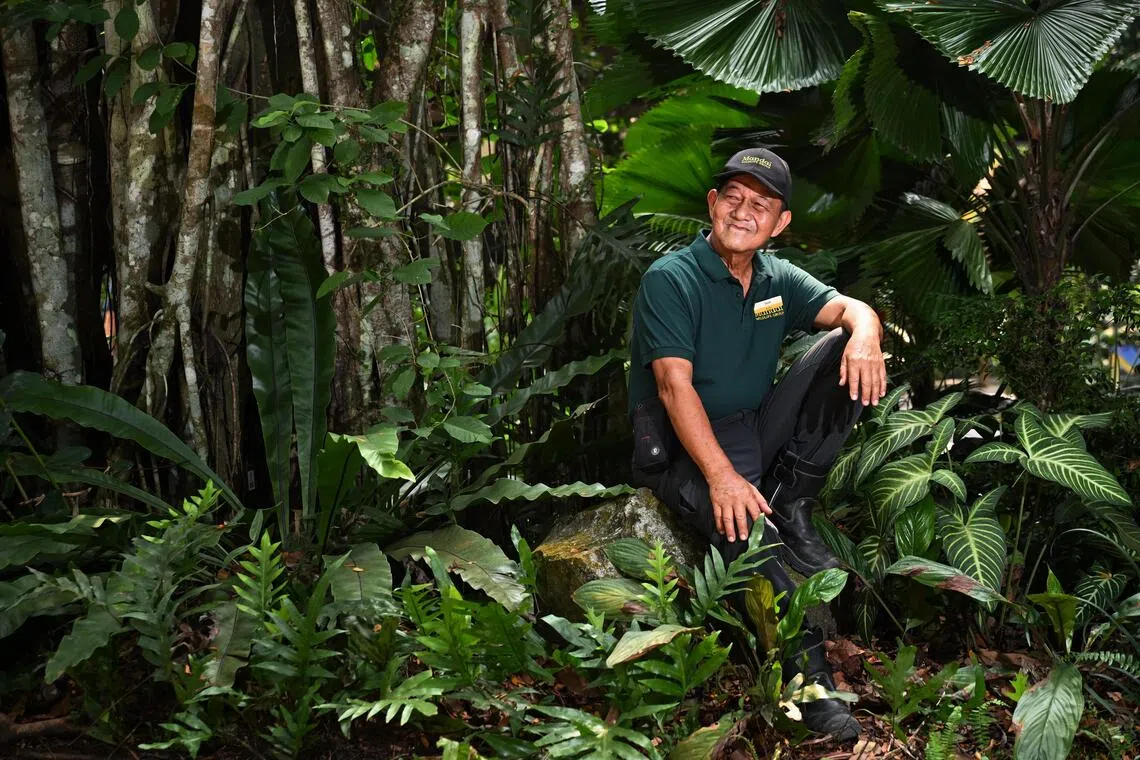
Mandai Wildlife Group assistant manager for horticulture Said Mohamed spent 44 years working with plants and has both their native and biological names at his green fingertips.
ST PHOTO: AZMI ATHNI
Published Oct 11, 2026, 05:00 AM
Updated Oct 11, 2026, 09:32 AM
- Said Mohamed has spent 44 years caring for Mandai Wildlife Reserve plants, including a 50m buah sentul tree he planted as a seedling.
- Singapore surveys show many seniors work past retirement for social ties, mental health, or money, while employment among those 65 and above has risen.
- Experts and workers say older staff bring experience and calm, so employers should offer flexible roles and keep their skills in use.
SINGAPORE – Said Mohamed’s life is deeply rooted in the Mandai Wildlife Reserve.
Not surprising, as he started working at the then Singapore Zoo at the age of 27 and spent the next 44 years proudly watching his “leafy children” stretch towards the sun, weather the elements and blossom into their full potential under his protective care.
One such “child” is the 50m-tall buah sentul , or cotton fruit tree, that sits at the entrance to the proboscis monkey exhibit at the wildlife reserve. He planted it as a seedling and nurtured it for the next 40 years.
“I also met and married my supervisor at the zoo,” said the 71-year-old , laughing.
Having spent almost a lifetime making sure the plants that now flourish in the five attractions at the wildlife reserve thrive, Said is not ready to give it all up and retire any time soon.
“Apart from having made good friends and a social network here to help keep me mentally alert, I also need to work to be able to support my son financially,” he said.
Said’s son, 37, has a disability and still attends a special school for adults. Said has also hired a domestic helper to manage his son’s daily needs.
While more than three in five seniors in Singapore continue punching the clock beyond their retirement age, citing social connection or mental stimulation as top reasons, a substantial proportion, like Said, work for financial reasons.
Even among Singapore’s high-income respondents, 48% said they needed additional income to cover daily living expenses and ensure long-term financial security.
These were the findings from a November 2025 survey conducted by Sun Life, an international financial services organisation, which looked at what it meant to age with confidence and the steps seniors were taking to make their vision of retirement a reality.
Called Retirement Reimagined: Asia’s Retirement Divide, the interviews were conducted online with a total of 3,006 people across Hong Kong, Indonesia, Malaysia, the Philippines, Singapore and Vietnam – with those from the island republic totalling 521.
A similar result turned up in a survey conducted around the same time , between September and October 2025, by the National Trades Union Congress (NTUC) with nearly 600 respondents across all age groups.
The NTUC study found that almost half, or 46%, of the respondents expressed a desire to work past the age of 70.
This willingness increased with age.
More than 66% of those aged 64 or above want to continue working past 70, compared with only 51% of those aged between 50 and 63.
The 50m-tall buah sentul, or cotton fruit tree, that Said Mohamed planted and nurtured from a seedling now towers over the entrance to the proboscis monkey exhibit at the wildlife reserve. ST PHOTO: AZMI ATHNI
The 50m-tall buah sentul, or cotton fruit tree, that Said Mohamed planted and nurtured from a seedling now towers over the entrance to the proboscis monkey exhibit at the wildlife reserve.
Since July 2026, Singapore’s statutory retirement age has moved from age 63 to 64, and the re-employment age has also gone up to 69 from 68.
For someone approaching retirement, this means another year of earnings, more time to save, or an opportunity to move into a less demanding role.
And according to the Ministry of Manpower’s Labour Force in Singapore Advance Release 2025 , between 2015 and 2025, the employment rate among workers aged 65 and above rose from 24.7% to 31.5%.
The NTUC survey found that maintaining mental and physical health by staying active was a top motivation, followed closely by the need for income to cover living expenses. These motivations are reflected in broader labour market data.
Based on the findings of the survey by his company, Sun Life Singapore chief executive Christopher Albrecht said: “What we are seeing is not a single retirement experience, but two very different realities. For those who are prepared, working longer can be a choice that offers flexibility and freedom. For others, it reflects financial pressure.
“Planning early, and planning holistically, is what determines which path people are on.”
Agreeing, Paulin Straughan, director of the Centre for Research on Successful Ageing at the Singapore Management University, said it is important to address the larger issue of senior engagement when it comes to those who have to work and those who wish to work.
Finding purpose in later-life work
Today’s older workers bring different expectations to the table.
Angelique Chan, the director of the Centre for Ageing Research & Education at Duke-NUS Medical School, said the whole discussion is about the fact that “60 is the new 40”.
“The current 65-year-olds, or even the 70-year-olds, are often healthier, better educated and more tech-savvy than the same cohort a generation ago. Our healthy life expectancy today is so high that we have actually pushed out the time in which we become disabled,” she said.
Straughan added: “Being a lot more educated, we want to remain socially relevant to apply our skills and play our part to make this world a better place.
“Living longer also makes many worry that retiring early may render us economically ill-prepared for retirement.
“Then there is also the fact that there are sometimes no grandchildren to play with or look after.”
That is why many people now view retirement less as a sudden, hard stop to working and more as a flexible transition that blends partial work, lifestyle and active mental engagement while allowing for ongoing personal growth and community .
Here, Chan said, the answer is to have employers adapt accordingly – flexible schedules, remote opportunities and part-time arrangements – to make it easier for experienced workers to contribute without burning out.
Agreeing, Straughan added: “Regardless of the triggers, employers must learn that if they want to do business in Singapore, they must restructure paid work and learn to purposefully and meaningfully engage older workers in their 50s to 70s.
“This means they have to recalibrate how they can design tasks that leverage older workers’ experiences and engage them on their own terms.”
Chan said: “What workers above 60 have is crystallised intelligence. This is a collection of facts, skills and information that they have accumulated over their lifetime through education and experience, and it is really something not to be discounted.
“You can’t teach it. It has to be lived. And if you start devaluing that, then you are going to have (young) workers who stay at a company for two years, three years, and they move on. Institutional memory becomes less and less, and with that, comes less and less loyalty to a company.”
This is perhaps why some companies prefer to retain staff beyond age 65 to preserve critical institutional knowledge, ease tight labour markets, and benefit from the strong performance and stability of mature workers.
Said’s critical experience in plant growing and care stood him in good stead when it came to passing on his knowledge to younger colleagues at the reserve.
Even Mandai Wildlife Group assistant vice-president for horticulture June Foo confidently told The Straits Times that Said was her mentor during the 20 years she had worked with him.
Like Said, Gleneagles Hospital assistant director of nursing Susan Kok, 70, saw her tenure extended beyond retirement age at the institution.
She has been working in the nursing profession since 1976, literally starting from the bottom.
“Old nurses never really go away,” Kok said, laughing.
Susan Kok (centre), assistant director of nursing at Gleneagles Hospital, continues working beyond retirement age as she enjoys passing on her healthcare knowledge to younger colleagues. ST PHOTO: JUDITH TAN
Susan Kok (centre), assistant director of nursing at Gleneagles Hospital, continues working beyond retirement age as she enjoys passing on her healthcare knowledge to younger colleagues.
ST PHOTO: JUDITH TAN
“Like how I was mentored by my older colleagues at the hospitals where I started, I now choose to stay to help groom the next generation of nurses by passing clinical knowledge and judgment, teaching them to overcome challenges and support planning and policies,” she said.
“Having worked 50 years in this field, managing patients and assisting the doctors, my life’s focus has remained here. Perhaps I would continue nursing as a volunteer in the community when I really retire.”
Pivoting to a new role
Unlike Kok, Phuah Gaik Kheng, 73, a former nurse manager at the Singapore General Hospital, left nursing but remained at the institution as one of its senior patient experience managers (SPEM).
“Being a nurse was my identity for 54 years. I first trained and worked in the UK for 11 years – in psychiatry, critical care and emergency medicine. Then I returned and carried on until I retired from SGH, where I was senior nurse manager in the emergency department (ED),” she said.
Former SGH nurse manager Phuah Gaik Kheng left the profession but remained at the institution as one of its senior patient experience managers. ST PHOTO: GIN TAY
Former SGH nurse manager Phuah Gaik Kheng left the profession but remained at the institution as one of its senior patient experience managers.
She became an SPEM in 2020 when she turned 67.
“I continued at ED, where emotions and tempers can run very high. It is also where staff are most at risk of facing abuse. As someone who has been on both sides, I can advocate for patients as well as for my healthcare colleagues,” Phuah said.
Phuah said her life experience helped especially when she was able to put herself in the shoes of others.
“Most of the time, the problem is simply from miscommunication, or a wrong choice of words. Even poor bedside manners, like spending more time on the screen than speaking to the patient, can set them off. Having been trained, I now help in changing mindsets at both ends,” she said.
Chan said pivoting to post-retirement usually meant switching to a completely new industry or launching a business. While it is increasingly common, recreating a career later in life introduces a unique set of “non-linear challenges”.
The older worker cannot be complacent.
Questions such as ‘Why do you want to do it?’ and ‘Can you do it?’ can hurt too.
Here, it is about people being able to learn and grow as they age, Chan said.
“However, ‘Can you do it?’ is more problematic. Here, the person would have to show the energy and enough education in the new area to be able to be convincing,” she said.
“In terms of meritocracy, it is not about how old you are, but whether you are passionate enough or if you have studied enough about the area and could think laterally. Then the odds are you will do well in the new position.”
Retention in the same profession has its issues as well, Chan said.
“The older nurse is revered for her experience and knowledge, but there also is the issue of keeping up with technology, with artificial intelligence. I have seen some instances where team members wonder why the older ones are not as savvy on social media.
“So, older people also have a responsibility to keep up. They do not have to be fantastic at it, but they need to keep up,” she said.
Sociologists often ask whether teams in the office should be made up of both older and young workers.
Chan said the answer is “yes”, as the seniors would bring to the table “institutional memory and crystallised intelligence”.
“Everyone in the team has different strengths. And if AI is important, we have younger people to take on that as their major load. Then the older person brings wisdom, calmness, experience and perhaps shortcuts – something that you cannot buy or teach,” she said.
Foo said Said still amazes his colleagues whenever they stroll through the reserve to make sure the shrubs and trees are doing fine.
“He would be telling us both the native and biological names of the plants and what they are good for as herbs to treat certain ailments.
“We would want to have Said around as long as we can keep him,” she said.
万代野生动物集团园艺助理经理赛义德·穆罕默德从事植物相关工作 44 年,对植物的本地名称和生物学名称都了如指掌。
ST 摄影:AZMI ATHNI
发布于2026年10月11日 上午5:00
更新于2026年10月11日上午9:32
- Said Mohamed 花了 44 年时间照料曼代野生动物保护区的植物,其中包括一棵他亲手栽种的 50 米高的榕树幼苗。
- 新加坡的调查显示,许多老年人为了维系社交关系、保持心理健康或赚钱,在退休后仍然继续工作,而65岁及以上人群的就业率有所上升。
专家和员工表示,年长的员工经验丰富、沉稳冷静,因此雇主应该提供灵活的工作岗位,让他们的技能得到充分利用。
新加坡——赛义德·穆罕默德的生活与万代野生动物保护区有着深厚的联系。
这不足为奇,因为他 27 岁就开始在当时的新加坡动物园工作,并在接下来的 44 年里,自豪地看着他的“绿叶孩子们”向着太阳伸展,经受住各种考验,并在他的精心呵护下充分发挥潜力。
其中一棵他亲手栽种的“孩子”是高达50米的棉花果树,它位于野生动物保护区长鼻猴展区的入口处。他当初把它种下,并在接下来的40年里精心照料。
“我还在动物园遇到了我的主管,并和他结婚了,”这位71岁的老人笑着说。
赛义德几乎毕生致力于确保野生动物保护区五个景点的植物茁壮成长,因此他并不打算放弃这一切,很快退休。
他说:“除了在这里结交了好朋友,建立了社交网络,帮助我保持头脑清醒之外,我还需要工作来养活我的儿子。”
赛义德37岁的儿子身患残疾,目前仍在成人特殊学校就读。赛义德还雇佣了一名家政人员来照顾儿子的日常生活。
虽然新加坡超过五分之三的老年人在退休年龄后仍然继续工作,并将社交联系或精神刺激作为主要原因,但像赛义德这样的相当一部分人是为了经济原因而工作。
即使在新加坡的高收入受访者中,也有 48% 的人表示他们需要额外的收入来支付日常生活开支并确保长期的财务安全。
这是国际金融服务机构 Sun Life 在 2025 年 11 月进行的一项调查的结果,该调查研究了自信老去意味着什么,以及老年人正在采取哪些措施来实现他们的退休愿景。
这项名为“重新构想退休:亚洲的退休鸿沟”的调查通过网络进行,共采访了来自香港、印度尼西亚、马来西亚、菲律宾、新加坡和越南的 3006 人,其中来自越南的受访者共 521 人。
全国职工总会(NTUC)在 2025 年 9 月至 10 月期间进行的一项调查也得出了类似的结果,该调查对各个年龄段的近 600 名受访者进行了调查。
全国职工总会(NTUC)的研究发现,近一半(46%)的受访者表示希望在70岁以后继续工作。
随着年龄增长,这种意愿也随之增强。
64 岁及以上人群中,超过 66% 的人希望在 70 岁以后继续工作,而 50 至 63 岁人群中只有 51% 的人有此意愿。
赛义德·穆罕默德亲手栽种并精心培育的这棵50米高的棉花树(Buah Sentul),如今巍峨耸立在野生动物保护区长鼻猴展区的入口处。(海峡时报照片:阿兹米·阿特尼)
赛义德·穆罕默德从幼苗开始种植和培育的 50 米高的布阿·森图尔(棉花果树)现在高耸于野生动物保护区长鼻猴展区的入口处。
自 2026 年 7 月起,新加坡的法定退休年龄已从 63 岁提高到 64 岁,再就业年龄也从 68 岁提高到 69 岁。
对于即将退休的人来说,这意味着可以再挣一年钱,有更多的时间储蓄,或者有机会转到一份工作压力较小的岗位。
根据新加坡人力部发布的《2025 年新加坡劳动力预告》,2015 年至 2025 年间,65 岁及以上工人的就业率从 24.7% 上升至 31.5%。
全国职工总会(NTUC)的调查发现,保持身心健康、积极运动是人们工作的首要动机,其次是需要收入来支付生活开支。这些动机也反映在更广泛的劳动力市场数据中。
根据其公司调查结果,永明金融新加坡首席执行官克里斯托弗·阿尔布雷希特表示:“我们看到的并非单一的退休体验,而是两种截然不同的现实。对于那些做好准备的人来说,延长工作年限可以带来灵活性和自由。而对于其他人来说,这则反映了经济压力。”
“及早规划,并进行全面规划,才能决定人们走上哪条道路。”
新加坡管理大学成功老龄化研究中心主任保林·斯特劳恩对此表示赞同,并指出,对于不得不工作的人和想要工作的人来说,解决老年人参与社会的更大问题至关重要。
在晚年工作中寻找意义
如今的老年员工对工作提出了不同的期望。
杜克-新加坡国立大学医学院老龄化研究与教育中心主任陈安琪表示,整个讨论的核心是“60岁是新的40岁”。
“如今65岁甚至70岁的人,往往比上一代同龄人更健康、受教育程度更高、更精通科技。我们今天的健康预期寿命如此之高,以至于我们实际上推迟了残疾发生的时间,”她说道。
斯特劳恩补充道:“我们受过更好的教育,希望保持社会相关性,运用我们的技能,为使这个世界变得更美好贡献一份力量。”
“寿命延长也让许多人担心,提前退休可能会使我们在经济上为退休做好准备。”
“此外,有时也没有孙辈可以一起玩耍或照顾。”
这就是为什么现在许多人不再把退休看作是突然、彻底停止工作,而更多地看作是一个灵活的过渡,它融合了部分工作、生活方式和积极的脑力活动,同时允许持续的个人成长和社区生活。
陈先生表示,解决之道在于让雇主做出相应的调整——灵活的工作时间、远程办公机会和兼职安排——以便让经验丰富的员工更容易做出贡献而不会精疲力竭。
斯特劳恩对此表示赞同,并补充道:“无论触发因素是什么,雇主必须明白,如果他们想在新加坡开展业务,就必须重组有偿工作,并学会有目的地、有意义地雇用 50 多岁到 70 多岁的年长员工。
“这意味着他们必须重新调整工作方式,以便设计出能够利用老年员工经验并让他们按照自己意愿参与的任务。”
陈先生说:“60岁以上的劳动者拥有的是晶体智力。这是他们一生中通过教育和经验积累的事实、技能和信息的集合,这真的不容小觑。”
“这种精神是教不来的,必须亲身经历。如果你开始贬低它,那么(年轻的)员工就会在一家公司待上两三年就离开。机构记忆会越来越少,随之而来的是员工对公司的忠诚度也会越来越低。”
这或许可以解释为什么一些公司更愿意留住 65 岁以上的员工,以保留关键的机构知识,缓解劳动力市场紧张的局面,并从成熟员工的出色表现和稳定性中受益。
赛义德在植物种植和养护方面积累的宝贵经验,使他能够很好地将知识传授给保护区里的年轻同事。
曼代野生动物集团园艺助理副总裁琼·福自信地告诉《海峡时报》,在她与赛义德共事的 20 年里,赛义德一直是她的导师。
正如赛义德所说,70岁的鹰阁医院护理部助理主任苏珊·科克在该机构的任期超过了退休年龄。
她从 1976 年起从事护理工作,可谓是从最底层做起。
“老护士们其实永远不会真正离开,”Kok笑着说。
郭素馨(中),鹰阁医院护理部助理主任,已过退休年龄但仍继续工作,她乐于将自己的医疗知识传授给年轻的同事。(海峡时报摄影:陈朱迪思)
郭素馨(中)是鹰阁医院的护理部助理主任,她已超过退休年龄,但仍继续工作,因为她乐于将自己的医疗保健知识传授给年轻的同事。
《海峡时报》照片:朱迪思·谭
“就像我当初在医院里受到资深同事的指导一样,我现在选择留下来帮助培养下一代护士,通过传授临床知识和判断力,教他们克服挑战,并支持规划和政策,”她说。
“我从事这个领域50年了,一直负责管理病人、协助医生,我的生活重心始终在这里。也许等我真正退休后,我会继续在社区做志愿者护士。”
转型担任新角色
与 Kok 不同,73 岁的 Phuah Gaik Kheng 曾是新加坡中央医院的护士长,他虽然离开了护理行业,但仍然留在该机构担任高级患者体验经理 (SPEM)。
“54年来,护士一直是我的身份认同。我最初在英国接受培训并工作了11年——从事精神科、重症监护和急诊医学方面的工作。之后我回到新加坡,继续从事护士工作,直到从新加坡中央医院退休,退休前我是急诊科的高级护士长,”她说。
前新加坡中央医院护士长傅桂庆(Phuah Gaik Kheng)已离开护理行业,但仍留在该院担任高级患者体验经理。海峡时报摄影:金泰(GIN TAY)
前新加坡中央医院护士长 Phuah Gaik Kheng 离开了护理行业,但仍然留在该机构担任高级患者体验经理之一。
她在2020年67岁时成为了一名SPEM(高级专业医疗人员)。
“我继续在急诊科工作,那里情绪波动很大,容易发脾气。同时,那里的工作人员也最容易遭受虐待。因为我曾经身处患者和医护人员的双重角色,所以我既能为患者发声,也能为我的医护同事们争取权益,”Phuah说道。
Phuah表示,她的人生经历对她很有帮助,尤其是在她能够设身处地为他人着想的时候。
“大多数时候,问题仅仅源于沟通不畅或用词不当。即使是糟糕的医患沟通技巧,比如花更多时间盯着屏幕而不是和病人交流,也会引发他们的不满。经过培训,我现在可以帮助医患双方转变观念,”她说道。
陈女士表示,退休后转型通常意味着进入一个全新的行业或创办自己的企业。虽然这种情况越来越普遍,但晚年重塑职业生涯会带来一系列独特的“非线性挑战”。
年长的员工不能掉以轻心。
诸如“你为什么要做这件事?”和“你能做到吗?”之类的问题也可能伤人。
陈说,这里指的是人们随着年龄增长能够学习和成长。
“然而,‘你能做到吗?’这个问题就更棘手了。在这种情况下,应聘者必须展现出足够的精力和对新领域的足够了解,才能令人信服,”她说道。
“就精英制度而言,重要的不是你的年龄,而是你是否足够热情,是否对该领域有足够的了解,以及是否具备横向思维能力。如果你具备这些素质,那么你在新职位上取得成功的几率就会更大。”
陈女士表示,同一行业的员工留任也存在问题。
“资深护士因其经验和知识而备受尊敬,但同时也存在跟上技术发展,尤其是人工智能发展的问题。我曾见过一些团队成员疑惑,为什么年长的护士不太擅长使用社交媒体。”
“所以,老年人也有责任跟上时代的步伐。他们不必做得非常出色,但他们需要跟上时代的步伐,”她说。
社会学家经常会问,办公室团队是否应该由年长的员工和年轻的员工组成。
陈表示答案是“是的”,因为资深人士会带来“机构记忆和晶体智力”。
“团队里的每个人都有不同的优势。如果人工智能很重要,我们会安排年轻人承担这项主要工作。然后,年长者会带来智慧、沉稳、经验,或许还有一些捷径——这些都是买不到也教不来的,”她说。
Foo 说,每当他和同事们一起漫步保护区,查看灌木和树木是否生长良好时,Said 仍然让他的同事们感到惊讶。
“他会告诉我们这些植物的原名和生物学名称,以及它们作为草药治疗某些疾病的功效。
“我们希望赛义德能一直留在我们身边,”她说。