URA flags “persistent trend” of suspected cases of unauthorised works in residential units市区重建局指出,住宅单元中疑似存在未经授权工程的案件呈“持续趋势”。
URA warns of persistent trend of suspected unauthorised works in strata residential units, with enforcement action possible. Read more at straitstimes.com.
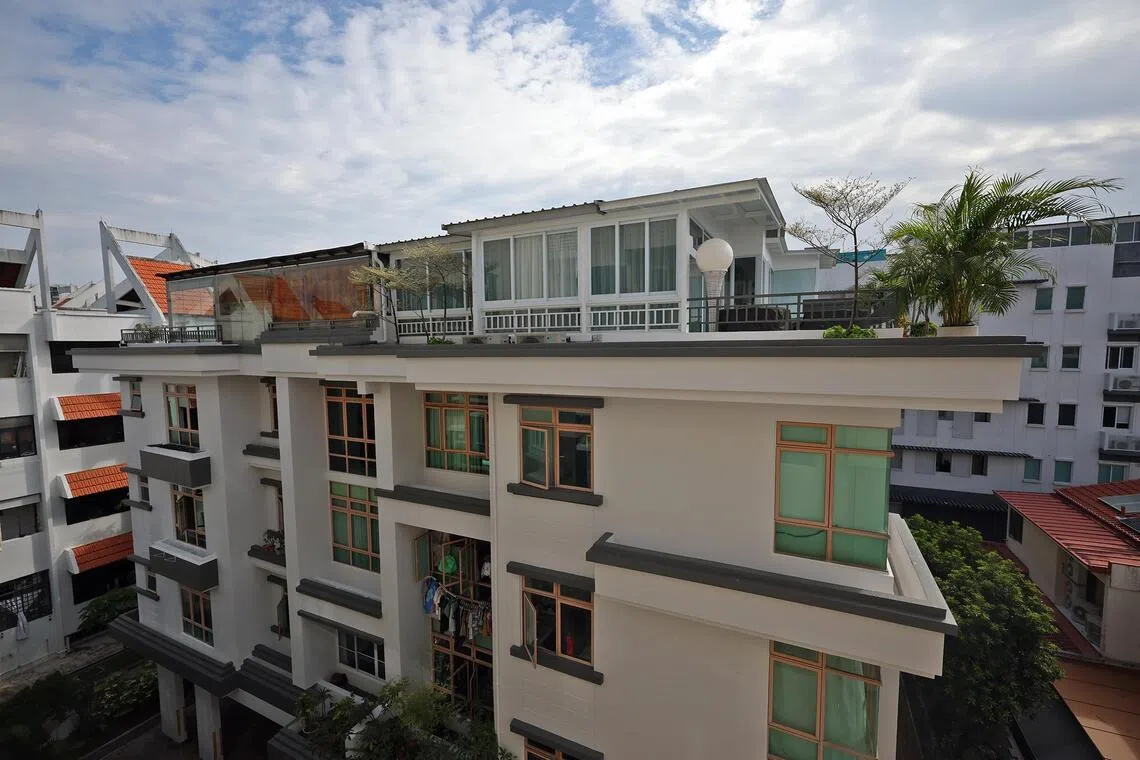
Enclosed structures on the private roof terrace of Rose Maison in Haig Lane pictured on Aug 29, 2024.
Published Oct 11, 2026, 01:00 PM
Updated Oct 11, 2026, 01:13 PM
- URA warned of a persistent trend suspected unauthorised works in strata-titled homes, with 147 reports in 2024, 148 in 2025 and 116 lodged in the first nine months of 2026.
- Such works may harm structural safety, insurance, financing and fairness among owners, said the authority.
- Owners must seek approvals from the MCST, agencies and a qualified person; failure to remove or regularise works can lead to fines of up to $200,000 and other penalties.
SINGAPORE – The Urban Redevelopment Authority (URA) has warned that enforcement action may be taken against those responsible for unauthorised works in strata-titled residential units, amid a “persistent trend” of suspected cases of such works being reported to the agency.
Examples of such works include the construction of lofts or mezzanines with an area of more than 5 sq m, or unauthorised enclosed structures on private roof terraces or private first-storey patios.
In a statement on Oct 11, the URA said it had received 147 reports of suspected cases of unauthorised works in 2024, and 148 in 2025.
In the first nine months of 2026, a further 116 suspected cases have been reported.
These reports are typically received from fellow residents of the estate or from its Management Corporation Strata Title (MCST), as well as from periodic structural inspections required for residential buildings, said URA.
It added that about 90 per cent of the suspected cases were found to have unauthorised works, and that enforcement action has been initiated against parties involved in “a number of cases”.
“We will continue to take action when we establish more cases of infringements. As investigations are ongoing, we are unable to share more details,” said a spokesperson for the agency, who added that most unauthorised works in strata-titled residential units have been removed following enforcement action without further court action.
“However, URA will not hesitate to prosecute offenders in court if they do not comply with the enforcement notices,” he said.
URA said unauthorised works in strata-titled developments could have implications in three areas: structural safety, insurance claims and property financing, and equity.
Mezzanine floors, for example, could add load onto a building’s slabs, beams and columns, which may not have been designed to support such weight.
“Without proper assessment by a qualified person, such works could compromise the building’s structural safety and potentially affect not only the occupants of the unit but also their neighbours,” URA said.
A qualified person could be a registered architect or professional engineer, who can advise homeowners on building codes, and if planned works are in accordance with safety regulations.
URA also said unauthorised works could affect insurance claims or result in property owners failing to meet the conditions attached to their property financing.
An AI-generated image showing an unauthorised loft that has an area of more than 5 sq m. PHOTO: URBAN REDEVELOPMENT AUTHORITY
An AI-generated image showing an unauthorised loft that has an area of more than 5 sq m.
PHOTO: URBAN REDEVELOPMENT AUTHORITY
A General Insurance Association of Singapore spokesperson said unauthorised structures may lead to out-of-pocket expenses as claims linked to or caused by unauthorised works or structural modifications may not be covered when loss or damage occurs.
Finally, unauthorised works that add floor area to a unit may raise equity concerns among owners of a strata development, it added.
“This is because estate maintenance fees and sinking fund contributions are typically calculated based on the unit’s share value which takes into account its floor area,” it said.
It said that when additional floor area is created without obtaining approvals, an owner “could enjoy additional space without a corresponding adjustment to the fees and contributions payable for the unit unlike their neighbours who abide by the rules”.
What to do before carrying out works
Before carrying out works, unit owners generally have to seek approvals or advice from three parties – the MCST, government agencies, and a qualified person.
For instance, works that increase the gross floor area of a strata unit require a 90 per cent resolution at the development’s annual general meeting.
“This is because the addition of floor area for the exclusive benefit of an individual owner has implications for the collective property rights of the other owners,” said URA.
Generally, any covered floor space counts towards gross floor area.
Before Jan 12, 2013, the URA did not consider private semi-outdoor areas and private roof terraces part of the gross floor area of a strata unit in flats and condominiums.
An AI-generated image showing an unauthorised enclosure of a patio that is intended to function as a semi-outdoor space. PHOTO: URBAN REDEVELOPMENT AUTHORITY
An AI-generated image showing an unauthorised enclosure of a patio that is intended to function as a semi-outdoor space.
However, by erecting enclosed structures in these spaces – which creates covered floor space – unit owners add floor area to their homes, in turn affecting collective property rights in a strata development.
Shelters over such spaces will not count towards gross floor area as long as they do not come with walls that enclose the space.
An AI-generated image showing a covered patio that does not flout regulations. PHOTO: URBAN REDEVELOPMENT AUTHORITY
An AI-generated image showing a covered patio that does not flout regulations.
The URA and/or Building and Construction Authority’s (BCA) approval may also be required for works.
What to do if unauthorised works have been carried out
URA said that property owners who have already carried out unauthorised works should remove the structures or obtain necessary approvals to retain them, if this is provided for under the law.
Should the works have added gross floor area, unit owners are to obtain 90 per cent resolution at their development’s annual general meeting before engaging a qualified person to submit an application to URA seeking permission to retain the works.
An AI-generated image showing an unauthorised enclosed structure on a private roof terrace. PHOTO: URBAN REDEVELOPMENT AUTHORITY
An AI-generated image showing an unauthorised enclosed structure on a private roof terrace.
If approved , said URA, the additional floor area may be subject to a land betterment charge if the development’s total gross floor area has exceeded its paid-up gross floor area.
“It is the responsibility of property owners to take steps to rectify or regularise unauthorised works, including in cases where the works were already in place when they purchased the property,” said the URA, which added that failure to do so may result in further enforcement action.
Under the Planning Act, which guides URA’s work, any person who is found guilty of carrying out, or permitting the works to build unauthorised structures without planning permission, may be fined up to $200,000.
Under the Building Control Act, any person who is found guilty of commencing, carrying out, or permitting any building work without obtaining planning approval or a permit to commence structural works may be fined $200,000, jailed up to two years, or both.
Periodic structural inspections for all residential buildings – a process that comes under the BCA – are carried out every 10 years, and that unauthorised works uncovered during these inspections are referred to relevant agencies for further action.
A BCA spokesperson said the agency investigated an average of about 50 reported cases of unauthorised structures annually in strata-titled residential developments over the past three years, and most were assessed to be structurally safe.
“Structures that are considered unsafe generally lack adequate support or anchoring, or impose loads exceeding the capacity designed for existing floor structure,” she said.
The URA added that agencies will engage MCSTs and managing agents to raise awareness of the requirements and potential implications of unauthorised works, so that property owners can make informed decisions before carrying out such works.
2024 年 8 月 29 日拍摄的位于海格巷玫瑰庄园私人屋顶露台上的封闭式建筑。
发布于2026年10月11日下午1点
更新于2026年10月11日下午1:13
- 市区重建局警告称,分层地契房屋中疑似未经授权的工程持续出现,2024 年收到 147 起报告,2025 年收到 148 起报告,2026 年前九个月收到 116 起报告。
该机构表示,此类工程可能会损害结构安全、保险、融资以及业主之间的公平性。
- 业主必须向市政委员会、相关机构和合格人员申请批准;未能拆除或规范工程可能会导致最高 20 万美元的罚款和其他处罚。
新加坡——市区重建局 (URA) 警告称,鉴于近期不断有疑似分层地契住宅单元内未经授权工程的案件被举报,该机构可能会对相关责任人采取执法行动。
此类工程的例子包括建造面积超过 5 平方米的阁楼或夹层,或在私人屋顶露台或私人一楼庭院上建造未经授权的封闭式结构。
市区重建局在 10 月 11 日的一份声明中表示,2024 年共收到 147 起疑似未经授权工程的案件报告,2025 年共收到 148 起。
2026 年前九个月,又报告了 116 例疑似病例。
市区重建局表示,这些报告通常来自该住宅区的其他居民或其管理公司地契(MCST),以及住宅建筑所需的定期结构检查。
报告还指出,约 90% 的疑似案件被发现存在未经授权的工程,并且已经对“多起案件”的涉案人员采取了执法行动。
该机构发言人表示:“一旦发现更多违规案件,我们将继续采取行动。由于调查仍在进行中,我们无法透露更多细节。”他还补充说,大多数分层产权住宅单元内的违章工程已在执法行动后被拆除,无需进一步的法庭诉讼。
“但是,如果违法者不遵守强制执行通知,市区重建局将毫不犹豫地在法庭上对其提起诉讼,”他说。
市区重建局表示,分层地契开发项目中的未经授权的工程可能会对三个方面产生影响:结构安全、保险索赔和房地产融资以及股权。
例如,夹层可能会给建筑物的楼板、梁和柱子增加荷载,而这些结构可能并非设计用来承受如此大的重量。
市区重建局表示:“如果没有合格人员进行适当评估,此类工程可能会损害建筑物的结构安全,不仅会影响单元内的住户,还可能影响他们的邻居。”
合格的人员可以是注册建筑师或专业工程师,他们可以就建筑规范向业主提供建议,并确认计划的工程是否符合安全规定。
市区重建局还表示,未经授权的工程可能会影响保险索赔,或导致业主无法满足其房产融资所附带的条件。
一张人工智能生成的图像显示了一个面积超过5平方米的违章阁楼。图片来源:市区重建局
一张人工智能生成的图像显示了一个未经授权的阁楼,面积超过 5 平方米。
照片:市区重建局
新加坡普通保险协会发言人表示,未经授权的建筑物可能会导致自掏腰包,因为与未经授权的工程或结构改造相关的索赔,在发生损失或损害时可能不在承保范围内。
最后,报告还指出,未经授权增加单元建筑面积的工程可能会引起分层地契开发项目业主之间的公平性担忧。
“这是因为物业维护费和维修基金缴款通常是根据单元的股份价值计算的,而股份价值又考虑了单元的建筑面积,”声明中写道。
报告称,未经批准擅自增加建筑面积,业主“可以享受额外的空间,而无需像遵守规定的邻居那样,支付相应的费用和贡献”。
施工前需要做什么
在进行工程之前,业主通常需要向三方寻求批准或建议——MCST、政府机构和合格人员。
例如,增加分契式产权单元总建筑面积的工程需要在开发项目的年度股东大会上获得 90% 的赞成票才能通过。
“这是因为为个别业主专属增加的建筑面积会对其他业主的集体财产权产生影响,”市区重建局表示。
一般而言,任何有遮盖的地面面积都计入总建筑面积。
2013 年 1 月 12 日之前,市区重建局 (URA) 不将私人半户外区域和私人屋顶露台计入公寓和产权公寓分层单元的总建筑面积。
一张人工智能生成的图像显示,一处原本用作半户外空间的露台被未经许可封闭。图片:市区重建局
一张人工智能生成的图像显示,一个原本打算作为半户外空间的露台被未经授权地封闭起来。
然而,通过在这些空间中建造封闭结构(从而创造有顶楼面空间),单元业主增加了房屋的建筑面积,进而影响了分层开发中的集体产权。
只要此类空间上方的遮蔽物没有围合空间的墙壁,则此类遮蔽物不计入总建筑面积。
一张人工智能生成的图像,显示了一个符合规定的有顶露台。图片:市区重建局
一张由人工智能生成的图像,显示了一个符合规定的有顶露台。
工程可能还需要市区重建局 (URA) 和/或建设局 (BCA) 的批准。
如果发生了未经授权的施工,该怎么办?
市区重建局表示,已经进行未经授权工程的业主应该拆除这些建筑物,或者如果法律允许,则应获得必要的批准以保留这些建筑物。
如果工程增加了建筑面积,则业主必须在其所在开发项目的年度股东大会上获得 90% 的决议,然后才能聘请合格人士向市区重建局提交申请,以获得保留工程的许可。
一张人工智能生成的图像显示,私人屋顶露台上存在未经许可的封闭式建筑。图片来源:市区重建局
一张人工智能生成的图像显示,私人屋顶露台上有一个未经授权的封闭式建筑。
市区重建局表示,如果获得批准,且开发项目的总建筑面积超过其已缴建筑面积,则新增的建筑面积可能需要缴纳土地改良费。
市区重建局表示:“业主有责任采取措施纠正或规范未经授权的工程,包括购买房产时工程已经存在的情况。”该局还补充说,如果业主不这样做,可能会受到进一步的执法行动。
根据指导市区重建局工作的《规划法》,任何被发现犯有建造或允许建造未经规划许可的违章建筑工程的人,最高可被罚款 20 万美元。
根据《建筑管制法》,任何人未经规划批准或结构工程开工许可证而开始、进行或允许任何建筑工程,均可被处以 20 万美元罚款、最高两年监禁,或两者并罚。
所有住宅建筑均需定期进行结构检查(这是建筑规范 (BCA) 下的一个程序),每 10 年进行一次,并且在这些检查中发现的未经授权的工程将移交给相关机构采取进一步行动。
建设局发言人表示,过去三年,该机构平均每年调查约 50 起分层产权住宅开发项目中未经授权的建筑物报告案件,其中大多数经评估结构安全。
她表示:“通常情况下,被认为不安全的结构缺乏足够的支撑或锚固,或者施加的荷载超过了现有楼板结构的设计承载能力。”
市区重建局补充说,各机构将与市政委员会和管理代理合作,提高人们对未经授权工程的要求和潜在后果的认识,以便业主在进行此类工程之前能够做出明智的决定。