Parked, but no space to open the door: How today's bigger cars are outgrowing older parking spaces车停好了,却没地方开门:如今的大型汽车是如何超出老式停车位的
With the average vehicle size growing over the years, motorists are having a tough time navigating tight lots and ramps at some older car parks.
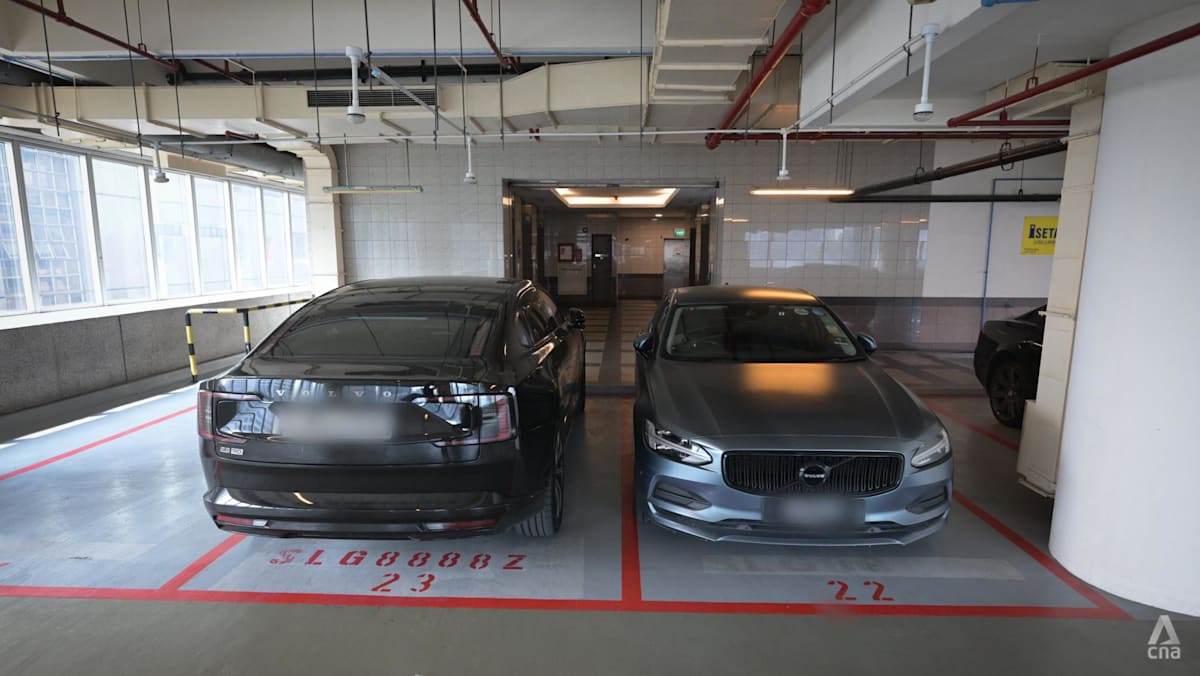
With the average vehicle size growing over the years, motorists are having a tough time navigating tight lots and ramps at some older car parks.
A car parked beyond its parking lot marking because of the tight spaces at Shaw House car park on Oct 6, 2026, meaning the neighbouring lot cannot be used. (Photo: CNA/Syamil Sapari)
This audio is generated by an AI tool.
To an uninitiated driver looking for a car park lot in Orchard Road during peak hours, Shaw House along Scotts Road might seem like a good bet.
There is usually no shortage of parking with several left lots empty even though they are close to the lifts.
But drive up to those lots, and one can see why they are still empty – they are too narrow for larger modern cars to fit into.
Shaw House, like a number of older buildings, is notorious for having tight car park spaces.
CNA Games Guess Word Crack the word, one row at a time Buzzword Create words using the given letters Mini Sudoku Tiny puzzle, mighty brain teaser Mini Crossword Small grid, big challenge Word Search Spot as many words as you can Show More Show Less The car park is made up primarily of blocks of three lots, hemmed in by two walls on either side. But once two cars are parked in one of these blocks, it is virtually impossible for the third remaining lot to be used. Even if a third vehicle does manage to squeeze into the space, it is unlikely that the driver or passengers would be able to open the car doors. Mr Nevin Ho, who visits Shaw House to watch movies or go to a nearby 24-hour gym, is all too familiar with this situation. The content creator said friends or family members driving him there typically give empty parking spaces on the lower floors a miss and head straight to the upper floors, where they know there are fewer cars already parked. Even then, Mr Ho and other passengers may have to alight before the car is parked. "If you own a big car, and you park in the middle lot, no one else can park in the lots on either side. Or even if you can park, the driver may not be able to come out. "Maybe they must crawl out from the top," he said with a laugh. An online search of discussion forums found drivers complaining about a number of car parks aside from the one at Shaw House, including People's Park Complex, Burlington Square and OCBC Centre, with drivers unhappy not only over narrow lots but also tight corners and ramps.
The car park is made up primarily of blocks of three lots, hemmed in by two walls on either side. But once two cars are parked in one of these blocks, it is virtually impossible for the third remaining lot to be used.
Even if a third vehicle does manage to squeeze into the space, it is unlikely that the driver or passengers would be able to open the car doors.
Mr Nevin Ho, who visits Shaw House to watch movies or go to a nearby 24-hour gym, is all too familiar with this situation.
The content creator said friends or family members driving him there typically give empty parking spaces on the lower floors a miss and head straight to the upper floors, where they know there are fewer cars already parked.
Even then, Mr Ho and other passengers may have to alight before the car is parked.
"If you own a big car, and you park in the middle lot, no one else can park in the lots on either side. Or even if you can park, the driver may not be able to come out.
"Maybe they must crawl out from the top," he said with a laugh.
An online search of discussion forums found drivers complaining about a number of car parks aside from the one at Shaw House, including People's Park Complex, Burlington Square and OCBC Centre, with drivers unhappy not only over narrow lots but also tight corners and ramps.
A car parked beyond its parking lot marking because of the tight spaces at Shaw House car park on Oct 6, 2026. (Photo: CNA/Syamil Sapari)
CARS GOT BETTER BUT ALSO BIGGER
The car parks drawing the most complaints were built decades ago. And while most of Singapore's car park infrastructure has remained largely unchanged, the cars navigating them have been slowly growing in size, creating an increasingly awkward fit.
And it's not just luxury car owners who are facing this issue.
In Singapore, the width of the top-selling car model in 2015, the Toyota Corolla Altis, was 1,780mm. Last year, the top-selling model was the BYD Sealion 7, which is 1,925mm wide.
Brussels-based Transport & Environment (T&E), an independent non-profit organisation that campaigns for cleaner transport in Europe found last year that the average dimensions of new cars sold in Europe, some of which are sold here, have continued to increase.
It reported that the average length of new cars has been increasing by about 1.2cm a year, while their height has risen by around 0.5cm annually. In 2024, it reported that the average width of new cars was increasing by about 0.5cm a year.
New cars in Singapore, as in other parts of the world, have slowly become larger in recent years. (Photo: CNA/Syamil Sapari)
Under current standards, a regular car parking lot in Singapore must be at least 2.4m wide and 4.8m long.
When a lot is next to a wall or column, an additional 300mm of clearance is required to provide enough room for car doors to open comfortably, the Land Transport Authority (LTA) told CNA.
However, the latest requirements, revised in January 2024, apply only to new private developments and redevelopment proposals, and are not retrospectively applied to existing developments built to earlier standards.
The LTA could not provide information on previous dimension requirements for regular car park lots.
NAVIGATING TIGHT LOTS AND RAMPS
CNA visited three car parks which are infamous among drivers for having tight lots and narrow ramps.
At Shaw House, which was built in 1958, CNA found some parking spaces that were less than 2.3m wide while others just eked out 2.4m, if measured to the outer end of the boundary markings.
Many also did not have the 300mm clearance next to a wall or column that would be required in a new or redeveloped car park.
Another driver, who wanted to be known only as Mr Chong, described the car park as "very challenging", saying the spaces were narrow even for his sedan.
"It is also difficult to enter or exit the car (after parking)," he said.
Over at Beauty World Centre at Upper Bukit Timah, the narrow lots are primarily caused by pillars eating into lot space. The parking situation has resulted in some shoppers avoiding the basement car park altogether.
Ms Wai Mun Yong, 38, a finance professional who visits the shopping centre a few times a week because her son attends enrichment classes there, has taken to walking to the mall from her nearby home instead of driving.
"This is one of the worst car parks I have to go to. It's just very cramped.
"If I parked in a lot with the pillars surrounding the car, I can't even open the driver's side door," she said, describing her Tesla Model Y as being slightly "bulky".
A vehicle parked at the car park at Beauty World Centre on Oct 6, 2026. (Photo: CNA/Mak Jia Kee)
A general view of the car park at Beauty World Centre on Oct 6, 2026. (Photo: CNA/Mak Jia Kee)
The front of a vehicle extending beyond a lot's markings at the Beauty World Centre car park on Oct 6, 2026. (Photo: CNA/Mak Jia Kee)
On occasions when she does drive, the difficulty does not always end once she has managed to park. To get enough room to buckle her children into the car, she sometimes drives down to an open space on the first floor before picking up her children.
"I just want the space big enough to open the door," she said.
Another regular visitor, Ms Karen Hsu, makes a similar calculation when she drives her Bentley to Beauty World Centre once or twice a week to buy groceries.
If she cannot find a suitable space, the housewife said that she has to either go to a higher level, or park at other car parks near the shopping centre.
"I mean, this is an old car park, so the lots are smaller, so I can't blame them," said the 50-year-old. "But cars are getting bigger, so it's a struggle for more and more car owners to park here."
I mean, this is an old car park, so the lots are smaller, so I can't blame them. But cars are getting bigger, so it's a struggle for more and more car owners to park here.
CNA found that the widths of parking spaces at Beauty World varied. Two lots nestled between pillars measured about 2.4m wide each, but there were also lots that were 2.5m wide and some 2.8m.
Over at Pandan Valley, a condominium built in 1977, motorists face not only narrow lots but also tight ramps and turns between the levels of its four multi-storey car parks.
Mr Alvin Lam, 34, encountered this on his first visit to the development, when he was there with a colleague for work.
As he turned up a ramp to the second storey, he heard what he described as "the most ear-piercing screech any driver could hear".
His car had struck a knee-high structure protruding from a pillar, which he said he had not noticed or expected.
The impact damaged his side fender and headlight cover and bent an iron bracket of his side fender. He had the car repaired over three days in Johor Bahru, Malaysia for RM3,000 (S$941).
For residents who use the car park regularly, navigating these tight spaces has become something of a science.
Ms Jeannie Loo, 39, typically takes two manoeuvres to negotiate one of the ramps safely. After successfully making the turn in one go several times, she had become complacent on one occasion and ended up scratching and denting her car.
The financial consultant paid about S$400 (US$312) to repair the dent and paint her car.
Ms Loo still uses the multi-storey car park, but said she now drives slowly and takes more time to manoeuvre her way through the ramps. The open-air car park is an alternative, but one she would rather avoid.
"It comes with bird poop, leaves and twigs ... The hot sun is really what I want to avoid."
Other residents are less willing to take their chances on the ramps, she said. Some who fail to find a space on a lower level would reverse out and park in the open-air area instead of continuing upwards.
Making the lots larger may not provide a straightforward solution either.
Ms Loo said repainting them to create wider spaces would mean having fewer lots on each level, potentially forcing more motorists to travel higher up the multi-storey car park – and negotiate more of the ramps they already find difficult.
At Pandan Valley, which has four multi-storey car parks, CNA found narrow ramps and tight turns between levels. One ramp measured about 2.8m across, with visible scrape marks on the pillars beside it. There were also similar marks found on the pillars at other ramps.
Under LTA requirements, the minimum clear width for a single-lane ramp or accessway for cars is 3.6m on a straight section and 4.2m on a curve.
When contacted by CNA, Pandan Valley's estate management team said it had not received any feedback about the car park since it took over five months ago.
Katong Shopping Centre car park lots have been redrawn to make them bigger. (Photo: CNA/Raj Nadarajan)
Some older developments have sought to create more room for motorists by reconfiguring their parking spaces.
Katong Shopping Centre, which was built in 1971 , has redrawn some of its parking lots and turned spaces with three lots side-by-side into spaces that accommodate only two cars now.
When CNA visited the building, it found the original markings remained faintly visible alongside the newer ones.
CNA contacted Katong Shopping Centre seeking to ask when and why the lots were redrawn, how their dimensions had changed and whether the move reduced the overall number of parking spaces, but calls to the management went unanswered.
Similar changes have also been made to the parking layout at Orchard Rendezvous Hotel.
The hotel, however, said it did not have the historical information needed to establish exactly what changes had been made, including the dimensions of the lots before and after. It declined to comment further, saying it did not want to provide information that could be incomplete or inaccurate.
Beyond changes made by individual developments, LTA said it regularly reviews its standards for parking layouts.
These reviews include design simulations that take into account vehicle dimensions and manoeuvring requirements, as well as the space needed for drivers and passengers to get in and out of their vehicles.
For Ms Loo, who has learnt to take her time navigating the Pandan Valley car park after damaging her car there, motorists also have a responsibility to be careful.
"Can it be avoided? Absolutely," she said. "But I think a functional car park should not cause so much stress and anxiety for anyone."
Additional reporting by Amanda Yeap and Loraine Lee.
Get our pick of top stories and thought-provoking articles in your inbox
Stay updated with notifications for breaking news and our best stories
Join our channel for the top reads for the day on your preferred chat app
随着车辆平均尺寸逐年增大,驾驶者在一些老旧停车场狭窄的停车位和坡道上行驶时遇到了困难。
2026年10月6日,由于邵氏大厦停车场空间狭窄,一辆汽车停在了划线外,导致相邻的停车位无法使用。(图片:CNA/Syamil Sapari)
这段音频由人工智能工具生成。
对于高峰时段在乌节路寻找停车场的新手司机来说,位于史各士路的邵氏大厦似乎是一个不错的选择。
通常情况下,停车位并不短缺,即使靠近电梯,也还有好几个空位。
但是,开车到那些停车场,你就会明白为什么它们仍然空着——它们太窄了,大型现代汽车停不进去。
肖氏大厦和许多老建筑一样,因停车位紧张而臭名昭著。
CNA游戏 猜词游戏 逐行破解单词 流行词游戏 用给定的字母组成单词 迷你数独 小谜题,大脑筋急转弯 迷你填字游戏 小方格,大挑战 单词搜索 尽可能多地找出单词 显示更多 显示更少 停车场主要由三个车位组成的区域构成,两侧各有一面墙。但一旦其中一个区域停了两辆车,剩下的第三个车位几乎就无法使用了。即使第三辆车设法挤了进去,司机或乘客也很难打开车门。经常去邵氏大厦看电影或去附近24小时健身房的何先生对这种情况非常熟悉。这位内容创作者说,朋友或家人开车送他去那里时,通常会放弃低层的空车位,直接开到楼上,因为他们知道楼上停的车比较少。即便如此,何先生和其他乘客可能还是得在车停好之前下车。 “如果你开的是辆大车,停在中间的停车场,两边的车位就没法停了。就算能停进去,司机可能也出不来。”他笑着说,“说不定他们得从车顶爬出来呢。”网上论坛的讨论显示,除了邵氏大厦的停车场,还有很多其他停车场也存在类似的问题,例如珍珠坊、伯灵顿广场和华侨银行中心。司机们不仅对狭窄的停车位不满,也对急转弯和坡道感到不满。
停车场主要由三个车位组成的街区构成,两侧各有一面墙。但一旦其中一个街区停了两辆车,剩下的第三个车位几乎就无法使用了。
即使第三辆车设法挤进这个空间,驾驶员或乘客也不太可能打开车门。
经常去邵氏大厦看电影或去附近24小时健身房的何先生对这种情况非常熟悉。
这位内容创作者表示,朋友或家人开车送他去那里时,通常会放弃低楼层的空停车位,直接前往高层,因为他们知道那里停的车比较少。
即使如此,何先生和其他乘客可能也需要在汽车停好之前下车。
“如果你开的是辆大车,停在中间的停车场,那么两侧的停车场就没法停车了。就算你能停进去,司机也可能无法出来。”
“也许它们必须从上面爬出来,”他笑着说。
通过在线搜索论坛发现,除了邵氏大厦停车场外,还有许多司机抱怨其他停车场,包括珍珠坊、伯灵顿广场和华侨银行中心,司机们不仅对狭窄的停车位感到不满,还对狭窄的拐角和坡道感到不满。
2026年10月6日,由于邵氏大厦停车场空间狭窄,一辆汽车停在了划线外。(图片:CNA/Syamil Sapari)
汽车变得更好了,但也更大了。
投诉最多的停车场建于几十年前。虽然新加坡大部分停车场的基础设施基本保持不变,但停放在其中的车辆尺寸却在缓慢增大,导致停车场与车辆的匹配度越来越低。
面临这个问题的不仅仅是豪车车主。
在新加坡,2015年最畅销的车型丰田卡罗拉Altis的宽度为1780毫米。去年最畅销的车型是比亚迪Sealion 7,其宽度为1925毫米。
总部位于布鲁塞尔的交通与环境组织 (T&E) 是一家独立的非营利组织,致力于在欧洲推广更清洁的交通方式。该组织去年发现,在欧洲销售的新车(其中一些也在英国销售)的平均尺寸持续增大。
报告指出,新车的平均长度每年增加约1.2厘米,高度每年增加约0.5厘米。报告还预测,到2024年,新车的平均宽度将以每年约0.5厘米的速度增长。
与世界其他地区一样,新加坡的新车近年来也逐渐变得更大。(图片:CNA/Syamil Sapari)
根据现行标准,新加坡的普通停车场宽度至少为 2.4 米,长度至少为 4.8 米。
陆路交通管理局 (LTA) 告诉 CNA,当停车场靠近墙壁或柱子时,需要额外 300 毫米的净空,以便为汽车车门提供足够的空间舒适地打开。
然而,2024 年 1 月修订的最新要求仅适用于新的私人开发项目和重建提案,并不追溯适用于按照早期标准建造的现有开发项目。
陆路交通管理局无法提供有关以往普通停车场车位尺寸要求的信息。
在狭窄的停车场和坡道上行驶
CNA 走访了三个因车位狭窄、坡道窄而臭名昭著的停车场。
在建于 1958 年的邵氏大厦,CNA 发现一些停车位宽度不足 2.3 米,而另一些停车位如果测量到边界标记的外端,宽度也只有 2.4 米。
许多停车场也没有足够的空间在新建或改建的停车场中所需的靠近墙壁或柱子的 300 毫米净空。
另一位只愿透露姓氏为 Chong 的司机形容停车场“非常具有挑战性”,并表示即使对于他的轿车来说,停车位也很狭窄。
“停车后上下车也很困难,”他说。
在武吉知马路上段的美世界中心,停车位狭窄主要是由于立柱侵占了车位空间造成的。停车状况导致一些购物者干脆放弃使用地下停车场。
38岁的金融从业人员魏文勇女士每周都会去购物中心几次,因为她的儿子在那里参加课外辅导班。她现在习惯从附近的家步行去商场,而不是开车。
“这是我去过的最糟糕的停车场之一。它太拥挤了。”
“如果我把车停在有柱子环绕的停车场里,我甚至都打不开驾驶员侧的车门,”她说道,并形容她的特斯拉 Model Y 有点“笨重”。
2026年10月6日,一辆汽车停在美世界中心停车场。(图片:CNA/麦嘉琪)
2026年10月6日,美世界中心停车场全景。(图片:CNA/麦嘉琪)
2026年10月6日,在美世界中心停车场,一辆车的车头超出了停车位的标线。(图片:CNA/麦嘉琪)
她偶尔开车时,停车之后困难也并非就此结束。为了腾出足够的空间给孩子们系安全带,她有时会先把车开到一楼的空地上,然后再去接孩子。
“我只想要一个足够大的空间,可以打开门,”她说。
另一位常客许嘉琳女士每周都会开着她的宾利车去美世界中心一两次买菜,她也会做类似的计算。
这位家庭主妇说,如果找不到合适的停车位,她要么得去楼上停车,要么就得停在购物中心附近的其它停车场。
“我的意思是,这是一个老停车场,所以停车位比较小,我不能责怪他们,”这位50岁的男子说道。“但是汽车越来越大,所以越来越多的车主在这里停车变得很困难。”
我的意思是,这是一个老停车场,车位比较小,所以我也不能怪他们。但是汽车越来越大,越来越多的车主在这里停车变得很困难。
中央社发现,美世界停车场的停车位宽度不一。有两个位于柱子之间的停车位,宽度约为2.4米,但也有一些停车位宽2.5米,还有一些宽2.8米。
在建于 1977 年的 Pandan Valley 公寓,驾车者不仅要面对狭窄的停车位,还要面对其四座多层停车场的狭窄坡道和楼层之间的转弯。
34岁的林先生第一次到访该开发项目时就遇到了这种情况,当时他和一位同事因工作需要到那里。
当他沿着坡道驶向二楼时,他听到了一声他形容为“任何司机都能听到的最刺耳的尖叫声”。
他的车撞上了一个从柱子上伸出的齐膝高的物体,他说他没有注意到也没有预料到。
撞击导致他的侧挡泥板和前大灯罩受损,侧挡泥板上的一个铁支架也弯曲了。他在马来西亚柔佛州新山花了三天时间修好了车,花费了3000令吉(约合941新元)。
对于经常使用停车场的居民来说,如何在这些狭窄的空间里穿梭已经成为一门学问。
39岁的Jeannie Loo女士通常需要两次转弯才能安全地驶过其中一个坡道。在几次成功一次性转弯后,她有一次变得松懈,结果刮蹭并撞凹了她的车。
这位财务顾问花了大约 400 新元(312 美元)来修理汽车上的凹痕并重新喷漆。
卢女士仍然使用多层停车场,但她说现在她开车速度慢了下来,需要更多时间才能顺利通过坡道。露天停车场也是一个选择,但她宁愿避免使用。
“上面会有鸟粪、树叶和树枝……我最想避免的就是烈日暴晒。”
她说,其他居民则不太愿意冒险在坡道上停车。一些在较低楼层找不到停车位的人,会倒车出来停在露天区域,而不是继续向上行驶。
扩大地块面积也未必能提供简单的解决方案。
卢女士表示,重新粉刷这些停车场以创造更宽敞的空间意味着每层的停车位数量会减少,这可能会迫使更多驾车者前往多层停车场的更高层,并克服他们已经觉得困难的更多坡道。
在拥有四座多层停车场的潘丹谷,CNA发现坡道狭窄,楼层之间转弯也很急。其中一条坡道宽约2.8米,旁边的柱子上有明显的刮擦痕迹。其他坡道的柱子上也发现了类似的痕迹。
根据陆路交通管理局的规定,单车道坡道或车辆通道的最小净宽,直线段为 3.6 米,曲线段为 4.2 米。
CNA联系潘丹谷物业管理团队后,该团队表示,自五个月前接管停车场以来,尚未收到任何关于该停车场的反馈。
加东购物中心停车场已重新规划,扩大了停车位面积。(图片:CNA/Raj Nadarajan)
一些较早开发的住宅区通过重新配置停车位,试图为驾车者创造更多空间。
建于 1971 年的加东购物中心重新规划了一些停车场,将原本三个车位并排的停车位改为现在只能容纳两辆车的停车位。
中央社记者到访该建筑时发现,原有的标记与新的标记一起仍然隐约可见。
CNA联系了加东购物中心,询问何时以及为何重新划分停车位,停车位的尺寸发生了哪些变化,以及此举是否减少了停车位的总数,但致电管理层均无人接听。
乌节路酒店的停车场布局也进行了类似的改动。
然而,酒店方面表示,他们没有所需的历史资料来确定究竟进行了哪些改动,包括地块改动前后的尺寸。酒店拒绝进一步置评,称不想提供可能不完整或不准确的信息。
除了个别开发项目做出的改变外,陆路交通管理局表示,它会定期审查其停车场布局标准。
这些审查包括设计模拟,其中考虑了车辆尺寸和操纵要求,以及驾驶员和乘客上下车所需的空间。
对于卢女士来说,她在潘丹谷停车场损坏了自己的汽车后,学会了放慢速度,谨慎驾驶。她认为,驾车者也有责任小心谨慎。
“这种情况可以避免吗?当然可以,”她说。“但我认为,一个功能齐全的停车场不应该给任何人带来如此大的压力和焦虑。”
Amanda Yeap 和 Loraine Lee 也参与了报道。
订阅我们的邮件,即可获取精选热点新闻和引人深思的文章。
订阅通知,第一时间获取突发新闻和精彩报道。
加入我们的频道,即可在您常用的聊天应用上获取当日热门文章。