Sheng Siong shares fall 3% after Maybank downgrade, target price cut受马来亚银行下调评级和目标价影响,昇菘集团股价下跌3%。
Sheng Siong shares fall after Maybank downgrades supermarket chain and cuts target price on weaker growth outlook. Read more at straitstimes.com.
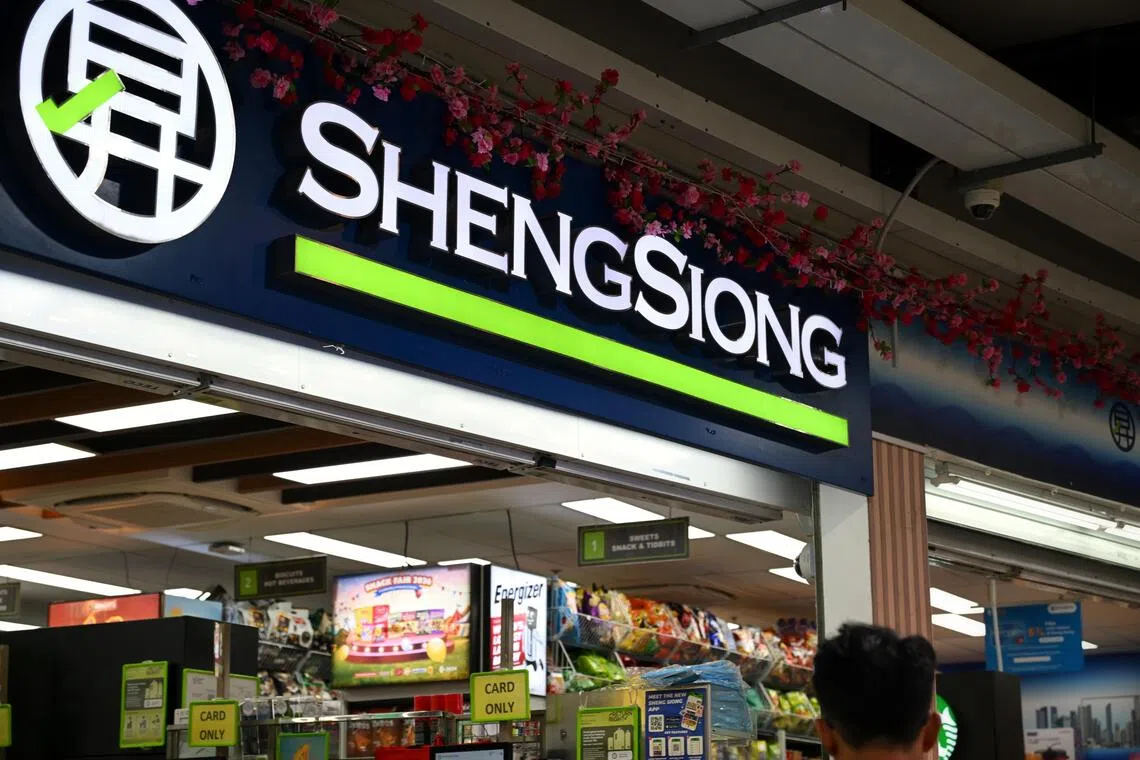
The research house also lowered its forecast for new Sheng Siong stores in 2028 from five to four.
ST PHOTO: KUA CHEE SIONG
Published Oct 12, 2026, 12:45 PM
Updated Oct 12, 2026, 02:00 PM
Maybank downgraded Sheng Siong to “hold” and cut its target price to $3.12, sending the shares down as much as 3% on Oct 12.
The broker said Sheng Siong is now one of the region’s “most expensive food retailers” after a strong rerating, even with 8% NPAT CAGR to 2028 and a 2.5% dividend yield.
Maybank also trimmed profit forecasts and warned that vouchers, competition, RTS-linked shopping and online grocery growth could weaken Sheng Siong’s future growth.
SINGAPORE – Shares of Sheng Siong fell as much as 3% on Oct 12 after Maybank downgraded the supermarket chain to “hold” from “buy” and cut its target price.
The counter fell as low as $2.83 in early trade on Oct 12, but pared some losses to be 1.7% down at $2.87 as at 10.10am. On Oct 9, it was the biggest decliner on the Singapore Exchange, having fallen 5.5%.
The decline followed Maybank cutting Sheng Siong’s target price from $3.22 to $3.12 on Oct 9.
This was due to a narrower upside that makes the supermarket chain one of the region’s “most expensive food retailers” at a forward price-to-earnings ratio of 28.4 times.
This is despite a net profit after tax (NPAT) compound annual growth rate (CAGR) of 8% through 2028 and a 2.5% dividend yield.
Maybank analyst Hussaini Saifee said: “Within the consumer space, we prefer Food Empire, supported by its strong NPAT growth (31% CAGR), moderate valuations and 5% dividend yield.”
The research house also lowered its forecast for new Sheng Siong stores in 2028 from five to four and reduced financial year 2026-2028 net profit after tax by a range of 1% to 3%.
“Sheng Siong remains a high-quality operator, but its strong share price re-rating now prices in much of it,” said Saifee. “With growth normalising and slight headwinds emerging, we see limited scope for further re-rating.”
Tailwinds turn into headwinds
While Sheng Siong has benefited from “resilient consumption”, market share gains and targeted vouchers that channelled spending directly to supermarkets, such tailwinds are weakening.
Maybank said that more assistance is being provided through unrestricted goods and services tax vouchers and cash payments.
The $500 tranche of CDC vouchers, originally scheduled for January 2027, was brought forward to June 2026, boosting financial year 2026 demand but raising the comparison base for FY2027.
With supermarket growth already easing to low single digits, the research house expects Sheng Siong’s growth to track underlying income and population trends, rather than benefit from a repeat of the unusually favourable conditions of recent years.
Sheng Siong’s capture of displaced demand from store closures at Giant and Cold Storage has also petered out, as the two competing chains have closed only one store between them.
Cold Storage’s new owner, Macrovalue, which bought both chains from DFI Retail Group in 2025, has “resumed expansion” through its On The Go convenience stores.
It will be rolled out progressively to all 58 Esso petrol stations across Singapore through 2026 and targets more than 100 outlets over time.
Saifee said: “Although the convenience-led format does not directly replicate Sheng Siong’s full-basket proposition, it adds competition for top-up grocery purchases, convenience items and ready-to-eat meals.”
Separately, Johor Bahru-Singapore Rapid Transit System (RTS)-linked cross-border shopping and the gradual evolution of online grocery fulfilment could also pose headwinds for Sheng Siong.
The supermarket chain appears more exposed to northern Singapore catchments than its larger competitors. About 10% of its network – nine stores – is within 5km of the RTS station, while about 27.5% – 25 stores – is within 15km.
“While neither appears disruptive enough to reshape the industry in the near term, both point to a less favourable backdrop than in recent years,” said the analyst. THE BUSINESS TIMES
该研究机构还将 2028 年昇菘超市新店数量的预测从 5 家下调至 4 家。
《海峡时报》摄影:郭志雄
发布于 2026 年 10 月 12 日下午 12:45
更新于2026年10月12日下午2:00
马来亚银行将昇菘银行的评级下调至“持有”,并将目标价下调至 3.12 美元,导致该股在 10 月 12 日下跌了 3%。
经纪人表示,尽管昇菘超市到 2028 年的净利润复合年增长率为 8%,股息收益率为 2.5%,但在强劲的重新估值之后,它现在已成为该地区“最昂贵的食品零售商”之一。
马来亚银行也下调了盈利预期,并警告称,代金券、竞争、与RTS相关的购物和在线杂货增长可能会削弱昇菘超市未来的增长。
新加坡——10月12日,马来亚银行将昇菘超市连锁店的评级从“买入”下调至“持有”,并下调了目标价格,昇菘的股价一度下跌3%。
该股10月12日早盘一度跌至2.83美元,但随后收复部分失地,截至上午10点10分,下跌1.7%至2.87美元。10月9日,该股是新加坡交易所跌幅最大的股票,下跌5.5%。
此前,马来亚银行于 10 月 9 日将昇菘银行的目标股价从 3.22 美元下调至 3.12 美元。
这是由于上涨空间有限,使得这家连锁超市成为该地区“最昂贵的食品零售商”之一,其预期市盈率为 28.4 倍。
尽管到 2028 年税后净利润 (NPAT) 复合年增长率 (CAGR) 为 8%,股息收益率为 2.5%,但情况依然如此。
马来亚银行分析师侯赛尼·赛菲表示:“在消费领域,我们更看好 Food Empire,这得益于其强劲的净利润增长(年复合增长率 31%)、适中的估值和 5% 的股息收益率。”
该研究机构还将 2028 年昇菘超市新店数量的预测从 5 家下调至 4 家,并将 2026-2028 财年的税后净利润下调了 1% 至 3%。
“昇菘银行依然是一家高质量的运营商,但其强劲的股价重估已经充分反映了这一点,”赛菲表示。“随着增长趋于正常化以及一些不利因素的出现,我们认为其股价进一步重估的空间有限。”
顺风变成了逆风
尽管昇菘超市受益于“韧性消费”、市场份额增长以及引导消费直接流向超市的定向优惠券,但这些利好因素正在减弱。
马来亚银行表示,将通过无限制的商品和服务税代金券和现金支付提供更多援助。
原定于 2027 年 1 月发放的 500 美元 CDC 代金券提前至 2026 年 6 月发放,这提高了 2026 财年的需求,但也提高了 2027 财年的比较基数。
由于超市增速已经放缓至个位数,该研究机构预计昇菘超市的增长将跟随潜在的收入和人口趋势,而不是受益于近年来异常有利的条件重现。
由于 Giant 和 Cold Storage 这两家竞争连锁超市关闭门店后,昇菘超市抢占了剩余需求的势头,但随着这两家竞争连锁超市加起来只关闭了一家门店,昇菘超市抢占剩余需求的势头也逐渐减弱。
Cold Storage 的新东家 Macrovalue 于 2025 年从 DFI Retail Group 手中收购了这两个连锁店,并通过其 On The Go 便利店“恢复了扩张”。
这项措施将在 2026 年前逐步推广到新加坡所有 58 家埃索加油站,目标是最终覆盖 100 多家门店。
Saifee表示:“虽然这种以便利为主导的模式并没有直接复制昇菘超市的全套商品模式,但它增加了对补充食品杂货、便利商品和即食食品的竞争。”
此外,新山-新加坡捷运系统 (RTS) 连接的跨境购物以及在线杂货配送的逐步发展也可能对昇菘超市构成不利影响。
这家连锁超市似乎比规模更大的竞争对手更注重新加坡北部地区的客流量。其约10%的门店(9家)位于RTS车站5公里范围内,而约27.5%的门店(25家)位于15公里范围内。
“虽然这两项因素似乎都不足以在短期内重塑行业格局,但它们都预示着当前形势不如近年来有利,”这位分析师表示。《商业时报》