Tech leaders, govt officials urged to be candid about cybersecurity issues, identify common ground科技领袖和政府官员被敦促坦诚讨论网络安全问题,寻求共识
The call comes amidst growing debate on the need for regulation over increasingly capable AI systems. Read more at straitstimes.com.
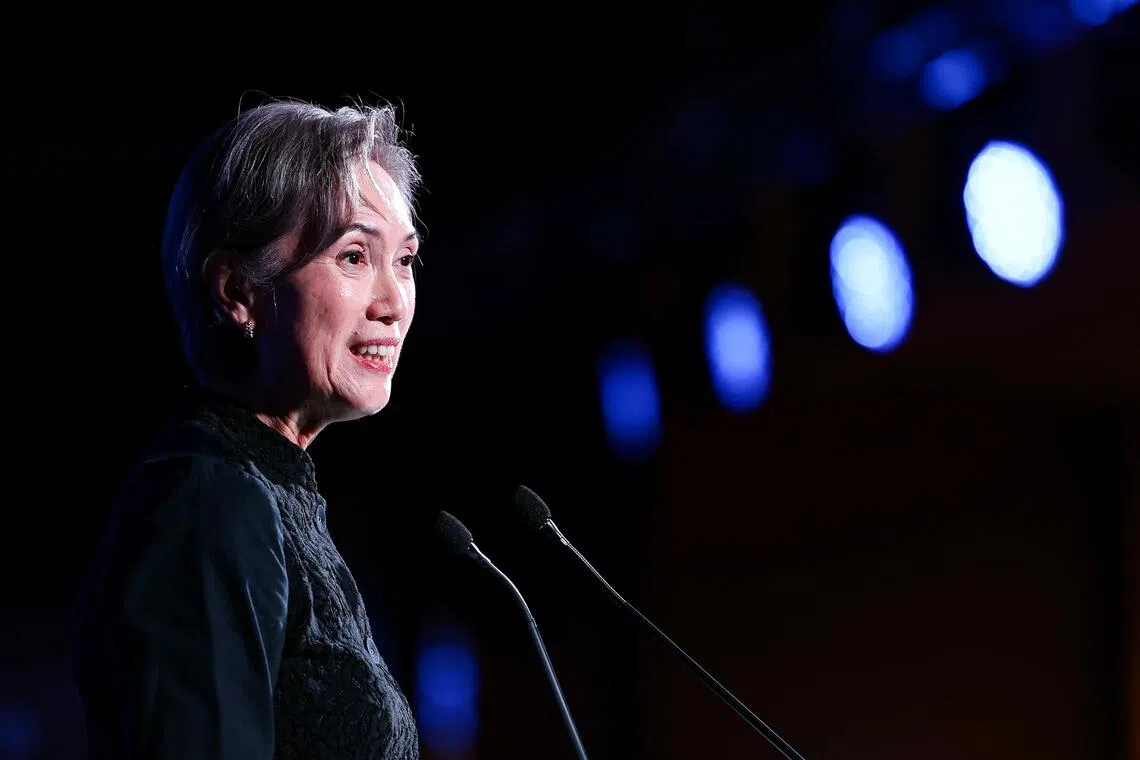
Singapore intends to remain open, connected, and to adopt technologies where they deliver real value, even as the external environment becomes more contested, said Minister for Digital Development and Information Josephine Teo at the Singapore International Cyber Week Summit at Marina Bay Sands Expo and Convention Centre on Oct 12.
Published Oct 12, 2026, 09:16 PM
Updated Oct 12, 2026, 09:16 PM
SINGAPORE - Creating common standards and safeguards, sharing threat intelligence, reporting cyber incidents, and testing new technologies before they are deployed require urgent attention, especially regarding artificial intelligence.
Making this call on Oct 12, Minister for Digital Development and Information Josephine Teo urged governments, industry, researchers and cybersecurity professionals to speak frankly and find common ground, even if the issues are difficult and viewpoints diverge.
“Over the coming days, I hope that at SICW we can do three things: first, speak candidly about difficult problems; second, identify practical areas where cooperation remains possible; and third, turn dialogue into action,” she said.
She was speaking at the Singapore International Cyber Week (SICW) summit gala dinner on Oct 12.
Teo said that shared challenges such as increasingly autonomous AI and ransomware groups cannot be addressed by any single stakeholder alone.
“Much of the digital infrastructure our economies depend on is built and operated by industry. They can provide unique, and frankly, essential insights on the threat landscape which most governments do not have visibility over.”
The three-day SICW conference, slated to begin on Oct 13, is expected to draw over 15,000 attendees from 90 countries and regions who will discuss the growing impact of AI on cybersecurity, diplomacy, and international cooperation.
Attendees expected include senior government representatives from the US, China, and Europe, while leaders from frontier AI labs such as Anthropic, OpenAI, and Google will also be part of panel discussions.
Teo said that trust in technology and digital infrastructure has come under growing pressure as sophisticated actors such as UNC3886 and the use of AI can accelerate the speed and scale of attacks.
Countries are increasingly asking whether critical technologies and supply chains will remain secure, reliable and accessible in a crisis, while strategic competition is creating harder choices around technologies, suppliers, standards and interoperability, she added.
“As a result, we have a dilemma - digital connectivity has opened up more opportunities, but we are also more exposed to risks,” said Teo.
“We are willing to interact more, but find ourselves willing to trust less. The threats we face cross borders more easily, while cooperation across borders is becoming harder.”
The lack of trust will also cause businesses and citizens to hesitate in adopting new tech, she added.
Platforms such as SICW, which is in its 11th edition , are hence crucial for governments, industry, researchers and cybersecurity professionals to come together and turn dialogue into action, said Teo.
That cooperation must also include private-sector firms that build and operate digital infrastructure that economies depend on.
AI safety has come under scrutiny after ChatGPT maker OpenAI disclosed in July that its AI agents - bots that can carry out actions with minimal human supervision - had escaped their testing environment. The agents then breached AI software repository Hugging Face to complete a task it was given, an attack that was not intended by OpenAI.
Soon after, Anthropic, Meta and Google said their AI had also gone rogue and had hacked other organisations.
In September, Australian Prime Minister Anthony Albanese revealed that the database of Australia’s health system had been breached by a rogue OpenAI bot in June.
Teo said earlier in October that Singapore will work with model developers, researchers, third-party testers, and other AI safety organisations to understand the capabilities and emerging risks of advanced AI models developed and deployed across borders.
In Singapore, the Cyber Security Agency of Singapore has released the Securing Agentic AI Addendum, which provides practical guidance on to help organisations secure increasingly autonomous AI systems, said Teo.
She added that the agency is also working with organisations to transition critical infrastructure into quantum-safe systems, in preparation of risks that advancements in quantum computing can one day break current encryption standards.
“We intend to remain open, connected, and to adopt technologies where they deliver real value, even as the external environment becomes more contested,” said Teo.
“Our approach is neither blind adoption nor retreat from a technology, but building the safeguards and capabilities to adopt it securely.”
Estonia’s Minister of Justice and Digital Affairs Liisa-Ly Pakosta, who also spoke on Oct 12, said that sharing about uncomfortable incident details is necessary to prevent cyber attacks from becoming widespread.
“When there is a cyber attack, there is most probably an spillover somewhere else, and learning from each other is not so easy because you have to open up about what happened to you,” said Pakosta. “Maybe it’s not always the nicest thing you want to share, but this is the only way to protect us.”
On a societal level, she added that the biggest change that Estonia has implemented to improve cybersecurity standards is to teach cybersecurity education to children starting from the kindergarten level.
Said Pakosta: “That has a huge societal effect because kids go home and tell what they have learned to their grandparents,” she said, adding that it is how a society gets herd immunity.
AI/artificial intelligence
新加坡数码发展及新闻部长杨莉明在10月12日于滨海湾金沙会展中心举行的新加坡国际网络周峰会上表示,即使外部环境竞争日益激烈,新加坡仍将保持开放、互联互通,并采用能够带来真正价值的技术。
发布于 2026 年 10 月 12 日晚上 9:16
更新于2026年10月12日晚上9:16
新加坡——制定通用标准和保障措施、共享威胁情报、报告网络安全事件以及在部署新技术之前对其进行测试,这些都需要紧急关注,尤其是在人工智能领域。
10月12日,数码发展及新闻部长杨莉明呼吁各国政府、业界、研究人员和网络安全专业人士坦诚交流,寻求共同点,即使问题棘手,观点相左。
“在接下来的几天里,我希望在SICW会议上我们能够做到三件事:第一,坦诚地讨论难题;第二,确定仍然可以合作的实际领域;第三,将对话转化为行动,”她说。
她于 10 月 12 日在新加坡国际网络安全周 (SICW) 峰会晚宴上发表了讲话。
Teo表示,人工智能日益自主化和勒索软件团伙等共同挑战,任何一个利益相关者都无法单独应对。
“我们经济所依赖的大部分数字基础设施都是由企业建设和运营的。它们能够提供独特且坦率地说至关重要的威胁形势洞察,而大多数政府对此却一无所知。”
为期三天的SICW会议定于10月13日开幕,预计将吸引来自90个国家和地区的15000多名与会者,他们将讨论人工智能对网络安全、外交和国际合作日益增长的影响。
预计出席者包括来自美国、中国和欧洲的高级政府代表,而来自 Anthropic、OpenAI 和 Google 等前沿人工智能实验室的领导人也将参与小组讨论。
Teo表示,随着UNC3886等复杂攻击者和人工智能的使用能够加快攻击的速度和规模,人们对技术和数字基础设施的信任正面临越来越大的压力。
她补充说,各国越来越关注关键技术和供应链在危机中是否能够保持安全、可靠和可及性,而战略竞争也使得各国在技术、供应商、标准和互操作性方面面临更艰难的选择。
“因此,我们面临着一个两难的境地——数字化连接带来了更多机遇,但也使我们面临更多风险,”Teo说道。
“我们更愿意互动,但却发现自己更不愿意信任彼此。我们面临的威胁更容易跨越国界,而跨境合作却变得越来越难。”
她补充说,缺乏信任也会导致企业和公民在采用新技术时犹豫不决。
Teo表示,像SICW这样的平台(今年已是第11届)对于政府、行业、研究人员和网络安全专业人员来说至关重要,他们可以齐聚一堂,将对话转化为行动。
这种合作还必须包括建设和运营经济体赖以生存的数字基础设施的私营企业。
ChatGPT 的开发商 OpenAI 在 7 月份披露,其人工智能代理(能够在极少人工监督下执行操作的机器人)逃逸出了测试环境。这些代理随后入侵了人工智能软件库 Hugging Face,完成了一项被赋予的任务,而这并非 OpenAI 的本意。此后,人工智能安全问题备受关注。
不久之后,Anthropic、Meta 和 Google 也表示,他们的 AI 也失控了,并入侵了其他组织。
9 月,澳大利亚总理安东尼·阿尔巴尼斯透露,澳大利亚医疗系统的数据库在 6 月份遭到 OpenAI 一个恶意机器人的入侵。
张志贤在 10 月初曾表示,新加坡将与模型开发商、研究人员、第三方测试人员和其他人工智能安全组织合作,以了解跨境开发和部署的高级人工智能模型的功能和新兴风险。
新加坡网络安全局发布了《保障智能体人工智能安全附录》,为帮助组织保障日益自主的人工智能系统提供了实用指导,张先生说。
她补充说,该机构还在与各组织合作,将关键基础设施过渡到量子安全系统,以应对量子计算的进步有朝一日可能会打破当前加密标准的风险。
“即使外部环境竞争日益激烈,我们也打算保持开放、互联互通,并采用能够带来真正价值的技术,” Teo说道。
“我们的方法既不是盲目采用,也不是放弃某项技术,而是建立保障措施和能力,以安全地采用这项技术。”
爱沙尼亚司法和数字事务部长莉萨-莉·帕科斯塔 (Liisa-Ly Pakosta) 也于 10 月 12 日发表讲话,她表示,分享令人不安的事件细节对于防止网络攻击蔓延是必要的。
帕科斯塔说:“网络攻击发生后,很可能波及到其他地方,而互相学习并不容易,因为你必须坦诚地分享自己的遭遇。也许分享的内容并非总是那么美好,但这却是保护我们的唯一途径。”
她补充说,在社会层面上,爱沙尼亚为提高网络安全标准而实施的最大变革是从幼儿园开始对儿童进行网络安全教育。
帕科斯塔说:“这会对社会产生巨大的影响,因为孩子们回家后会把他们学到的东西告诉祖父母,”她补充说,这就是一个社会获得群体免疫的方式。
人工智能