Flying with his feet on the ground: Why this SAF scholar chose intelligence over the cockpit脚踏实地:这位新加坡武装部队奖学金获得者为何选择情报工作而非驾驶座舱
Learn how the SAF Merit Scholarship took this aerospace engineering graduate from the flying club to the Digital and Intelligence Service. Read more at straitstimes.com.
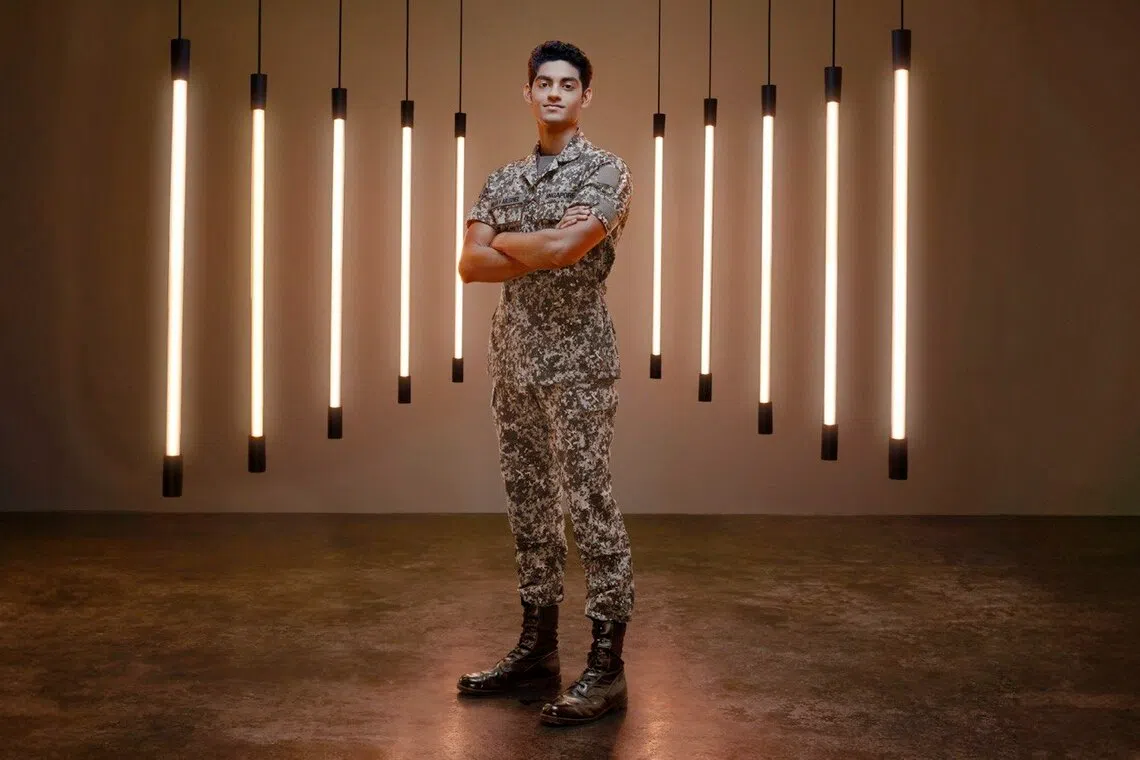
A fascination with flying led aerospace engineer Florian Ableitner into the armed forces, but technology, intelligence and the changing nature of warfare ultimately took him in another direction
Military Expert 4 Apprentice Florian Ableitner is training as a senior military intelligence expert with the Joint Intelligence Command under the Digital and Intelligence Service, the fourth branch of the Singapore Armed Forces (SAF).
PHOTO: COURTESY OF FLORIAN ABLEITNER
Published Oct 13, 2026, 04:00 AM
When Military Expert 4 Apprentice Florian Ableitner first thought of joining the armed forces, he was convinced he was going to be a pilot.
Much of that certainty came from his time at the Singapore Youth Flying Club, where several of his instructors were former Republic of Singapore Air Force (RSAF) fighter pilots.
In and out of the cockpit, they would share stories from their flying days – of operating at speed, keeping track of what was happening around them and staying alert to potential threats.
For Ableitner, it offered an early glimpse of what a career in the Air Force could look like. And for a while, he expected to follow a similar path.
Then, at Officer Cadet School, another side of defence caught his attention. Recruiters from what was then the Command, Control, Communications, Computers and Intelligence (C4I) community spoke about work where the challenge was not flying an aircraft, but making sense of a security picture that could change in real time.
Being awarded the SAF Merit Scholarship in 2022, Ableitner (back row, third from left) marked the start of a path that would take him from aerospace engineering at Nanyang Technological University (NTU) into military intelligence.
“The situation never really stays still,” he says. “The picture changes daily, sometimes hourly, and the job is to keep analysing that shifting data and turning it into intelligence that decision-makers can act on.”
He was also intrigued by how emerging technologies such as drones and artificial intelligence were changing both the nature of warfare and the way information was gathered and analysed.
The combination of technology, analysis and a constantly evolving security environment gave him a different way to imagine his future in the armed forces.
Instead of following his instructors into the RSAF, Ableitner joined the C4I community, which would later become the Digital and Intelligence Service (DIS), and took up the Singapore Armed Forces (SAF) Merit Scholarship in 2022 to study aerospace engineering at Nanyang Technological University.
Learning how AI and drones change modern warfare
Before starting his degree, Ableitner was posted to the SAF Computer Vision Unit, where he worked with a team improving visual-recognition algorithms used to detect, identify and locate potential objects of interest more quickly and accurately.
It was his first opportunity to see how technology could help turn raw information into something useful for intelligence work.
At university, he began exploring the same idea from another angle: not just how machines could interpret what they saw, but how they could be made to act on their own.
For his final-year project, Ableitner and his teammates built a swarm of three autonomous drones from scratch. His main role was programming the drones to work out their own flight paths, including how to navigate around obstacles without human control.
“It is a different kind of flying,” he says. “Instead of reacting to the environment from the cockpit, you are designing rules the aircraft follows before it even takes off.”
On a computer, those rules could be tested under controlled conditions. The real test came when the team took them out to fly.
Wind, signal interference and even the air being pushed back towards a drone when it flew close to the ground could cause the aircraft to behave differently from the simulations. Suddenly, a flight path that worked neatly on screen did not always translate into a smooth flight.
Ableitner and his teammates had to redesign parts of the system and build in redundancies so the drones could cope with unpredictable real-world conditions without veering off course or crashing.
The experience taught Ableitner that technology rarely behaves exactly as expected once it leaves a controlled environment. That lesson has become increasingly relevant as warfare grows more data-driven, automated and dependent on systems that have to perform under uncertain real-world conditions.
For his final-year project at NTU, Ableitner (centre) and his teammates built three autonomous drones that could plot their own flight paths and avoid obstacles. PHOTO: COURTESY OF FLORIAN ABLEITNER
For his final-year project at NTU, Ableitner (centre) and his teammates built three autonomous drones that could plot their own flight paths and avoid obstacles.
After graduating earlier this year, Ableitner returned to the DIS, where he is now undergoing training to become a senior military intelligence expert with the Joint Intelligence Command (JIC). The JIC provides the Ministry of Defence and the SAF with intelligence for decision-making and early warning.
His training is focused on developing his analytical skills and deepening his understanding of the regional security environment before he is assigned to a formation.
Those earlier experiences with computer vision and autonomous drones also changed the way Ableitner thinks about where an advantage in modern warfare can come from. Increasingly, it is not just what a military can see, but how quickly it can make sense of that information and act on it.
AI, in particular, stands out to him for its ability to speed up this process of “sensemaking”.
“Warfare operates on a cycle: seeing, understanding, then acting,” he explains. “The side that can turn raw data into a decision in seconds rather than minutes has a real edge.”
Military intelligence in an uncertain digital battlefield
Warfare has also changed in another fundamental way: The battlefield itself has expanded into the digital domain, where the boundaries are far less clear. The army defends Singapore on land; the air force safeguards its skies; the navy protects its waterways.
But what about the digital space? “Much of it is still unexplored or unknown to us,” he says. “There are a lot of uncertainties and ambiguities in this space, so we are constantly thinking of what warfare is going to look like in the next five, 10 years.”
His posting to the SAF Computer Vision Unit before university gave Ableitner (standing, far left) an early look at how visual-recognition technology could support intelligence work. PHOTO: COURTESY OF FLORIAN ABLEITNER
His posting to the SAF Computer Vision Unit before university gave Ableitner (standing, far left) an early look at how visual-recognition technology could support intelligence work.
The uncertainty is not just about the technology or where threats might come from.
Ableitner points out that while international law applies in cyberspace, there is no single binding treaty covering every possible cyber incident. This can make the appropriate response less clear, particularly when an attack involves a state or non-state actor.
“So the question becomes: how do you operate in a space where the principles exist, but the practical rules of engagement are not always clear?” he asks.
To him, that uncertainty is part of what makes the field of military intelligence exciting. He is an aerospace engineer, after all – someone trained to solve problems where some variables are unknown and assumptions do not always hold once they encounter the real world.
It also brings him back to a lesson from his drone experiments.
“You can plan for every scenario you can think of, but the ones that get you are the ones you did not think of,” he says.
“So you have to stay curious and be comfortable about not having all the answers upfront. And that mindset is what I think this field demands.”
Explore the defence career pathways opened up by the SAF Merit Scholarship.
对飞行的痴迷使航空航天工程师弗洛里安·阿布莱特纳加入了军队,但技术、情报以及战争性质的改变最终将他引向了另一个方向。
军事专家 4 级学员 Florian Ableitner 正在新加坡武装部队 (SAF) 第四个分支——数字与情报服务部下属的联合情报司令部接受高级军事情报专家的培训。
照片:由弗洛里安·阿布莱特纳提供
发布于 2026 年 10 月 13 日 上午 4:00
军事专家 4 级学徒弗洛里安·阿布莱特纳第一次想到加入军队时,他坚信自己会成为一名飞行员。
这种自信很大程度上源于他在新加坡青年飞行俱乐部的经历,他的几位教练都是新加坡共和国空军(RSAF)的前战斗机飞行员。
在驾驶舱内外,他们会分享自己飞行时的故事——高速飞行、密切关注周围发生的事情以及对潜在威胁保持警惕。
对阿布莱特纳来说,这让他提前看到了空军生涯的可能面貌。有一段时间,他也以为自己会走上类似的道路。
后来,在军官学员学校,国防的另一个方面引起了他的注意。当时指挥、控制、通信、计算机和情报(C4I)部门的招募人员谈到,这项工作的挑战不在于驾驶飞机,而在于理解可能实时变化的安全形势。
2022 年,Ableitner(后排左起第三位)获得了新加坡武装部队优秀奖学金,这标志着他从南洋理工大学 (NTU) 的航空航天工程专业进入军事情报领域的开始。
“形势永远不会一成不变,”他说。“情况每天都在变化,有时甚至每小时都在变化,我们的工作就是不断分析这些不断变化的数据,并将其转化为决策者可以采取行动的情报。”
他还对无人机和人工智能等新兴技术如何改变战争的性质以及信息的收集和分析方式很感兴趣。
技术、分析和不断变化的安全环境的结合,让他对自己在军队中的未来有了不同的看法。
阿布莱特纳没有像他的教官那样加入新加坡空军,而是加入了 C4I 社区(后来发展成为数字与情报服务部 (DIS)),并在 2022 年获得了新加坡武装部队 (SAF) 优秀奖学金,在南洋理工大学学习航空航天工程。
了解人工智能和无人机如何改变现代战争
在攻读学位之前,Ableitner 被派往 SAF 计算机视觉部门,在那里他与一个团队合作,改进用于更快、更准确地检测、识别和定位潜在感兴趣对象的视觉识别算法。
这是他第一次有机会了解技术如何帮助将原始信息转化为对情报工作有用的信息。
在大学里,他开始从另一个角度探索同样的想法:不仅是机器如何解释它们所看到的东西,而且还如何让它们自主行动。
阿布莱特纳的毕业设计项目是与队友从零开始搭建一个由三架自主无人机组成的集群。他的主要任务是编写程序,让无人机自行规划飞行路线,包括如何在无人操控的情况下绕过障碍物。
“这是一种不同的飞行方式,”他说。“你不是在驾驶舱内对环境做出反应,而是在飞机起飞前就制定好飞机必须遵循的规则。”
在电脑上,这些规则可以在受控条件下进行测试。真正的考验是在团队进行飞行测试时。
风、信号干扰,甚至无人机低空飞行时受到的反作用力,都可能导致无人机的实际飞行表现与模拟结果有所不同。突然间,屏幕上流畅的飞行路径,在实际飞行中却未必能保持平稳。
阿布莱特纳和他的队友不得不重新设计系统的部分内容,并建立冗余机制,以便无人机能够应对不可预测的现实世界条件,而不会偏离航线或坠毁。
这次经历让阿布莱特纳明白,技术一旦离开受控环境,就很少能完全按照预期运行。随着战争日益数据驱动、自动化,并依赖于必须在不确定的现实世界条件下运行的系统,这一教训变得愈发重要。
在南洋理工大学的毕业设计项目中,阿布莱特纳(图中)和他的队友们制造了三架能够自主规划飞行路线并避开障碍物的无人机。照片:由弗洛里安·阿布莱特纳提供
在南洋理工大学的毕业设计项目中,Ableitner(中)和他的队友们制造了三架自主无人机,这些无人机可以规划自己的飞行路线并避开障碍物。
今年早些时候毕业后,阿布莱特纳回到国防情报局(DIS),目前正在接受培训,以成为联合情报司令部(JIC)的高级军事情报专家。联合情报司令部为国防部和新加坡武装部队提供情报,用于决策和预警。
他的训练重点是培养他的分析能力,加深他对区域安全环境的了解,然后再分配到某个部队。
早期在计算机视觉和自主无人机方面的经验也改变了阿布莱特纳对现代战争优势来源的看法。如今,军队的优势不仅在于能够看到什么,更在于能够多快地理解这些信息并采取行动。
在他看来,人工智能尤其突出,因为它能够加快这种“意义建构”的过程。
他解释说:“战争的运作遵循一个循环:观察、理解、行动。能够在几秒钟内而非几分钟内将原始数据转化为决策的一方,就拥有真正的优势。”
在充满不确定性的数字化战场上进行军事情报
战争还发生了另一个根本性的变化:战场本身已扩展到数字领域,在那里,界限远不如以往清晰。陆军负责保卫新加坡的陆地;空军负责守护其领空;海军负责保护其水域。
那么数字领域呢?他表示:“其中很多领域我们仍然未知或不了解。这个领域存在很多不确定性和模糊性,所以我们一直在思考未来五到十年战争会是什么样子。”
在进入大学之前,阿布莱特纳(图中左侧站立者)曾在新加坡武装部队计算机视觉部门工作,这使他很早就了解到视觉识别技术如何支持情报工作。照片:由弗洛里安·阿布莱特纳提供
在进入大学之前,Ableitner(站立者,最左边)曾在新加坡武装部队计算机视觉部门工作,这使他很早就了解了视觉识别技术如何支持情报工作。
不确定性不仅在于技术或威胁可能来自何处。
阿布莱特纳指出,虽然国际法适用于网络空间,但目前尚无一项具有约束力的条约涵盖所有可能发生的网络事件。这使得适当的应对措施变得不那么明确,尤其是在攻击涉及国家或非国家行为体时。
“所以问题就变成了:在一个原则存在,但实际操作规则并不总是清晰的空间里,你该如何运作?”他问道。
对他而言,这种不确定性正是军事情报领域令人兴奋的原因之一。毕竟,他是一名航空航天工程师——接受过专门训练,能够解决那些变量未知、假设在现实世界中往往不成立的问题。
这也让他想起了无人机实验中的一个教训。
“你可以为你能想到的所有情况都做好计划,但真正让你措手不及的往往是你没想到的情况,”他说。
“所以你必须保持好奇心,并且坦然接受自己无法一开始就拥有所有答案。我认为这种心态正是这个领域所需要的。”
探索新加坡武装部队优秀奖学金所开辟的国防职业发展道路。