Singapore startup opens plant to recover lithium from EV batteries, raises US$7.6 million新加坡初创公司开设工厂从电动汽车电池中回收锂,并筹集了760万美元。
NEU Battery Materials says its Tuas plant can process 1,300 tonnes of battery materials a year but will not run at full capacity for now.
NEU Battery Materials says its Tuas plant can process 1,300 tonnes of battery materials a year but will not run at full capacity for now.
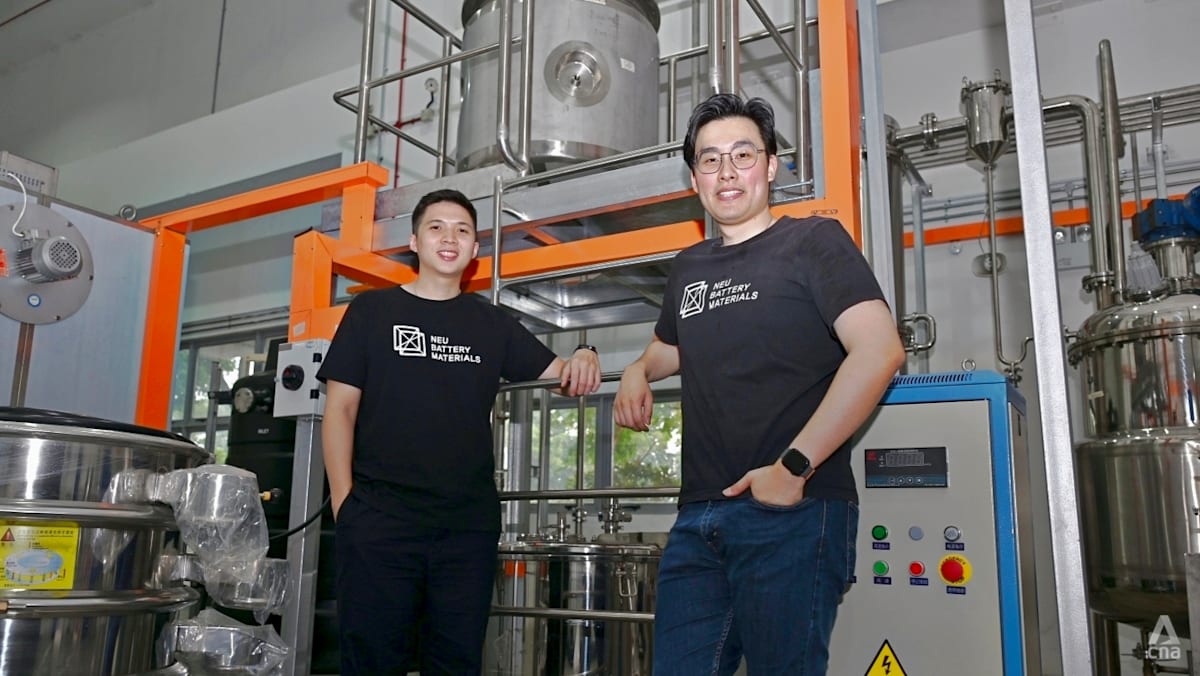
NEU Battery Materials' co-founders, chief technology officer Kenneth Palmer (left) and CEO Bryan Oh, at the firm's new plant in Tuas on Oct 12, 2026. (Photo: CNA/Raydza Rahman)
This audio is generated by an AI tool.
SINGAPORE: A Singapore startup has opened its first plant to scale up a process it says could make recovering lithium from certain electric vehicle (EV) batteries commercially viable.
NEU Battery Materials marked the opening of the 12,000 sq ft facility in Tuas on Tuesday (Oct 13). The plant can process 1,300 tonnes of battery materials a year.
The company also announced the close of an oversubscribed US$7.6 million (S$9.7 million) funding round.
Co-founder and chief executive Bryan Oh told CNA the money will go towards running the plant, developing the technology and expanding overseas, which the firm is targeting next year. It is eyeing Europe and the United States, where it hopes to build larger facilities alongside battery manufacturers.
CNA Games Guess Word Crack the word, one row at a time Buzzword Create words using the given letters Mini Sudoku Tiny puzzle, mighty brain teaser Mini Crossword Small grid, big challenge Word Search Spot as many words as you can Show More Show Less Mr Oh said NEU does not intend to run the Singapore plant at full capacity for now. “The purpose is to run tests and then improve (the process) so that we can create the final blueprint to replicate for really big scale,” he said.
Mr Oh said NEU does not intend to run the Singapore plant at full capacity for now.
“The purpose is to run tests and then improve (the process) so that we can create the final blueprint to replicate for really big scale,” he said.
NEU Battery Materials' new plant in Tuas will be able to process up to 1,300 tonnes of battery materials a year to recover lithium. (Photo: CNA/Raydza Rahman)
WHAT THE COMPANY DOES
NEU specialises in recovering lithium from lithium iron phosphate battery materials. These batteries are increasingly used in EVs as an alternative to nickel manganese cobalt batteries.
Lithium iron phosphate batteries accounted for more than 55 per cent of EV batteries deployed globally in 2025, up from nearly 50 per cent the year before, according to the International Energy Agency. Deployment was heavily concentrated in China.
Unlike nickel manganese cobalt batteries, they do not contain valuable metals such as nickel and cobalt, leaving recyclers with less high-value material to sell. Lithium makes up a small proportion of the material, making it difficult to recover enough value to cover processing costs.
Black mass and production scrap will be fed into a hopper at NEU Battery Materials' plant to kickstart the process of lithium recovery. (Photo: CNA/Raydza Rahman)
"We have 50 per cent global market share in the world using lithium iron phosphate, but not many people can actually make money recycling (this). So this presents a very difficult problem," Mr Oh said.
"If you cannot recycle lithium iron phosphate, then all these will just go into the landfill."
NEU has developed a patented electrochemical redox process that uses electricity and water. Conventional hydrometallurgical processes consume chemicals to extract metals, but NEU's process reuses its proprietary chemical, Mr Oh said.
This lowers processing costs and could make lithium recovery commercially viable at scale, he said.
The system takes production scrap or black mass, a powder produced after end-of-life batteries are shredded, and extracts lithium hydroxide. This is then processed into battery-grade lithium, which can be used to make new lithium iron phosphate batteries.
The electrolyser uses electricity and a membrane to separate lithium from the battery material that is processed. (Photo: CNA/Raydza Rahman)
About 85 per cent of NEU’s current feedstock is production scrap, which is waste generated during battery manufacturing. Mr Oh said the waste generated can be substantial.
"So what we want to do today at the early wave of the battery and EV industry is to recycle this, sell back the lithium to them, so that they can continue the (circular) journey."
NEU also processes black mass from end-of-life batteries, but volumes are smaller, partly because the batteries entered the market more recently.
Mr Oh said the company holds about 40 to 50 tonnes of material – mostly from overseas battery manufacturers – at its Singapore facility. This is enough for about six months of operations.
Black mass from end-of-life electric vehicle batteries is one of the materials NEU Battery Materials can process to recover lithium. (Photo: CNA/Raydza Rahman)
SELLING LITHIUM TO BATTERY MAKERS
NEU plans to supply the lithium carbonate to battery manufacturers for use in new batteries.
Mr Oh said the company is working with manufacturers to validate the quality and consistency of the recovered lithium, sending progressively larger quantities for testing. Some of these manufacturers supplied the production scrap.
The lithium carbonate could also be sold to buyers in China, where lithium iron phosphate batteries accounted for more than 80 per cent of EV battery sales in 2025, according to the International Energy Agency.
If successful, the technology could help address a growing challenge as more of these batteries reach the end of their lives in the coming years.
NEU is prepared to scale up the Singapore facility if more end-of-life batteries become available locally, Mr Oh said. Existing equipment can accommodate about double the current processing capacity, while going beyond that would require additional equipment.
For now, the company's priority is still to use the facility as a testbed to refine its technology and establish the engineering blueprint for its larger plants overseas, he said.
Get our pick of top stories and thought-provoking articles in your inbox
Stay updated with notifications for breaking news and our best stories
Join our channel for the top reads for the day on your preferred chat app
NEU电池材料公司表示,其位于大士的工厂每年可加工1300吨电池材料,但目前不会满负荷运转。
2026年10月12日,NEU电池材料公司联合创始人、首席技术官Kenneth Palmer(左)和首席执行官Bryan Oh在公司位于大士的新工厂。(图片:CNA/Raydza Rahman)
这段音频由人工智能工具生成。
新加坡:一家新加坡初创公司开设了第一家工厂,旨在扩大其工艺规模。该公司表示,该工艺可以使从某些电动汽车 (EV) 电池中回收锂在商业上可行。
NEU电池材料公司于周二(10月13日)在Tuas举行了占地12000平方英尺的工厂的开业典礼。该工厂每年可加工1300吨电池材料。
该公司还宣布完成了一轮超额认购的760万美元(970万新元)融资。
联合创始人兼首席执行官吴文杰(Bryan Oh)告诉亚洲新闻台(CNA),这笔资金将用于工厂运营、技术研发以及海外扩张,公司计划明年进军海外市场。公司正着眼于欧洲和美国,希望与电池制造商合作,在那里建设更大规模的工厂。
CNA游戏猜词游戏 逐行破解单词 流行词游戏 用给定的字母组成单词 迷你数独 小谜题,大挑战 迷你填字游戏 小方格,大挑战 单词搜索 尽可能多地找出单词 显示更多 显示更少 Oh先生表示,NEU目前不打算让新加坡工厂满负荷运转。“目的是进行测试,然后改进(流程),以便我们能够制定最终蓝图,进行大规模复制,”他说。
Oh先生表示,NEU目前不打算让新加坡工厂满负荷运转。
他说:“我们的目的是进行测试,然后改进(流程),以便我们能够创建最终蓝图,从而实现大规模复制。”
NEU电池材料公司位于大士的新工厂每年可处理多达1300吨电池材料,用于回收锂。(图片:CNA/Raydza Rahman)
公司业务范围
NEU公司专门从事从磷酸铁锂电池材料中回收锂。这些电池越来越多地被用于电动汽车,作为镍锰钴电池的替代品。
国际能源署预测,到2025年,磷酸铁锂电池在全球电动汽车电池部署中的占比将超过55%,高于前一年的近50%。其中,部署主要集中在中国。
与镍锰钴电池不同,锂离子电池不含镍、钴等贵金属,因此回收商可出售的高价值材料较少。锂的含量也很低,难以回收足够的价值来弥补加工成本。
在NEU电池材料公司的工厂里,黑色原料和生产废料将被送入料斗,以启动锂回收流程。(图片:CNA/Raydza Rahman)
“我们在全球磷酸铁锂市场占有50%的份额,但实际上能靠回收利用(这种材料)赚钱的人并不多。所以这是一个非常棘手的问题,”吴先生说。
“如果不能回收利用磷酸铁锂,那么这些最终都只能被填埋。”
NEU公司开发了一种获得专利的电化学氧化还原工艺,该工艺利用电力和水。吴先生表示,传统的湿法冶金工艺需要消耗化学品来提取金属,而NEU的工艺则可以重复利用其专有的化学品。
他表示,这将降低加工成本,并可能使锂回收在大规模商业上可行。
该系统利用生产废料或黑块(废旧电池粉碎后产生的粉末),提取氢氧化锂。然后将其加工成电池级锂,可用于制造新的磷酸铁锂电池。
电解槽利用电力和隔膜将锂从待处理的电池材料中分离出来。(图片:CNA/Raydza Rahman)
NEU目前约85%的原料是生产废料,也就是电池制造过程中产生的废弃物。吴先生表示,产生的废弃物数量相当可观。
“因此,在电池和电动汽车行业的早期阶段,我们今天想要做的就是回收利用这些锂,把锂卖回给他们,以便他们能够继续(循环)发展。”
NEU 也处理废旧电池的黑块,但处理量较小,部分原因是这些电池进入市场的时间较晚。
吴先生表示,公司在新加坡的工厂储存着约40至50吨原材料,主要来自海外电池制造商。这些原材料足够公司运营约六个月。
废旧电动汽车电池产生的黑色物质是NEU电池材料公司可用于回收锂的材料之一。(图片:CNA/Raydza Rahman)
向电池制造商出售锂
NEU计划向电池制造商供应碳酸锂,用于生产新型电池。
吴先生表示,公司正与生产商合作,验证回收锂的质量和稳定性,并逐步增加送检样品的数量。部分生产商也提供了生产废料。
根据国际能源署的数据,到 2025 年,磷酸铁锂电池将占中国电动汽车电池销量的 80% 以上,而碳酸锂也可以销往中国市场。
如果成功,这项技术可以帮助应对未来几年内随着更多此类电池达到使用寿命终点而日益严峻的挑战。
吴先生表示,如果新加坡本地有更多废旧电池可供处理,NEU已做好准备扩大其新加坡工厂的规模。现有设备的处理能力大约可以达到目前产能的两倍,而要达到更高的产能则需要添置新的设备。
他表示,目前公司的首要任务仍然是利用该设施作为试验平台,改进其技术,并为海外更大规模的工厂建立工程蓝图。
订阅我们的邮件,即可获取精选热点新闻和引人深思的文章。
订阅通知,第一时间获取突发新闻和精彩报道。
加入我们的频道,即可在您常用的聊天应用上获取当日热门文章。