Why turning on the air-conditioner alone will not keep haze particles out of indoor air为什么仅仅打开空调并不能阻止雾霾颗粒进入室内空气
The Straits Times talks to experts on what can bring reprieve. Read more at straitstimes.com.
新闻视频
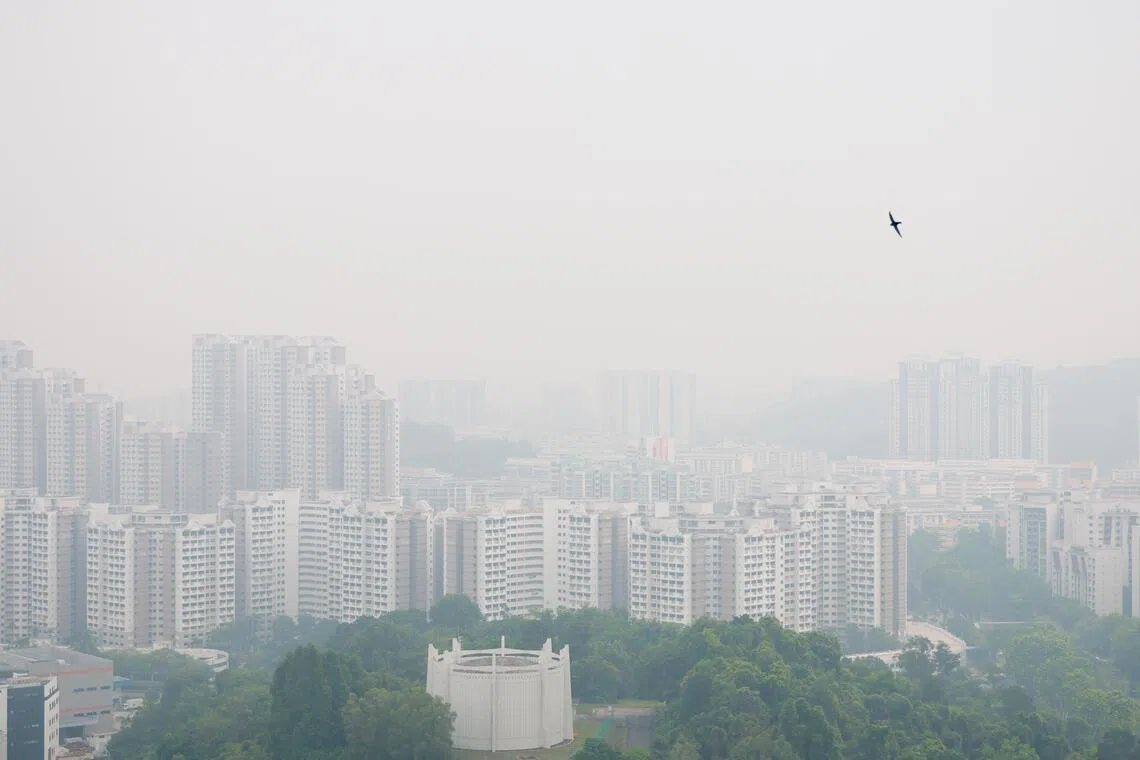
The Straits Times talks to experts on what can bring reprieve from the haze.
ST PHOTO: JASON QUAH
Published Oct 13, 2026, 12:40 PM
Updated Oct 13, 2026, 12:40 PM
SINGAPORE – Singapore is currently experiencing its longest stretch of unhealthy air quality since September, with the Pollutant Standards Index (PSI) here recording readings above 101 since Oct 5.
The authorities also warned on Oct 9 that air quality may worsen and breach ‘very unhealthy’ levels if hot, hazy conditions continue.
The Straits Times talks to experts on what can bring reprieve.
Will turning on the air conditioner alone help to filter out haze particles?
Experts say that while air-conditioning helps to cool a room to make it more comfortable, its filters are designed to capture large dust particles, and not tiny haze pollutant particles.
The dominant pollutants during periods of transboundary haze are PM2.5 – tiny particles measuring 2.5 microns in diameter, 30 times smaller than the width of a strand of hair. These particles can get lodged deep in the lungs and enter the bloodstream.
Liu Zheng from NTU’s School of Materials Science and Engineering said a home air-conditioner mostly cools the same air that is already in the room. Its filter is only meant to catch dust, instead of haze particles which are far too small.
“So it makes the room cooler, but not much cleaner,” he said. Turning on the air conditioner, however, does help in an indirect way as the closed doors and windows help to keep much of the haze out, he added.
Rajasekhar Balasubramanian from the NUS College of Design and Engineering said that while air conditioning systems contain filters, those commonly used at homes are generally not efficient at removing fine particulate matter.
Upgrading air conditioners to include filters of Minimum Efficiency Reporting Values (MERVs) of 13 and above can also improve the removal of airborne fine particles, said Prof Balasubramanian. MERVs indicate the ability of an air filter to capture airborne particles.
Otherwise, experts said that using an air purifier with a High-Efficiency Particulate Air filter, or HEPA filter — which is designed to catch the tiny haze particles – in an enclosed room can help improve indoor air quality.
However, the air purifier must have enough capacity to match the size of the room and should not be confused with humidifiers and dehumidifiers, said Dr Philip Eng, a senior consultant respiratory physician at Mount Elizabeth Hospital.
Will indoor plants help to improve air quality?
Singapore Environment Council’s executive director Cheang Kok Chung said that while indoor plants can absorb small amounts of gaseous pollutants, such as volatile organic compounds which are toxic gaseous compounds, plants are unable to filter out fine particular matter , like the haze particles.
NUS’ Balasubramanian said plants can capture some airborne particles on their leaves.
But their limited leaf surface area and contact with indoor air mean that they are generally ineffective at removing fine particular matter at a meaningful level.
How are PSI and PM2.5 readings different?
The National Environment Agency provides two indicators of air quality : 24-hour PSI and one-hour PM2.5 readings. Both measures serve different functions.
The PSI, which is Singapore’s official national reporting system for air quality, is a measure of air quality in Singapore, and readings of over 100 reflect unhealthy air quality.
It is calculated based on six different pollutants – small particulate matter PM10 and PM2.5, sulphur dioxide, nitrogen dioxide, ozone and carbon monoxide.
PSI readings are averaged out over a 24-hour period, which is why they may not always be reflective of current conditions. For instance, it sometimes appear hazier than what the PSI readings indicate.
Meanwhile, PM2.5 readings refer to concentrations of the dominant pollutant particle during haze episodes. It provides a more reflective indicator of current air quality.
There are four bands on the PM2.5 concentration scale: zero to 55 for normal, 56 to 150 for elevated, 151 to 250 for high, and very high for any higher reading.
When these readings are at elevated levels, vulnerable individuals – including the elderly, pregnant women and those with chronic lung or heart disease – should avoid all outdoor activities for the next hour.
The public can view a personal guide for planning outdoor activities using these readings at this website .
In a nutshell, people should refer to the PM2.5 values for planning their immediate activities, and refer to the PSI forecast if they are planning an outdoor activity the next day.
Can I wear a surgical mask instead of an N95 mask to filter out haze pollutants?
N95 masks are designed to filter out at least 95% of the fine airborne particles when worn correctly, Parkway Shenton’s acting medical director Dr Sharon Ngoh. For effective protection, the mask must fit snugly around the nose and mouth, without gaps that allow polluted air to enter, she said.
Surgical masks, on the other hand, are mainly designed to prevent the spread of respiratory droplets, she said.
“As they do not fit tightly around the face, fine haze particles can still enter through the gaps,” she added. “While they may offer some protection against larger particles, they are not reliable for protection against PM2.5.”
Surgical masks are mainly designed to prevent the spread of respiratory droplets. ST PHOTO: KELVIN CHNG
Surgical masks are mainly designed to prevent the spread of respiratory droplets.
ST PHOTO: KELVIN CHNG
Ngoh also cautioned that N95 masks can make breathing more difficult, especially during physical activity. “If you experience breathing discomfort, slow down, take a break and move indoors to an area with cleaner air,” she said.
Older adults, pregnant women and individuals with severe heart or lung conditions should also consult their doctors before using N95 masks, she added.
NTU’s Liu said that some N95 masks have a small valve that makes breathing out easier and trying another size or brand may help.
Mount Elizabeth Hospital’s Eng added that any form of face cover is better than none.
According to the haze task force, N95 masks are generally not required for short outdoor exposure, like commuting from home to school or work, or when indoors.
A healthy individual who has to be outdoors for several hours may wear an N95 mask to reduce exposure when the air quality forecast is in the “hazardous range”, where PSI exceeds 300.
Vulnerable people such as the elderly, pregnant women and individuals with chronic heart or lung disease may wear an N95 mask to reduce exposure when the air quality forecast is in the “very unhealthy” range where the PSI exceeds 200 and if they have to be outdoors for several hours.
Any person who feels discomfort when using an N95 mask should take a break from using the mask, according to the haze task force.
Chin Hui Shan is a journalist covering the environment beat at The Straits Times.
National Environment Agency
《海峡时报》采访了专家,探讨哪些措施可以缓解雾霾。
《海峡时报》摄影:JASON QUAH
发布于2026年10月13日下午12:40
更新于2026年10月13日下午12:40
新加坡——新加坡目前正经历自 9 月以来持续时间最长的空气质量不佳时期,自 10 月 5 日以来,新加坡的污染物标准指数 (PSI) 读数一直高于 101。
当局还在 10 月 9 日发出警告,如果炎热、雾霾天气持续下去,空气质量可能会恶化并达到“非常不健康”的水平。
《海峡时报》采访了专家,探讨哪些因素可以带来喘息之机。
单独开启空调就能过滤掉雾霾颗粒吗?
专家表示,虽然空调有助于降低房间温度,使其更加舒适,但其过滤器设计用于捕捉较大的灰尘颗粒,而不是微小的雾霾污染物颗粒。
跨境雾霾期间的主要污染物是PM2.5——直径为2.5微米的微小颗粒,比一根头发丝的宽度还要细30倍。这些颗粒可以深入肺部并进入血液。
南洋理工大学材料科学与工程学院的刘铮表示,家用空调冷却的主要是室内原有的空气。它的过滤器只能过滤灰尘,而无法过滤雾霾颗粒,因为雾霾颗粒太小了。
“所以空调能让房间凉快些,但清洁效果并不明显,”他说。不过,他补充道,打开空调确实能起到间接作用,因为关好的门窗有助于阻挡大部分雾霾。
新加坡国立大学设计与工程学院的拉贾塞卡尔·巴拉苏布拉马尼亚表示,虽然空调系统包含过滤器,但家庭常用的过滤器通常不能有效去除细颗粒物。
巴拉苏布拉马尼亚教授表示,升级空调系统,采用最低效率报告值(MERV)为13及以上的过滤器,也能提高空气中细颗粒物的去除率。MERV值表示空气过滤器捕获空气中颗粒物的能力。
专家表示,否则,在封闭的房间里使用带有高效微粒空气过滤器(HEPA过滤器)的空气净化器(HEPA过滤器旨在捕捉微小的雾霾颗粒)可以帮助改善室内空气质量。
伊丽莎白山医院高级呼吸科顾问医师菲利普·恩格博士表示,空气净化器的容量必须足以匹配房间的大小,并且不应与加湿器和除湿器混淆。
室内植物有助于改善空气质量吗?
新加坡环境理事会执行董事张国忠表示,虽然室内植物可以吸收少量气态污染物,例如有毒的挥发性有机化合物,但植物无法过滤掉细小的颗粒物,例如雾霾颗粒。
新加坡国立大学的巴拉苏布拉马尼安表示,植物可以通过叶片捕获一些空气中的颗粒物。
但由于其叶片表面积有限且与室内空气接触较少,因此它们通常无法有效地去除细小颗粒物。
PSI 和 PM2.5 读数有何不同?
国家环境署提供两项空气质量指标:24小时PSI值和1小时PM2.5读数。这两项指标的功能各不相同。
PSI 是新加坡官方的国家空气质量报告系统,用于衡量新加坡的空气质量,读数超过 100 表示空气质量不健康。
它是根据六种不同的污染物计算得出的——细颗粒物 PM10 和 PM2.5、二氧化硫、二氧化氮、臭氧和一氧化碳。
PSI读数是24小时平均值,因此可能无法始终反映当前情况。例如,有时实际雾霾程度可能比PSI读数显示的要严重。
同时,PM2.5读数指的是雾霾期间主要污染物颗粒的浓度。它能更准确地反映当前的空气质量。
PM2.5 浓度等级分为四个级别:0 到 55 为正常,56 到 150 为升高,151 到 250 为高,任何高于此值的读数均为非常高。
当这些读数处于较高水平时,包括老年人、孕妇和患有慢性肺病或心脏病的人在内的弱势群体,应在接下来的一个小时内避免所有户外活动。
公众可以通过本网站查看使用这些阅读材料规划户外活动的个人指南。
简而言之,人们应该参考 PM2.5 值来计划他们近期的活动,如果计划第二天进行户外活动,则应该参考 PSI 预报。
我可以用医用外科口罩代替N95口罩来过滤雾霾污染物吗?
百汇珊顿医院代理医疗总监吴莎伦医生表示,N95口罩设计用于过滤掉至少95%的空气细颗粒物,前提是正确佩戴。她指出,为了有效防护,口罩必须紧贴口鼻,不能有缝隙让污染空气进入。
她表示,外科口罩的主要作用是防止呼吸道飞沫的传播。
她补充说:“由于它们不能紧密贴合面部,细小的雾霾颗粒仍然可以通过缝隙进入。虽然它们可能对较大的颗粒物有一定的防护作用,但对PM2.5的防护效果并不可靠。”
外科口罩的主要作用是防止呼吸道飞沫的传播。(海峡时报图片:KELVIN CHNG)
医用口罩的主要作用是防止呼吸道飞沫的传播。
《海峡时报》摄影:KELVIN CHNG
吴女士还提醒说,N95口罩可能会使呼吸更加困难,尤其是在进行体育活动时。“如果您感到呼吸不适,请放慢速度,休息片刻,并移步到空气更清新的室内区域。”她说。
她还补充说,老年人、孕妇以及患有严重心脏或肺部疾病的人在使用N95口罩前也应该咨询医生。
南洋理工大学的刘教授表示,有些N95口罩带有一个小阀门,可以让呼吸更顺畅,尝试其他尺寸或品牌的口罩可能会有所帮助。
伊丽莎白山医院的恩格补充说,任何形式的面部遮盖都比不戴要好。
根据雾霾工作组的说法,短时间的户外暴露,例如从家到学校或工作地点的通勤途中,或者在室内时,通常不需要佩戴 N95 口罩。
如果空气质量预报处于“危险范围”(即 PSI 超过 300),则健康的人如果需要在户外待几个小时,可以佩戴 N95 口罩以减少暴露。
当空气质量预报处于“非常不健康”的范围内(PSI 超过 200),并且老年人、孕妇和患有慢性心脏病或肺病的人等弱势群体必须在户外待几个小时时,可以佩戴 N95 口罩以减少暴露。
据雾霾工作组称,任何在使用 N95 口罩时感到不适的人都应该暂停使用口罩。
Chin Hui Shan是《海峡时报》负责环境报道的记者。
国家环境局