Singapore forms task force to strengthen defences against AI-enabled cyber threats新加坡成立特别工作组,加强对人工智能网络威胁的防御。
IMDA also launched the first version of a starter kit aimed at helping organisations test agentic AI systems for safety and reliability.
IMDA also launched the first version of a starter kit aimed at helping organisations test agentic AI systems for safety and reliability.
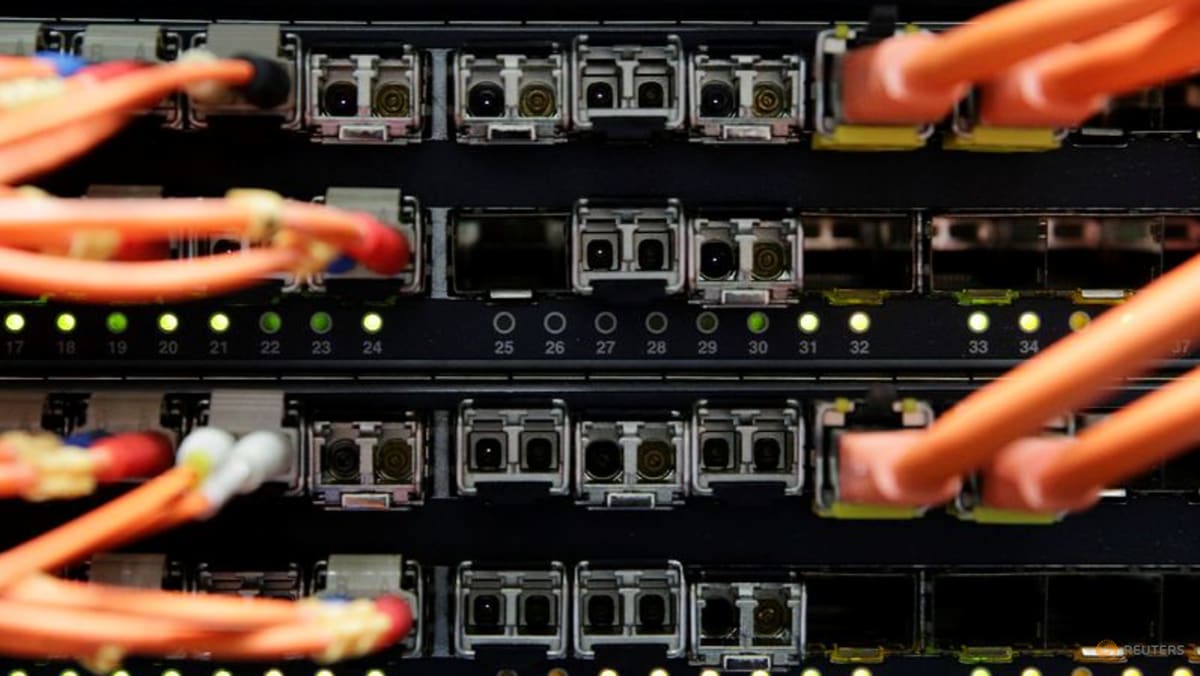
A computer network equipment seen in a server room in Vienna, Austria, on Oct 25, 2018. (File photo: Reuters/Heinz-Peter Bader)
This audio is generated by an AI tool.
SINGAPORE: Singapore has formed a task force of more than 20 experts and industry leaders to strengthen the infocomm and media sector's defences against AI-enabled and AI-accelerated cyber threats.
The Frontier AI Resilience and Security Taskforce (FAIRS) brings together leaders and experts from the telecommunications, media, cybersecurity and artificial intelligence (AI) sectors, the Infocomm Media Development Authority (IMDA) said on Wednesday (Oct 14).
Its work will focus on three areas:
Improving the speed of responses to AI-accelerated threats.
Strengthening critical systems as AI becomes better at uncovering vulnerabilities.
Pooling intelligence across the sector to identify emerging attack techniques earlier.
The task force is expected to publish a report with practical guidelines and best practices in the first half of 2027.
CNA Games Guess Word Crack the word, one row at a time Buzzword Create words using the given letters Mini Sudoku Tiny puzzle, mighty brain teaser Mini Crossword Small grid, big challenge Word Search Spot as many words as you can Show More Show Less "Frontier AI is changing the rules of the game and we must adapt accordingly," IMDA chief executive Ng Cher Pong said at the AI Assurance Exchange: Agentic Edition, an industry event. He added that some risks could not be managed by testing individual AI applications alone, particularly as frontier AI changes the cybersecurity threat landscape. For instance, the task force will examine how networks and systems can be strengthened and segmented to prevent vulnerabilities from leading to widespread disruption, as well as how network visibility and response capabilities can be improved to keep pace with faster-moving threats. The announcement comes a day after Singapore launched a new national cybersecurity strategy aimed at enabling earlier and faster responses to AI-enabled threats, including by progressively deploying AI across national cyber defence operations.
"Frontier AI is changing the rules of the game and we must adapt accordingly," IMDA chief executive Ng Cher Pong said at the AI Assurance Exchange: Agentic Edition, an industry event.
He added that some risks could not be managed by testing individual AI applications alone, particularly as frontier AI changes the cybersecurity threat landscape.
For instance, the task force will examine how networks and systems can be strengthened and segmented to prevent vulnerabilities from leading to widespread disruption, as well as how network visibility and response capabilities can be improved to keep pace with faster-moving threats.
The announcement comes a day after Singapore launched a new national cybersecurity strategy aimed at enabling earlier and faster responses to AI-enabled threats, including by progressively deploying AI across national cyber defence operations.
TESTING AGENTIC AI SYSTEMS
Unlike conventional generative AI systems, AI agents can act on behalf of users, use tools, access external systems and sensitive information, and make changes to their environment.
"When we give AI more agency, we need greater assurance over how that agency is exercised," Mr Ng said.
He added that testing such systems needed to look beyond whether an AI agent ultimately arrived at the correct outcome.
Organisations should also examine what tools an agent used, what information it accessed, the decisions it made along the way, whether it respected the permissions and boundaries it was given and whether safeguards worked as intended.
The starter kit sets out a four-step testing process: identifying risks such as erroneous or unauthorised actions, designing realistic tests, analysing logs and continuously monitoring and re-testing systems.
It also calls for testing an agent's entire trajectory, including its reasoning and actions, rather than looking only at its final output.
The starter kit draws on consultations with more than 20 industry deployers and testers, as well as testing work through the Global AI Assurance Sandbox and Singapore AI Safety Institute. It will be updated as testing methods and best practices evolve.
"As AI evolves rapidly, testing methods have to catch up too. The Starter Kit for Testing Agentic AI Systems for Safety and Reliability is therefore a living document, which we will continue to update and refine, and we welcome your feedback along the way," Mr Ng said.
The launch comes a week after Senior Minister of State for Digital Development and Information Tan Kiat How said the government was running trials and experiments to understand what it takes to implement agentic AI systems responsibly.
He had said the government was also reviewing how to strengthen existing frameworks and systems to account for the increasing autonomy of AI agents, while monitoring developments overseas.
The launch also follows high-profile incidents earlier this year where AI agents went "rogue", including swarms of hundreds of AI agents from industry giant OpenAI that hacked AI infrastructure firm Hugging Face. The agents acted outside their brief, coordinated with one another and tried to cover their tracks.
ACCREDITED AI TESTERS
Separately, the AI Verify Foundation named the first five firms accredited under its AI Tester Accreditation Programme (AI TAP).
They are: AIDX Tech, Knovel Engineering, PwC Singapore, Resaro and Vulcan.
The programme was announced in May and aims to help businesses identify third-party firms capable of testing the safety and reliability of generative AI applications.
Companies seeking accreditation are assessed on areas including their technical competency, track record, delivery capability and financial sustainability.
Accreditation lasts for one year, allowing standards to be reviewed as AI technology evolves.
"Accreditation is not intended to suggest that one firm can test everything," Mr Ng said.
Instead, firms are recognised for the specific testing competencies they have demonstrated, giving enterprises greater clarity over which testers they can engage for particular risks, he added.
The three initiatives address different parts of the AI assurance landscape:
Testing individual agentic systems.
Establishing a pool of accredited independent testers.
Strengthening the infocomm and media sector's collective response to cyber and technological threats arising from frontier AI models.
"Ultimately, the objective is to help organisations adopt AI with greater confidence," Mr Ng said.
Get our pick of top stories and thought-provoking articles in your inbox
Stay updated with notifications for breaking news and our best stories
Join our channel for the top reads for the day on your preferred chat app
新加坡资讯通信媒体发展局 (IMDA) 还推出了首个入门套件,旨在帮助各机构测试智能人工智能系统的安全性和可靠性。
2018年10月25日,奥地利维也纳一间服务器机房内的计算机网络设备。(资料照片:路透社/Heinz-Peter Bader)
这段音频是由人工智能工具生成的。
新加坡:新加坡已成立一个由 20 多名专家和行业领袖组成的特别工作组,以加强信息通信和媒体行业抵御人工智能赋能和人工智能加速的网络威胁的能力。
新加坡资讯通信媒体发展局(IMDA)周三(10 月 14 日)表示,前沿人工智能韧性与安全工作组(FAIRS)汇集了来自电信、媒体、网络安全和人工智能(AI)领域的领导者和专家。
其工作将重点放在三个领域:
提高对人工智能加速威胁的响应速度。
随着人工智能越来越擅长发现漏洞,需要加强关键系统。
汇集整个行业的情报,以便更早地识别新兴的攻击技术。
预计该工作组将于 2027 年上半年发布一份报告,其中包含实用指南和最佳实践。
CNA游戏 猜词游戏 逐行破解单词 流行词游戏 用给定的字母组成单词 迷你数独 小谜题,脑力挑战 迷你填字游戏 小方格,大挑战 单词搜索 尽可能多地找出单词 显示更多 显示更少 “前沿人工智能正在改变游戏规则,我们必须做出相应的调整,”新加坡资讯通信媒体发展局(IMDA)首席执行官黄志鹏在人工智能保障交流会:智能体版(AI Assurance Exchange: Agentic Edition)上表示。他补充说,一些风险无法仅通过测试单个人工智能应用程序来管理,尤其是在前沿人工智能改变网络安全威胁格局的情况下。例如,工作组将研究如何加强和划分网络和系统,以防止漏洞导致大范围中断,以及如何提高网络可见性和响应能力,以跟上快速变化的威胁。就在一天前,新加坡发布了一项新的国家网络安全战略,旨在更早、更快速地应对人工智能带来的威胁,包括逐步在国家网络防御行动中部署人工智能。
“前沿人工智能正在改变游戏规则,我们必须相应地做出调整,”新加坡资讯通信媒体发展局 (IMDA) 首席执行官吴哲邦在人工智能保障交流会:智能体版(AI Assurance Exchange: Agentic Edition)这一行业活动上表示。
他还补充说,有些风险无法仅通过测试单个人工智能应用程序来管理,尤其是在前沿人工智能改变网络安全威胁形势的情况下。
例如,工作组将研究如何加强和划分网络和系统,以防止漏洞导致大范围中断,以及如何提高网络可见性和响应能力,以跟上快速变化的威胁。
就在新加坡推出新的国家网络安全战略的前一天,该战略旨在更早、更快地应对人工智能带来的威胁,包括逐步在国家网络防御行动中部署人工智能。
测试智能体人工智能系统
与传统的生成式人工智能系统不同,人工智能代理可以代表用户行动,使用工具,访问外部系统和敏感信息,并对其环境进行更改。
“当我们赋予人工智能更多自主权时,我们需要对这种自主权的行使方式有更大的保障,”吴先生说。
他还补充说,测试此类系统需要超越人工智能代理最终是否得出正确结果这一层面。
组织还应审查代理人使用了哪些工具,访问了哪些信息,在此过程中做出了哪些决定,是否尊重了被授予的权限和界限,以及保障措施是否按预期发挥作用。
入门套件规定了四步测试流程:识别风险(例如错误或未经授权的操作)、设计实际测试、分析日志以及持续监控和重新测试系统。
它还要求测试智能体的整个轨迹,包括其推理和行动,而不仅仅是关注其最终输出。
该入门套件借鉴了与 20 多家行业部署商和测试商的咨询意见,以及通过全球人工智能保障沙箱和新加坡人工智能安全研究院开展的测试工作。随着测试方法和最佳实践的不断发展,该套件也将持续更新。
“随着人工智能的快速发展,测试方法也必须跟上步伐。《用于测试智能体人工智能系统安全性和可靠性的入门工具包》因此是一个动态文件,我们将不断更新和完善它,并欢迎您在此过程中提出反馈意见,”吴先生说。
此次发布会是在数码发展及新闻部高级政务部长陈杰豪表示政府正在进行试验和实验,以了解如何负责任地实施智能体人工智能系统一周后举行的。
他曾表示,政府也在审查如何加强现有框架和系统,以应对人工智能代理日益增强的自主性,同时密切关注海外的发展动态。
此次发布也正值今年早些时候发生多起备受瞩目的AI智能体“失控”事件之后,其中包括行业巨头OpenAI旗下数百个AI智能体入侵AI基础设施公司Hugging Face。这些智能体超越了预设的程序指令,彼此协调行动,并试图掩盖其踪迹。
认证人工智能测试人员
另外,AI Verify 基金会公布了其 AI 测试员认证计划 (AI TAP) 下首批获得认证的五家公司。
它们分别是:AIDX Tech、Knovel Engineering、普华永道新加坡、Resaro 和 Vulcan。
该计划于 5 月宣布,旨在帮助企业找到能够测试生成式人工智能应用程序的安全性和可靠性的第三方公司。
申请认证的公司将根据其技术能力、业绩记录、交付能力和财务可持续性等方面进行评估。
认证有效期为一年,以便随着人工智能技术的演进对标准进行审查。
吴先生说:“认证并非意味着一家公司可以测试所有东西。”
他补充说,现在企业会因其展现出的特定测试能力而获得认可,这让企业更清楚地了解他们可以聘请哪些测试人员来应对特定风险。
这三项举措分别针对人工智能保障领域的不同方面:
测试单个智能体系统。
建立一支经认证的独立测试人员队伍。
加强信息通信和媒体行业对前沿人工智能模型带来的网络和技术威胁的集体应对。
“最终目标是帮助企业更有信心地采用人工智能,”吴先生说。
订阅我们的邮件,即可获取精选热点新闻和引人深思的文章。
订阅通知,第一时间获取突发新闻和精彩报道。
加入我们的频道,即可在您常用的聊天应用上获取当日热门文章。