Singapore brings forward N95 mask distribution amid worsening haze新加坡在雾霾加剧的情况下提前发放N95口罩
Mask distribution for vulnerable citizens began earlier than originally planned after the 1-hour PM2.5 reading hit 288 in the west at 2pm on Wednesday.
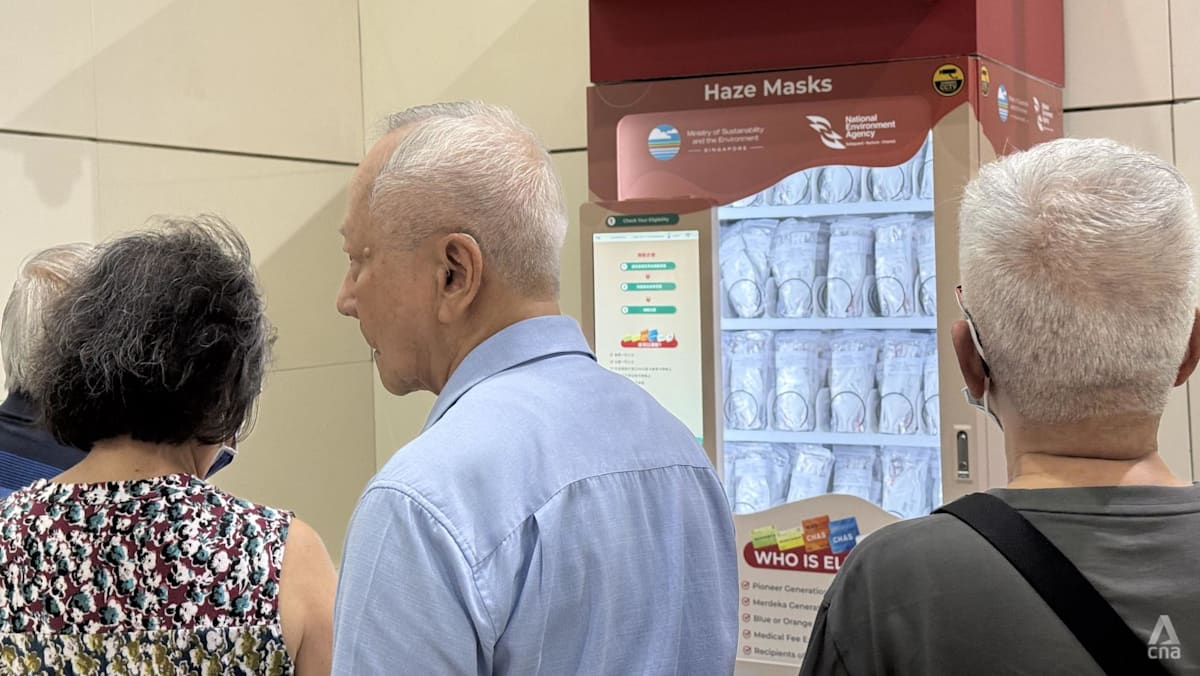
Mask distribution for vulnerable citizens began earlier than originally planned after the 1-hour PM2.5 reading hit 288 in the west at 2pm on Wednesday.
People queuing to collect a free mask at a vending machine at Clementi Bus Interchange on Oct 14, 2026. (Photo: CNA/Charmaine Jacob)
This audio is generated by an AI tool.
SINGAPORE: The government has begun distributing N95 masks to vulnerable Singaporeans before the 24-hour Pollutant Standards Index (PSI) exceeds 200, amid worsening haze and calls from some members of the public for earlier access.
The phased rollout began on Wednesday (Oct 14), after 1-hour PM2.5 readings reached the very high range, with the National Environment Agency (NEA) noting in a media advisory that the PSI could also enter the very unhealthy range.
The 1-hour PM2.5 reading in the west crossed into the very high band at 2pm on Wednesday, the first time this haze season.
Masks are being made available progressively at designated collection points, including community clubs and vending machines at selected public transport hubs, Social Service Offices and People's Association venues. NEA said they may not be immediately available at all locations.
CNA Games Guess Word Crack the word, one row at a time Buzzword Create words using the given letters Mini Sudoku Tiny puzzle, mighty brain teaser Mini Crossword Small grid, big challenge Word Search Spot as many words as you can Show More Show Less Before Wednesday's announcement, CNA had spoken to 21 members of the public about the government's plans for N95 mask distribution. Close to three-quarters said they wanted masks to be made available before the 24-hour PSI exceeded 200. Among them is 72-year-old retiree Mohammed Yusof, a stroke patient who has largely stopped going out since the haze worsened. Mr Yusof, who goes out to exercise and meet friends, said he now stays close to his block and started wearing a mask last week after developing a cough. “Why must we wait for 200? They should start giving out masks now, instead of playing the waiting game,” he said. “It’s important for our health. We are old people. If not, we would fall sick.” Mr Yusof added that he and his wife did not know where to buy N95 masks themselves.
Before Wednesday's announcement, CNA had spoken to 21 members of the public about the government's plans for N95 mask distribution.
Close to three-quarters said they wanted masks to be made available before the 24-hour PSI exceeded 200.
Among them is 72-year-old retiree Mohammed Yusof, a stroke patient who has largely stopped going out since the haze worsened.
Mr Yusof, who goes out to exercise and meet friends, said he now stays close to his block and started wearing a mask last week after developing a cough.
“Why must we wait for 200? They should start giving out masks now, instead of playing the waiting game,” he said.
“It’s important for our health. We are old people. If not, we would fall sick.”
Mr Yusof added that he and his wife did not know where to buy N95 masks themselves.
Under the original plans announced by the government's haze task force on Oct 9, distribution was to begin when the 24-hour PSI exceeded 200, which is in the very unhealthy range.
Eligible groups include pregnant women, children aged seven to 16 and people with medical conditions such as asthma. The task force has said N95 masks are generally not required for short outdoor exposure, such as commuting from home to school or work, or when indoors.
Assistant Professor Seow Wei Jie from the National University of Singapore's (NUS) Saw Swee Hock School of Public Health said the PSI remains an established indicator for assessing daily air quality and planning broader public health measures.
“Much of the scientific evidence on the short-term health effects of particulate matter is based on daily average concentrations,” she said.
The one-hour PM2.5 reading, meanwhile, provides a more immediate indication of air quality, particularly when conditions change rapidly.
“Both indicators therefore serve different but complementary purposes,” Asst Prof Seow said.
Health risks also depend on the duration of exposure, physical activity and individual health conditions, she added.
These factors should be considered when deciding on appropriate precautions, particularly for vulnerable groups.
Dr Chew Wei Yang from Our Family Nest said fixed thresholds provide a broad guide for population-level measures, but described the figures as "quite arbitrary" when applied to individuals, who may respond differently depending on factors such as age and underlying health conditions.
People who develop symptoms at lower readings should take steps to reduce their exposure rather than wait for a fixed threshold to be reached, he added.
Qigong practitioner Lindy Foo, 78, doing a Qigong stance in Bishan on Oct 13, 2026. (Photo: CNA/Raydza Rahman)
Retiree Lindy Foo, 78, said some regular participants of her exercise group had stayed away because they were concerned about the haze.
Ms Foo, who said she has a "bad lung" and coughs easily, said that N95 masks should be made available before PSI reaches 200.
“I think they should give out earlier,” she said, adding that waiting until pollution levels become higher could “defeat the purpose of protecting yourself”.
Rachel Lim, a 34-year-old sales executive who is 22 weeks pregnant, also wants earlier distribution.
“At least we can all be prepared,” she said.
Ms Lim, who started wearing a mask when PSI readings reached around 150, said beginning distribution only after the threshold is crossed could mean a further wait.
“Even now at 150, I feel N95 is a good time to use,” she said.
She keeps most of the windows at home shut, runs an air purifier around the clock and reduces outdoor activities when air quality worsens.
“What concerns me is health more than comfort,” she said.
HEALTH RISKS VARY, MASK FIT MATTERS
Medical experts CNA spoke to said N95 masks can reduce exposure to fine particulate matter when worn correctly, but the point at which people need to take precautions can vary.
“In reality, the health effects of PM2.5 do not suddenly start or stop at a threshold,” said Associate Professor Miranda Loh from NUS Saw Swee Hock School of Public Health.
Some people, particularly those who are vulnerable, may experience effects below fixed PSI thresholds while others may not, she said.
“Those who experience discomfort or symptoms at lower levels should not wait for a threshold to be reached before taking action.”
Duration also matters, Assoc Prof Loh said, with prolonged exposure posing greater potential health risks than brief, unavoidable outdoor exposure.
A vending machine holding 500 masks has been set up at Clementi Bus Interchange on Oct 14, 2026. (Photo: CNA/Charmaine Jacob)
For people who cannot tolerate or are unsuitable for N95 masks, reducing outdoor activities and creating cleaner indoor air are among the alternatives, said Dr Farah Khairi from Dr+ Medical and Paincare Telok Blangah.
The government has advised elderly people, pregnant women and those with severe lung or heart problems who have difficulty breathing at rest or on exertion to consult a doctor before using an N95 mask. "At present, there is no clear health threshold below which haze exposure can be considered safe, especially for vulnerable individuals," said Dr Farah.
N95 masks work by reducing the amount of fine particulate matter a person inhales, but their effectiveness depends on getting a proper fit, experts said.
Assoc Prof Loh said the mask needs to fit the size and shape of a person's face and form a good seal.
A poorly fitting N95 can therefore provide less protection.
Inhalers at a local clinic, as seen on Oct 13, 2026. (Photo: CNA/Raydza Rahman)
For some people with respiratory conditions, wearing an N95 can be difficult.
Asiya Bakht, a media professional, said that as a person with asthma, wearing masks makes her feel “very suffocated” and "very breathless".
“I find it very uncomfortable, and that is the reason I'm not at all able to wear it,” the 52-year-old said.
Instead, she has reduced her exposure in other ways, including working from home and going out less.
Despite being unable to tolerate masks herself, Ms Bakht strongly supported distributing N95 masks earlier for those who can use them.
“For people who can wear it, that is the best defence,” she said.
A 76-year-old retiree who only wanted to be known by his surname, Tan, also felt earlier distribution would particularly benefit those who may struggle to afford N95 masks themselves.
“I think it's better to give,” Mr Tan said. “Don't wait until when the thing happens, then you start distributing.”
If conditions improve, people can meanwhile keep the masks.
“Not everybody can afford to buy masks,” Mr Tan said. He recalled once buying a box of masks for S$5 (US$3.9) during a previous severe haze episode.
Unlike Ms Bakht, however, Shreya Ahuja, who also has asthma, did not feel masks needed to be distributed before PSI 200.
“I think it's a good threshold,” the 22-year-old student said.
She said her asthma has not been significantly affected at current air quality levels and acknowledged that others with asthma may be more sensitive to polluted air than she is.
Dr Lee Kai Xin from GoodHealth Medical and Surgery said the level at which people experience symptoms can vary depending on their health.
“Some people probably don't get triggered at 200, and some people will get triggered at 80,” she said.
People should take their own medical conditions into account rather than relying strictly on the numbers, she added.
“It’s important to stop what you’re doing and take a rest."
Not all seniors CNA spoke to wanted earlier distribution either.
Mrs Arumugam, a 77-year-old retiree who only wanted to be known by her last name, said she had not experienced any effects from the haze and still had masks left over from the COVID-19 pandemic.
“Wait and see. See how the situation is," Mrs Arumugam said.
People walking and cycling with their masks on around Tampines Central on Oct 10, 2026. (Photo: CNA/Raydza Rahman)
PARENTS WANT EARLIER ACTION
Similar questions have arisen over the haze task force's announcement on Oct 9 that the Ministry of Education (MOE) will consider closing schools when the following day's air quality is forecast to be in the hazardous range, with the 24-hour PSI exceeding 300.
Schools also monitor 1-hour PM2.5 readings throughout the day and adjust activities as conditions change. During haze conditions, students are kept in enclosed indoor spaces with air purifiers, while outdoor activities are avoided and lessons may be modified.
Some parents CNA spoke to felt action should be taken before the 24-hour PSI exceeds 300.
Amanda Towers, 41, said she was comfortable sending her children to school at current pollution levels but would become concerned as readings approached 250.
“I think 300 is a bit too high,” said the executive assistant. “It should be about 250.”
Software engineer Jonathan K, 43, whose 10-year-old daughter has asthma, is already considering taking her out of classes.
His daughter uses an inhaler regularly and has recently seen a doctor.
“I don't want her to sit in class all day long exposed to the outside air,” he said
Unlike Mrs Towers, Mr Jonathan does not have a specific indicator at which he would keep his daughter home.
“It's only down to what she's feeling,” he said.
Vidya Iyer, a 38-year-old PhD student whose eight-year-old daughter also has asthma, would prefer schools to offer hybrid or home-based learning if conditions deteriorate.
Her daughter's doctor recently advised the family to use her inhaler daily during the haze, she said. She also has a 10-year-old who attends a school for children with special needs.
“Although they will be glued to the laptop, I guess there's a trade-off,” she said.
However, not all parents fully supported closing schools earlier.
For Nur Akirah, 26, who works in civil service, earlier closure presents a complicated trade-off.
Her six-year-old daughter has mild asthma and was recently unwell.
Ms Akirah said she worries about her daughter having an asthma attack while she is at work.
But when asked whether schools should close before PSI reaches 300, she said: “I think as a working mom, I will say yes and no.”
"The main concern is how frequently I can keep an eye on her when I'm at work and sometimes, I need to be out from my desk for meetings," she added.
She said parents could instead be given additional childcare leave or temporary work-from-home arrangements during severe haze periods.
Kenneth Chew, 36, whose children are three and five, said he would prefer schools to remain open below PSI 300, activities moved indoors and additional masks made available.
“If it's more than 300, of course, I feel that it should close and (the children) stay at home,” the data engineer said.
He added that earlier closures could force working parents to take leave to care for their children.
Get our pick of top stories and thought-provoking articles in your inbox
Stay updated with notifications for breaking news and our best stories
Join our channel for the top reads for the day on your preferred chat app
周三下午 2 点,西部地区 1 小时 PM2.5 读数达到 288,之后,向弱势群体分发口罩的行动比原计划提前开始。
2026年10月14日,人们在金文泰巴士转换站排队领取免费口罩。(图片:CNA/Charmaine Jacob)
这段音频是由人工智能工具生成的。
新加坡:由于雾霾日益严重,一些公众呼吁提前发放口罩,政府已开始在24小时污染物标准指数(PSI)超过200之前向弱势新加坡人分发N95口罩。
分阶段推广措施于周三(10 月 14 日)开始,此前 1 小时 PM2.5 读数达到非常高的水平,国家环境局 (NEA) 在一份媒体公告中指出,PSI 也可能进入非常不健康的水平。
周三下午 2 点,西部地区 1 小时 PM2.5 读数进入极高水平,这是本雾霾季的第一次。
口罩正逐步在指定领取点发放,包括民众俱乐部、部分公共交通枢纽的自动售货机、社会服务办事处和人民协会场所。国家环境局表示,口罩可能不会立即在所有地点都供应。
CNA游戏 猜词游戏 逐行破解单词 流行词游戏 用给定的字母组成单词 迷你数独 小谜题,脑力挑战 迷你填字游戏 小方格,大挑战 单词搜索 尽可能多地找出单词 显示更多 显示更少 在周三的公告发布之前,CNA曾就政府分发N95口罩的计划采访了21位公众人士。近四分之三的人表示,他们希望在24小时PSI指数超过200之前就能获得口罩。其中一位是72岁的退休老人穆罕默德·优素福,他是一名中风患者,自雾霾加剧以来,他基本上停止了外出。优素福先生以前会外出锻炼和与朋友见面,他说现在他只待在自己居住的楼附近,上周开始咳嗽后就戴上了口罩。“为什么非要等到200?他们应该现在就开始分发口罩,而不是玩这种等待的游戏,”他说。“这关系到我们的健康。我们都是老年人了。否则,我们会生病的。”尤索夫先生补充说,他和妻子也不知道去哪里购买N95口罩。
在周三的公告发布之前,CNA 曾就政府分发 N95 口罩的计划采访了 21 位市民。
近四分之三的人表示,他们希望在 24 小时 PSI 超过 200 之前提供口罩。
其中包括 72 岁的退休人员穆罕默德·优素福,他是一名中风患者,自从雾霾加剧以来,他基本上就不再出门了。
尤索夫先生平时会外出锻炼和与朋友见面,他说现在他都待在自己居住的街区附近,而且上周开始出现咳嗽症状后就开始戴口罩了。
“为什么非要等到200人?他们现在就应该开始发放口罩,而不是继续等待,”他说。
“这关系到我们的健康。我们年纪大了,不然我们会生病的。”
尤索夫先生补充说,他和妻子也不知道去哪里购买N95口罩。
根据政府雾霾工作组 10 月 9 日公布的原计划,当 24 小时 PSI 超过 200(处于非常不健康的范围内)时,将开始分发。
符合佩戴口罩条件的人群包括孕妇、7至16岁的儿童以及患有哮喘等疾病的人群。工作组表示,短时间的户外活动,例如上下学或上下班途中,或在室内活动时,通常不需要佩戴N95口罩。
新加坡国立大学苏瑞福公共卫生学院助理教授萧伟杰表示,PSI 仍然是评估每日空气质量和规划更广泛的公共卫生措施的既定指标。
“关于颗粒物对健康短期影响的大部分科学证据都是基于每日平均浓度的,”她说。
与此同时,一小时 PM2.5 读数可以更直接地指示空气质量,尤其是在情况快速变化时。
“因此,这两个指标用途不同,但又互为补充,”Seow助理教授说。
她补充说,健康风险还取决于接触时间的长短、身体活动水平和个人健康状况。
在决定采取适当的预防措施时,应考虑这些因素,特别是对于弱势群体而言。
来自“我们的家庭巢穴”的周伟扬医生表示,固定的阈值为人口层面的衡量提供了一个大致的指导,但当应用于个人时,这些数字“相当随意”,因为个人的反应可能会因年龄和潜在健康状况等因素而有所不同。
他还补充说,即使读数较低也出现症状的人应该采取措施减少接触,而不是等到达到固定阈值才采取行动。
2026年10月13日,78岁的气功练习者Lindy Foo在碧山练习气功。(图片:CNA/Raydza Rahman)
78岁的退休人士林迪·福表示,她所在健身小组的一些常客因为担心雾霾而没有参加。
Foo女士表示自己“肺不好”,容易咳嗽,她说在PSI达到200之前,应该提供N95口罩。
“我认为他们应该早点发放,”她说,并补充说,等到污染水平更高时再发放可能会“违背保护自己的初衷”。
34 岁的销售主管 Rachel Lim 已经怀孕 22 周,她也希望早点收到货。
“至少我们都能做好准备,”她说。
林女士表示,当 PSI 读数达到 150 左右时,她就开始戴口罩。她说,只有在突破阈值后才开始分发口罩,可能意味着还要等待更长时间。
“即使现在气温高达 150 度,我仍然觉得 N95 口罩是使用的好时机,”她说。
她把家里的窗户大多关着,24小时开着空气净化器,空气质量恶化时减少户外活动。
“我更关心的是健康,而不是舒适,”她说。
健康风险因人而异,口罩佩戴是否合适至关重要
CNA采访的医学专家表示,正确佩戴N95口罩可以减少接触细颗粒物,但人们需要采取预防措施的程度可能有所不同。
“实际上,PM2.5 对健康的影响并不会随着浓度达到某个阈值而突然开始或停止,”新加坡国立大学苏瑞福公共卫生学院副教授 Miranda Loh 说。
她说,有些人,特别是那些易感人群,可能会在低于固定 PSI 阈值的情况下受到影响,而其他人则可能不会受到影响。
“那些在较低水平下就感到不适或出现症状的人,不应等到达到阈值才采取行动。”
罗副教授表示,持续时间也很重要,长时间暴露在户外比短暂、不可避免的户外暴露带来更大的潜在健康风险。
2026年10月14日,金文泰巴士转换站设立了一台装有500个口罩的自动售货机。(图片:CNA/Charmaine Jacob)
Dr+ Medical and Paincare Telok Blangah 的 Farah Khairi 医生表示,对于不能忍受或不适合佩戴 N95 口罩的人来说,减少户外活动和创造更清洁的室内空气是可行的替代方案。
政府建议老年人、孕妇以及患有严重肺部或心脏疾病、在休息或运动时呼吸困难的人群,在使用N95口罩前咨询医生。法拉赫医生表示:“目前,尚无明确的健康阈值来界定雾霾暴露的安全程度,尤其对于易感人群而言。”
专家表示,N95口罩的工作原理是减少人吸入的细颗粒物数量,但其有效性取决于是否佩戴合适。
罗副教授表示,口罩需要贴合人脸的尺寸和形状,并形成良好的密封。
因此,不合适的N95口罩提供的防护效果会降低。
2026年10月13日,当地诊所摆放着吸入器。(图片:CNA/Raydza Rahman)
对于一些患有呼吸系统疾病的人来说,佩戴N95口罩可能会比较困难。
媒体从业人员阿西娅·巴赫特表示,作为一名哮喘患者,戴口罩让她感到“非常窒息”和“非常喘不过气”。
“我觉得很不舒服,这就是我根本穿不了它的原因,”这位52岁的女士说道。
相反,她通过其他方式减少了接触风险,包括在家工作和减少外出。
尽管巴赫特女士本人无法忍受戴口罩,但她强烈支持更早地向能够使用口罩的人分发 N95 口罩。
“对于能够佩戴它的人来说,这是最好的防御措施,”她说。
一位76岁的退休老人,只愿透露自己的姓氏是谭,也认为提前分发口罩将特别有利于那些可能难以负担N95口罩的人。
“我认为应该主动付出,”陈先生说。“不要等到事情发生后才开始分发。”
如果情况好转,人们可以暂时继续佩戴口罩。
“不是每个人都买得起口罩,”陈先生说。他回忆起之前一次严重的雾霾天气,他曾花5新元(3.9美元)买了一盒口罩。
然而,与巴赫特女士不同的是,同样患有哮喘的什雷娅·阿胡贾认为在 PSI 200 之前没有必要分发口罩。
“我认为这是一个很好的门槛,”这位22岁的学生说。
她说,在目前的空气质量水平下,她的哮喘并没有受到明显影响,并承认其他哮喘患者可能比她对污染的空气更敏感。
来自 GoodHealth Medical and Surgery 的李凯欣医生表示,人们出现症状的程度可能因健康状况而异。
“有些人可能不会对 200 这个词感到愤怒,而有些人 80 这个词就会让他们愤怒,”她说。
她补充说,人们应该考虑自身的健康状况,而不是仅仅依赖这些数字。
“重要的是停下你正在做的事情,休息一下。”
并非所有接受 CNA 采访的老年人都希望提前分发药品。
77岁的退休人士阿鲁穆甘夫人(她只愿透露自己的姓氏)表示,她没有感受到雾霾的任何影响,而且还有新冠疫情期间剩下的口罩。
“等等看吧,看看情况如何发展,”阿鲁穆甘夫人说。
2026年10月10日,人们戴着口罩在淡滨尼中心附近步行和骑自行车。(图片:CNA/Raydza Rahman)
家长希望更早采取行动
10 月 9 日,雾霾工作组宣布,如果预计第二天的空气质量将达到危险级别,24 小时 PSI 值超过 300,教育部将考虑关闭学校。这一消息也引发了类似的疑问。
学校还会全天监测PM2.5的1小时读数,并根据情况变化调整活动。雾霾天气下,学生会被安排在配备空气净化器的室内场所,避免户外活动,课程安排也可能有所调整。
接受 CNA 采访的一些家长认为,应该在 24 小时 PSI 超过 300 之前采取行动。
41 岁的阿曼达·托尔斯表示,在目前的污染水平下,她可以放心地送孩子去上学,但如果读数接近 250,她就会开始担心。
“我觉得300有点太高了,”行政助理说,“应该在250左右。”
43岁的软件工程师乔纳森·K,他的10岁女儿患有哮喘,已经在考虑让她退学了。
他的女儿经常使用吸入器,最近还去看过医生。
“我不想让她整天坐在教室里,暴露在室外空气中,”他说。
与托尔斯太太不同,乔纳森先生并没有一个具体的标准来判断他是否会让女儿待在家里。
“这完全取决于她的感受,”他说。
38 岁的博士生 Vidya Iyer 的 8 岁女儿也患有哮喘,她希望如果情况恶化,学校能够提供混合式或居家学习。
她说,她女儿的医生最近建议他们一家在雾霾期间每天给女儿使用吸入器。她还有一个10岁的孩子,在一所特殊儿童学校就读。
“虽然他们会一直盯着笔记本电脑,但我想这其中也存在一些权衡,”她说。
然而,并非所有家长都完全支持提前关闭学校。
对于 26 岁的公务员努尔·阿基拉来说,提前关闭意味着一个复杂的权衡。
她六岁的女儿患有轻微哮喘,最近身体不舒服。
阿基拉女士说,她担心女儿在她上班时哮喘发作。
但当被问及学校是否应该在 PSI 达到 300 之前关闭时,她说:“作为一名职业妈妈,我认为我会说是,也会说不是。”
她补充说:“我最担心的是,我在工作时能多久才能照看她一次,而且有时候,我需要离开办公桌去开会。”
她表示,在雾霾严重时期,可以给予家长额外的育儿假或临时居家办公安排。
36 岁的 Kenneth Chew 有两个孩子,一个三岁,一个五岁。他说,他希望学校在 PSI 低于 300 的情况下保持开放,活动转移到室内,并提供额外的口罩。
“如果超过 300 例,我当然觉得应该关闭,(孩子们)应该待在家里,”这位数据工程师说。
他还补充说,提前关闭可能会迫使在职父母请假照顾孩子。
订阅我们的邮件,即可获取精选热点新闻和引人深思的文章。
订阅通知,第一时间获取突发新闻和精彩报道。
加入我们的频道,即可在您常用的聊天应用上获取当日热门文章。