Microbes along S’pore coastline break down oil faster when sand is less waterlogged, has more oxygen: Report报告显示,新加坡海岸线附近的微生物在沙子含水量较低、氧气含量较高时,能更快地分解石油。
Research shows microbes clean up oil spills faster in oxygen-rich, well-drained sand, offering new strategies to accelerate natural coastal recovery in Singapore. Read more at straitstimes.com.
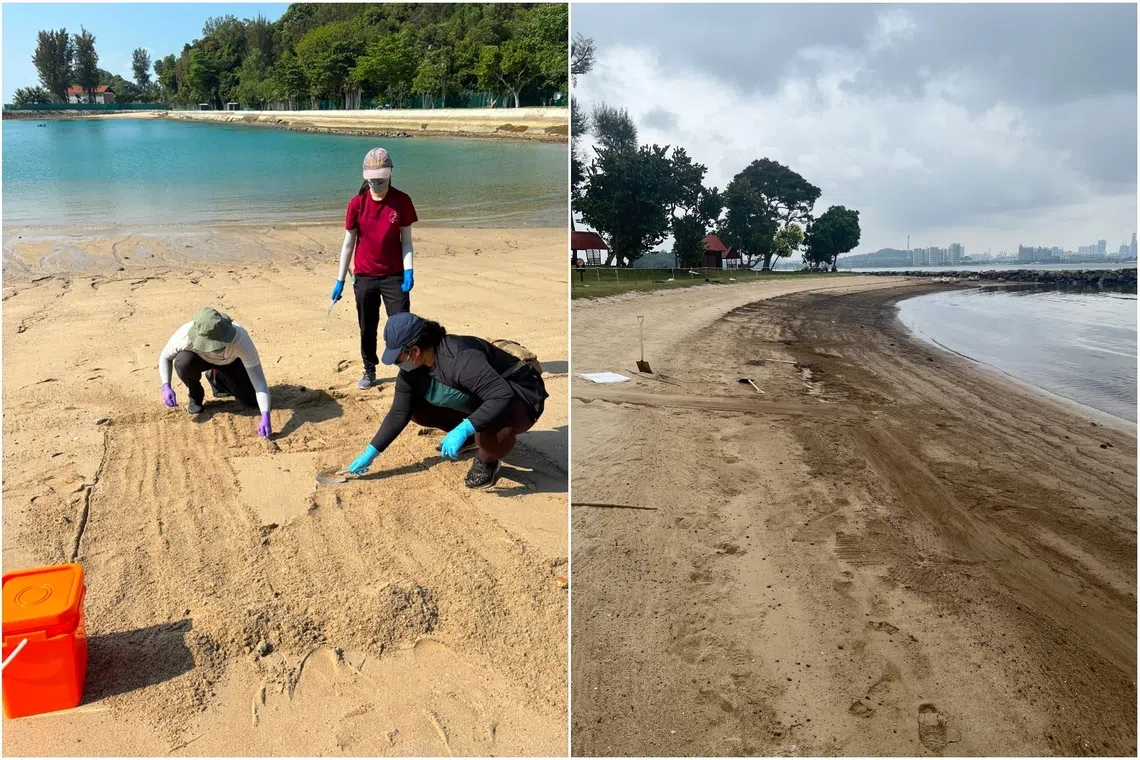
Samples of sand were collected from Bendera Bay on St John’s Island, a beach designated for long-term scientific study.
PHOTO: STEPHEN BRIAN POINTING
Published Sep 06, 2026, 03:00 PM
Updated Sep 06, 2026, 03:00 PM
SINGAPORE – Nature can be man’s best friend in responding to man-made disasters like an oil spill.
Micro-organisms, which already clean up the oil naturally, can do an even better job of the task under certain conditions – specifically when the sand is less waterlogged and has more oxygen – according to newly released research.
This finding could help responders better understand the conditions that favour natural oil removal and come up with interventions to speed up oil spill clean-ups, said Professor Stephen Brian Pointing of the National University of Singapore, who led the research.
The research was published in August in a peer-reviewed journal, Environmental Science and Ecotechnology.
Over 90 days, microbes degraded 40 per cent of the oil in sand that was well-drained and rich in oxygen. But in waterlogged and oxygen-poor sand, that figure fell to 5 per cent over the same duration .
Oxygen is an important factor in determining how efficiently microbes break down oil , said Pointing. While bacteria can still degrade oil when oxygen is scarce, the process is far slower and less efficient.
Different types of bacteria take over depending on how much oxygen is available.
In oxygen-rich sand, certain bacteria – particularly those from a group called Alphaproteobacteria – use oxygen to rapidly break down oil. Meanwhile, in waterlogged and oxygen poor sand, other bacteria take over to degrade the oil, albeit less efficiently.
These findings stemmed from the team’s initial research in September 2025, prompted by one of Singapore’s worst oil spills. In June 2024, a dredging boat collided with a bunker vessel, releasing more than 400 tonnes of oil into the nation’s southern waters.
Pointing said: “The first study was basically showing that the microbes were involved in cleaning up the sand from that big spill in 2024, and this study is explaining exactly how they achieve it.”
“In the past, people knew that the oil disappears, but they didn’t know what’s causing it,” he said.
“We have shown that 40 per cent of the oil is being broken down by the microbes, which is quite a significant amount. This means that keeping our beaches healthy in terms of their microbial populations is a really important part of management .”
The researchers found that there is a total of 298 species of microbes breaking down the oil in sand collected from Bendera Bay on St John’s Island, a beach designated for long-term scientific study.
They were identified using metagenomic sequencing, a method that enables scientists to characterise all genetic material in a sample and also the microbes’ ways to degrade oil.
The latest research also revealed that some microbes are “unusually adapted” to both the presence and absence of oxygen, so they can degrade oil under both conditions as beach conditions fluctuate such as during a change in tide, said Pointing.
They may act as metabolic bridges, allowing degradation to continue while the environment is switching between oxygen-rich and oxygen-depleted states, he added.
The NUS researchers found that there is a total of 298 species of microbes breaking down the oil in sand collected from Bendera Bay on St John’s Island. PHOTO: STEPHEN BRIAN POINTING
The NUS researchers found that there is a total of 298 species of microbes breaking down the oil in sand collected from Bendera Bay on St John’s Island.
Using these findings and data, the research team is now building predictive models to identify which beaches are likely to break down oil naturally and quickly, and which ones the oil will linger on, requiring active intervention.
This could mean leaving parts of the beaches alone, or taking steps to reproduce the conditions needed to accelerate the process of the oil being broken down naturally.
For example, responders could aerate the sand, promote water drainage in the sand or make sure the slopes of the beaches are not too shallow.
“The end goal is to provide some practical and sort of tractable low-cost advice that will just let us plan better instead of having to deploy massive effort to remove oil,” he said.
Pointing noted that Singapore’s equatorial climate, highly used shipping lanes and highly dynamic tropical coastlines make it a treasure trove for research in this field. Most of the world’s detailed knowledge of major marine oil spills has historically come from other places.
“Recovery from an oil spill does not stop when the visible oil disappears,” he said.
“There is a largely invisible biological recovery process continuing within the sediment. Understanding that gives us another tool for protecting and managing tropical coastlines.”
Chin Hui Shan is a journalist covering the environment beat at The Straits Times.
从圣约翰岛的本德拉湾采集了沙子样本,该海滩被指定为长期科学研究用地。
照片:斯蒂芬·布莱恩·波因廷
发布于 2026 年 9 月 6 日下午 3:00
更新于2026年9月6日下午3:00
新加坡——在应对石油泄漏等人为灾难时,大自然可以成为人类最好的朋友。
根据最新发布的研究,微生物本身就能自然地清除石油,在某些条件下(特别是当沙子含水量较低且氧气较多时),它们可以更好地完成这项工作。
领导这项研究的新加坡国立大学斯蒂芬·布莱恩·波因廷教授表示,这一发现可以帮助救援人员更好地了解有利于自然清除石油的条件,并提出干预措施来加快石油泄漏清理工作。
该研究成果于 8 月发表在同行评审期刊《环境科学与生态技术》上。
在排水良好、富含氧气的沙子中,微生物在90天内降解了40%的石油。但在水分饱和、缺氧的沙子中,同样的时间里,这一比例下降到了5%。
波因廷表示,氧气是决定微生物分解石油效率的重要因素。虽然在氧气匮乏的情况下,细菌仍然可以降解石油,但过程会慢得多,效率也低得多。
根据氧气供应量的多少,不同类型的细菌会占据主导地位。
在富氧的沙土中,某些细菌——特别是属于α-变形菌纲的细菌——利用氧气快速分解石油。与此同时,在含水量高且缺氧的沙土中,其他细菌也会参与石油的降解,尽管效率较低。
这些发现源于该团队于2025年9月开展的初步研究,起因是新加坡历史上最严重的漏油事件之一。2024年6月,一艘挖泥船与一艘加油船相撞,导致超过400吨原油泄漏到该国南部海域。
波因廷说:“第一项研究基本上表明,微生物参与了清理 2024 年那次大泄漏事故中的沙子,而这项研究则解释了它们究竟是如何做到这一点的。”
“过去人们知道石油会消失,但他们不知道造成这种情况的原因,”他说。
“我们已经证明,40%的石油正在被微生物分解,这是一个相当可观的比例。这意味着,保持海滩微生物群落的健康是管理工作中非常重要的一部分。”
研究人员发现,在圣约翰岛本德拉湾采集的沙子中,共有 298 种微生物正在分解石油。本德拉湾是一处指定用于长期科学研究的海滩。
科学家利用宏基因组测序技术鉴定了这些微生物,这种方法能够对样本中的所有遗传物质以及微生物降解石油的方式进行表征。
最新研究还表明,一些微生物“异常适应”有氧和无氧环境,因此它们可以在海滩条件波动(例如潮汐变化期间)的情况下降解石油,波因廷说。
他还补充说,它们可以起到代谢桥梁的作用,使降解过程在环境从富氧状态切换到缺氧状态时继续进行。
新加坡国立大学的研究人员发现,在圣约翰岛本德拉湾采集的沙子中,共有298种微生物正在分解石油。照片:斯蒂芬·布莱恩·波因廷
新加坡国立大学的研究人员发现,在圣约翰岛本德拉湾采集的沙子中,共有 298 种微生物正在分解石油。
利用这些发现和数据,研究团队目前正在构建预测模型,以确定哪些海滩可能会自然快速地分解石油,以及哪些海滩上的石油会长时间滞留,需要积极干预。
这可能意味着保留部分海滩,或者采取措施重现加速石油自然分解过程所需的条件。
例如,救援人员可以给沙子通气,促进沙子中的水排出,或者确保海滩的坡度不要太浅。
他说:“最终目标是提供一些切实可行且成本低廉的建议,让我们能够更好地进行规划,而不是投入大量精力来清除石油。”
波因廷指出,新加坡的赤道气候、繁忙的航道和变化莫测的热带海岸线使其成为该领域研究的宝库。历史上,世界上大部分关于重大海洋溢油事故的详细知识都来自其他地方。
他说:“石油泄漏后的恢复工作并非在肉眼可见的石油消失后就结束了。”
“沉积物中存在着一个很大程度上不可见的生物恢复过程。了解这一过程为我们保护和管理热带海岸线提供了另一种工具。”
Chin Hui Shan是《海峡时报》负责环境报道的记者。