This Singaporean shoemaker moved to Kyoto to make barefoot shoes by hand这位新加坡鞋匠移居京都,手工制作赤足鞋。
Singaporean craftsperson Chin Shiying went to Japan to master traditional shoemaking – only to realise she didn’t want to wear the shoes she made. That discovery eventually led her to barefoot footwear and a new life in Kyoto.
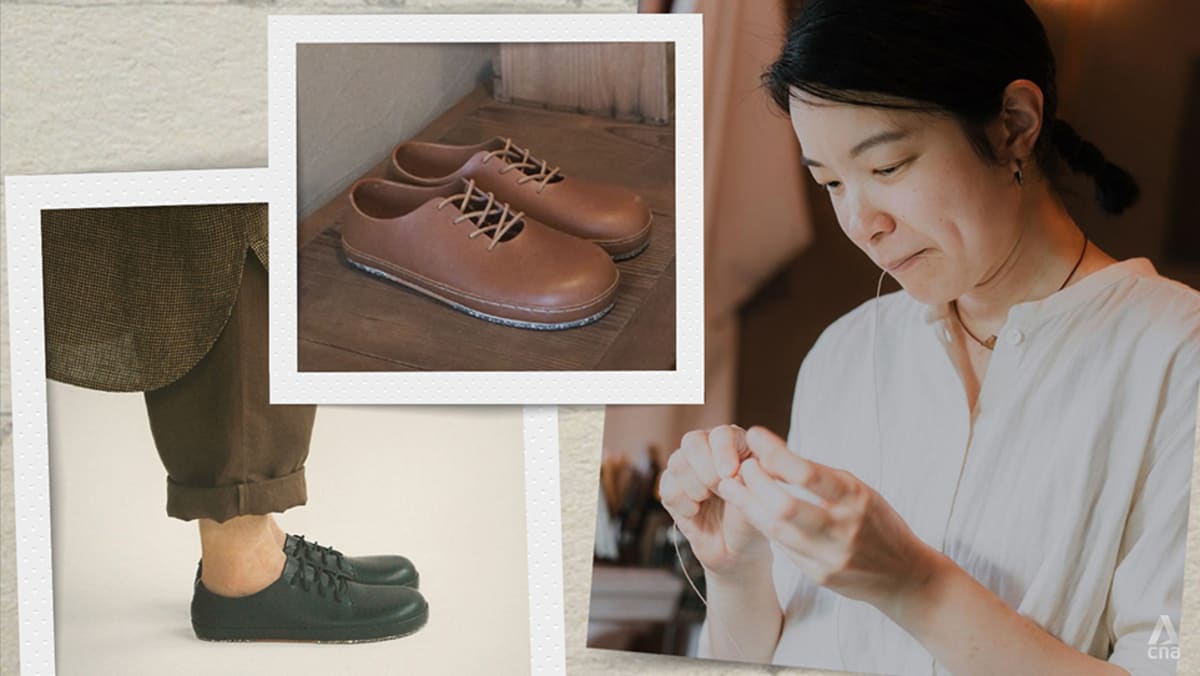
Singaporean craftsperson Chin Shiying went to Japan to master traditional shoemaking – only to realise she didn’t want to wear the shoes she made. That discovery eventually led her to barefoot footwear and a new life in Kyoto.
Singaporean craftsperson Chin Shiying, 37, moved to Kyoto in 2024 to launch Yanmaei, an artisanal label specialising in handmade leather barefoot shoes. (Photos: Yanmaei; Art: CNA/Chern Ling)
This audio is generated by an AI tool.
A good friend of mine once told me he had never owned a truly comfortable pair of shoes until he was in his twenties. It was only after having his feet properly measured that he discovered they were wider than average. For years, he had simply squeezed them into narrower, off-the-rack shoes without questioning it.
It was a classic case of not knowing what you don’t know: If discomfort is all you’ve ever felt, you might not recognise it as discomfort at all.
That is the question at the heart of Singaporean craftsperson Chin Shiying’s work: What if we have simply forgotten what shoes – and feet – are supposed to feel like?
Yanmaei founder, Chin Shiying. (Photo: Ethan Ingle)
Through Yanmaei, her Kyoto-based artisanal leather label, the 37-year-old makes barefoot shoes designed to give the feet more freedom to move. They have thin, flexible soles, no raised heel and a wide toe box that allows the toes to spread naturally.
“When we wear shoes that are not feet-shaped, over time, our feet will naturally mould into the shape of the shoe,” said Chin.
She believes the problem is especially pronounced in conventional dress shoes, whose narrow, pointed lasts and rigid soles restrict how the foot moves.
“The hardness of the soles doesn’t allow you to bend your feet when you move, so you’re just walking with ‘micro-bends’,” she said. “All that rigidity adds to the body not being able to perform at its best.”
AN EARLY INSTINCT FOR MAKING THINGS
As a child, Chin dismantled toys and Barbie dolls to see how they worked. At school, she was the one classmates turned to when something needed fixing.
Her parents still run a signboard-making business, and Chin spent much of her childhood in their workshop, peeling vinyl stickers and watching them build signs by hand.
“I grew up watching them build their own business,” she said. “It’s something that I feel very naturally inclined to.”
Chin's tools at Yanmaei. (Photo: Ethan Ingle)
After struggling through Millennia Institute, Chin left in her second year and enrolled at the Nanyang Academy of Fine Arts to study fashion design at her mother’s suggestion. The entrance test involved sewing and drawing.
“I was like, ‘Oh, this is the most fun I’ve ever had,’” she recalled.
She eventually earned her degree and worked across production, retail and tailoring, imagining that she might one day start her own label.
View this post on Instagram A post shared by Tarzan (@tarzanweb)
A post shared by Tarzan (@tarzanweb)
But a 2014 trip to Kyoto to visit her sister sent her in another direction. Chin attended several workshops at a nearby leather studio and was immediately drawn to the unforgiving nature of the material.
“With leather, you can see where you make a mistake, whereas you can probably disguise it in fabrics,” she said. “There’s no cheating. If you want to do it well, then you have to spend the time to master it.”
At the end of the workshops, she asked the Japanese leather artisan, over Google Translate, if she could return to learn more.
“Whenever you’re ready, just come back,” he replied.
It took Chin about two and a half years to save enough money. In the meantime, she learnt Japanese, eventually passing the upper-intermediate N2 proficiency exam.
In 2016, she returned to Kyoto and spent roughly a year apprenticing with the artisan, learning through the daily rhythm of production rather than a formal syllabus.
“There was something new every day,” she said. “As I was helping him to craft something, he would teach me the steps naturally.”
WHEN MAKING BECAME TOO MUCH
Back in Singapore, Chin launched her own leather accessories label, Senkoubou, in 2018, making bags, wallets and other small leather goods. Its name was a play on the Japanese pronunciation of her surname and koubou, meaning “workshop”.
The business grew, but so did the demands of running a one-person craft operation. During the pandemic, Chin took on too many custom jobs and found herself confronting a basic limitation of making everything by hand: Her income depended on how much she could physically produce.
“Your hands don’t move, you don’t get paid,” she said.
Wanting a reset, she enrolled at a reputable shoemaking school in Tokyo, initially to expand her technical skills rather than start a shoe business.
Yanmaei founder Chin Shiying. (Photo: Ethan Ingle)
The course required her to make 10 types of classic men’s shoes, including oxfords and monk straps, with each pair taking up to two months.
She loved the rigour of making them. Wearing them was another matter.
“I walked a lot in the shoes I made and my feet would hurt,” she said. “There was a sense of accomplishment when I finished making the shoes, but I realised I didn’t want to wear them.”
Once each pair was finished, she found herself reaching for sneakers instead.
Around the same time, Chin discovered barefoot shoes on Instagram and bought a pair from British brand Vivobarefoot. Chin has hypermobile ankles, and found that being closer to the ground made her feel steadier.
“So I thought: Maybe I could make barefoot shoes using the techniques I’ve already learnt,” she said.
There was another person she had in mind, too.
Her mother has bunions and has long struggled to find comfortable shoes. “Since I was young, when she takes me shopping, it’s really hard for my mum to buy shoes. Everything would be so squished,” Chin said.
“So my first target customer is my mum.”
MOVING TO KYOTO FOR GOOD
By then, Chin had also begun thinking about staying in Japan more permanently.
She already knew its craft ecosystem, and Kyoto offered specialist leather, tools and suppliers, along with something she had missed in Singapore: A community of people equally invested in the minutiae of making things.
“I felt very lonely in Singapore, not really able to discuss the small details of craft,” she said.
But inspiration alone wasn’t enough to justify the move. She needed a business concept that could meet Kyoto’s requirements for a Business Manager visa. Chin put forward her handmade leather barefoot shoe concept, building on the shoemaking skills she had acquired in Tokyo. Once her application was approved, she moved to Kyoto in 2024.
The move also marked her rebrand from Senkoubou to Yanmaei, named after the Chinese bayberry – yangmei – a small, sweet red fruit that grows in bunches.
Yanmaei's selection of products. (Photo: Ethan Ingle)
After building Senkoubou largely on her own, Chin wanted the new business to grow differently: Into a small team where everyone could feel part of creating something wholesome together.
She set up her studio in Jodo-ji, near Ginkaku-ji and the Philosopher’s Path – first in an old house she renovated with friends, before moving to a bigger, brighter space nearby. Her first customer was the owner of a juice bar in the neighbourhood.
Yanmaei's studio in Kyoto. (Photo: Ethan Ingle)
Two years into her new life in Kyoto, Chin says things are beginning to fall into place.
“Business has been improving month by month,” she said. “I feel like I have a community I can depend on, and I’ve grown to be more confident.”
THE HARDEST PART ISN’T THE SHOE
For all the painstaking work involved in making a shoe by hand, Chin says one of her biggest challenges comes before the shoe itself: Figuring out what shape it should begin with.
View this post on Instagram A post shared by yanmaei・ヤンメイ (@yanmaei_)
A post shared by yanmaei・ヤンメイ (@yanmaei_)
At the heart of every shoe is the last, the three-dimensional mould around which it is built. Conventional lasts follow established ideas of how a shoe should look and fit. A barefoot last, by contrast, has to accommodate a wider toe box, flatter profile and the foot’s natural movement.
That has left Chin navigating between two approaches to shoemaking.
Many of the last-makers she approached are deeply skilled in traditional shoemaking but have little experience working outside those conventions. She has also found that the craft is often approached from a design perspective – how a shoe should look, how a last should be proportioned – while her starting point is nearly the opposite.
“My purpose is comfort first, then design,” she said.
It has been a slow process of finding open-minded collaborators and working things out one step at a time. Chin has learnt to make lasts herself while continuing to search for specialised guidance.
“It’s quite stressful to figure this out by myself,” she said. “I don’t want to make shoes that end up causing people more problems.”
For her, a finished shoe has to pass two tests: “It doesn’t hurt when I wear it for the entire week, and aesthetically, it’s something I want to look at every day.”
Today, shoes are Yanmaei’s main focus, while bags and wallets are produced in smaller quantities.
Its current shoe collection features three barefoot styles, including T-strap and lace-up variations, priced from ¥69,800 (around S$575). Made to order in Chin’s Kyoto workshop, they use vegetable-tanned leather sourced from Italy, Japan and Mexico, and feature wide toe boxes, zero-drop construction and thin, flexible soles.
Production can take up to six months, depending on the season. The shoes are still made mostly by Chin, with help from a former shoemaking schoolmate who recently moved to Kyoto and joined Yanmaei part-time.
It remains a small operation. Yanmaei produces roughly 10 to 20 pairs every two to three months, and most customers are Japanese. Many visit the studio first to try on samples, given the importance of fit.
But Chin is beginning to reconsider an assumption that shaped her first business: That being a craftsperson means doing everything herself.
She wants to introduce more styles, grow her team and outsource some processes – partly because the economics of staying in Japan demand it.
“I used to have that mindset,” she said. “But because I’m not in Singapore, I have to profit to be able to renew my visa. I’m like, okay, I need to put on my business hat. I need to share the workload.”
It is a lesson she has already learnt once. With Senkoubou, the limits of the business were ultimately the limits of her own two hands. With Yanmaei, she is trying to build something that can grow beyond them.
Whether Kyoto will be a permanent base, she doesn’t yet know. For now, Chin is giving herself roughly five years to see where the business takes her.
What she does know is that she wants to keep doing the thing that has followed her from her parents’ signboard workshop in Singapore to a leather studio in Kyoto, and now to a shoemaking bench of her own.
“I just want to be making something.”
A single handpicked story that we think you shouldn't miss. Just one a day.
Our chief editor shares analysis and picks of the week's biggest news every Saturday.
新加坡手工艺人陈诗莹前往日本学习传统制鞋技艺,却发现自己并不想穿自己亲手制作的鞋子。这一发现最终引领她走向赤足鞋的世界,并在京都开启了新的生活。
37岁的新加坡手工艺人陈诗英于2024年移居京都,创立了Yanmaei品牌,该品牌专营手工皮革赤足鞋。(图片:Yanmaei;艺术:CNA/Chern Ling)
这段音频是由人工智能工具生成的。
我的一位好友曾告诉我,直到二十多岁,他才拥有一双真正舒适的鞋子。原来,他认真量过脚的尺寸后才发现自己的脚比一般人宽。多年来,他一直只是把脚硬塞进那些窄窄的成鞋里,从未想过这个问题。
这是一个典型的“不知道自己不知道什么”的例子:如果你一直以来都只感到不舒服,你可能根本不会意识到这是不舒服。
这就是新加坡工匠陈诗英作品的核心问题:如果我们已经忘记了鞋子——以及双脚——应该是什么感觉,那该怎么办?
燕麦创始人秦世英。(摄影:Ethan Ingle)
这位37岁的女性通过她在京都创立的手工皮革品牌Yanmaei,制作赤足鞋,旨在赋予双脚更大的活动自由度。这些鞋子鞋底轻薄柔韧,没有鞋跟,宽敞的鞋头设计让脚趾可以自然舒展。
“当我们穿不符合脚型的鞋子时,随着时间的推移,我们的脚会自然而然地变成鞋子的形状,”秦说。
她认为这个问题在传统的正装鞋中尤为突出,因为这种鞋的鞋楦窄而尖,鞋底坚硬,限制了脚的活动。
“鞋底太硬,走路时脚部无法弯曲,只能做‘微弯曲’,”她说。“这种僵硬感会影响身体的最佳状态。”
从小就有一种创造事物的本能
小时候,秦就喜欢拆解玩具和芭比娃娃,研究它们的构造。在学校里,同学们遇到需要修理的东西,都会来找她帮忙。
她的父母仍然经营着一家招牌制作公司,秦的童年大部分时间都在他们的作坊里度过,撕掉乙烯基贴纸,看着他们手工制作招牌。
“我从小就看着他们一步步建立自己的事业,”她说。“我觉得自己很适合做这件事。”
燕麦的秦氏工具。(照片:伊桑·英格尔)
在千禧学院苦读之后,陈在二年级时辍学,听从母亲的建议,进入南洋艺术学院学习服装设计。入学考试包括缝纫和绘画。
她回忆说:“我当时想,‘哦,这是我玩得最开心的一次。’”
她最终获得了学位,并在生产、零售和裁剪等各个环节工作过,梦想着有一天能创立自己的品牌。
在 Instagram 上查看此帖子 由 Tarzan (@tarzanweb) 分享的帖子
Tarzan (@tarzanweb) 分享的帖子
但2014年去京都探望姐姐的一次旅行改变了她的人生方向。秦参加了附近一家皮革工作室的几个工作坊,立刻被这种材料毫不妥协的特性所吸引。
“用皮革的话,哪里出错就一目了然,而用布料的话,错误可能更容易掩盖,”她说。“没有捷径可走。如果你想做好,就必须花时间去精通。”
工作坊结束后,她通过谷歌翻译询问那位日本皮革工匠,她是否可以回来学习更多。
“你准备好了就回来吧,”他回答说。
Chin花了大约两年半的时间才攒够钱。在此期间,她学习了日语,最终通过了中高级N2水平考试。
2016 年,她回到京都,花了大约一年时间跟随工匠学习,通过日常生产的节奏而不是正式的课程来学习。
“每天都有新鲜事,”她说。“当我帮他制作东西时,他会自然而然地教我步骤。”
当制作变得太多时
回到新加坡后,Chin于2018年创立了自己的皮具配饰品牌Senkoubou,生产包袋、钱包和其他小型皮具。品牌名称取自她姓氏的日语发音和“koubou”(意为“作坊”)的谐音。
生意越做越大,但经营一家单人手工艺作坊的压力也随之增加。疫情期间,Chin接了太多定制订单,发现自己面临着纯手工制作的根本局限:收入完全取决于她的实际产量。
“你的手不动,你就拿不到工资,”她说。
为了重新开始,她报读了东京一所知名的制鞋学校,最初是为了提升自己的技术技能,而不是为了开办制鞋生意。
燕麦创始人秦世英。(图片:Ethan Ingle)
课程要求她制作 10 种经典的男鞋,包括牛津鞋和僧侣鞋,每双鞋的制作时间长达两个月。
她喜欢制作它们的严谨过程。至于穿戴它们,那就是另一回事了。
“我穿着自己做的鞋子走了很多路,脚都疼了,”她说。“做完鞋子后,我确实很有成就感,但我意识到我并不想穿它们。”
每穿完一双鞋,她都会忍不住换上运动鞋。
大约在同一时间,Chin在Instagram上发现了赤足鞋,并从英国品牌Vivobarefoot购买了一双。Chin的脚踝活动度过大,她发现赤足鞋让她感觉更贴近地面,从而更加稳定。
“所以我想:也许我可以利用我已经学到的技术来制作赤足鞋,”她说。
她心中还有另一个人选。
她的母亲患有拇外翻,长期以来一直难以找到舒适的鞋子。“从我小时候起,妈妈带我去购物时,买鞋对她来说就非常困难。鞋子总是挤得难受,”陈女士说。
“所以我的首要目标客户就是我妈妈。”
永久移居京都
那时,秦也开始考虑长期留在日本。
她已经了解了京都的工艺生态系统,京都不仅拥有专业的皮革、工具和供应商,还有她在新加坡所怀念的东西:一个同样致力于制作物品细节的人们的社群。
“我在新加坡感到非常孤独,无法真正讨论工艺方面的小细节,”她说。
但光有灵感并不足以让她下定决心。她需要一个符合京都商务经理签证要求的商业理念。于是,她提出了自己手工制作皮革赤足鞋的理念,并在此基础上发展了她在东京习得的制鞋技艺。申请获批后,她于2024年搬到了京都。
此举也标志着她从 Senkoubou 更名为 Yanmaei,这个名字来源于中国杨梅(yangmei),一种成串生长的小型甜红色水果。
Yanmaei 的产品系列。(图片:Ethan Ingle)
在独自一人创立 Senkoubou 之后,Chin 希望新公司能够以不同的方式发展:成为一个小型团队,让每个人都能感受到共同创造美好事物的乐趣。
她在净土寺附近,靠近银阁寺和哲学之道的地方设立了自己的工作室——最初是在她和朋友一起翻修的一栋老房子里,后来搬到了附近一个更大更明亮的地方。她的第一位顾客是附近一家果汁店的老板。
Yanmaei在京都的工作室。(摄影:Ethan Ingle)
在京都开始新生活两年后,Chin说一切都开始步入正轨了。
“生意每个月都在好转,”她说。“我觉得我拥有一个可以依靠的社区,我的自信心也增强了。”
最难的部分不是鞋子。
尽管手工制作一双鞋需要付出大量的心血,但 Chin 表示,她面临的最大挑战之一是在鞋子制作之前:确定鞋子的初始形状。
在 Instagram 上查看此帖子 由 янмаіi・ヤンメイ (@yanmaei_) 分享的帖子
由 янмаіi・ヤンメイ (@yanmaei_) 分享的帖子
鞋楦是每双鞋的核心,它是鞋子制作的三维模具。传统鞋楦遵循既定的鞋子外观和合脚度理念。相比之下,赤足鞋楦则必须容纳更宽的鞋头、更平坦的鞋型以及足部的自然运动。
这使得秦在制鞋方式上需要在两种方法之间做出选择。
她接触的许多鞋楦制作师都精通传统制鞋技艺,但鲜有跳出传统框架的经验。她还发现,他们通常从设计的角度出发——考虑鞋子的外观、鞋楦的比例——而她的出发点几乎恰恰相反。
“我的宗旨是舒适至上,设计其次,”她说。
这是一个缓慢的过程,需要找到思想开放的合作伙伴,并一步一步地解决问题。在不断寻求专业指导的同时,Chin 也学会了自己制作拖鞋。
“自己想办法解决这个问题压力很大,”她说。“我不想做出最终会给人们带来更多麻烦的鞋子。”
对她来说,一双成品鞋必须通过两项测试:“穿着它一整周都不会觉得脚疼,而且从美观上来说,它是我每天都想看到的。”
如今,鞋类是燕麦的主要业务,而包袋和钱包的产量较小。
其目前的鞋履系列包含三种赤足鞋款式,包括T字带和系带款式,售价从69,800日元(约合575新元)起。这些鞋履均在Chin位于京都的工作室按订单生产,采用来自意大利、日本和墨西哥的植物鞣革,并具有宽敞的鞋头、零落差结构和轻薄柔韧的鞋底。
根据季节不同,制作周期最长可达六个月。鞋子仍然主要由Chin制作,一位最近搬到京都并兼职加入Yanmaei的前制鞋同学也会提供帮助。
它仍然是一家小作坊。Yanmaei 每两到三个月大约生产 10 到 20 双鞋,而且大部分顾客都是日本人。考虑到合身的重要性,许多顾客会先到工作室试穿样品。
但 Chin 开始重新思考她第一次创业时的一个假设:成为一名手工艺人意味着事事亲力亲为。
她想引入更多款式,扩大团队规模,并将一些流程外包出去——部分原因是留在日本的经济状况要求她这样做。
“我以前也是这么想的,”她说。“但因为我不在新加坡,我必须盈利才能续签签证。我就想,好吧,我得认真做生意了。我需要分担工作。”
这是她已经吸取过一次教训的。在先光坊,生意的极限最终受限于她自身的能力。而现在,她想在燕梅打造一个能够超越自身局限的事业。
她目前还不确定京都是否会成为她的永久据点。现在,Chin给自己大约五年时间,看看生意会如何发展。
她所知道的是,她想继续做这件事,这件事从她父母在新加坡的招牌作坊一直伴随着她,到京都的皮革工作室,现在又到了她自己的制鞋台前。
“我只是想创作点什么。”
每天一篇,我们精心挑选一篇您不容错过的精彩故事。
我们的主编每周六都会分享对本周重大新闻的分析和精选。