Proposed COE changes could reshape Singapore’s used car market, say dealers经销商称,拥车证(COE)改革方案或将重塑新加坡二手车市场。
Dealers and analysts say some mass-market vehicles could lose resale value under the proposed COE changes, while demand for pre-owned luxury cars may rise.
新闻视频
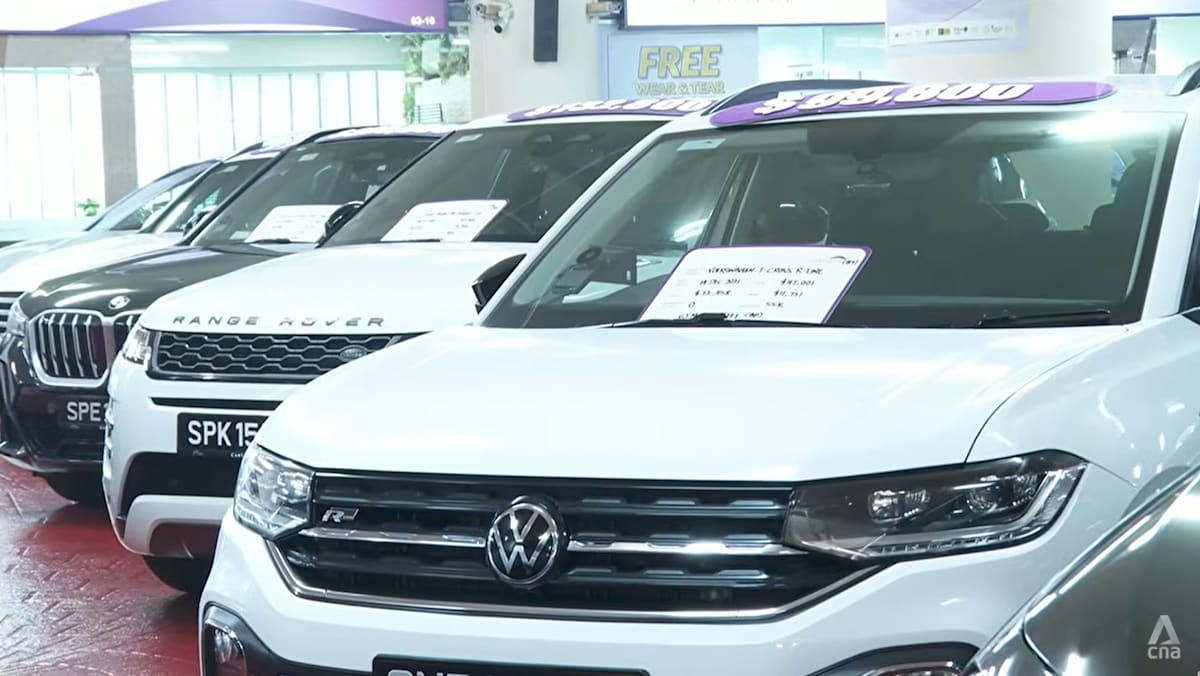
Dealers and analysts say some mass-market vehicles could lose resale value under the proposed COE changes, while demand for pre-owned luxury cars may rise.
Pre-owned cars for sale at CarTimes Automobile. (Image: CNA)
This audio is generated by an AI tool.
SINGAPORE: Proposed changes to the Certificate of Entitlement (COE) system could reshape the used car market, with industry players saying that some mass market vehicles may lose resale value while pre-owned luxury cars could become more attractive to buyers.
The Land Transport Authority (LTA) has proposed merging categories A and B , which classify cars by engine size and power, into a single COE category, and introducing fees and rebates for different car models based on their open market value (OMV).
Under the proposed fee-and-rebate system, the maximum price difference between a higher-end car and a mass-market car would be S$30,000 (US$23,000).
Car dealers told CNA that this could change the price gap between new and second-hand vehicles.
CNA Games Guess Word Crack the word, one row at a time Buzzword Create words using the given letters Mini Sudoku Tiny puzzle, mighty brain teaser Mini Crossword Small grid, big challenge Word Search Spot as many words as you can Show More Show Less
For mass-market models that stand to benefit from such rebates, lower prices for new vehicles could put pressure on the resale value of comparable used cars.
"Consumers are all competing within the same market," Mr Benjamin Loo, chief operating officer of CarTimes Automobile, said.
"If a consumer is able to buy a brand-new vehicle for S$15,000 less, they might reconsider buying a one-year-old pre-owned vehicle. Dealers will have to remain competitive because it does not make sense for a used vehicle to be priced the same as, or higher than, a brand-new one."
Existing owners of newer mass-market cars could also face lower trade-in values if cheaper new vehicles put downward pressure on used-car prices, Mr Loo said.
RESALE VALUES MAY SHIFT
The reverse could happen at the higher end of the market, according to analysts.
The demand for pre-owned premium vehicles could increase if proposed surcharges make new luxury models significantly more expensive, while electric vehicle owners could also be affected.
Categories A and B have traditionally segmented the market for cars into smaller, less powerful models and larger, more powerful ones, based on engine capacity and power.
However, LTA noted that advances in vehicle technology, particularly EVs, have made those criteria “less effective”, as manufacturers are increasingly able to adjust vehicle specifications to fit within existing Category A thresholds.
This has increased competition in Category A and narrowed the gap between the two categories, with Category A premiums exceeding those in Category B three times between February and June this year.
Many EV models are currently configured to meet Category A requirements by limiting their power output.
If categories A and B are merged, newer versions of those vehicles could be sold without such restrictions, potentially making older models less attractive in the resale market.
Asked which current models could be most affected by the proposed changes, Mr Darren Ang of MV Auto pointed to higher-OMV vehicles configured to qualify for Category A COEs. Such models may not qualify for rebates and could instead face surcharges because of their higher OMVs, he said.
Associate Professor Walter Theseira from the Singapore University of Social Sciences' (SUSS) School of Business also said that owners of power-limited EVs may face challenges obtaining the resale prices they had anticipated.
This is because buyers may opt for newer versions of the same models if they are sold without power restrictions under the proposed changes.
Dealers could also adjust their offerings, particularly for cars just above the cut-off for a more favourable band, said Assoc Prof Theseira. This could include removing certain features or making them available only through subscriptions.
DEALERS COULD FACE INVENTORY LOSSES
Dealers could also face losses on vehicles already in inventory if market prices adjust before those cars are sold, said industry players.
Mr Eric Chua, honorary secretary of the Singapore Vehicle Traders Association, told CNA that any changes to policies would create adjustment periods for the industry.
“It is a process where the dealers would have to go through to clear their current inventory, which will run into risk of losses, and then it will moderate and regulate after a while,” he said.
Asked how the dealership might respond if demand weakens for particular models, Mr Ang of MV Auto said it could lower asking prices, offer less for trade-ins or carry fewer units in stock.
“Ultimately, the extent of any impact will depend on where COE premiums settle under the proposed system and how consumers respond to the changes,” Mr Chua added.
Based on the 52,678 cars newly registered in 2025, about half would have received a rebate or seen no change under the changes that have been floated, while the other half would have faced a surcharge.
When asked how the rebate and surcharge amounts were determined, LTA said they were based on a judgment of what would constitute a meaningful price difference between mass-market and higher-end vehicles.
It noted that the historical gap between Category A and Category B COE premiums has generally ranged from about S$20,000 to S$30,000, although the difference has narrowed in recent years.
The changes are intended to better differentiate between mass-market and premium vehicles, particularly as more EVs have been engineered to qualify for Category A COEs despite their higher prices, according to LTA.
The authority added that it would review and publish the band for each car model annually to keep buyers informed before they decide on their purchases.
A public consultation for the proposal opened on Oct 8 and will end on Nov 2. LTA will share its findings and recommendations by the first half of 2027.
Get our pick of top stories and thought-provoking articles in your inbox
Stay updated with notifications for breaking news and our best stories
Join our channel for the top reads for the day on your preferred chat app
经销商和分析师表示,拟议的拥车证变更可能会导致一些大众市场车辆的转售价值下降,而对二手豪华车的需求可能会上升。
CarTimes Automobile 出售二手车。(图片来源:CNA)
这段音频由人工智能工具生成。
新加坡:拥车证(COE)制度的拟议改革可能会重塑二手车市场,业内人士表示,一些大众市场车辆可能会失去转售价值,而二手豪华车可能会对买家更具吸引力。
陆路交通管理局 (LTA) 提议将按发动机排量和功率对汽车进行分类的 A 类和 B 类合并为一个单一的拥车证 (COE) 类别,并根据不同车型的公开市场价值 (OMV) 引入费用和回扣。
根据拟议的费用和回扣制度,高端汽车与大众市场汽车之间的最大价格差为 30,000 新元(23,000 美元)。
汽车经销商告诉中央社,这可能会改变新车和二手车之间的价格差距。
CNA游戏 猜词游戏 逐行破解单词 流行词游戏 用给定的字母组成单词 迷你数独 小小谜题,挑战你的大脑 迷你填字游戏 小方格,大挑战 单词搜索 尽可能多地找出单词 显示更多 显示更少
对于能够从这些折扣中受益的大众市场车型而言,新车价格的降低可能会对同类二手车的转售价值造成压力。
“消费者都在同一个市场中竞争,”CarTimes Automobile 的首席运营官 Benjamin Loo 先生表示。
“如果消费者能以比新车便宜15000新元的价格买到一辆全新的车,他们可能会重新考虑购买一辆车龄一年的二手车。经销商必须保持竞争力,因为二手车的价格与新车相同或更高是不合理的。”
卢先生表示,如果价格更低的新车对二手车价格造成下行压力,那么现有较新的大众市场汽车的车主也可能面临更低的置换价格。
转售价值可能会发生变化
分析师认为,高端市场可能会出现相反的情况。
如果拟议的附加费使新款豪华车型的价格大幅上涨,那么对二手高档车的需求可能会增加,而电动汽车车主也可能受到影响。
传统上,汽车市场根据发动机排量和功率分为 A 类和 B 类,将汽车市场细分为较小、动力较弱的车型和较大、动力较强的车型。
然而,陆路交通管理局指出,车辆技术的进步,特别是电动汽车的进步,使得这些标准“效果降低”,因为制造商越来越能够调整车辆规格以符合现有的 A 类门槛。
这加剧了 A 类保险的竞争,缩小了 A 类保险和 B 类保险之间的差距,今年 2 月至 6 月期间,A 类保险的保费是 B 类保险的三倍。
目前许多电动汽车车型为了满足 A 类要求,都限制了其功率输出。
如果 A 类和 B 类车辆合并,这些车辆的较新版本就可以不受此类限制地销售,这可能会降低旧款车型在二手车市场上的吸引力。
当被问及哪些现有车型可能受拟议变更影响最大时,MV Auto的Darren Ang先生指出,那些配置为符合A类拥车证资格的高OMV车型可能会受到影响。他表示,这类车型可能无法享受折扣,反而可能因为其较高的OMV而被征收附加费。
新加坡社会科学大学(SUSS)商学院副教授沃尔特·特塞拉也表示,动力有限的电动汽车车主可能难以获得他们预期的转售价格。
这是因为,如果按照拟议的变更,新型号的售价不受功率限制,那么买家可能会选择购买新型号的商品。
副教授塞西拉表示,经销商还可以调整他们的产品,特别是对于那些价格略高于优惠区间门槛的车型。这可能包括移除某些功能,或者将其改为仅限订阅用户使用。
经销商可能面临库存损失
业内人士表示,如果市场价格在车辆售出前进行调整,经销商也可能面临库存车辆的损失。
新加坡汽车贸易商协会名誉秘书蔡先生告诉亚洲新闻台,任何政策变化都会给行业带来调整期。
他说:“经销商必须经历这个过程来清理他们目前的库存,这会面临损失的风险,但过一段时间后,情况就会有所缓和和稳定。”
当被问及如果特定车型的需求减弱,经销商会如何应对时,MV Auto 的 Ang 先生表示,他们可能会降低要价、减少旧车置换价格或减少库存车辆。
蔡先生补充说:“最终,任何影响的程度将取决于拥车证保费在拟议制度下的最终结果,以及消费者对这些变化的反应。”
根据 2025 年新注册的 52,678 辆汽车计算,大约一半的汽车会获得退款或根据已提出的改革方案不会有任何变化,而另一半汽车则会面临附加费。
当被问及回扣和附加费金额是如何确定时,陆路交通管理局表示,这是根据对大众市场车辆和高端车辆之间有意义的价格差异的判断而定的。
报告指出,A类和B类拥车证保费之间的历史差距通常在2万新元到3万新元之间,尽管近年来差距有所缩小。
据陆路交通管理局称,这些变化旨在更好地区分大众市场车辆和高端车辆,尤其是随着越来越多的电动汽车被设计成符合 A 类拥车证的资格,尽管它们的价格更高。
该机构补充说,将每年审查并公布每款车型的频段,以便在买家决定购买之前让他们了解情况。
该提案的公众咨询于10月8日开始,将于11月2日结束。陆路交通管理局将于2027年上半年公布其调查结果和建议。
订阅我们的邮件,即可获取精选热点新闻和引人深思的文章。
订阅通知,第一时间获取突发新闻和精彩报道。
加入我们的频道,即可在您常用的聊天应用上获取当日热门文章。