MRT reliability hits new all-time high after previous record in August继8月份创下历史新高后,地铁可靠性再创新高。
MRT reliability hits a record high in Singapore, with four mature lines improving and train punctuality rising in September. Read more at straitstimes.com.
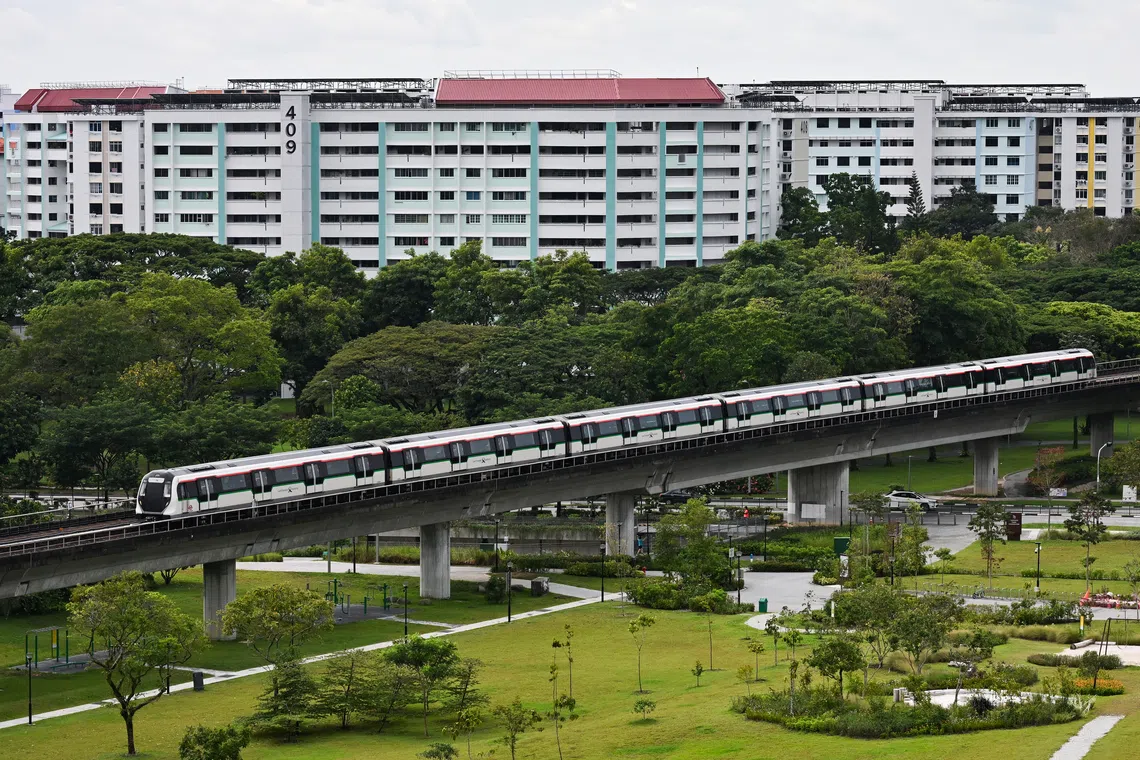
Train punctuality and the proportion of train services that operated on schedule also saw improvements.
Published Oct 15, 2026, 05:00 PM
Updated Oct 15, 2026, 05:02 PM
Singapore’s MRT reliability hit a record high in September, with average performance reaching 3.38 million train-km between delays, far above the 1 million target.
The East-West and North-South lines improved most, while the North East Line stayed the most reliable. The Downtown Line fell, after a major delay on 29 September.
Transport Minister Jeffrey Siow called six months above 2 million train-km “quite unprecedented”, but said MKBF cannot rise forever. LTA expects the Thomson-East Coast Line to improve after full opening in 2026.
SINGAPORE – The MRT network has reached an all-time high in reliability, with four of the five mature rail lines recording improvements in September.
Between October 2025 and September 2026, MRT trains clocked an average of 3.38 million train-km between delays lasting more than five minutes, the Land Transport Authority (LTA) said in its latest rail reliability report published on Oct 15.
This is triple the Republic’s rail reliability target of one million train-km for the entire MRT network, as measured by mean kilometres between failure (MKBF).
MKBF is a widely used engineering measure of rail reliability and shows how far a train travels before it encounters a delay lasting more than five minutes. LTA’s figures are based on a 12-month moving average.
The latest data marks the first time the network’s MKBF has surpassed three million train-km. It is also the sixth consecutive month that the network’s MKBF has exceeded two million train-km.
The East-West Line (EWL) and North-South Line (NSL), both operated by SMRT, recorded the biggest gains in reliability.
The reliability of the EWL rose from 2.52 million train-km between delays to 3.36 million train-km, while the NSL’s increased from 1.65 million train-km to 2.48 million train-km.
The Circle Line, also run by SMRT, saw a slight improvement from 2.51 million train-km to 2.57 million train-km.
The North East Line (NEL), operated by SBS Transit, remained the most reliable MRT line, with its MKBF rising from 4.48 million train-km to 4.5 million train-km.
However, the other SBS Transit-operated line, the Downtown Line (DTL), experienced a sharp dip from 8.37 million train-km to 4.19 million train-km.
Only the DTL had a major delay exceeding 30 minutes in September, on Sept 29, which affected fewer than 5,000 passengers, LTA said.
Speaking to reporters at the Ten Mile Junction depot on Oct 15, Transport Minister Jeffrey Siow described the six consecutive months in which the network’s MKBF exceeded two million train-km as “quite unprecedented”.
“It shows that we have been working really hard at making sure the reliability of the system is good.”
He noted that train systems are complicated systems, with many components and many parts.
“It is invariable that sometimes, occasionally, there will be faults in the systems, or components that are not working, and there will be a delay or a disruption. This is inevitable. But we will work very hard to minimise these occurrences,” Siow added.
However, he cautioned that the MKBF will not be able to go up forever. As it is calculated on a rolling 12-month basis, a line that does not experience a disruption for a whole year would have reached its theoretical maximum threshold.
Siow noted that the NEL in particular had not experienced a disruption for a year.
Overall train punctuality improved from 99.03% to 99.36%, with only the NEL experiencing a slight dip from 99.08% to 98.61%.
It similarly recorded a small decrease from 99.9% to 99.86% when it came to operating on schedule, while all the other MRT lines had improvements, or in the case of the EWL, remained the same.
Overall, 99.84% of train services operated on schedule in September, up from 99.62% the previous month, the report said.
The figures for the network’s newest line, the SMRT-run Thomson-East Coast Line (TEL), are excluded from the overall report, as MRT lines in their early stages tend to have significantly lower mileage due to relatively low ridership and trains not running at typical frequencies.
The TEL’s reliability went up in September, averaging 498,000 train-km between delays, up from 415,000 train-km the previous month.
It also did not encounter a major delay exceeding 30 minutes, and LTA said it expects the line’s performance to improve after it fully opens in 2026 and operations have stabilised.
The fifth and final stage of the TEL, comprising Bedok South and Sungei Bedok stations, will open later in the year.
On the LRT front, there was a dip in reliability, with trains averaging 622,000 car-km between delays, down from 734,000 car-km previously.
While the SMRT-operated Bukit Panjang LRT’s (BPLRT) reliability remained unchanged in reliability at 443,000 car-km between delays, the Sengkang-Punggol LRT run by SBS Transit recorded 776,000 car-km, down from 1.08 million car-km the month before.
LTA noted, however, that the BPLRT has achieved its highest MKBF, having started with an MKBF of 53,000 car-km in 2017 before renewal works in 2018. This is because a substantial amount of renewal works was completed this year.
The authority added: “This was only possible because of our transport workers and rail operators.
“Our high MKBF levels over the last six months reflect their sustained effort and dedication to uplift reliability and improve their response to faults and incidents, as well as the constant upgrading and maintenance work on our rail systems.”
Aqil Hamzah is a transport journalist at The Straits Times. He is also interested in issues related to crime and technology.
列车准点率和按时运行的列车服务比例也有所提高。
发布于2026年10月15日下午5:00
更新于2026年10月15日下午5:02
新加坡地铁的可靠性在9月份创下历史新高,平均每公里列车运行次数达到338万次,远远超过100万次的目标。
东西线和南北线改善最为显著,东北线依然是最可靠的线路。市区线在9月29日发生重大延误后,可靠性有所下降。
交通部长萧敬腾称,列车运行里程连续六个月超过200万公里“实属罕见”,但他表示,列车运行里程不可能永远增长。陆路交通管理局预计,汤申-东海岸线在2026年全面开通后,运行状况将有所改善。
新加坡——地铁网络可靠性已达到历史最高水平,五条成熟的地铁线路中有四条在9月份的可靠性有所提高。
陆路交通管理局 (LTA) 在 10 月 15 日发布的最新铁路可靠性报告中表示,从 2025 年 10 月到 2026 年 9 月,地铁列车平均运行 338 万列车公里,期间没有出现超过 5 分钟的延误。
这相当于新加坡地铁网络平均故障间隔公里数 (MKBF) 的三倍,该目标为整个地铁网络的铁路可靠性达到一百万列车公里。
MKBF(平均延误时间)是铁路可靠性的一项广泛应用的工程指标,它显示列车在遭遇超过五分钟的延误之前可以行驶多远。陆路交通管理局(LTA)的数据基于12个月的移动平均值。
最新数据显示,该铁路网的列车运行里程(MKBF)首次突破300万列车公里。同时,这也是该铁路网的列车运行里程连续第六个月超过200万列车公里。
由 SMRT 运营的东西线 (EWL) 和南北线 (NSL) 在可靠性方面取得了最大的进步。
东线铁路的可靠性从每公里延误 252 万列火车增加到每公里延误 336 万列火车,而南线铁路的可靠性从每公里延误 165 万列火车增加到每公里延误 248 万列火车。
由 SMRT 运营的环线客运量略有提高,从 251 万列车公里增至 257 万列车公里。
由新捷运运营的东北线(NEL)仍然是最可靠的地铁线路,其MKBF从448万列车公里增加到450万列车公里。
然而,另一条由新捷运运营的线路——市区线(DTL)的客运量却从 837 万列车公里大幅下降至 419 万列车公里。
陆路交通管理局表示,9 月份只有滨海市区线 (DTL) 出现过超过 30 分钟的重大延误,发生在 9 月 29 日,受影响的乘客不到 5000 人。
10 月 15 日,交通部长萧正树在十里枢纽站接受记者采访时表示,该铁路网的 MKBF 连续六个月超过 200 万列车公里,这是“前所未有的”。
“这表明我们一直在努力确保系统的可靠性。”
他指出,火车系统是复杂的系统,由许多组件和部件组成。
“系统偶尔会出现故障,或者某些部件无法正常工作,导致延迟或中断,这是不可避免的。但我们会尽最大努力将此类情况的发生降到最低,”萧补充道。
然而,他提醒说,MKBF不可能一直上涨。由于它是按滚动12个月计算的,一条线路如果一整年都没有发生中断,那么它就已经达到了理论最大值。
Siow指出,特别是东北线(NEL)已经一年没有出现过中断情况了。
整体列车准点率从 99.03% 提高到 99.36%,只有东北线列车准点率略有下降,从 99.08% 降至 98.61%。
同样,该线路的准点率也从 99.9% 略微下降到 99.86%,而其他所有地铁线路的准点率都有所提高,或者像东西线那样保持不变。
报告称,9 月份列车服务按时运行的比例为 99.84%,高于上个月的 99.62%。
由于地铁线路在早期阶段客流量相对较低,列车运行频率也不正常,因此,由 SMRT 运营的最新线路——汤申-东海岸线 (TEL) 的里程数并未计入整体报告中。
9 月份 TEL 的可靠性有所提高,平均每 498,000 列车公里不发生延误,高于上个月的 415,000 列车公里。
该线路也没有出现超过 30 分钟的重大延误,陆路交通管理局表示,预计该线路在 2026 年全面开通运营稳定后,其运行状况将会改善。
汤申-东南线(TEL)的第五期也是最后一期工程,包括勿洛南站和双溪勿洛站,将于今年晚些时候开通。
在轻轨方面,可靠性有所下降,列车平均每行驶 622,000 车公里才会出现一次延误,低于之前的 734,000 车公里。
虽然由 SMRT 运营的武吉班让轻轨 (BPLRT) 的可靠性保持不变,两次延误之间的行驶里程为 443,000 车公里,但由 SBS Transit 运营的盛港-榜鹅轻轨的两次延误之间的行驶里程为 776,000 车公里,低于上个月的 108 万车公里。
陆路交通管理局指出,BPLRT 的 MKBF 已达到最高水平,在 2018 年进行更新工程之前,其 2017 年的 MKBF 为 53,000 车公里。这是因为今年完成了大量的更新工程。
该机构补充说:“这完全得益于我们的运输工人和铁路运营商。”
“过去六个月我们较高的 MKBF 水平反映了他们为提高可靠性、改善对故障和事故的响应能力所付出的持续努力和奉献精神,以及我们铁路系统不断进行的升级和维护工作。”
阿基尔·哈姆扎是《海峡时报》的交通记者。他也对犯罪和科技相关议题感兴趣。