Cross Island Line: Traffic to be diverted in Ang Mo Kio Ave 3 amid suspension of tunnelling works跨岛线:由于隧道工程暂停,宏茂桥3道交通将改道
Cross Island Line works will reconfigure traffic on Ang Mo Kio Avenue 3 from Nov 14 for 1½ years, says LTA. Read more at straitstimes.com.
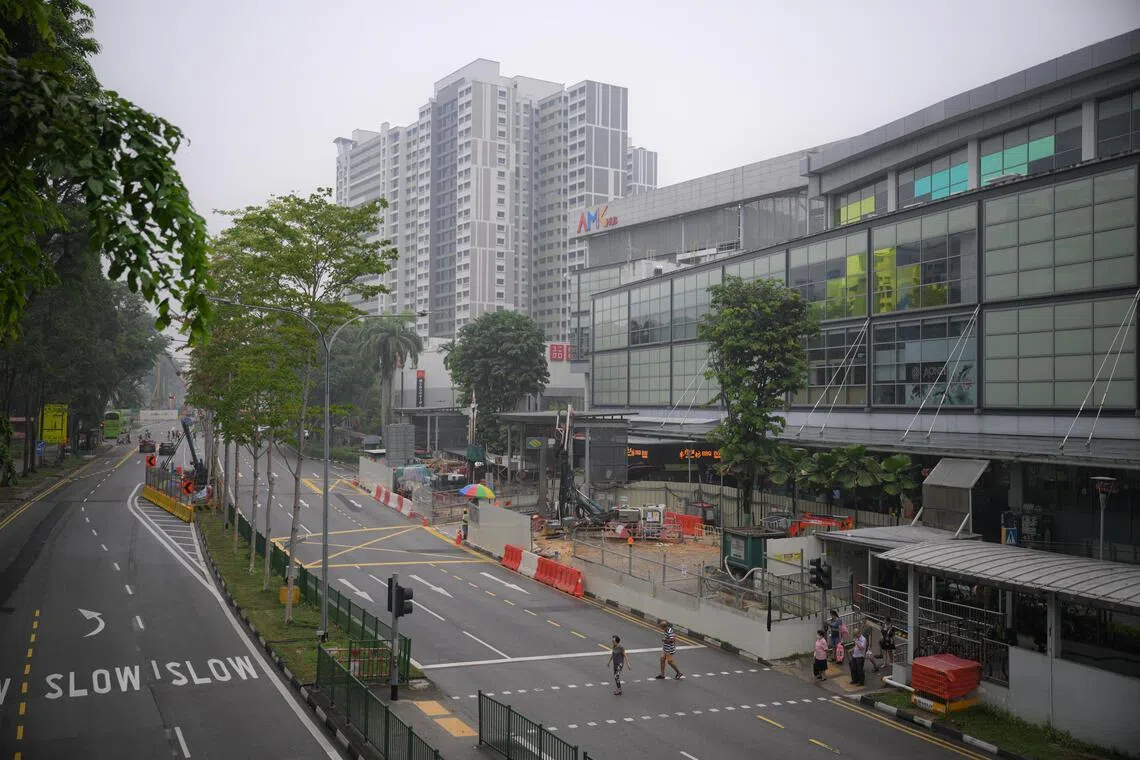
The stretch of road that runs past AMK Hub mall in Ang Mo Kio Avenue 3 will be partially closed to all vehicles except public buses from Nov 14, 2026, to May 2028.
ST PHOTO: MARK CHEONG
Published Oct 16, 2026, 10:00 AM
Updated Oct 16, 2026, 10:00 AM
Traffic outside AMK Hub will be rerouted from Nov 14, 2026 to May 2028 to support investigations into underground obstructions discovered during tunnelling for Cross Island Line.
LTA found that these obstructions damaged tunnel boring machine cutters, and stopped tunnelling works to carry out ground stabilisation works as well as investigations.
Drivers and shoppers should expect longer delays and new traffic configurations.
SINGAPORE – Motorists can expect traffic delays near AMK Hub for the next 18 months while roads are realigned to remove a tangle of steel wires underground that is obstructing Cross Island Line tunnelling works.
Traffic will be rerouted during the road diversions, which will last from Nov 14, 2026, to May 2028.
The stretch of road that runs past AMK Hub mall in Ang Mo Kio Avenue 3 – next to the Ang Mo Kio Avenue 8 junction – will close partially to motor traffic. One lane will remain open for buses.
The Land Transport Authority (LTA), in a statement on Oct 16 , said the closures and diversions will help its engineers take a closer look at the thick wires hindering underground tunnelling work for the Cross Island Line (CRL).
Tunnelling work for the first stage of the CRL is being paused while LTA determines the full extent of the obstruction, how the materials got there, and how all of this will impact the overall timeline of CRL works. Ground stabilisation works will also be carried out, LTA said.
The first phase of the CRL – slated to be completed in 2030 – comprises 12 stations over 29km, from Aviation Park in Changi to Bright Hill. Ang Mo Kio station is one of the four interchanges on this stretch.
LTA group director for CRL Ng Choon Yeang, in response to queries on whether the suspension of tunnelling operations will result in delays to the completion of the first phase of CRL, said the team is still assessing the impact of the obstructions.
Once traffic diversions are in place, more work will be done to investigate the obstructions before any further steps are taken, he added.
“We will share more information when it is available to us,” said Ng.
As for why the obstructions were not discovered earlier, Ng said it was an “unforeseen” development because the wires were not detected during advance soil investigation works, and not reflected in drawings made available to the team during engineering studies.
It was only when the tunnel boring machine reached that spot that the underground objects turned up, he added.
When the materials were first encountered during tunnelling works in May, LTA tried to first remove the thick wires entangled around the cutterhead before carrying on with tunnelling works.
The cutterhead is the rotating steel wheel at the front of a tunnel boring machine, which excavates soil or rock.
Between May and July, workers came across even more obstructions, and needed to intervene 100 times to stop the tunnel boring machine before removing the wires by hand.
Along the way, 22 cutters – a component of the cutterhead – were damaged and had to be replaced, and about 800kg of wires were pulled out from the machine.
Investigations later found that the wires were part of ground anchors – steel structures drilled into the ground – to temporarily support retaining walls or structures, and prevent them from shifting during construction.
LTA said running into ground anchors during tunnelling works could damage the tunnel boring machine’s cutter tools, disrupt tunnelling and pose safety risks to underground works and the roads above.
That is why tunnelling works came to a stop before ground improvement works – to strengthen and stabilise the ground where the tunnel is – began.
Workers will then start removing the obstructions from the machine, before resuming tunnelling works in a safe and controlled manner, said LTA.
A ground anchor found in front of the tunnel boring machine’s cutterhead. PHOTO: LTA
A ground anchor found in front of the tunnel boring machine’s cutterhead.
To enable these efforts, the 180m stretch of road at AMK Hub in Ang Mo Kio Avenue 3 will be reconfigured for about 1½ years, starting from Nov 14.
Changes include converting the three-lane east-bound carriageway – for motorists heading towards Ang Mo Kio Avenue 8 – into one bus-only lane.
The three-lane west-bound carriageway – for those travelling towards Ang Mo Kio Central 1 – will become a two-lane road.
The three-lane west-bound carriageway – for those travelling towards Ang Mo Kio Central 1 – will become a two-lane road. ST PHOTO: MARK CHEONG
The pick-up and drop-off point at AMK Hub will also have its traffic direction reversed, with exiting vehicles needing to stop at a new traffic light before they turn right towards Ang Mo Kio Central 1.
Vehicles leaving the AMK Hub carpark also have to turn right towards 51@AMK mall when the new traffic arrangement is in place.
A new pedestrian crossing, complete with traffic lights, will be set up near the exit of the AMK Hub carpark.
Pedestrians can still cross the road using the existing overhead bridge, although they will only be able to access AMK Hub through the second level – and not the ground floor – during the mall’s operating hours.
Pedestrians can still cross the road using the existing overhead bridge via the second level of AMK Hub. ST PHOTO: MARK CHEONG
Pedestrians can still cross the road using the existing overhead bridge via the second level of AMK Hub.
LTA said motorists can expect longer lines to enter AMK Hub during peak hours, with an added travel time of about 10 to 15 minutes.
Ng said: “Safety remains our top priority. We understand the temporary traffic changes will cause some inconvenience to residents, motorists, and businesses in the area.
“These changes are, however, necessary to give our teams safe access and space to carry out the investigations, assessments, and recovery works.”
LTA said the area will remain safe for the public. It added that ground conditions around the mall will be monitored closely throughout the works.
In response to queries, a spokeswoman from Link Asset Management, which manages AMK Hub, said the mall remains open and continues to operate as usual during works at the site.
She said: “Visitors can continue to access the mall, shop and dine.
“To facilitate traffic movement, the exit route has been adjusted with clear directional signage in place to guide motorists and ensure a smooth journey to and from the mall.”
Esther Loi is a journalist at The Straits Times, where she covers transport issues.
从 2026 年 11 月 14 日至 2028 年 5 月,宏茂桥 3 道 AMK Hub 购物中心附近的路段将部分封闭,除公共巴士外,所有车辆均不得通行。
《海峡时报》照片:张马克
发布于2026年10月16日上午10:00
更新于2026年10月16日上午10:00
为配合对跨岛线隧道施工过程中发现的地下障碍物的调查,从 2026 年 11 月 14 日至 2028 年 5 月,AMK Hub 以外的交通将改道行驶。
陆路交通管理局发现这些障碍物损坏了隧道掘进机的刀具,因此停止了隧道掘进工作,进行地面稳定工作和调查。
司机和购物者应做好延误时间延长和交通状况发生变化的准备。
新加坡——未来 18 个月内,由于道路需要重新规划以清除地下阻碍跨岛线隧道工程的一堆钢丝,驾车人士预计 AMK Hub 附近会出现交通延误。
道路改道期间,交通将改道,改道时间为 2026 年 11 月 14 日至 2028 年 5 月。
位于宏茂桥3道、靠近宏茂桥8道路口的AMK Hub购物中心附近的路段将部分封闭,禁止机动车通行。其中一条车道将保留供公交车通行。
陆路交通管理局 (LTA) 在 10 月 16 日的一份声明中表示,道路封闭和改道将帮助其工程师更仔细地检查阻碍跨岛线 (CRL) 地下隧道工程的粗电线。
陆路交通管理局表示,由于需要确定障碍物的具体范围、材料是如何运到那里的,以及所有这些因素将如何影响CRL工程的整体工期,CRL一期工程的隧道施工工作已暂停。陆路交通管理局还表示,将同时开展地面加固工作。
环城铁路一期工程预计于2030年竣工,全长29公里,设有12个车站,从樟宜的航空园站延伸至光明山站。宏茂桥站是该路段的四个换乘站之一。
针对隧道施工暂停是否会导致CRL一期工程延期的问题,陆路交通管理局CRL项目组长吴俊扬表示,团队仍在评估这些障碍的影响。
他补充说,一旦交通改道措施到位,将会有更多工作来调查障碍物,然后再采取任何进一步措施。
“一旦有更多信息,我们会与大家分享,”吴先生说。
至于为什么这些障碍物没有更早被发现,吴先生表示这是一个“意想不到的”情况,因为在之前的土壤勘测工作中没有发现这些电线,而且在工程研究期间提供给团队的图纸中也没有反映出来。
他补充说,只有当隧道掘进机到达那个位置时,地下物体才被发现。
今年 5 月,在隧道施工过程中首次遇到这些材料时,陆路交通管理局 (LTA) 试图先清除缠绕在刀盘周围的粗电线,然后再继续进行隧道施工。
刀盘是隧道掘进机前端的旋转钢轮,用于挖掘土壤或岩石。
5 月至 7 月期间,工人们遇到了更多障碍,不得不干预 100 次才能让隧道掘进机停下来,然后才能用手移除电线。
在此过程中,切割头的 22 个切割器(切割头的一个部件)损坏并不得不更换,大约 800 公斤的电线从机器中被拉了出来。
调查后来发现,这些电线是地锚的一部分——地锚是钻入地下的钢结构——用于临时支撑挡土墙或建筑物,防止它们在施工过程中发生移位。
陆路交通管理局表示,隧道施工过程中撞到地锚可能会损坏隧道掘进机的刀具,扰乱隧道施工,并对地下工程和地面道路构成安全隐患。
因此,隧道挖掘工程在开始进行地基改良工程(加固和稳定隧道所在位置的地基)之前就停止了。
陆路交通管理局表示,工作人员随后将开始清除机器上的障碍物,然后以安全可控的方式恢复隧道掘进工作。
在隧道掘进机刀盘前方发现的地锚。(图片:陆路交通管理局)
在隧道掘进机刀盘前方发现了一个地锚。
为了实现这些目标,宏茂桥 3 道 AMK Hub 的 180 米长的道路将从 11 月 14 日开始进行改造,改造期约为 1 年半。
变更包括将三车道东行车道(供驾车者前往宏茂桥 8 道)改为一条公交专用道。
往西行的三车道公路(前往宏茂桥中心 1 方向)将变为两车道公路。
往西行的三车道公路(通往宏茂桥中心1方向)将改为两车道。海峡时报摄影:张马克
AMK Hub 的接送点交通方向也将反转,驶出的车辆需要在新的交通信号灯处停车,然后右转前往宏茂桥中心 1 号。
新的交通管制措施实施后,从 AMK Hub 停车场驶出的车辆也必须右转前往 51@AMK 购物中心。
AMK Hub 停车场出口附近将设立一条新的行人过街通道,并配有交通信号灯。
行人仍然可以使用现有的天桥过马路,但在商场的营业时间内,他们只能通过二楼进入 AMK Hub,而不能通过一楼进入。
行人仍可通过宏茂桥中心二层的现有天桥过马路。海峡时报摄影:张马克
行人仍可通过 AMK Hub 二楼现有的天桥过马路。
陆路交通管理局表示,高峰时段驾车人士进入宏茂桥枢纽站可能会出现更长的排队现象,行程时间将增加约 10 至 15 分钟。
吴先生表示:“安全仍然是我们的首要任务。我们理解临时交通管制措施会给该地区的居民、驾车人士和商家带来一些不便。”
“然而,这些改变是必要的,以便我们的团队能够安全地进入现场,并拥有足够的空间开展调查、评估和恢复工作。”
陆路交通管理局表示,该区域将保持安全。管理局还补充说,施工期间将密切监测商场周围的地质状况。
针对相关询问,管理 AMK Hub 的 Link Asset Management 的一位发言人表示,商场在施工期间仍将照常营业。
她说:“游客可以继续进入商场购物和用餐。”
“为了方便交通通行,出口路线已进行调整,并设置了清晰的指示标志,以引导驾驶员,确保往返商场的旅程顺畅。”
埃丝特·罗伊是《海峡时报》的记者,主要报道交通运输问题。