Beyond trial and error: Tailoring drug therapies to patients’ DNA超越反复试验:根据患者的DNA定制药物疗法
Singapore heart attack patient’s case highlights how genetic testing is helping doctors personalise drug therapies through pharmacogenomics. Read more at straitstimes.com.
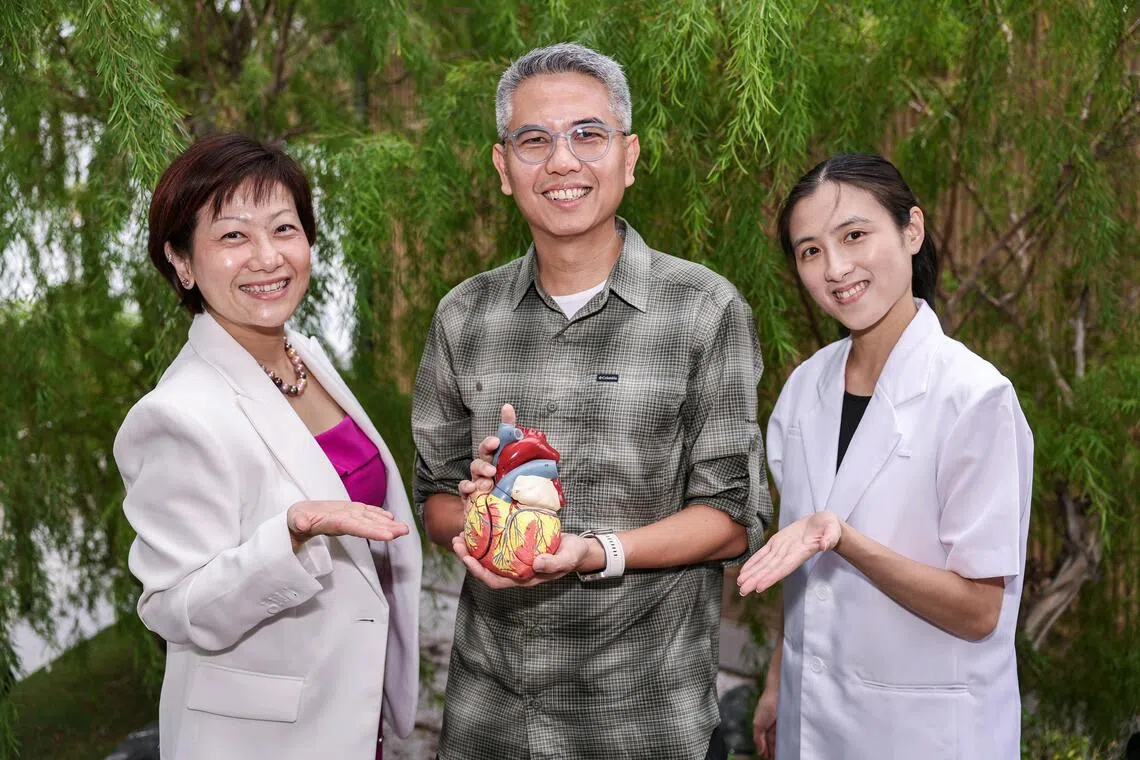
IT professional Gan Chee Hiong (centre) with cardiology specialist pharmacist Doreen Tan (left) and principal clinical pharmacist Elaine Lo.
Published Oct 16, 2026, 02:35 PM
Updated Oct 16, 2026, 02:35 PM
Singapore is using pharmacogenomics to match drug therapy to patients’ DNA, moving away from trial and error in routine care.
Gan Chee Hiong had a heart attack, then breathlessness from Ticagrelor. Testing showed he could switch to Clopidogrel, which fit him better.
The NUHS pilot has tested more than 4,000 patients. Every patient had at least one genetic variant, and one in five had a variant linked to an unusual drug response.
SINGAPORE – IT professional Gan Chee Hiong, 55, was on his weekly run up Bukit Timah Hill when he had a mild heart attack.
The date: Aug 13, 2024 – a day before his 53rd birthday.
“After the first hour, I was super tired, so I checked my watch for my heart rate, and it was 50 beats per minute. I thought I was off form because I had cycled 40km the day before and swum about 200 laps in the pool the week before,” he said.
Gan took himself to the emergency department of the National University Hospital (NUH), but it was not until his third day there that doctors ascertained he had suffered a heart attack.
He underwent angioplasty to address the three blockages in his heart and was prescribed Ticagrelor, a blood thinner that prevents blood platelets from clumping together, lowering the risk of blood clots, heart attacks, and strokes.
Instead of providing peace of mind, the medication became a source of anxiety for Gan, who developed frequent episodes of breathlessness.
Suspecting that Ticagrelor could be the cause, Gan brought his concerns to Doreen Tan, a cardiology specialist pharmacist at the National University Heart Centre, Singapore, to ask if he could switch to an alternative medication.
“But she told me that the commonly used Ticagrelor was the more effective medication, and the alternative called Clopidogrel might not be suitable for Asians,” Gan said.
Since Gan was not reacting positively to Ticagrelor, Tan encouraged him to enrol in the pre-emptive pharmacogenomics (PPGx) clinical implementation pilot to assess his suitability for the older drug Clopidogrel.
The pilot is part of a broader effort by the National University Health System to integrate pharmacogenomics into routine care. Conducted as an implementation research programme, it analyses genetic variations across 16 genes known to influence patients’ responses to commonly prescribed medications.
Tan initially tested Gan’s platelets for their response to the different blood thinners.
“We also collected genes from the blood samples, and that was when we chanced upon the prevalence of gene mutations, specifically for the antiplatelet (medication). More than 60% of locals have the mutations,” she said.
In 2022, scientists found that most Singaporeans have at least one genetic variant that could react poorly with a drug . The finding was made after the Republic mapped the DNA of 10,000 Singaporeans .
Scientists also found that one in four carries a variant that raises the risk of life-threatening side effects from at least one medication.
Together with Elaine Lo, a principal clinical pharmacist at NUH who was looking into precision medicine, Tan conceptualised and rolled out the first PGx clinical pilot.
Tan said Gan underwent genetic testing as well as platelet function testing “because the turnaround time for that particular test was faster, and he was breathless when he came to the clinic”.
Gan Chee Hiong (centre) switched to clopidogrel after genetic testing showed he could take the drug. ST PHOTO: BRIAN TEO
Gan Chee Hiong (centre) switched to clopidogrel after genetic testing showed he could take the drug.
Tan said that in cardiology, it is not just antiplatelet medication but also two other classes of drugs – anticoagulants and beta-blockers – whose effects are influenced by genes and how people respond to medication.
She added that people with very poor gene function are 10 times more likely to have a recurrent cardiac event than those without the variant.
Lo, who is also the lead pharmacist for the pilot, said the team started recruiting patients in 2023.
“At that point in time the target was 1,000 patients. By Phase 2, there was funding from PRECISE (Precision Health Research, Singapore), a body that coordinates Singapore’s multi-phase National Precision Medicine programme,” she said.
To date, more than 4,000 patients have undergone pharmacogenomics testing under the programme.
Findings from the pilot have shown that every patient tested carried at least one genetic variant, while one in five had a variant that could predict an atypical response to one of their prescribed medications.
Lo felt that there should be a subsidy to help people afford the test.
“When you need the drug, your information would have been in the system, which would prompt doctors to give the right medication without ordering (separate genetic) tests for each drug needed to treat the condition,” she said.
In recent years, Tan has also advocated the reverse approach – giving heart patients without the mutation Clopidogrel instead.
"If we could use precision medicine to choose the right people for Ticagrelor or for Clopidogrel, that would make the most sense,” she added.
Gan’s life has largely returned to normal, and he has been able to resume moderate exercise.
He told The Straits Times that, having benefited from PPGx, he is now “a strong believer in genetic testing and precision medicine and have encouraged many family members and friends to sign up for it”.
“I was even able to fly to Japan to witness the birth of my grandson. He was born on Aug 13, 2025 – exactly a year after I suffered my heart attack,” he said.
Heart/Cardiac diseases
National University Hospital
IT 专业人士 Gan Chee Hiong(中)与心脏病专科药剂师 Doreen Tan(左)和首席临床药剂师 Elaine Lo 合影。
发布于 2026 年 10 月 16 日下午 2:35
更新于2026年10月16日下午2:35
新加坡正在利用药物基因组学将药物治疗与患者的 DNA 相匹配,从而摆脱常规护理中的反复试验。
颜志雄突发心脏病,之后又因服用替格瑞洛而出现呼吸困难。检测结果显示他可以改用氯吡格雷,这种药物更适合他。
新加坡国立大学医院的试点项目已经对超过4000名患者进行了测试。每位患者都至少携带一种基因变异,其中五分之一的患者携带的变异与异常药物反应有关。
新加坡——55岁的IT专业人士颜志雄(音译)在每周例行的武吉知马山跑步时,突发轻微心脏病。
日期:2024 年 8 月 13 日——他 53 岁生日前一天。
“第一个小时过后,我感觉非常疲惫,于是看了看手表,心率只有每分钟50次。我以为自己状态不好,因为前一天我骑了40公里自行车,前一周还在泳池里游了大约200圈,”他说。
甘某自行前往新加坡国立大学医院(NUH)急诊科就诊,但直到住院第三天,医生才确诊他患有心脏病。
他接受了血管成形术来解决心脏中的三处阻塞,并被开了替格瑞洛(Ticagrelor),这是一种血液稀释剂,可以防止血小板聚集在一起,降低血栓、心脏病发作和中风的风险。
药物非但没有给甘带来安心,反而成了焦虑的根源,他经常出现呼吸困难的症状。
甘怀疑替格瑞洛可能是罪魁祸首,于是向新加坡国立大学心脏中心的心脏病专科药剂师陈多琳咨询,是否可以换用其他药物。
“但她告诉我,常用的替格瑞洛是更有效的药物,而另一种名为氯吡格雷的药物可能不适合亚洲人,”甘说。
由于甘对替格瑞洛没有积极反应,谭鼓励他参加先发制人的药物基因组学(PPGx)临床实施试点,以评估他是否适合使用老药氯吡格雷。
该试点项目是加拿大国立大学健康系统将药物基因组学融入日常医疗护理的更广泛计划的一部分。作为一项实施研究项目,它分析了16个已知会影响患者对常用处方药物反应的基因的遗传变异。
Tan 首先测试了 Gan 的血小板对不同血液稀释剂的反应。
“我们还从血液样本中采集了基因,正是在那时,我们偶然发现了基因突变的普遍性,特别是抗血小板药物相关的突变。超过60%的当地人携带这种突变,”她说。
2022年,科学家发现大多数新加坡人至少携带一种可能与某种药物产生不良反应的基因变异。这一发现是在新加坡对1万名新加坡人的DNA进行测序后得出的。
科学家还发现,四分之一的人携带一种变异基因,这种基因会增加服用至少一种药物后出现危及生命的副作用的风险。
Tan 与新加坡国立大学医院 (NUH) 的首席临床药剂师 Elaine Lo(她当时正在研究精准医疗)一起,构思并推出了第一个 PGx 临床试点项目。
Tan表示,Gan接受了基因检测和血小板功能检测,“因为这项检测的周转时间比较快,而且他来诊所时已经气喘吁吁”。
颜志雄(中)在基因检测显示他可以服用氯吡格雷后,改用该药。海峡时报摄影:张文杰
颜志雄(中)在基因检测显示他可以服用氯吡格雷后,改用了这种药物。
Tan表示,在心脏病学中,不仅是抗血小板药物,还有另外两类药物——抗凝血剂和β受体阻滞剂——其效果受基因和人们对药物的反应的影响。
她补充说,基因功能极差的人发生复发性心脏事件的可能性是没有这种变异的人的 10 倍。
罗先生同时也是该试点项目的首席药剂师,他表示,团队从 2023 年开始招募患者。
“当时的目标是招募1000名患者。到了第二阶段,我们获得了新加坡精准健康研究中心(PRECISE)的资助,该机构负责协调新加坡的多阶段国家精准医疗计划,”她说道。
迄今为止,已有超过 4000 名患者在该计划下接受了药物基因组学检测。
试点研究结果表明,每位接受测试的患者都至少携带一种基因变异,而五分之一的患者携带的变异可以预测他们对所开处方药的某种反应会表现出非典型性。
罗认为应该提供补贴,帮助人们负担得起这项检测。
她说:“当你需要这种药物时,你的信息就会在系统中,这样医生就能开出正确的药物,而无需为治疗这种疾病所需的每种药物都进行(单独的基因)检测。”
近年来,谭医生也提倡采取相反的做法——给没有基因突变的心脏病患者服用氯吡格雷。
她补充说:“如果我们能够利用精准医疗来选择适合服用替格瑞洛或氯吡格雷的患者,那将是最有意义的。”
甘的生活基本恢复正常,他已经能够恢复适度的运动。
他告诉《海峡时报》,受益于 PPGx 技术后,他现在“坚信基因检测和精准医疗,并鼓励许多家人和朋友报名参加”。
“我甚至还飞到日本去见证我孙子的出生。他出生于2025年8月13日——正好是我心脏病发作一年后,”他说。
心脏/心脏疾病
国立大学医院