Mental health practitioners call for lower or no parental consent age as more youths seek help随着越来越多的青少年寻求帮助,心理健康从业者呼吁降低或取消家长同意年龄。
Some practitioners want the threshold lowered to as young as 13 or 14 - even none at all - as the government works on guidelines on parental consent for mental health services.
新闻视频
Some practitioners want the threshold lowered to as young as 13 or 14 - even none at all - as the government works on guidelines on parental consent for mental health services.
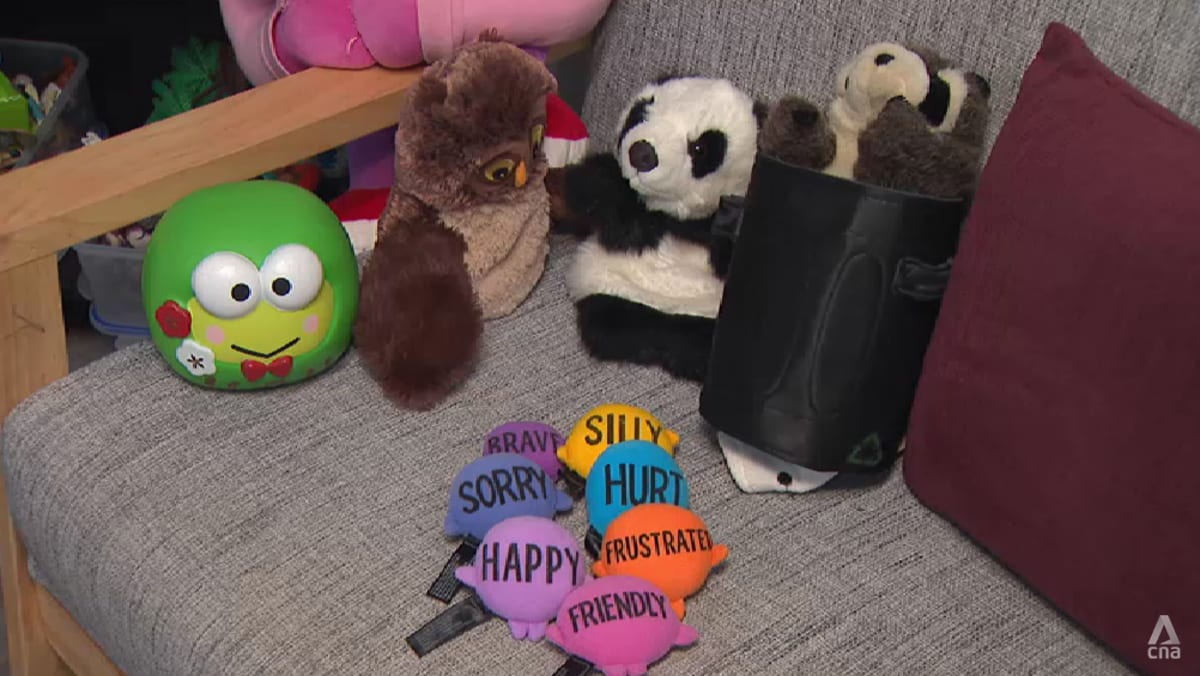
These toys help young clients put their feelings into words during mental health therapy. (Image: CNA)
This audio is generated by an AI tool.
SINGAPORE: Mental health practitioners are calling for younger teenagers to be allowed to seek counselling without parental consent, saying some youths who approach them for help ultimately walk away because they are unwilling or unable to involve their parents.
Some practitioners want the threshold lowered to as young as 13 or 14, as the government works on guidelines on parental consent for mental health services.
Current practices vary depending on where young people seek help.
Callers to the national mental health helpline 1771 can remain anonymous, while community-based providers generally do not insist on parental consent before providing counselling and support.
CNA Games Guess Word Crack the word, one row at a time Buzzword Create words using the given letters Mini Sudoku Tiny puzzle, mighty brain teaser Mini Crossword Small grid, big challenge Word Search Spot as many words as you can Show More Show Less But schools are more likely to require parental consent before formal counselling begins, reflecting their approach of maintaining a strong partnership with families. General mental health providers also typically seek parental consent before treating those under 18, in line with professional guidelines. Practitioners say the issue has become more pressing as more young people independently seek professional help, amid greater awareness of mental health and reduced stigma around counselling. Dr John Lim, chief well-being officer at the Singapore Counselling Centre, said the centre recently had to turn away two teenagers, aged 14 and 15, because they did not want to obtain parental consent. “When we highlighted the need for parental consent, they were most reluctant. Hence, we couldn't proceed and they did not come back again with the parental consent form,” he told CNA. While the centre has seen more parents bringing their teenagers for counselling, it has also seen an increase in young people turning up on their own, he added. Dr Lim wants youths from the age of 13 to be able to seek counselling without parental consent, saying many at that age are capable of recognising when they need professional support. "A lot of them actually know what they want. They see the need to speak to a professional counsellor, they want a human to confide in … and not just talk to ChatGPT as a form of support,” he said. Some may be reluctant to seek parental consent because of stigma or because they do not want their parents to know about the problems they are facing. In some cases, the difficulties may involve one or both parents, Dr Lim said. “There are cases where counsellors … realise it's not so much the youth that needs counselling, it's actually the parents,” he said. Some parents are receptive when this is raised and counselling can develop into family therapy, which Dr Lim said has been constructive.
But schools are more likely to require parental consent before formal counselling begins, reflecting their approach of maintaining a strong partnership with families.
General mental health providers also typically seek parental consent before treating those under 18, in line with professional guidelines.
Practitioners say the issue has become more pressing as more young people independently seek professional help, amid greater awareness of mental health and reduced stigma around counselling.
Dr John Lim, chief well-being officer at the Singapore Counselling Centre, said the centre recently had to turn away two teenagers, aged 14 and 15, because they did not want to obtain parental consent.
“When we highlighted the need for parental consent, they were most reluctant. Hence, we couldn't proceed and they did not come back again with the parental consent form,” he told CNA.
While the centre has seen more parents bringing their teenagers for counselling, it has also seen an increase in young people turning up on their own, he added.
Dr Lim wants youths from the age of 13 to be able to seek counselling without parental consent, saying many at that age are capable of recognising when they need professional support.
"A lot of them actually know what they want. They see the need to speak to a professional counsellor, they want a human to confide in … and not just talk to ChatGPT as a form of support,” he said.
Some may be reluctant to seek parental consent because of stigma or because they do not want their parents to know about the problems they are facing. In some cases, the difficulties may involve one or both parents, Dr Lim said.
“There are cases where counsellors … realise it's not so much the youth that needs counselling, it's actually the parents,” he said.
Some parents are receptive when this is raised and counselling can develop into family therapy, which Dr Lim said has been constructive.
Allowing youths to get help early could also prevent emerging mental health problems from becoming more serious, he said.
“Many youths experience a lot of anxiety. We do not want it to be developed into a clinical issue, like clinical depression or generalised anxiety disorder,” he said.
“The key is we need to mitigate it, especially on the onset of those mental health challenges. So professional counselling, thought therapy, psychotherapy, can be very helpful.”
“AN EXTRA PAIR OF LISTENING EARS”
Counselling psychologist Geraldine Tan, director of The Therapy Room, has similarly had to turn away clients under 18 who refused to obtain parental consent.
She said she has noticed a shift in how young people view counselling, including youths approaching her on behalf of friends.
“They say, ‘I think my friend needs it. Can they come to you?’ This is a very heartening change from before, when it was taboo and they feel that the resources are out of reach,” she said.
Young clients approach her with concerns ranging from family and friendship problems to academic stress and existential crises.
Dr Tan said 14 is the age typically suggested by mental health professionals for youths to be able to seek counselling independently.
“At 14, there’s a little bit more maturation. They’ve moved to a different developmental age group. There's a lot of hormonal changes,” she said. “A lot of changes in their friendships, their understanding of things. So that's quite a turbulent time for them.”
But she hopes the upcoming guidelines will not impose age restrictions, so children of any age can approach mental health professionals for help.
“I would say that anybody can walk into the doctor's office, right? So why can't anybody walk into a mental health (facility) or to a psychologist, who's your emotional doctor?” She asked.
CONSENT ONLY PART OF THE ISSUE
For many young people, however, getting through the counselling room door is only the first step. What happens to the information they disclose can be just as important.
Ms Roseanne Yeong began seeing her school counsellor at 13, mainly about problems she was experiencing at home.
But her sense that counselling was a safe and confidential space was later damaged when the counsellor spoke to her parents about what she had disclosed without first informing her.
“When I found out that the counsellor had contacted my parents and did not let me know beforehand, it really shattered that trust I had in the counsellor,” she said.
Afterwards, she became more selective about what she discussed.
“After I knew what were certain things that would get me reported to my parents, I tended to not touch on those topics anymore because I was not ready to share that part of myself with my parents, especially because we were not on great terms,” she recalled.
Ms Yeong, who is now a psychologist working with people with intellectual disabilities, said allowing children greater access to mental health services would be a positive step, but decisions over parental involvement should be made case by case.
Parents or another family member may need to be informed if a child is at risk of suicide, self-harm or harming others, for example.
“Let's say a child is actively dealing with suicidal ideation, then in that case, it would be good for a family member to know,” she said, as that person could keep a closer watch on the child.
But the considerations would be different if, for instance, the child was experiencing abuse at home, she said.
She suggested such decisions could be reviewed by a professional such as a case manager.
TOWARDS CLEARER CONSENT GUIDELINES
Health Minister Ong Ye Kung said last week that there needs to be a balanced approach that acts in a young person's best interests while safeguarding their well-being.
“The right system is one that lets a young person enter through a safe door, and then involve the family appropriately as the care journey progresses,” he said.
The Singapore Medical Council is revising its ethical guidelines to provide doctors with clearer guidance on parental consent. The Ministry of Health is also developing guidelines on parental consent for various service providers. Public views will be sought in the coming weeks.
Mr Ong encouraged young people who are struggling to continue to seek help.
“It is important to know that asking for help is an act of responsibility, and not a disappointment to your family. You do not need to work everything out by yourself. Start by speaking to someone you trust and are most comfortable with,” he said.
He also urged parents to give their children time and space if they are not immediately ready to confide in them.
“When they do speak, you can’t judge too early. When it comes to mental health, patience is often the most important support we can give them,” he said.
Get our pick of top stories and thought-provoking articles in your inbox
Stay updated with notifications for breaking news and our best stories
Join our channel for the top reads for the day on your preferred chat app
一些从业者希望将门槛降低到 13 或 14 岁,甚至取消门槛,因为政府正在制定有关心理健康服务家长同意的指导方针。
这些玩具可以帮助年轻的患者在心理健康治疗过程中用语言表达自己的感受。(图片来源:CNA)
这段音频由人工智能工具生成。
新加坡:心理健康从业者呼吁允许青少年在未经父母同意的情况下寻求心理咨询,他们表示,一些前来寻求帮助的青少年最终会放弃,因为他们不愿意或无法让父母参与进来。
一些从业者希望将门槛降低到 13 或 14 岁,因为政府正在制定有关心理健康服务家长同意的指导方针。
目前的做法因青少年寻求帮助的地点而异。
拨打全国心理健康热线 1771 的人可以保持匿名,而社区服务提供者通常不会在提供咨询和支持之前坚持要求获得父母的同意。
CNA游戏 猜词游戏 逐行破解单词 流行词游戏 用给定的字母造词 迷你数独 小谜题,脑力挑战 迷你填字游戏 小方格,大挑战 单词搜索 尽可能多地找出单词 显示更多 显示更少 但学校更有可能在正式咨询开始前要求获得家长同意,这反映了他们与家庭保持紧密合作关系的做法。一般心理健康服务提供者通常也会根据专业指南,在治疗18岁以下人士之前征得家长同意。从业人员表示,随着越来越多的年轻人独立寻求专业帮助,以及人们对心理健康的认识提高和对咨询的偏见减少,这个问题变得更加紧迫。新加坡咨询中心首席健康官林约翰博士表示,该中心最近不得不拒绝两名分别为14岁和15岁的青少年,因为他们不愿获得家长同意。“当我们强调需要家长同意时,他们非常不情愿。因此,我们无法继续进行,他们也没有再带着家长同意书回来,”他告诉CNA。林医生补充说,虽然中心发现越来越多的家长带着青少年来接受咨询,但独自前来的年轻人也越来越多。他希望13岁以上的青少年无需父母同意就能寻求咨询,因为很多这个年龄段的青少年已经能够意识到自己何时需要专业的帮助。“他们中的很多人其实知道自己想要什么。他们意识到需要和专业的咨询师交谈,他们想要找个人倾诉……而不仅仅是把和ChatGPT聊天当作一种支持方式,”他说。有些人可能因为害怕被贴上“社会歧视”的标签,或者不想让父母知道自己面临的问题,而不愿寻求父母的同意。林医生说,在某些情况下,问题可能涉及父母一方或双方。“有些咨询师……意识到真正需要咨询的不是青少年,而是他们的父母,”他说。有些父母在被提出这个问题时会接受,咨询可以发展成家庭治疗,林医生认为这种治疗方式很有建设性。
但学校更有可能在正式辅导开始前要求获得家长同意,这反映了他们与家庭保持紧密合作关系的做法。
根据专业准则,一般心理健康服务提供者在治疗 18 岁以下患者之前,通常也会征得父母的同意。
从业者表示,随着人们对心理健康的认识不断提高,以及对心理咨询的偏见减少,越来越多的年轻人开始独立寻求专业帮助,这个问题变得更加紧迫。
新加坡辅导中心首席福利官林约翰博士表示,该中心最近不得不拒绝两名分别为 14 岁和 15 岁的青少年,因为他们不愿获得父母的同意。
“当我们强调需要父母同意时,他们非常不情愿。因此,我们无法继续进行,他们也没有再拿出父母同意书,”他告诉亚洲新闻台。
他补充说,虽然中心发现越来越多的家长带着青少年来接受咨询,但也有越来越多的年轻人独自前来。
林医生希望 13 岁以上的青少年能够在没有父母同意的情况下寻求心理咨询,他说,很多这个年龄段的青少年都能够意识到自己何时需要专业帮助。
他说:“他们中的很多人其实知道自己想要什么。他们意识到需要和专业咨询师交谈,他们想要找个人倾诉……而不仅仅是把和 ChatGPT 聊天当作一种支持方式。”
有些人可能因为害怕被贴上耻辱的标签,或者不想让父母知道自己面临的问题,而不愿寻求父母的同意。林医生说,在某些情况下,这些困难可能涉及父母一方或双方。
他说:“有些情况下,咨询师会意识到,真正需要咨询的不是青少年,而是他们的父母。”
当提出这个问题时,有些家长能够接受,咨询可以发展成家庭治疗,林医生说这很有建设性。
他还表示,让青少年及早获得帮助,也可以防止新出现的心理健康问题变得更加严重。
“很多青少年都承受着巨大的焦虑。我们不希望这种情况发展成临床问题,比如临床抑郁症或广泛性焦虑症,”他说。
“关键在于我们需要减轻这些影响,尤其是在心理健康问题出现初期。因此,专业的咨询、思维疗法和心理疗法都非常有帮助。”
“多一双倾听的耳朵”
心理咨询师、心理治疗室主任 Geraldine Tan 也曾不得不拒绝为 18 岁以下、拒绝获得父母同意的客户提供服务。
她说,她注意到年轻人对心理咨询的看法发生了转变,包括一些年轻人代表朋友来找她咨询。
“他们会说,‘我觉得我的朋友需要帮助。他们可以来找你吗?’这与以前的情况相比,是一个非常令人鼓舞的变化,以前这还是个禁忌话题,他们觉得这些资源遥不可及,”她说。
年轻的客户向她咨询的问题五花八门,从家庭和友谊问题到学业压力和生存危机,不一而足。
谭医生表示,心理健康专家通常建议青少年在 14 岁左右可以独立寻求心理咨询。
“到了14岁,他们的心智成熟度会更高一些。他们进入了不同的发育阶段,荷尔蒙也发生了很大的变化,”她说。“他们的友谊、对事物的理解都会发生很多变化。所以,对他们来说,那是一个相当动荡的时期。”
但她希望即将出台的指导方针不会设置年龄限制,以便任何年龄的儿童都可以向心理健康专家寻求帮助。
“我想说,任何人都可以走进医生的办公室,对吧?那么,为什么任何人都不能走进心理健康中心或去看心理医生,也就是你的情绪医生呢?”她问道。
同意只是问题的一部分
然而,对许多年轻人来说,走进咨询室仅仅是第一步。他们所透露的信息如何处理同样重要。
Roseanne Yeong 女士 13 岁时开始接受学校辅导员的帮助,主要是为了解决她在家里遇到的问题。
但后来,咨询师在没有事先告知她的情况下,就把她透露的内容告诉了她的父母,这破坏了她对咨询是一个安全保密的空间的感受。
“当我发现咨询师联系了我的父母,而且事先没有通知我时,我对咨询师的信任彻底崩溃了,”她说。
之后,她对谈论的话题变得更加谨慎。
“在我知道哪些事情会让我被父母告发之后,我就尽量不再谈论这些话题了,因为我还没准备好与父母分享我内心的这一部分,尤其是我和父母的关系并不好,”她回忆道。
杨女士目前是一名为智力障碍人士服务的心理学家,她表示,让儿童更容易获得心理健康服务将是一个积极的举措,但关于父母参与的决定应该具体问题具体分析。
例如,如果孩子有自杀、自残或伤害他人的风险,则可能需要通知父母或其他家庭成员。
“假设一个孩子正在积极应对自杀念头,那么在这种情况下,让家人知道是件好事,”她说,因为这个人可以更密切地关注孩子。
但她表示,如果例如孩子在家中遭受虐待,情况就会有所不同。
她建议此类决定可以由个案经理等专业人士进行审查。
制定更清晰的知情同意指南
卫生部长王乙康上周表示,需要采取平衡的方法,既要维护年轻人的最大利益,又要保障他们的福祉。
他说:“正确的制度应该让年轻人通过安全的大门进入,然后在护理过程中适当地让家人参与进来。”
新加坡医学理事会正在修订其伦理准则,以便为医生提供更清晰的关于家长同意的指导。卫生部也在为各类服务提供者制定关于家长同意的指导方针。未来几周将征求公众意见。
王先生鼓励那些正在经历困境的年轻人继续寻求帮助。
“重要的是要明白,寻求帮助是一种责任行为,而不是让家人失望。你不需要独自解决所有问题。首先可以和您信任且最自在的人谈谈,”他说。
他还敦促家长,如果孩子还没有准备好向他们倾诉,就应该给他们时间和空间。
“当他们开口说话时,你不能过早下判断。在心理健康方面,耐心往往是我们能给予他们的最重要的支持,”他说。
订阅我们的邮件,即可获取精选热点新闻和引人深思的文章。
订阅通知,第一时间获取突发新闻和精彩报道。
加入我们的频道,即可在您常用的聊天应用上获取当日热门文章。