Now open in Singapore: French label Polene is here, but are its viral bags still worth it?法国品牌 Polene 现已登陆新加坡,但它爆款包包现在还值得购买吗?
Discover Polene's rise as a luxury handbag brand blending French design, Spanish craftsmanship, and sustainable growth with its first Singapore boutique. Read more at straitstimes.com.
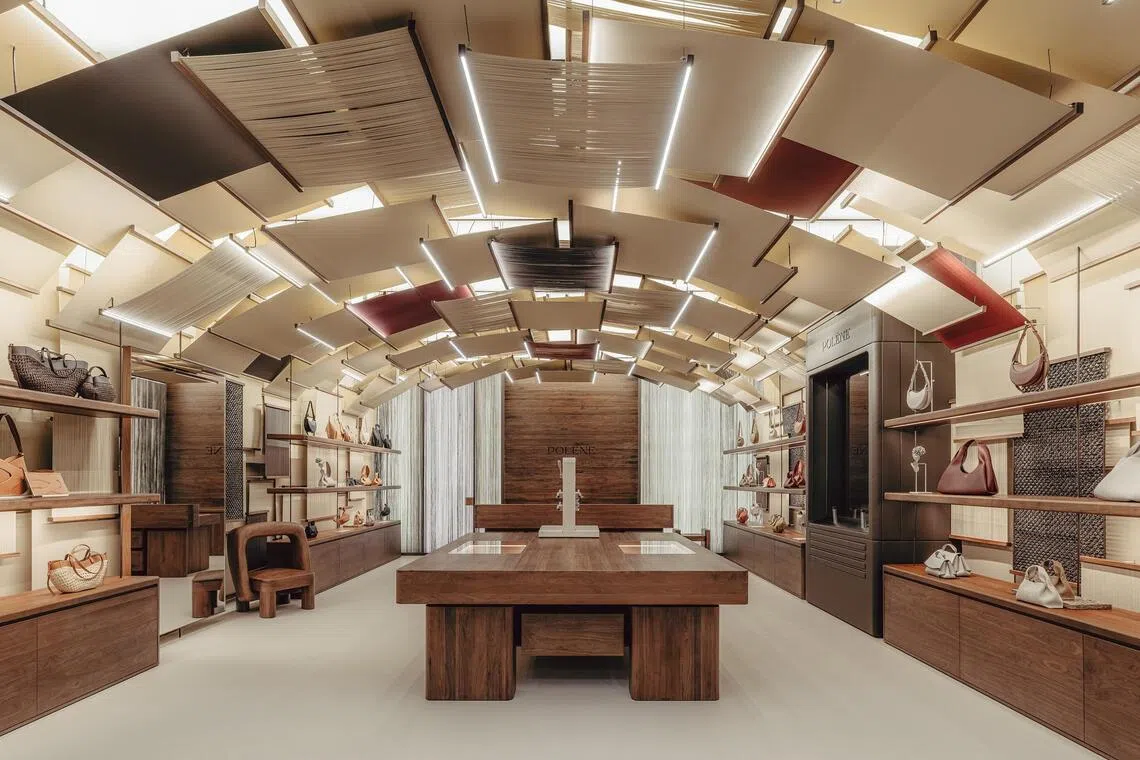
Polene's Singapore boutique in The Shoppes at Marina Bay Sands. The family-owned brand has had a meteoric rise since its founding in Paris in 2016.
Published Sep 03, 2026, 09:05 AM
Updated Sep 03, 2026, 01:35 PM
SINGAPORE – It seems like a lifetime ago now that Polene was a secret on the internet.
The Paris-born luxury handbag label was once exclusively worn by French women drawn by national pride and a desire for novel, sculptural shapes. Though it opened its first store in the Bastille area of Paris in 2016, the year it launched, it was a rare occurrence to find anyone toting a Polene bag outside France.
If you spotted one in Singapore, you probably made a mental note that it was a nice bag and moved on.
Nowadays, it is a different story. The pandemic-era trend of “quiet luxury” fuelled interest in alternative labels and quality leather bags with “under $500” price tags – surfacing Polene, with its poetic visual campaigns, as a front runner.
TikTok spread the word like wildfire, Polene’s number of boutiques around the world more than doubled, and it has become a household name holding its own alongside luxury houses with 10 times the history.
Singaporeans have fallen for it too. The brand’s best-selling Cyme totes – that boat-shaped, work-appropriate carry-al l with sides that can be tucked in, changing the shape of the bag – fill the streets and MRT cabins here, inspiring dupes from local and international competitors alike.
Likely, more will join them, now that Polene has opened its first Singapore store in The Shoppes at Marina Bay Sands on Aug 1.
Chief executive Antoine Mothay still finds it hard to believe that the family-owned brand has achieved such renown in just a decade.
In an exclusive e-mail interview with The Straits Times, he says: “We certainly hoped people would connect with Polene, but we could not have anticipated the international resonance it has today. We are very grateful for it.”
Polene Cyme in Textured Root (left) and Polene Cyme Cognac. PHOTOS: POLENE
Polene Cyme in Textured Root (left) and Polene Cyme Cognac.
Singapore is the latest step in Polene’s aggressive Asia expansion, which began with a store in Tokyo in 2023. Shortly after came standalone stores in Seoul in 2024 and Beijing in end-2025, then department stores in Osaka and Tokyo in mid-2026.
“We could already see a strong connection with Polene in Singapore through our digital activity long before having a physical presence here,” says Mothay.
“But we were also genuinely drawn to the city itself,” he adds, noting that Singapore is “at a historical crossroads between East and West, shaped by trade and maritime heritage” and possessing a strong contemporary architectural identity.
“That relationship between heritage and modernity felt particularly relevant to the way we think about our boutiques.”
Good leather is central to the business and it makes up a big part of store design across Polene’s boutiques, though no two are alike.
Polene designed Singapore’s with a nod to its maritime heritage and fishing village narrative. Lightweight fishing huts inspired the suspended leather panels that form a canopy across the boutique’s ceiling. Hand-woven in full-grain leather, each panel took nearly three hours of work.
Polene’s Singapore boutique features suspended leather panels inspired by fishing huts and has an exclusive Craft At Work – A Puzzle Of Leather machine installation. PHOTOS: POLENE
Polene’s Singapore boutique features suspended leather panels inspired by fishing huts and has an exclusive Craft At Work – A Puzzle Of Leather machine installation.
An installation titled Craft At Work – A Puzzle Of Leather gives a peek into the first step in making a bag, where a machine custom-developed for the boutique recreates the cutting of 36 different leather pieces that make up the brand’s Mokki bag.
French roots, Spanish craft
Polene was established in 2016 by Antoine and his siblings Elsa and Mathieu Mothay, great-grandchildren of the founders behind Normandy sailor stripes apparel label Saint James.
The aim then was to build a maison at the intersection of artistic rigour and wearable functionality – contemporary yet enduring, with sculptural silhouettes, subtle details and very little visible branding, says Antoine Mothay, 40. “Our vision was never about fleeting trends. It was about creating a visual language, where creativity meets understated elegance, exceptional craftsmanship and leatherwork.”
He was first inspired after an open house at an Hermes workshop in Madrid.
Things fell into place upon a visit to Ubrique, the southern Spanish town known for its leatherwork, where heritage luxury house Loewe also makes much of its leather goods.
It is a small town tucked into the mountains, but within its workshops, you will find one of the highest concentrations of leather artisanship in the world, Mothay says. “It is not a place you arrive at by accident. It is a place you are drawn to if you truly care about how a bag is born.”
The Spanish town of Ubrique, where Polene manufactures its bags. PHOTO: POLENE
The Spanish town of Ubrique, where Polene manufactures its bags.
He travelled through different manufacturing regions in Europe before eventually settling in Ubrique for a year.
There, he was struck by the depth of knowledge that had been passed down through generations. The leather goods industry powers the town’s economy and so the artisans take pride in passing on their expertise.
“We began producing there and, step by step, built very strong relationships with the city and its artisans. Today, Ubrique is inseparable from the identity of Polene.”
The brand built a workshop there and has a second in the works. Owning an integrated production model means Polene can gain greater control of all stages – from the selection and testing of materials to technical development to assembly – plus foster close dialogue between designers, technicians and artisans.
A Polene bag in an Ubrique workshop, and an artisan in Ubrique working on a Polene Mokki bag. PHOTOS: POLENE
A Polene bag in an Ubrique workshop, and an artisan in Ubrique working on a Polene Mokki bag.
Today, some 2,200 artisans in Ubrique work for Polene. Every new employee who joins the label makes an orientation visit to the town.
Much has changed since the brand’s founding.
Most notably, the LVMH group acquired a minority stake in Polene in September 2024 through its private equity firm, L Catterton.
If the tale sounds familiar, L Catterton once acquired, and later sold, a 20 per cent stake in Singapore’s Charles & Keith in 2011 when it was called L Capital Asia.
So it is an accolade for any young, independent fashion brand – even if it might come with trade-offs.
Polene, which also makes jewellery and leather accessories, increases the prices of its handbags yearly.
Since 2021, prices of popular styles like the Cyme have surged by around 30 per cent to 50 per cent. The crescent-shaped Numero Dix suffered the steepest increase in retail price of more than 60 per cent, from €270 (S$398) in 2021 to €450 in 2025 for a textured one.
The company’s last reported turnover was €142 million in 2023.
Polene Numero Dix in Graine Noir (left) and Polene Numero Dix Galop in Cerise Noire. PHOTOS: POLENE
Polene Numero Dix in Graine Noir (left) and Polene Numero Dix Galop in Cerise Noire.
With the brand gaining mass popularity, it has also received its fair share of criticism around the quality-to-price ratio of its products.
Yet, the queues keep coming. On a late Monday afternoon, a line forms outside the modest 84 sq m store in The Shoppes at Marina Bay Sands. Women march in single-mindedly, ask for bags they have clearly wishlisted online and try them on, two at a time.
In Singapore, prices for bags range from $460 to $1,140, while jewellery ranges from around $230 for a ring to $980 for a necklace. The local bestsellers are the Cyme ($790), Cyme Mini ($700), Numero Neuf Mini ($700), Numero Dix (from $800) and Mokki ($970) – if you can even get your hands on the limited stock in-store.
As prices climb, could Polene be at risk of losing the “affordable luxury” label that first made it viral?
The brand would not comment on the LVMH stake and Polene’s price increases.
Asked whether he still regards Polene as a small brand, he replies: “It depends on how you define small.
“In terms of scale, Polene is obviously no longer the company it was when we started 10 years ago. We have more people, more boutiques, more clients, more responsibility. We are a growing international maison.
Polene Mokki in Smoky Olive (left) and Polene Shuldo in Desert. PHOTOS: POLENE
Polene Mokki in Smoky Olive (left) and Polene Shuldo in Desert.
“But I think there are qualities from those early years that are very important for us to preserve. We still take time to develop products. We remain selective about what we launch and where we open.”
The brand takes around 18 months to develop a new silhouette, choosing to plug waits between new styles by reinterpreting existing silhouettes through new materials, colours and variations.
“We launch it only when we feel the design is fully resolved. We don’t work according to a traditional seasonal rhythm or feel that we need to introduce something new because the calendar requires it,” Mothay says.
“I would say we are a larger brand in reach and scale, but we still want to retain the focus, curiosity and attention to detail that shaped the maison from the beginning. Becoming larger should never mean becoming less precise.”
Staying true to origins
With 14 retail locations globally, Polene is looking to expand further. It plans to continue at a “steady pace” of opening six to eight stores a year, with Dubai, Vienna and Costa Mesa coming up next.
But long-time fans should not be alarmed by the rapid scaling, Mothay assures.
“We are very conscious of the pace of our development, not because we are afraid of growth, but because we respect what it takes to grow well. Several openings in Asia happened close together, but that was more a coincidence than a new rhythm for the maison. These projects are planned far in advance,” he says.
Polene’s Singapore boutique. PHOTOS: POLENE
Polene’s Singapore boutique.
What has particularly impressed him, in Polene’s Asia expansion, is the sophistication of the clients. They have a strong knowledge and appreciation of design, materials and craftsmanship, and a willingness to understand what goes into making a piece.
“That is something we deeply respect,” he says. “We don’t try to ‘win’ customers in the conventional sense. We try to earn their attention, piece by piece, detail by detail.
“We believe the most persuasive thing we can do is to remain consistent, and uncompromising on quality and unique design.”
About 80 per cent of Polene’s sales are generated abroad, as reported by French newspaper Le Monde in March 2025, with many developing a relationship with the brand without ever encountering its products in person. Hence, the need for physical retail to express more of the maison and make its savoir-faire (French for know-how) more visible, says Mothay.
Polene Numero Neuf Mini (front) and East West at Polene's Singapore boutique. PHOTO: POLENE
Polene Numero Neuf Mini (front) and East West at Polene's Singapore boutique.
“I completely understand that fear (that we might forget our roots),” he adds.
“For us, this comes back to coherence and continuity. We are building a maison and that requires time, discipline and a very clear point-of-view. Growth should allow us to deepen our expertise rather than dilute it. We are not trying to become a house that does everything.”
Winning as a brand, to him, is about being better than they were yesterday – and earning the trust of a client who chooses them again.
“We still spend more time in Ubrique than we do in boardrooms,” he adds.
“In 10 years, I hope we can look back at every product, store and project, and still feel proud of the choices we made.”
Info: Polene is located at B2-108A The Shoppes at Marina Bay Sands, 2 Bayfront Avenue
Polene在新加坡滨海湾金沙购物中心设有精品店。这个家族品牌自2016年在巴黎创立以来,发展迅猛。
发布于 2026 年 9 月 3 日上午 9:05
更新于2026年9月3日下午1:35
新加坡——感觉Polene在互联网上还是个秘密品牌,仿佛已经是上辈子的事了。
这个诞生于巴黎的奢侈手袋品牌,曾经只受到法国女性的青睐,她们出于民族自豪感和对新颖雕塑造型的追求而选择它。尽管该品牌于2016年在巴黎巴士底狱附近开设了第一家门店,但当时在法国以外的地方,很少见到有人拎着Polene包。
如果你在新加坡看到过一个,你可能会默默记下这是一个不错的包,然后就继续前行了。
如今情况已大不相同。疫情期间兴起的“低调奢华”风潮激发了人们对价格低于500美元的另类品牌和优质皮包的兴趣,而凭借其诗意的视觉宣传,Polene 脱颖而出,成为领跑者之一。
TikTok 让 Polene 的名声迅速传播开来,其在全球的精品店数量翻了一番还多,并已成为家喻户晓的品牌,与拥有十倍历史的奢侈品牌并驾齐驱。
新加坡人也为之倾倒。该品牌最畅销的Cyme手提包——这款船型、适合上班使用的多功能手提包,两侧可以收拢,改变包型——在新加坡的街头巷尾和地铁车厢里随处可见,引发了本地和国际竞争对手的竞相模仿。
8 月 1 日,Polene 在滨海湾金沙购物中心开设了第一家新加坡门店,很可能会有更多人加入他们的行列。
首席执行官安托万·莫泰仍然难以置信,这个家族品牌在短短十年内就取得了如此巨大的成就。
他在接受《海峡时报》独家电子邮件采访时表示:“我们当然希望人们能喜欢波琳,但我们无法预料到它如今会在国际上引起如此大的反响。我们对此非常感激。”
波琳香氛(Polene Cyme)纹理根茎(左)和波琳香氛干邑。图片:波琳
纹理根中的波伦赛梅(左)和波伦赛梅干邑。
新加坡是 Polene 积极拓展亚洲市场的最新一步,其亚洲扩张始于 2023 年在东京开设的一家门店。随后不久,Polene 分别于 2024 年和 2025 年底在首尔和北京开设了独立门店,并于 2026 年年中在大阪和东京开设了百货商店。
“早在我们在新加坡设立实体机构之前,我们就已经通过我们的数字活动与 Polene 在新加坡建立了紧密的联系,”Mothay 说。
“但我们也确实被这座城市本身所吸引,”他补充道,并指出新加坡“处于东西方历史的十字路口,受贸易和航海遗产的影响”,并且拥有强烈的当代建筑特色。
“这种传统与现代之间的关系,与我们对精品店的思考方式尤为相关。”
优质皮革是该业务的核心,也是 Polene 各家精品店设计的重要组成部分,尽管没有两家是完全相同的。
Polene在设计新加坡精品店时,融入了当地的海洋文化遗产和渔村风情。轻盈的渔屋启发了设计师,他们用皮革面板打造出悬挂在精品店天花板上的华盖。每块面板均采用全粒面皮革手工编织而成,耗时近三个小时。
Polene新加坡精品店以渔民小屋为灵感,采用悬挂式皮革面板,并独家展出名为“匠心工艺——皮革拼图”的机械装置作品。图片:Polene
Polene 新加坡精品店以渔屋为灵感,设有悬挂式皮革面板,并独家展出“工艺制作——皮革拼图”机器装置。
名为“工艺制作——皮革拼图”的装置艺术,展现了制作包袋的第一步,其中一台为这家精品店定制开发的机器重现了构成该品牌 Mokki 包的 36 种不同皮革部件的切割过程。
法国血统,西班牙工艺
Polene 由 Antoine 和他的兄弟姐妹 Elsa 和 Mathieu Mothay 于 2016 年创立,他们是诺曼底水手条纹服装品牌 Saint James 创始人的曾孙。
当时的愿景是打造一个兼具艺术严谨性和实用功能的品牌——既现代又经久不衰,拥有雕塑般的廓形、精致的细节和极少的品牌标识,40岁的安托万·莫泰说道。“我们的愿景从来都不是追逐转瞬即逝的潮流。而是创造一种视觉语言,将创意与低调的优雅、卓越的工艺和皮革制品完美融合。”
他最初的灵感来自于马德里一家爱马仕工坊的开放日活动。
在参观了以皮革制品闻名的西班牙南部小镇乌布里克之后,一切都迎刃而解了。历史悠久的奢侈品牌 Loewe 也在那里生产许多皮革制品。
莫泰说,这是一个隐匿在群山中的小镇,但镇上的工坊却汇聚了世界上最高的皮革工艺水平之一。“这不是一个偶然来到这里的地方。如果你真心在意一个包袋是如何诞生的,那么你自然会被这里吸引。”
西班牙小镇乌布里克,Polene 的包袋产自这里。图片:POLENE
Polene 的包袋产自西班牙小镇乌布里克。
他游历了欧洲不同的制造业地区,最终在乌布里克定居了一年。
在那里,他被代代相传的深厚知识所深深震撼。皮革制品业是该镇的经济支柱,因此工匠们以传承技艺为荣。
“我们最初在那里生产,并逐步与这座城市及其工匠建立了非常牢固的关系。如今,Ubrique 已成为波莱内不可分割的一部分。”
该品牌在那里建立了一个工坊,第二个工坊也正在筹建中。采用一体化生产模式意味着Polene可以更好地掌控所有环节——从材料的选择和测试到技术研发再到组装——并促进设计师、技术人员和工匠之间的密切沟通。
在乌布里克的一家工坊里,一只波琳(Polene)包正在制作中;一位乌布里克的工匠正在制作一只波琳莫基(Polene Mokki)包。图片:波琳(Polene)
在乌布里克的一家工坊里,一个波琳包正在制作中;乌布里克的一位工匠正在制作一个波琳莫基包。
如今,乌布里克镇约有2200名工匠为波琳公司工作。每位新加入该品牌的员工都要到镇上进行一次入职培训。
自品牌创立以来,很多事情都发生了变化。
最值得注意的是,LVMH 集团于 2024 年 9 月通过其私募股权公司 L Catterton 收购了 Polene 的少数股权。
如果这个故事听起来很熟悉,那是因为 L Catterton 曾在 2011 年收购了新加坡 Charles & Keith 20% 的股份,后来又将其出售,当时该公司名为 L Capital Asia。
所以,这对任何年轻的独立时尚品牌来说都是一项荣誉——即使它可能伴随着一些权衡取舍。
Polene 除了生产珠宝和皮革配饰外,每年都会提高其手提包的价格。
自 2021 年以来,Cyme 等热门款式的价格上涨了约 30% 至 50%。新月形的 Numero Dix 零售价涨幅最大,超过 60%,纹理款的价格从 2021 年的 270 欧元(398 新元)涨至 2025 年的 450 欧元。
该公司最近公布的2023年营业额为1.42亿欧元。
《Graine Noir》中的 Polene Numero Dix(左)和《Cerise Noire》中的 Polene Numero Dix Galop。照片:波莱尼
《Graine Noir》中的 Polene Numero Dix(左)和《Cerise Noire》中的 Polene Numero Dix Galop。
随着该品牌获得大众认可,其产品的性价比也受到了不少批评。
然而,队伍依然络绎不绝。周一下午晚些时候,在滨海湾金沙购物中心那家面积仅84平方米的店铺外,排起了长队。女人们径直走进店里,询问她们显然在网上收藏的包包,然后一次试背两个。
在新加坡,包袋的价格从460新元到1140新元不等,珠宝的价格则从戒指的230新元左右到项链的980新元不等。当地最畅销的款式包括Cyme(790新元)、Cyme Mini(700新元)、Numero Neuf Mini(700新元)、Numero Dix(800新元起)和Mokki(970新元)——前提是你能抢到店内有限的库存。
随着价格上涨,Polene 是否有可能失去最初使其爆红的“平价奢侈品”标签?
该品牌拒绝就LVMH的持股和Polene的价格上涨发表评论。
当被问及他是否仍然认为 Polene 是一个小品牌时,他回答说:“这取决于你如何定义小。”
“就规模而言,Polene 显然已经不再是 10 年前我们创立之初的那家公司了。我们有更多的员工、更多的精品店、更多的客户,也承担了更多的责任。我们是一家不断发展的国际品牌。”
波琳·莫基身着烟熏橄榄色(左)和波琳·舒尔多身着沙漠色。图片:波琳
烟熏橄榄色的波琳·莫基(左)和沙漠色的波琳·舒尔多。
“但我认为,早期的一些特质对我们来说非常重要,需要保留。我们仍然会花时间研发产品。我们对推出的产品和开设新店的地点仍然非常挑剔。”
该品牌大约需要 18 个月的时间来开发一种新的廓形,他们选择通过新材料、颜色和变化来重新诠释现有的廓形,以此填补新款式之间的空档期。
“只有当我们认为设计完全定稿时,我们才会推出新品。我们不遵循传统的季节性节奏,也不会因为日程安排需要就推出新品,”莫泰说道。
“我认为,无论从影响力还是规模上来说,我们的品牌都更大了,但我们仍然希望保持从创立之初就塑造了品牌的专注、好奇心和对细节的关注。规模扩大绝不意味着降低精准度。”
不忘初心
Polene在全球拥有14家零售店,并计划进一步扩张。公司计划继续保持“稳步扩张”的步伐,每年开设六到八家新店,迪拜、维也纳和科斯塔梅萨将是下一个目标城市。
莫泰保证,老粉丝们不必对这种快速增长感到担忧。
“我们非常清楚自身的发展步伐,这并非因为我们害怕增长,而是因为我们尊重稳健发展所需的条件。我们在亚洲开设了几家分店,时间相近,但这更多的是一种巧合,而非品牌发展节奏的改变。这些项目都是提前很久就规划好的。”他说道。
Polene 的新加坡精品店。照片:波莱尼
Polene新加坡精品店。
在波琳拓展亚洲市场的过程中,最令他印象深刻的是客户的品味。他们对设计、材料和工艺有着深刻的理解和鉴赏力,并且乐于了解一件作品的制作过程。
“我们对此深表尊重,”他说。“我们不试图以传统的方式‘赢得’客户。我们努力一点一滴、一丝一毫地赢得他们的关注。”
“我们认为最有说服力的做法就是保持一致性,在质量和独特设计方面毫不妥协。”
据法国《世界报》2025年3月报道,Polene约80%的销售额来自海外,许多消费者在从未亲身接触过其产品的情况下就与该品牌建立了联系。因此,Mothay表示,实体零售店对于更好地展现品牌形象、提升其技艺(法语为savoir-faire)的可见度至关重要。
Polene Numero Neuf Mini(前)和 East West 款式,摄于 Polene 新加坡精品店。图片:POLENE
Polene Numero Neuf Mini(正面)和 East West 在 Polene 新加坡精品店。
“我完全理解那种恐惧(害怕我们会忘记自己的根),”他补充道。
“对我们而言,关键在于连贯性和延续性。我们正在打造一个品牌,这需要时间、自律和非常清晰的理念。发展应该让我们深化专业技能,而不是稀释它。我们并不想成为一家什么都做的品牌。”
在他看来,品牌成功的关键在于比昨天做得更好,并赢得客户的信任,让他们再次选择自己。
“我们花在 Ubrique 的时间仍然比花在会议室的时间多,”他补充道。
“我希望10年后,我们回顾每一件产品、每一家门店和每一个项目时,仍然会为我们所做的选择感到自豪。”
信息:Polene位于滨海湾金沙购物中心B2-108A,海湾大道2号