US Bangkok broadside to the IMF and the World Bank delivered by Scott Bessent who snubbed the meeting美国驻曼谷代表斯科特·贝森特向国际货币基金组织和世界银行发表了措辞强硬的讲话,他本人却冷落了此次会议。
Washington turns up the heat at Bangkok’s IMF–World Bank meetings. Absent Treasury chief Scott Bessent demands oil and gas funding, nuclear investment, an end to… Read More ›
新闻视频
October 16, 2026 at 1:05 pm
in Economy , Living , Media , Politics , Thailand
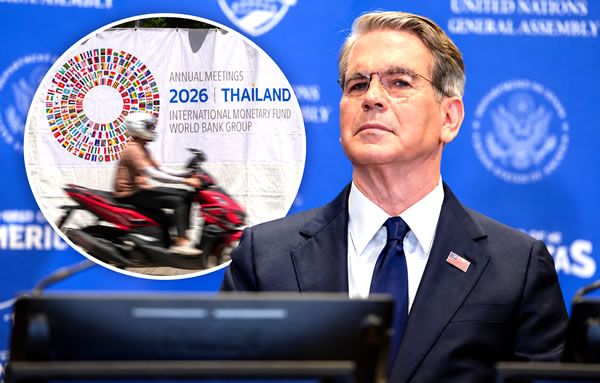
US Treasury Secretary Scott Bessent has launched a fierce attack on the World Bank and IMF at their Bangkok annual meetings, despite refusing to attend. In written statements, he demanded an end to climate-driven restrictions on oil and gas financing, alongside a call for enhanced investment in nuclear power, critical minerals and deep-sea mining. China faced direct criticism, with Bessent demanding an end to World Bank lending to Beijing and tougher IMF scrutiny of trade distortions. Furthermore, he warned that the IMF risked marginalisation and attacked executive boards costing over $200 million annually. His intervention puts Washington’s financial muscle behind a major overhaul of both institutions as Thailand struggles with weak growth, debt and mounting industrial competition.
US Treasury Secretary Scott Bessent snubs Bangkok’s IMF–World Bank meetings, demanding fossil fuel funding, an end to China loans and cuts to $200 million executive board costs. ( Source: Daily News )
US Treasury Secretary Scott Bessent has launched a blistering attack on the World Bank and International Monetary Fund during their annual meetings in Bangkok. Despite staying away from the gathering, Bessent delivered an extensive programme of reforms in written statements issued on Wednesday, October 14.
His demands, reported on Thursday, included ending climate-driven restrictions on financing oil and gas exploration and extraction. Furthermore, he called for greater investment in nuclear power, critical minerals and deep-sea mining.
China was another major target, with Washington demanding an end to World Bank lending to the communist-ruled country. Bessent also warned that the IMF risked becoming marginalised unless it challenged damaging economic policies. Meanwhile, he attacked executive spending, demanding freezes or cuts to board salaries and budgets costing more than $200 million annually.
Bessent skips Bangkok meetings but delivers a sweeping challenge to World Bank and IMF priorities
The intervention delivered one of the biggest news stories from the IMF–World Bank Annual Meetings in Bangkok. It also represented a direct challenge to the policies and priorities of two institutions central to international finance.
Notably, Bessent made his demands without attending the meetings personally. Instead, he remained in the United States, citing domestic commitments. Deputy Treasury Secretary Francis Brooke and Under Secretary for International Affairs Erin Browne led the American Treasury delegation.
However, Bessent’s absence did not prevent Washington from setting out an extensive reform programme. His statements challenged the World Bank’s energy financing, development priorities, lending practices and internal spending.
At the same time, he demanded fundamental changes to the IMF’s supervision of the international economy. He accused both institutions of losing focus on their original responsibilities. Moreover, he questioned their effectiveness and use of financial resources.
The United States is the largest shareholder in both institutions. Consequently, Washington occupies a powerful position in discussions over their future policies. Bessent’s intervention also reflected President Donald Trump’s determination to prioritise American economic and national security interests in international financial policy.
Washington demands an end to World Bank restrictions on financing oil and gas exploration projects
The Treasury Secretary’s most immediate demand concerned the World Bank’s restrictions on financing fossil fuel development. He called for the formal abandonment of restrictions on upstream oil and gas projects.
These projects include exploration and extraction, rather than simply transporting or distributing existing supplies. The restrictions have limited World Bank support for new oil and gas development. They form part of the institution’s climate-related financing policies.
Bessent argued that developing countries must have greater freedom to determine their energy requirements. He demanded a technology-neutral approach permitting financing across a wider range of energy sources.
In particular, Washington wants the World Bank to restore support for oil and gas exploration and extraction. Bessent also called for greater investment in natural gas infrastructure. He welcomed recent World Bank support for gas-related development in West Africa. Nevertheless, he insisted that further reforms were necessary.
The Treasury Secretary linked his demands directly to economic development and employment. He argued that affordable and reliable electricity is essential to industrial production, business investment and poverty reduction.
Additionally, he supported efforts to provide electricity access to another 300 million people across Africa. The initiative forms part of a wider effort to address inadequate electricity supplies across developing economies.
Climate financing restrictions face challenge as Bessent backs nuclear energy and fossil fuel projects
Bessent’s position directly challenges the influence of climate policies on international development lending. Instead, Washington wants energy financing decisions to concentrate more heavily on economic requirements and investment returns.
The proposed changes would reopen financing opportunities for projects currently restricted by World Bank policy. However, the demands remain proposals. The World Bank has not formally agreed to abandon its existing restrictions.
The timing was significant. The Middle East war has created another major international energy shock. As a result, energy-importing economies face additional pressure from higher costs. Developing countries also continue to require investment in electricity generation and industrial infrastructure. Bessent’s proposals would place fossil fuel development more prominently within the World Bank’s financing activities.
In parallel, the Treasury Secretary demanded greater support for nuclear energy. He announced an initial American contribution to the World Bank-administered Nuclear Energy Assistance Trust Fund.
The initiative supports countries preparing for future investment in nuclear electricity generation. Such preparations include technical expertise, regulatory systems, institutional capacity and investment planning. However, the Treasury Secretary did not disclose the size of Washington’s contribution.
Nuclear power joins critical minerals and deep-sea mining among Washington’s new investment priorities
The announcement placed nuclear power alongside fossil fuels in America’s preferred development financing priorities. Bessent presented nuclear energy as another means of expanding reliable electricity supplies.
Furthermore, the initiative would support countries seeking to develop the institutions and technical capacity required for nuclear projects. Washington is demanding a broader energy investment programme covering natural gas, oil and nuclear power.
On another front, Bessent identified critical minerals as a priority for World Bank investment. These materials are essential to advanced manufacturing, batteries, electronics, electricity infrastructure and defence industries.
The Treasury Secretary demanded greater support for mineral extraction, processing facilities and related infrastructure. He welcomed the World Bank’s recently approved Metals and Minerals Implementation Plan. Nevertheless, Bessent pressed the institution to move further and expand practical investment support.
Significantly, he singled out deep-sea mining as an emerging industry requiring greater attention. Deep-sea mining involves extracting mineral resources from the ocean floor. The industry has attracted international interest because of rising demand for strategically important materials. Bessent proposed a greater World Bank role in providing technical guidance and assistance for such projects.
China faces pressure over minerals and World Bank loans as Washington seeks major lending reforms
Deep-sea mining remains controversial because of concerns about damage to marine ecosystems. Its long-term environmental consequences also remain uncertain. Even so, Washington has placed critical minerals at the centre of its economic and national security priorities.
China occupies a powerful position in the processing and supply chains of several strategically important minerals. Developing alternative sources and processing capacity has therefore become a major American objective.
The World Bank proposals would expand international development financing into these industries. They would also support mineral-related investment in developing countries. Separately, Bessent launched another direct challenge involving China’s relationship with the World Bank.
He demanded faster progress towards ending sovereign lending to China and Poland. The Treasury Secretary argued that sufficiently developed economies should no longer receive the same financing opportunities as poorer countries.
He welcomed plans to withdraw lending from both countries. However, he insisted that the World Bank establish a stronger process for removing countries from borrowing eligibility. Bessent said the institution was experiencing the longest period in its history without a country graduating from lending eligibility.
Bessent questions World Bank loans to China and demands faster graduation of wealthy borrowing nations
The situation, he argued, raised serious questions about how the bank allocated development resources. Washington wants the institution to concentrate its lending on poorer economies with greater financing needs.
China was a particularly significant target. The communist-ruled country has become one of the world’s largest economies and a major industrial power. It is also one of America’s principal strategic and economic competitors.
Yet China has continued to qualify for certain World Bank financing arrangements. Bessent challenged the justification for this continued access. He demanded clearer rules for ending lending eligibility when countries reach sufficient levels of economic development.
The Treasury Secretary pressed the bank to accelerate the process. His demands would place greater pressure on middle-income borrowers approaching the institution’s graduation criteria. Nonetheless, Bessent did not identify Thailand as a country whose borrowing eligibility should end. The proposed changes would require decisions through the World Bank’s governing arrangements.
World Bank faces demands for debt transparency, competitive contracts and measurable results
In addition, Bessent attacked opaque international lending practices and demanded stronger debt transparency. He criticised coercive arrangements and insufficient disclosure in international financing. Although China was not directly identified in that section, Washington has repeatedly challenged Beijing’s overseas lending practices. The Treasury Secretary demanded greater transparency over debt obligations and financing arrangements.
His criticism extended beyond individual lending decisions. It also questioned the World Bank’s effectiveness in managing international development resources.
Bessent accused the institution of placing excessive emphasis on the volume of loans rather than their economic results. He argued that lending should be assessed against measurable improvements in employment, productivity and living standards. Moreover, he demanded a stronger concentration on poverty reduction and productive investment.
The Treasury Secretary acknowledged that the World Bank had introduced some reforms. These included changes to climate financing targets and greater attention to employment. He also recognised efforts to withdraw lending from countries considered sufficiently developed. Despite this, Bessent argued that progress remained inadequate. His demands challenged the institution’s operating priorities as well as its lending eligibility rules.
The Treasury Secretary also targeted the World Bank’s procurement arrangements. He criticised practices that favour subsidies, distort competition or permit corruption and collusion.
Such arrangements, he argued, can increase project costs and reduce the benefits of development financing. Washington wants stronger competition and better value for money in World Bank-funded contracts. Bessent acknowledged recent procurement improvements but demanded further action.
Bessent attacks private-sector lending failures and warns IMF over distorted international trade
His criticism also extended to the International Finance Corporation, the World Bank’s private-sector financing arm. The corporation has committed to directing 40% of new financing commitments towards the poorest and most fragile countries.
Yet Bessent said progress towards this target remained insufficient. He questioned whether the organisation was concentrating enough resources on countries with the greatest development needs. The intervention therefore challenged both sovereign lending and private-sector investment.
Turning to the International Monetary Fund, the Treasury Secretary delivered equally severe criticism. Bessent accused the institution of failing to challenge economic policies that distort international trade and competition. These included government intervention, exchange-rate practices and policies contributing to persistent global trade imbalances. He warned that the IMF risked becoming marginalised unless it responded more forcefully.
IMF faces criticism over China, industrial subsidies and failures to challenge global trade imbalances
The warning struck at one of the institution’s principal responsibilities. The IMF monitors national economic policies and developments affecting the international monetary system. It also assesses financial stability, debt sustainability and balance-of-payments problems.
However, Bessent argued that its economic surveillance had failed to address damaging policies adequately. He demanded more rigorous monitoring and stronger criticism of practices that distort international competition.
Although China was not explicitly named, Reuters and AFP interpreted the remarks as directed primarily towards Beijing. The Trump government has repeatedly criticised China’s industrial subsidies, manufacturing overcapacity and export dependence. Washington argues that such policies create unfair competition and damage producers elsewhere. Bessent’s statement placed greater responsibility on the IMF to challenge these practices.
Specifically, he demanded stronger scrutiny of government intervention and persistent trade imbalances. He also called for more effective assessments of exchange-rate policies and their economic consequences.
The Treasury Secretary warned that failure to act would weaken the IMF’s international relevance. Nevertheless, he reaffirmed American support for a strong and adequately funded institution. Washington’s demands concerned its direction and effectiveness rather than its continued existence.
Washington demands tighter IMF lending rules and targets executive spending at both global institutions
Bessent also called for stronger IMF lending programmes. He demanded better assessments of sovereign debt sustainability and greater financial discipline. Furthermore, he argued that the institution should concentrate on its core responsibilities.
These include international monetary stability, financial crises and balance-of-payments financing. The Treasury Secretary questioned whether some IMF activities had moved too far beyond those objectives.
In particular, he criticised aspects of the Resilience and Sustainability Trust. The trust provides longer-term financing to eligible countries facing structural challenges affecting economic stability.
Bessent questioned whether some financing had a sufficiently clear connection to balance-of-payments pressures. He demanded tighter control over lending activities and stronger justification for financial commitments. The criticism reflected Washington’s wider demand for international institutions to concentrate on their original purposes.
Bessent’s intervention went considerably further than lending and economic policy. He also launched a direct attack on the cost of running the World Bank and IMF.
The Treasury Secretary singled out their executive boards, whose combined annual costs exceed $200 million. He demanded that board budgets and salaries be frozen indefinitely or reduced. Additionally, he described their operating costs as substantially higher than those at comparable international financial institutions.
Bessent demands spending restraint and disposal of IMF facilities as Bangkok meetings continue
The demand placed executive remuneration and institutional overheads directly under American scrutiny. Bessent also called for continued restraint in administrative spending. He argued that international financial institutions should exercise tighter control over their own operating expenses.
Meanwhile, the IMF faced another specific demand involving its property and facilities. The Treasury Secretary called for the disposal of the Bretton Woods Recreation Centre and Concordia Hotel.
The proposals formed part of his broader campaign to reduce expenditure unrelated to the institutions’ principal financial functions. Consequently, the American reform programme extended from international lending policies to executive salaries and recreational facilities. The intervention was particularly striking because Bessent had chosen not to attend the Bangkok meetings.
The Treasury Department explained that domestic commitments prevented him from travelling. Instead, senior American Treasury officials represented Washington at the gathering. Even so, the Secretary’s written statements ensured that the American position occupied a central place in the proceedings. The meetings had brought together finance ministers, central bankers and senior economic officials from across the world.
Global energy shocks and mounting debt sharpen Washington’s demands at the Bangkok meetings
They were taking place amid considerable international economic uncertainty. The Middle East war had disrupted energy markets. Meanwhile, rising borrowing costs continued to threaten heavily indebted economies.
Global trade tensions were also placing pressure on manufacturing and international investment. Against this background, Bessent demanded changes across several major areas of international financial policy.
His proposals covered fossil fuel financing, nuclear energy, critical minerals, China, international lending and institutional expenditure. Furthermore, they challenged the effectiveness of IMF surveillance and World Bank development financing.
The American intervention came as the United States held the G20 presidency. Washington had already indicated that its participation in the meetings would reflect American economic and national security priorities.
Bessent’s statements provided a detailed account of those priorities. They also placed the institutions under direct pressure to justify their policies and spending. For Thailand, the developments were particularly relevant. Bangkok was hosting the meetings while facing weak economic growth, high household debt and investment difficulties. The country also faces increasing industrial competition from other Southeast Asian economies.
Thailand faces questions over energy financing, China trade and World Bank support for developing nations
Meanwhile, its manufacturing sector remains closely connected to Chinese and regional supply chains. Washington’s demands concerning Chinese industrial policies and international trade could therefore have implications for Thai manufacturers.
The proposed changes to energy financing are also relevant to developing and middle-income economies. Greater World Bank support for natural gas and nuclear power could eventually broaden available financing options.
However, any direct benefits for Thailand would depend on individual projects, lending arrangements and national energy policy. Similarly, expanded investment in critical minerals could affect industrial development across Southeast Asia. Bessent announced no specific measures directed at Thailand. Nor did he demand an end to Thai borrowing from the World Bank. His criticism focused on countries considered sufficiently developed to leave existing lending programmes.
Thai Finance Minister Ekniti outlines development priorities as Bessent challenges World Bank policies
Meanwhile, Deputy Prime Minister and Finance Minister Ekniti Nitithanpraphas addressed the World Bank Development Committee on Thursday. Representing the Southeast Asia Voting Group, Ekniti called for development financing that produces measurable economic benefits.
He emphasised quality employment, improved livelihoods and stronger economic capabilities. Additionally, the Thai Finance Minister stressed the importance of supporting middle-income countries seeking to upgrade their economies.
His remarks reflected Thailand’s interest in financing that improves productivity and employment. However, the Thai presentation also supported accelerating the transition towards cleaner energy. That position differed from Washington’s demand to remove restrictions on upstream oil and gas financing. Nevertheless, both statements emphasised the economic results of development investment.
Bessent’s intervention now leaves the World Bank and IMF facing a detailed American reform agenda. The Treasury Secretary wants the World Bank to abandon restrictions on financing oil and gas exploration and extraction.
He also wants greater support for nuclear power, critical minerals and deep-sea mining. Furthermore, Washington is demanding faster graduation of sufficiently developed countries from World Bank borrowing programmes. China and Poland were specifically identified.
Washington’s reform demands now confront IMF and World Bank governing bodies over future policy choices
At the IMF, Bessent demanded stronger action against economic policies that distort trade and competition. He also called for tighter lending discipline, better debt assessments and greater attention to financial stability. Meanwhile, both institutions face demands to reduce executive costs and restrain administrative expenditure. The proposals have not been adopted as institutional policy.
Changes to lending arrangements, energy financing and internal operations would require decisions through the institutions’ governing bodies. However, the United States possesses substantial influence as their largest shareholder. Washington’s demands consequently carry considerable weight in discussions over future policy.
Bessent’s intervention was also unusually broad. It challenged the World Bank’s climate-related financing restrictions and its continued lending to China. At the same time, it questioned the IMF’s willingness to criticise economic practices damaging international competition. Furthermore, it attacked the cost of running both institutions, including executive salaries and facilities.
The Treasury Secretary’s decision to remain in the United States did not reduce the scope of his demands. Instead, he delivered a comprehensive challenge through written statements issued as the annual meetings proceeded in Bangkok. The timing ensured that his proposals reached the institutions during one of their most important annual gatherings.
Bessent’s reform agenda puts World Bank lending, IMF oversight and executive spending under pressure
For the World Bank, the demands centred on development priorities, energy financing and the allocation of lending resources. For the IMF, they centred on economic surveillance, lending discipline and international monetary stability. Both institutions were also told to tighten their own spending.
The American position was therefore clear. Washington wants major changes to how the World Bank and IMF lend money, supervise economies and manage their operations. Bessent has now placed those demands before the institutions’ governing committees.
Their response will determine how far Washington succeeds in changing the direction of international development financing and economic oversight.
Prime Minister Anutin talks of an economy driven by ‘quality growth’ at the Bangkok IMF World Bank forum
Protests at the IMF World Bank meetings turn violent but Bangkok police strongly deny being heavy handed
Police chief says Bangkok is ready for World Bank and IMF meetings with over 18,000 delegates visiting
Thailand struggles economically even with revised World Bank GDP growth for 2026 coming in at 2% for 2026
Vietnam’s economic growth races ahead of Thailand’s putting it on track to overtake its net GDP by 2029
Vietnam is taking Thailand’s quality tourists in huge numbers while Bangkok flails about with crackdowns
Thailand’s once mighty tourism industry is failing but now faces further damage from overvalued baht
Economists baffled by extraordinary and damaging rise of the baht in 2025 hitting tourism and exports
Top Thai banker launches blistering attack on present state of the economy calling for more inclusion
Joseph Anthony is an expat from Ireland who has lived in Thailand for the last decade. He has worked extensively in the media including editorial positions in Ireland and Thailand. He is focused on economic and business stories in Thailand as well as the expat lifestyle.
All posts by Joseph O' Connor
Thai UK beauty wins Ms Global title. Highly educated marketing whiz stormed to victory in home pageant October 13, 2026 Beauty, brains and grit! Thai-British Saffron Maya
People’s Party bigwig calls on Pheu Thai to put the country first in the forthcoming no confidence vote October 12, 2026 Anutin faces a political showdown as the
Two Nigerians arrested for cocaine possession in Pattaya as police launch a crackdown on illicit drugs October 12, 2026 Police raid a Pattaya condo and discover cocaine
Thaksin’s mansion and bulletproof cars on the line as court reserves decision on tax debt injunction to halt collection October 11, 2026 Thaksin battles to stop a ฿17.6 billion tax
5 Chinese man gang departs Thailand within hours of a 37 million baht heist in Pattaya of Turkish target October 11, 2026 One month watching their target. Six hours to escape
Failing foreign tourism sector at war over tourist levy and exactly who benefits from the billions raised October 11, 2026 Deputy Prime Minister and Commerce Minister Suphajee
Eleven arrested in Saturday property raids linked to foreigners with links to criminality across Bangkok October 10, 2026 Police raid Bangkok’s luxury estates, targeting
Burmese drug kingpin with multiple identities and lives linked to massive cash seizure in Chiang Rai October 10, 2026 Dead in 2022. Arrested in South Korea in 2026. Noo
Thailand reels at story of mother taken against her will to a prison like nursing home with caged beds for inmates October 9, 2026 Police probe a family nightmare as Mother Phat, 63,
51 year old Frenchman arrested in Chiang Mai for running a tourist hostel through a nominee company October 9, 2026 Frenchman arrested after police raid a Chiang Mai
Queen is first Thai woman to fly a Swedish Gripen fighter jet. King in Surat Thani to congratulate her October 9, 2026 From Boeing jets to a supersonic fighter: Queen
Justice Minister and other cabinet members lead raids on Jewish centres in Bangkok as financial case grows October 8, 2026 A tiny Bangkok office registered to six entities, 61
Licenced online gambling site abroad linked to the husband of a government MP raises legal quandary October 8, 2026 A ฿1.9bn wealth controversy threatens to engulf
Horror care centre closed in Kanchanaburi where patients were locked into caged beds and prison cells October 7, 2026 Steel cage beds, barred rooms and psychiatric patients
New tourist tax of 450 baht a step closer with officials targeting early 2027 after cabinet approval is obtained October 7, 2026 Foreign tourists face a ฿450 Thai entry charge from
Corruption and crime crusader carted off to Bangkok Remand Prison after court refused last minute bail October 5, 2026 Atchariya is behind bars after losing bail as cyber
Vietnam’s economic growth races ahead of Thailand’s putting it on track to overtake its net GDP by 2029 October 5, 2026 Thailand’s economic lead is under pressure as
Upmarket Thai prostitution racket smashed by Hong Kong police. 16 people arrested in separate swoops October 13, 2026
Air force monitors Chinese base operation in Laos as Beijing strengthens military ties with neighbours October 12, 2026
Tourist police reach out to Russian Embassy to inform tourists visiting Thailand about laws and customs October 12, 2026
Police chief says Bangkok is ready for World Bank and IMF meetings with over 18,000 delegates visiting October 12, 2026
Indian YouTube on tour of Thailand with no money hits a snag at Udon Thani temple and is asked to leave October 11, 2026
Chiang Rai river basin findings ramp up the pressure on Thailand to act over poison flowing from Burma October 11, 2026
Horrorific work incident saw woman (49) decapitated by a lift on Saturday. Police investigation underway October 10, 2026
Counterfeiting racket selling on TikTok and Lazada busted in Samut Sakhon. Six foreigners arrested on site October 10, 2026
PM says he can explain. Denies power over impartial agencies as a no confidence motion is filed in House October 10, 2026
Murder in Trang over meth tablet dealing. Two men arrested after burned remains found near reservoir October 9, 2026
Commerce Minister says that a November signing of a US Thai trade deal is in sight as exporters stand by October 9, 2026
Armed police action in Nonthaburi as man wanted for attempted murder sought to evade an arrest warrant October 9, 2026
Thailand struggles economically even with revised World Bank GDP growth for 2026 coming in at 2% for 2026 October 8, 2026
New taxes simply for going in and out of Thailand in addition to higher airport tax already implemented October 8, 2026
Thaksin comes to Tax Court in Bangkok seeking temporary injunction to halt Revenue Department’s enforcement October 7, 2026
Senators from the ‘blue’ camp move against dissident Election Commissioner Sitthichot Intrawises October 6, 2026
Thai Airways defeats flood crisis but finds itself in a brewing crisis of confidence over its management October 5, 2026
Grab delivery driver strikes rich in Phuket by using trade to burgle 2 homes netting 3.69 million baht October 5, 2026
USS George HW Bush arrives in Phuket one day early and berths 3.3km offshore. Sailors landing ashore in holiday mode October 5, 2026
Police investigate a Burmese kingpin who entered Thailand by plane from India and had access to wealth October 4, 2026
Thai industrial base hammered by flooding crisis. Over 4k firms report a need for financial assistance October 4, 2026
House Committee chair Rome to call Bhumjaithai MP and Australian husband on Wednesday over wealth October 4, 2026
© 2026 Thai Examiner. All rights reserved.
2026年10月16日下午1点05分
经济、生活、媒体、政治、泰国
尽管拒绝出席在曼谷举行的世界银行和国际货币基金组织年会,美国财政部长斯科特·贝森特仍对这两个机构发起猛烈抨击。他在书面声明中要求取消因气候变化而对石油和天然气融资施加的限制,并呼吁加大对核能、关键矿产和深海采矿的投资。贝森特直接批评了中国,要求世界银行停止向北京提供贷款,并要求国际货币基金组织对贸易扭曲行为进行更严格的审查。此外,他还警告称,国际货币基金组织面临被边缘化的风险,并抨击其每年耗资超过2亿美元的执行董事会。贝森特的介入表明,华盛顿的财政实力正推动对这两个机构进行重大改革,而此时泰国正面临着经济增长乏力、债务缠身和日益激烈的产业竞争。
美国财政部长斯科特·贝森特缺席在曼谷举行的国际货币基金组织-世界银行会议,要求获得化石燃料资金、停止对中国的贷款,并削减2亿美元的执行董事会费用。(来源:《每日新闻》)
美国财政部长斯科特·贝森特在曼谷举行的世界银行和国际货币基金组织年会期间,对这两家机构发起了猛烈抨击。尽管贝森特本人并未出席会议,但他于10月14日(周三)发表书面声明,提出了一系列改革方案。
据周四报道,他的诉求包括取消因气候变化而对石油和天然气勘探开采融资的限制。此外,他还呼吁加大对核能、关键矿产和深海采矿的投资。
中国是另一个主要目标,华盛顿要求世界银行停止向这个共产党统治的国家提供贷款。贝森特还警告说,除非国际货币基金组织挑战那些有害的经济政策,否则它将面临被边缘化的风险。与此同时,他还抨击了高管开支,要求冻结或削减董事会薪酬以及每年超过2亿美元的预算。
贝森特缺席曼谷会议,但对世界银行和国际货币基金组织的优先事项提出了全面挑战。
此次干预行动成为曼谷国际货币基金组织-世界银行年会期间最引人瞩目的新闻事件之一。它也直接挑战了这两个国际金融核心机构的政策和优先事项。
值得注意的是,贝森特并未亲自出席会议,而是留在美国提出要求,理由是国内事务繁忙。美国财政部副部长弗朗西斯·布鲁克和国际事务副部长艾琳·布朗率领美国财政部代表团。
然而,贝森特的缺席并未阻止华盛顿推出一项全面的改革计划。他的声明对世界银行的能源融资、发展优先事项、贷款做法和内部支出提出了质疑。
与此同时,他要求对国际货币基金组织监管国际经济的方式进行根本性改革。他指责这两个机构偏离了其最初的职责。此外,他还质疑它们的效率和对金融资源的利用。
美国是这两家机构的最大股东。因此,华盛顿在有关其未来政策的讨论中占据着举足轻重的地位。贝森特的干预也体现了唐纳德·特朗普总统决心在国际金融政策中优先考虑美国的经济和国家安全利益。
华盛顿要求世界银行停止对石油和天然气勘探项目融资的限制。
财政部长最紧迫的要求是世界银行对化石燃料开发融资的限制。他呼吁正式取消对上游油气项目的限制。
这些项目包括勘探和开采,而不仅仅是运输或分销现有资源。这些限制措施制约了世界银行对新的油气开发项目的支持。它们是该机构气候相关融资政策的一部分。
贝森特认为,发展中国家必须拥有更大的自主权来决定自身的能源需求。他要求采取技术中立的方法,允许为更广泛的能源来源提供融资。
华盛顿尤其希望世界银行恢复对石油和天然气勘探和开采的支持。贝森特也呼吁加大对天然气基础设施的投资。他欢迎世界银行近期对西非天然气相关发展的支持。尽管如此,他仍然坚持认为有必要进行进一步的改革。
财政部长将他的诉求与经济发展和就业直接联系起来。他认为,价格合理且可靠的电力对于工业生产、商业投资和减贫至关重要。
此外,他还支持为非洲另外3亿人提供电力的努力。这项倡议是旨在解决发展中经济体电力供应不足问题的更广泛努力的一部分。
贝森特支持核能和化石燃料项目,气候融资限制面临挑战
贝森特的立场直接挑战了气候政策对国际发展贷款的影响。相反,华盛顿希望能源融资决策更加注重经济需求和投资回报。
拟议的改革将为目前受世界银行政策限制的项目重新开放融资机会。然而,这些要求目前仍处于提议阶段。世界银行尚未正式同意放弃现有的限制。
时机至关重要。中东战争引发了又一次重大的国际能源冲击。因此,能源进口经济体面临着成本上涨带来的额外压力。发展中国家也持续需要投资电力生产和工业基础设施。贝森特的提议将使化石燃料开发在世界银行的融资活动中占据更重要的地位。
与此同时,财政部长要求加大对核能的支持力度。他宣布美国将首次向世界银行管理的核能援助信托基金捐款。
该倡议旨在支持各国为未来投资核电做好准备。这些准备工作包括技术专长、监管体系、机构能力和投资规划。然而,美国财政部长并未透露华盛顿的捐助规模。
核能与关键矿产和深海采矿一起,成为华盛顿新的投资重点领域。
该声明将核能与化石燃料并列为美国优先发展融资领域。贝森特认为,核能是扩大可靠电力供应的又一途径。
此外,该倡议还将支持那些寻求发展核能项目所需机构和技术能力的国家。华盛顿方面则要求制定一项涵盖天然气、石油和核能的更广泛的能源投资计划。
另一方面,贝森特指出,关键矿产是世界银行投资的优先领域。这些材料对先进制造业、电池、电子产品、电力基础设施和国防工业至关重要。
财政部长要求加大对矿产开采、加工设施及相关基础设施的支持力度。他对世界银行近期批准的《金属和矿产实施计划》表示欢迎。然而,贝森特敦促世界银行采取进一步行动,扩大切实可行的投资支持。
值得注意的是,他特别指出深海采矿是一个新兴产业,需要更多关注。深海采矿是指从海底开采矿产资源。由于对具有战略意义的材料需求不断增长,该行业已引起国际社会的广泛关注。贝森特建议世界银行在为这类项目提供技术指导和援助方面发挥更大的作用。
中国在矿产资源和世界银行贷款方面面临压力,华盛顿方面正寻求进行重大贷款改革。
深海采矿一直备受争议,因为人们担心它会破坏海洋生态系统。其长期环境影响也尚不明朗。即便如此,华盛顿仍将关键矿产置于其经济和国家安全优先事项的核心位置。
中国在多种具有战略意义的矿产的加工和供应链中占据着举足轻重的地位。因此,开发替代矿产来源和加工能力已成为美国的一项重要目标。
世界银行的提议将扩大国际发展融资对这些行业的覆盖范围,并支持发展中国家的矿产相关投资。此外,贝森特还就中国与世界银行的关系提出了另一项直接挑战。
他要求加快终止对中国和波兰的主权贷款进程。这位财政部长认为,经济高度发达的国家不应再享有与较贫穷国家相同的融资机会。
他欢迎世界银行计划停止向两国提供贷款。但他坚持认为,世界银行必须建立更完善的取消国家贷款资格程序。贝森特表示,世界银行正经历着历史上最长的没有国家从贷款资格名单中移除的时期。
贝森特质疑世界银行向中国提供的贷款,并要求富裕借款国加快从债务管理体系中脱身。
他认为,这种情况引发了人们对世界银行如何分配发展资源的严重质疑。华盛顿希望该机构将贷款重点放在那些融资需求更大的较贫穷经济体上。
中国是一个尤为重要的目标。这个由共产党统治的国家已成为世界最大的经济体之一和主要的工业强国。它也是美国的主要战略和经济竞争对手之一。
然而,中国仍然有资格获得世界银行的某些融资安排。贝森特质疑这种持续获得贷款资格的合理性。他要求制定更明确的规则,规定当一个国家达到足够的经济发展水平时,如何终止其贷款资格。
财政部长敦促世界银行加快这一进程。他的要求将给那些即将达到世界银行“毕业标准”的中等收入借款人带来更大压力。然而,贝森特并未将泰国列为应终止其借款资格的国家之一。拟议的变更需要通过世界银行的治理机制做出决定。
世界银行面临着债务透明度、竞争性合同和可衡量成果方面的要求。
此外,贝森特抨击了不透明的国际贷款行为,并要求提高债务透明度。他批评了国际融资中存在的胁迫性安排和信息披露不足的问题。尽管该部分并未直接提及中国,但华盛顿方面已多次对北京的海外贷款行为提出质疑。这位财政部长要求提高债务义务和融资安排的透明度。
他的批评不仅限于个别贷款决策,还质疑世界银行在管理国际发展资源方面的有效性。
贝森特指责该机构过分重视贷款规模而非其经济效益。他认为,贷款评估应以就业、生产力和生活水平的可衡量改善为依据。此外,他还要求更加注重减贫和生产性投资。
财政部长承认世界银行已进行了一些改革,包括调整气候融资目标和更加重视就业问题。他还认可世界银行努力从被认为足够发达的国家撤回贷款。尽管如此,贝森特认为进展仍然不足。他的要求挑战了世界银行的运作重点及其贷款资格规则。
财政部长还把矛头指向了世界银行的采购安排。他批评了那些偏袒补贴、扭曲竞争或纵容腐败和串通的做法。
他认为,此类安排会增加项目成本,降低发展融资的效益。华盛顿希望世界银行资助的合同能够带来更激烈的竞争和更高的性价比。贝森特承认近期采购方面有所改进,但要求采取进一步行动。
贝森特抨击私营部门贷款失败,并就国际贸易扭曲问题向国际货币基金组织发出警告。
他的批评也延伸到了世界银行的私营部门融资机构——国际金融公司。该公司承诺将40%的新增融资承诺用于最贫困和最脆弱的国家。
然而,贝森特表示,实现这一目标的进展仍然不足。他质疑该组织是否将足够的资源集中用于发展需求最大的国家。因此,此次干预对主权贷款和私营部门投资都构成了挑战。
财政部长贝森特对国际货币基金组织(IMF)也提出了同样严厉的批评。他指责IMF未能挑战那些扭曲国际贸易和竞争的经济政策,包括政府干预、汇率政策以及导致全球贸易持续失衡的政策。他警告说,除非IMF采取更有力的应对措施,否则将面临被边缘化的风险。
国际货币基金组织因对华政策、产业补贴以及未能有效应对全球贸易失衡问题而面临批评。
这一警告触及了国际货币基金组织的主要职责之一。国际货币基金组织负责监测各国经济政策和影响国际货币体系的发展动态,并评估金融稳定性、债务可持续性和国际收支问题。
然而,贝森特认为,其经济监管未能充分应对有害政策。他要求加强监管,并对扭曲国际竞争的做法提出更严厉的批评。
尽管贝森特并未明确点名中国,但路透社和法新社均认为,贝森特的言论主要针对北京。特朗普政府曾多次批评中国的产业补贴、制造业产能过剩和出口依赖。华盛顿方面认为,这些政策造成了不公平竞争,损害了其他地区生产商的利益。贝森特的声明赋予了国际货币基金组织更大的责任,要求其对这些做法提出质疑。
他特别要求加强对政府干预和持续存在的贸易失衡问题的审查。他还呼吁对汇率政策及其经济后果进行更有效的评估。
财政部长警告说,不采取行动将削弱国际货币基金组织的国际影响力。尽管如此,他重申美国支持建立一个强大且资金充足的机构。华盛顿的要求关乎该机构的发展方向和效力,而非其是否继续存在。
华盛顿要求国际货币基金组织收紧贷款规则,并对这两个全球机构的行政支出进行限制。
贝森特还呼吁加强国际货币基金组织的贷款计划。他要求对主权债务可持续性进行更准确的评估,并加强财政纪律。此外,他认为该机构应该专注于其核心职责。
这些问题包括国际货币稳定、金融危机和国际收支融资。财政部长质疑国际货币基金组织的一些活动是否已经远远超出了这些目标。
他尤其批评了“韧性与可持续发展信托基金”的某些方面。该信托基金为面临影响经济稳定的结构性挑战的合格国家提供长期融资。
贝森特质疑某些融资活动与国际收支压力之间是否存在足够明确的关联。他要求加强对贷款活动的监管,并要求对金融承诺提供更有力的论证。这一批评反映了华盛顿更广泛的诉求,即要求国际机构专注于其最初的目标。
贝森特的干预远不止于贷款和经济政策。他还直接抨击了世界银行和国际货币基金组织的运营成本。
财政部长特别指出这些机构的执行董事会,其年度总成本超过2亿美元。他要求无限期冻结或削减董事会预算和薪酬。此外,他还指出,这些机构的运营成本远高于同类国际金融机构。
贝森特要求在曼谷会议期间控制支出并处置国际货币基金组织贷款。
这一要求将高管薪酬和机构运营成本直接置于美国监管之下。贝森特还呼吁继续控制行政开支。他认为,国际金融机构应该更严格地控制自身的运营费用。
与此同时,国际货币基金组织还面临着另一项涉及其财产和设施的具体要求。财政部长要求处置布雷顿森林休闲中心和康科迪亚酒店。
这些提议是他旨在削减与机构主要财务职能无关的开支的更广泛计划的一部分。因此,美国的改革方案涵盖了从国际贷款政策到高管薪酬和娱乐设施等各个方面。贝森特选择不出席曼谷会议,这使得他的干预显得尤为引人注目。
美国财政部解释说,由于国内事务繁忙,国务卿无法出行。因此,由美国财政部高级官员代表华盛顿出席了此次会议。即便如此,国务卿的书面声明仍然确保了美国的立场在会议进程中占据核心地位。此次会议汇聚了来自世界各地的财政部长、央行行长和高级经济官员。
全球能源冲击和不断攀升的债务加剧了华盛顿在曼谷会议上的要求。
这些事件发生时,国际经济形势极不明朗。中东战争扰乱了能源市场。与此同时,不断上涨的借贷成本持续威胁着负债累累的经济体。
全球贸易紧张局势也给制造业和国际投资带来了压力。在此背景下,贝森特要求在国际金融政策的几个主要领域进行改革。
他的提议涵盖化石燃料融资、核能、关键矿产、中国、国际贷款和机构支出。此外,他还对国际货币基金组织的监督和世界银行的发展融资的有效性提出了质疑。
美国此次介入正值其担任二十国集团轮值主席国期间。华盛顿此前已表明,其参与此次会议的立场将体现美国的经济和国家安全优先事项。
贝森特的声明详细阐述了这些优先事项,也直接向相关机构施压,要求其解释自身的政策和支出。对泰国而言,这些事态发展尤为重要。曼谷在举办此次会议的同时,正面临经济增长乏力、家庭债务高企和投资困难等问题。此外,泰国还面临着来自其他东南亚经济体日益激烈的产业竞争。
泰国在能源融资、对华贸易以及世界银行对发展中国家的支持等方面面临诸多问题。
与此同时,泰国制造业仍然与中国及区域供应链紧密相连。因此,华盛顿对中国产业政策和国际贸易的要求可能会对泰国制造商产生影响。
拟议的能源融资改革也与发展中经济体和中等收入经济体息息相关。世界银行加大对天然气和核能的支持力度,最终可能会拓宽可用的融资渠道。
然而,泰国能否直接受益取决于具体项目、贷款安排和国家能源政策。同样,加大对关键矿产的投资可能会影响整个东南亚的工业发展。贝森特没有宣布任何针对泰国的具体措施,也没有要求泰国停止向世界银行借款。他的批评主要集中在那些被认为发展到足以退出现有贷款计划的国家。
泰国财政部长埃克尼蒂概述发展优先事项,与此同时,贝森特对世界银行政策提出质疑。
与此同时,副总理兼财政部长埃克尼蒂·尼蒂坦普拉帕斯周四在世界银行发展委员会发表讲话。埃克尼蒂代表东南亚投票小组,呼吁提供能够产生可衡量经济效益的发展融资。
他强调了高质量就业、民生改善和经济实力增强的重要性。此外,泰国财政部长还强调了支持寻求升级经济的中等收入国家的重要性。
他的讲话体现了泰国对能够提高生产力和就业的融资的重视。然而,泰方的表态也支持加快向清洁能源转型。这一立场与华盛顿要求取消对上游油气融资限制的诉求有所不同。尽管如此,双方的表态都强调了发展投资带来的经济效益。
贝森特的介入使得世界银行和国际货币基金组织不得不面对美国提出的详细改革方案。这位财政部长希望世界银行放弃对石油和天然气勘探开采融资的限制。
他还希望加大对核能、关键矿产和深海采矿的支持力度。此外,华盛顿要求发达国家加快退出世界银行贷款项目。中国和波兰被特别点名。
华盛顿的改革要求如今将影响国际货币基金组织和世界银行未来政策的选择。
在国际货币基金组织,贝森特要求采取更有力的措施,打击扭曲贸易和竞争的经济政策。他还呼吁加强贷款纪律,改进债务评估,并更加重视金融稳定。与此同时,这两个机构都面临着削减行政成本和控制行政开支的呼声。这些提议尚未被采纳为机构政策。
贷款安排、能源融资和内部运营方面的任何变更都需要通过这些机构的管理机构做出决定。然而,作为其最大股东,美国拥有相当大的影响力。因此,华盛顿的要求在未来政策讨论中具有举足轻重的地位。
贝森特的干预也异常广泛。他质疑世界银行与气候相关的融资限制及其对中国的持续贷款。与此同时,他还质疑国际货币基金组织是否有意愿批评损害国际竞争的经济行为。此外,他还抨击了这两个机构的运营成本,包括高管薪酬和办公设施费用。
财政部长决定留在美国,但这并未缩小他的诉求范围。相反,他通过在曼谷举行的年度会议期间发表的书面声明,提出了全面的挑战。他选择的时机确保了他的提议在各机构最重要的年度会议之一期间送达。
贝森特的改革议程给世界银行贷款、国际货币基金组织的监管以及政府支出带来了压力。
世界银行面临的要求主要集中在发展优先事项、能源融资和贷款资源分配方面。国际货币基金组织面临的要求则主要集中在经济监管、贷款纪律和国际货币稳定方面。两家机构还被要求收紧自身支出。
因此,美国的立场很明确。华盛顿希望世界银行和国际货币基金组织在贷款方式、经济监管和运营管理方面进行重大改革。贝森特已将这些要求提交给这两个机构的理事会。
他们的回应将决定华盛顿在改变国际发展融资和经济监管方向方面能取得多大的成功。
阿努廷总理在曼谷举行的国际货币基金组织和世界银行论坛上谈到,经济应以“高质量增长”为驱动。
国际货币基金组织和世界银行会议期间发生抗议活动,并演变为暴力事件,但曼谷警方强烈否认使用暴力手段。
曼谷警察局长表示,曼谷已做好迎接世界银行和国际货币基金组织会议的准备,预计将有超过18000名代表到访。
即使世界银行将泰国2026年的GDP增长率修正为2%,泰国的经济仍然面临困境。
越南经济增长速度超过泰国,有望在2029年实现净GDP超过泰国。
越南正大量吸引泰国的优质游客,而曼谷却在打击非法游客的行动中束手无策。
泰国曾经强大的旅游业正在衰落,如今又面临泰铢高估带来的进一步打击。
经济学家对泰铢在2025年出现异常且破坏性的上涨感到困惑,认为这将重创旅游业和出口。
泰国顶级银行家猛烈抨击当前经济状况,呼吁加强包容性经济。
约瑟夫·安东尼是一位来自爱尔兰的侨民,过去十年一直居住在泰国。他曾在爱尔兰和泰国的媒体行业担任过编辑职务,拥有丰富的媒体从业经验。他主要关注泰国的经济和商业新闻,以及侨民的生活方式。
约瑟夫·奥康纳的所有帖子
泰英混血佳人摘得环球小姐桂冠。这位受过高等教育的营销奇才在本土选美大赛中一举夺魁(2026年10月13日)。美貌、智慧与毅力兼备!泰英混血的萨弗伦·玛雅
人民党重量级人物呼吁为泰党在即将于2026年10月12日举行的不信任投票中将国家利益放在首位。阿努廷面临一场政治摊牌。
2026年10月12日,芭堤雅警方展开打击非法毒品行动,两名尼日利亚人因持有可卡因而被捕。警方突袭芭堤雅一处公寓,查获可卡因。
他信的豪宅和防弹车岌岌可危,法院暂缓对一项旨在阻止税款征收的禁令作出裁决(2026年10月11日)。他信正努力阻止一项176亿泰铢的税款征收。
2026年10月11日,五名中国男子组成的犯罪团伙在芭堤雅抢劫了一名土耳其目标人物价值3700万泰铢的财物后数小时内逃离泰国。他们监视目标长达一个月,并计划用六小时逃脱。
外国旅游业举步维艰,围绕旅游税的征收问题陷入僵局,究竟谁能从筹集的数十亿资金中获益? 2026年10月11日 副总理兼商务部长苏帕吉
2026年10月10日,曼谷警方周六突击搜查多处房产,逮捕11名与涉嫌犯罪活动有关联的外国人。警方突击搜查了曼谷的豪华住宅区,目标是这些外国人。
缅甸毒枭,拥有多个身份和多条人命,与2026年10月10日清莱发生的巨额现金查获案有关。2022年死亡。2026年在韩国被捕。Noo
泰国震惊于一名母亲被强行送往如同监狱般的养老院,院内床位如同笼子一般,病人被关在笼子里。2026年10月9日,警方调查这起家庭噩梦:63岁的帕特母亲被强行送往养老院,院内床位如同笼子。
2026年10月9日,一名51岁的法国男子在清迈因通过代理公司经营旅游旅馆被捕。警方突袭清迈一家旅馆后,该法国男子被捕。
泰国王后成为首位驾驶瑞典鹰狮战斗机的泰国女性。国王于2026年10月9日前往素叻他尼府祝贺她。从波音喷气式飞机到超音速战斗机:王后
2026年10月8日,司法部长和其他内阁成员突击搜查曼谷的犹太中心,财务案件不断扩大。一家位于曼谷的小型办公室注册在六个实体名下,涉案金额达61美元。
一家与政府议员丈夫有关联的海外持牌在线赌博网站引发法律难题 2026年10月8日 19亿泰铢的财富纠纷或将席卷整个行业
2026年10月7日,北碧府一家恐怖的护理中心被关闭,该中心曾将病人锁在笼状床铺和牢房中。照片显示,该中心内有钢笼床、铁栅栏房间和精神病患者。
泰铢450泰铢的新旅游税计划在获得内阁批准后,于2027年初正式实施,距离实施又近了一步。2026年10月7日,外国游客将面临450泰铢的入境费。
反腐败和打击犯罪斗士阿查里亚(Atchariya)因网络犯罪被法院拒绝保释,于2026年10月5日被送往曼谷拘留监狱。
越南经济增长速度超过泰国,有望在2029年净GDP超过泰国(2026年10月5日)。泰国的经济领先地位正面临压力。
香港警方捣毁泰国高档卖淫团伙,16人于2026年10月13日分批出动逮捕。
美国空军密切关注中国在老挝的军事基地运作,北京正加强与邻国的军事联系 2026年10月12日
旅游警察联系俄罗斯大使馆,向前往泰国的游客介绍当地的法律和习俗(2026年10月12日)
曼谷警察局长表示,曼谷已为2026年10月12日举行的世界银行和国际货币基金组织会议做好准备,预计将有超过18000名代表到访。
2026年10月11日,一名身无分文的印度YouTube博主在泰国旅行时,在乌隆他尼寺庙遭遇阻碍,被要求离开。
清莱河流域调查结果加大了泰国应对缅甸毒物流入的压力 2026年10月11日
周六发生一起骇人听闻的工作场所事故,一名49岁女子被电梯斩首。警方已于2026年10月10日展开调查。
沙没沙空府警方捣毁了一个在TikTok和Lazada上销售假冒商品的团伙。2026年10月10日,六名外国人在现场被捕。
首相表示他可以解释。他否认对公正机构拥有权力,此前众议院于2026年10月10日提交了不信任动议。
董里府因冰毒片剂交易发生谋杀案。2026年10月9日,两名男子在水库附近发现被焚烧的尸体后被捕。
商务部长表示,美泰贸易协议有望在11月签署,出口商已做好准备。(2026年10月9日)
2026年10月9日,暖武里府警方对一名因涉嫌谋杀未遂而被通缉的男子采取武装行动,该男子试图逃避逮捕令。
即使世界银行将泰国2026年的GDP增长率修正为2%,泰国经济依然举步维艰。(2026年10月8日)
除了已经实施的更高机场税之外,泰国还将对进出境征收新的税费,该税项已于2026年10月8日生效。
他信于2026年10月7日向曼谷税务法庭申请临时禁令,以阻止税务部门的执法行动。
来自“蓝营”的参议员们对持不同政见的选举专员西提乔特·因特拉怀斯采取行动 2026年10月6日
泰国航空克服了洪灾危机,但却发现自己正面临着管理层信任危机(2026年10月5日)
2026年10月5日,一名Grab外卖员在普吉岛利用行窃机会入室盗窃两户人家,共盗走369万泰铢。
“乔治·H·W·布什”号航空母舰提前一天抵达普吉岛,停泊在离岸3.3公里处。水兵们于2026年10月5日以度假模式上岸。
警方正在调查一名缅甸黑帮头目,他于2026年10月4日从印度乘飞机进入泰国,并拥有雄厚的财力。
泰国工业基础遭受洪灾重创。超过4000家企业表示需要财政援助。(2026年10月4日)
众议院委员会主席罗姆将于2026年10月4日星期三致电泰国议员布姆贾伊泰及其澳大利亚籍丈夫,讨论财富问题。
© 2026 Thai Examiner。版权所有。