Singapore opens 1st centre dedicated to stem cell research for Asian heart新加坡开设首个致力于亚洲心脏干细胞研究的中心
Singapore opens first centre for Asian heart research using stem cells and patient-derived models Read more at straitstimes.com.
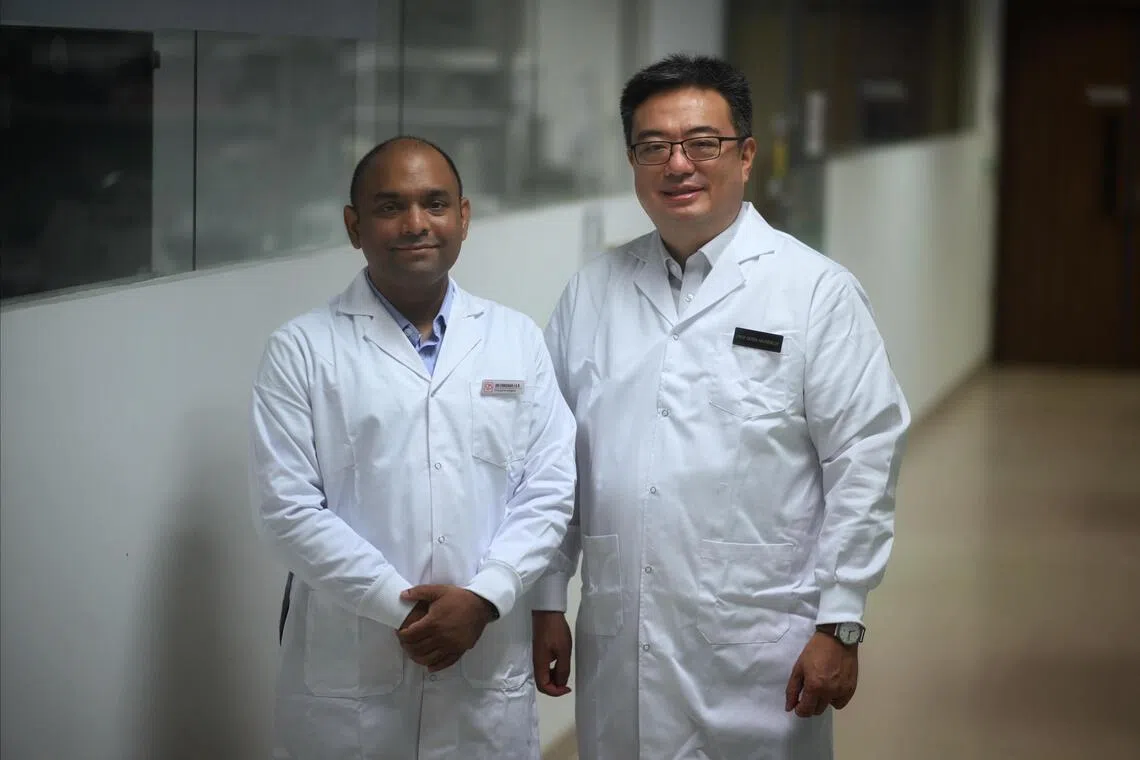
Centre for Integrative Human Cell Research and Translation (CIPHER) deputy director Chrishan Ramachandra (left) and director Derek Hausenloy on Oct 13.
ST PHOTO: CHONG JUN LIANG
Published Oct 16, 2026, 09:00 PM
Updated Oct 16, 2026, 09:00 PM
Singapore launched CIPHER, its first centre for stem cell and bench-to-bedside heart research, to better match treatment with Asian patients’ biology.
The centre uses patient blood cells and mini heart models to study disease, test drugs, and develop personalised therapies, aiming to cut side effects and improve outcomes.
At the same event, NHCS announced the $2.5 million Tong Ming Chuan Professorship, which will support surgical leaders and strengthen future cardiac care in Singapore and Asia.
SINGAPORE – The study and treatment of heart disease in the region have been boosted by the opening of the first centre in Singapore dedicated to stem cell research of the Asian heart that can be developed into treatments.
Launched on Oct 16, the Centre for Integrative Human Cell Research and Translation (CIPHER) aims to ensure that the science behind heart disease treatment takes into account the biology of Asian patients.
Its deputy director, Chrishan Ramachandra, said Asian patients develop heart disease earlier, present it differently, and tend to fare worse than their Western counterparts.
Yet for decades, the models used to study cardiovascular disease and develop treatments for Asian patients have been built largely on animal models and Western biology.
“ We want to study Asian cardiovascular biology in more detail from stem cells acquired from a 5ml blood sample,” said Chrishan, who is also the principal investigator with the National Heart Research Institute Singapore (NHRIS) and the National Heart Centre Singapore (NHCS).
The blood is “reprogrammed by exposing it to certain cocktails and turning them into stem cells known as induced pluripotent stem cells with the hope of trying to improve cardiovascular outcomes for these (Asian) populations”.
Chrishan added: “The centre’s mission is to accelerate our discovery (and develop) precision therapeutics for Asian cardiovascular diseases using human stem cell models and advanced multimodal platforms.”
NHCS has developed more than 40 patient-derived disease models covering conditions such as heart failure, arrhythmogenic disorders, and cardiomyopathy.
Arrhythmogenic disorders are rare, inherited conditions where the heart muscle cells fail to stick together properly, and are gradually replaced by scar tissues and fat.
Chrishan Ramachandra (left) and Derek Hausenloy are the deputy director and director of CIPHER. ST PHOTO: CHONG JUN LIANG
Chrishan Ramachandra (left) and Derek Hausenloy are the deputy director and director of CIPHER.
Cardiomyopathy is a disease of the heart muscle that causes it to stretch, thicken, or stiffen, making it difficult for the organ to pump blood effectively to the rest of the body.
NHCS’ library forms the foundation of CIPHER’s research programme.
“When we grow a heart muscle cell from a patient’s own blood and watch it beat in a dish, carrying that patient’s disease, we are looking at something no animal model can replicate,” Chrishan said.
Derek Hausenloy, who heads CIPHER, NHRIS and NHCS, said the cell platforms can be used to test drugs , as well as to improve heart function and metabolism.
“ (With these platforms), we are able to see which patients are more likely to be responsive without giving the drug to the patient himself and exposing him to the potential side effects or a drug that may or may not work,” he said.
CIPHER was officially launched by Senior Minister of State for Health Tan Kiat How at the 6th NHCS Heart to Heart Gala at The Ritz-Carlton Millenia Singapore.
“We are placing greater emphasis on prevention, earlier intervention and helping Singaporeans stay healthy and independent for longer,” Tan said.
“Innovation can support this shift, but its value is not measured by how sophisticated a technology is. It is measured by what it changes for patients.”
CIPHER deputy director Chrishan Ramachandra observing a cardiac organoid, a three-dimensional cluster of heart cells grown from Asian patients’ blood samples. ST PHOTO: CHONG JUN LIANG
CIPHER deputy director Chrishan Ramachandra observing a cardiac organoid, a three-dimensional cluster of heart cells grown from Asian patients’ blood samples.
In Singapore, about 23 people die from heart disease and stroke every day, with cardiovascular disease accounting for one in three deaths in 2025.
Hausenloy said: “Singapore is ideal for research (into the Asian heart) because of the varied ethnicity we have in our local populations – the Chinese, the Malays, and the Indians. This gives us an opportunity to really understand Asian cardiovascular diseases in an ethnic-specific context.”
Apart from using stem cells from the blood samples of patients, CIPHER has partnered clinical-stage biopharmaceutical company Medera Inc. to develop Human Heart-in-a-Jar , a miniaturised bioengineered human ventricular chamber that allows researchers to replicate and study selected features of human heart disease .
The mini-heart model about the size of a fingertip – a first in Asia – offers more physiologically relevant platform for testing potential treatments.
“By making these models, we want to identify specific drivers of the disease to find out why Asians have these unique cardiovascular phenotypes, identify new targets, and develop personalised therapies,” Hausenloy said.
Tong Ming Chuan Professorship in Cardiothoracic Surgery
At the centre launch, SingHealth Duke-NUS Academic Medicine Centre also announced that it had named its inaugural professorship after cardiothoracic and vascular surgeon Tong Ming Chuan.
Tong, who is currently in private practice at Mount Elizabeth Medical Centre, is also a visiting consultant at NHCS.
When he was at the Singapore General Hospital from 1981 to 1992 , he and his colleagues pioneered a number of cardiac surgery procedures in Singapore, including the first heart transplant operation in Singapore in 1990. He was part of the team that did the first lung transplant here, in 2000.
The Tong Ming Chuan Professorship in Cardiothoracic Surgery – made possible by a $2.5 million gift from Tong – is aimed at advancing clinical excellence, driving surgical research and nurturing future surgical leaders
The professorship, established under the Cardiovascular Sciences Academic Clinical Programme at SingHealth DukeNUS, will be awarded by Duke-NUS Medical School .
Chief executive officer of NHCS Yeo Khung Keong said: “Through CIPHER and the Tong Ming Chuan Professorship in Cardiothoracic Surgery, we are making two complementary commitments to the future of cardiovascular care.
“CIPHER ensures the science we build is grounded in the biology of our patients and strengthens Singapore’s position as a biomedical hub. The professorship ensures that we have the surgical leaders to translate that science into care.”
Heart/Cardiac diseases
10 月 13 日,整合人类细胞研究与转化中心 (CIPHER) 副主任 Chrishan Ramachandra(左)和主任 Derek Hausenloy 合影。
《海峡时报》照片:梁崇俊
发布于2026年10月16日晚上9点
更新于2026年10月16日晚上9点
新加坡成立了 CIPHER,这是该国第一个干细胞和从实验室到临床的心脏研究中心,旨在更好地将治疗与亚洲患者的生物学特征相匹配。
该中心利用患者血细胞和微型心脏模型来研究疾病、测试药物和开发个性化疗法,旨在减少副作用并改善治疗效果。
在同一活动中,新加坡国立心脏外科学会宣布设立价值 250 万美元的童明川教授职位,该职位将支持外科领域的领导者,并加强新加坡和亚洲未来的心脏护理。
新加坡——新加坡首个致力于亚洲心脏干细胞研究的中心成立,该中心的研究成果有望开发成治疗方法,这极大地促进了该地区心脏病的研究和治疗。
整合人类细胞研究与转化中心(CIPHER)于 10 月 16 日成立,旨在确保心脏病治疗背后的科学能够考虑到亚洲患者的生物学特性。
该机构副主任克里尚·拉马钱德拉表示,亚洲患者患心脏病的年龄更早,症状表现也不同,而且往往比西方患者预后更差。
然而,几十年来,用于研究心血管疾病和开发亚洲患者治疗方法的模型主要都是建立在动物模型和西方生物学的基础上的。
“我们希望利用从 5 毫升血液样本中获得的干细胞,更详细地研究亚洲心血管生物学,”克里尚说道,他同时也是新加坡国家心脏研究所 (NHRIS) 和新加坡国家心脏中心 (NHCS) 的首席研究员。
“通过将血液暴露于某些混合物中,对其进行重新编程,使其转化为称为诱导多能干细胞的干细胞,希望以此改善这些(亚洲)人群的心血管疾病预后”。
克里尚补充道:“该中心的使命是利用人类干细胞模型和先进的多模式平台,加速我们发现(和开发)针对亚洲心血管疾病的精准疗法。”
NHCS 已开发出 40 多种患者衍生疾病模型,涵盖心力衰竭、致心律失常疾病和心肌病等疾病。
心律失常性疾病是一种罕见的遗传性疾病,其特征是心肌细胞无法正常粘合在一起,并逐渐被瘢痕组织和脂肪所取代。
克里尚·拉马钱德拉(左)和德里克·豪森洛伊分别是CIPHER的副主任和主任。(海峡时报摄影:梁崇俊)
Chrishan Ramachandra(左)和 Derek Hausenloy 分别是 CIPHER 的副主任和主任。
心肌病是一种心脏肌肉疾病,会导致心肌拉伸、增厚或僵硬,使心脏难以有效地将血液泵送到身体其他部位。
NHCS 的图书馆构成了 CIPHER 研究计划的基础。
“当我们从患者自身的血液中培养出心肌细胞,并在培养皿中观察它跳动,同时携带该患者的疾病时,我们看到的是任何动物模型都无法复制的现象,”克里尚说。
负责 CIPHER、NHRIS 和 NHCS 的 Derek Hausenloy 表示,这些细胞平台可用于测试药物,以及改善心脏功能和新陈代谢。
“(借助这些平台),我们能够看到哪些患者更有可能对药物产生反应,而无需亲自给患者服用药物,从而避免患者面临潜在的副作用或可能无效的药物,”他说。
CIPHER 由卫生部高级政务部长陈杰豪在新加坡丽思卡尔顿美年酒店举行的第六届 NHCS 心连心慈善晚宴上正式推出。
“我们更加注重预防、早期干预,并帮助新加坡人保持更长时间的健康和独立生活能力,”陈先生说。
“创新可以支持这种转变,但其价值并非取决于技术的复杂程度,而是取决于它能为患者带来哪些改变。”
CIPHER副主任克里尚·拉马钱德拉正在观察心脏类器官,这是一种由亚洲患者血液样本培养而成的三维心肌细胞团。(海峡时报摄影:梁崇俊)
CIPHER 副主任 Chrishan Ramachandra 正在观察心脏类器官,这是一种由亚洲患者血液样本培养而成的三维心脏细胞簇。
在新加坡,每天约有 23 人死于心脏病和中风,到 2025 年,心血管疾病将占死亡总数的三分之一。
豪森洛伊表示:“新加坡是开展(亚洲心脏)研究的理想之地,因为我们当地人口拥有多元化的种族构成——华人、马来人和印度人。这使我们有机会在特定种族背景下真正了解亚洲心血管疾病。”
除了使用患者血液样本中的干细胞外,CIPHER 还与临床阶段生物制药公司 Medera Inc. 合作开发了“罐装人类心脏”,这是一种微型化的生物工程人类心室腔室,使研究人员能够复制和研究人类心脏病的特定特征。
这个指尖大小的微型心脏模型——亚洲首例——为测试潜在的治疗方法提供了更具生理相关性的平台。
“通过建立这些模型,我们希望找出该疾病的具体驱动因素,以探究亚洲人为何具有这些独特的心血管表型,从而确定新的靶点并开发个性化疗法,”豪森洛伊说。
童明川心胸外科教授职位
在中心启动仪式上,新加坡保健集团杜克-新加坡国立大学医学中心还宣布,将以心胸血管外科医生童明川的名字命名其首个教授职位。
Tong目前在伊丽莎白山医疗中心从事私人执业,同时也是NHCS的客座顾问。
1981 年至 1992 年,他在新加坡中央医院工作期间,与同事们在新加坡率先开展了多项心脏外科手术,包括 1990 年在新加坡进行的首例心脏移植手术。2000 年,他参与了新加坡首例肺移植手术。
由童明川先生捐赠250万美元设立的童明川心胸外科教授席位,旨在提升临床水平、推动外科研究并培养未来的外科领军人物。
该教授职位是在新加坡保健集团杜克-新加坡国立大学医学院心血管科学学术临床项目下设立的,将由杜克-新加坡国立大学医学院授予。
新加坡国立心脏外科中心首席执行官杨康强表示:“通过CIPHER和唐明川心胸外科教授职位,我们正在为心血管护理的未来做出两项互补的承诺。
“CIPHER项目确保我们开展的科学研究以患者的生物学为基础,并巩固新加坡作为生物医学中心的地位。该教授职位确保我们拥有能够将这些科学成果转化为临床实践的外科领军人物。”
心脏/心脏疾病