S-E Asia experiencing one of the worst haze episodes due to fires in Indonesia: WMO director世界气象组织主任表示,由于印尼山火,东南亚正经历最严重的雾霾天气之一。
He said that countries in the region should work together to develop measures to tackle the fires. Read more at straitstimes.com.
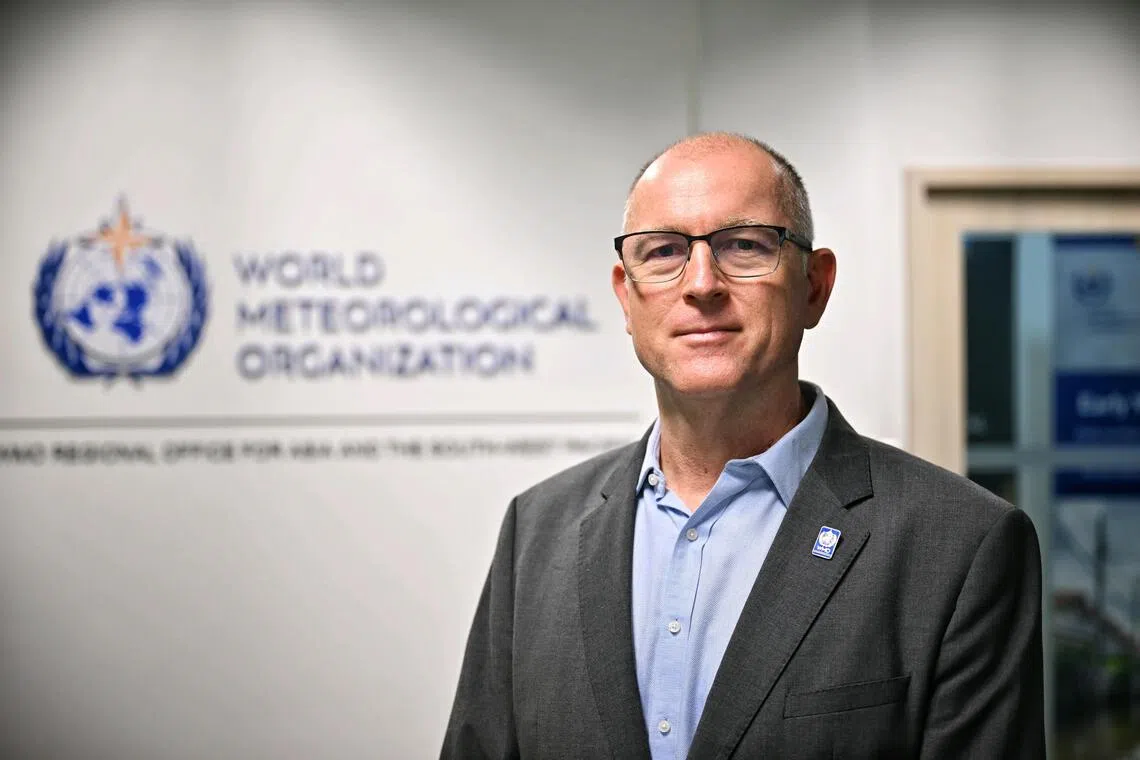
Ben Churchill, director of the World Meteorological Organisation’s regional office for Asia and the Pacific, proposed that ASEAN pool its firefighting resources.
ST PHOTO: ARIFFIN JAMAR
Published Oct 17, 2026, 11:00 AM
Updated Oct 17, 2026, 11:00 AM
One of the worst transboundary haze episodes has hit Singapore, Malaysia and the Philippines, caused by fires in Indonesia, said Ben Churchill, director of the WMO regional office for Asia and the Pacific.
He warned the haze could last weeks or months, fuelled by a strong El Nino that have made fires harder to put out.
He called for ASEAN to share firefighting resources, improve warnings and change land practices.
SINGAPORE – South -east Asia is in the grips of one of the worst transboundary haze episodes caused by the fires in Indonesia, a director at the UN’s weather and climate agency said on Oct 16.
The crisis could drag on for weeks, even months, until the winds change and rain drenches the fires there, said Ben Churchill, director of the World Meteorological Organisation’s (WMO) regional office for Asia and the Pacific.
Speaking to The Straits Times in an interview at the WMO regional office in Tai Seng, Churchill said the ongoing El Nino event is on track to be the strongest one ever observed.
The onset of this weather phenomenon – which brings drier, hotter weather to the equatorial ASEAN region – has coincided with the region’s dry season.
This has created “the perfect storm” for fires to persist and spread, Churchill said. When land is cleared using traditional slash-and-burn practices, wildfires break out .
He added: “ We’re seeing more and more unhealthy days and hours creeping in. My expectation is that this will continue.”
Singapore has so far h ad 13 consecutive days of unhealthy Pollutant Standards Index (PSI) readings , the longest continuous stretch the country has had to endure since the 2015 haze crisis. A day is considered to have unhealthy air quality when the PSI reading at any point in the day exceeds 100 in any part of Singapore.
Churchill’s comments come as Minister for Sustainability and the Environment Grace Fu warned at a press conference on Oct 16 that Singapore needed to brace itself for prolonged hazy conditions , and that air quality here could even breach hazardous levels.
She said that the situation might improve only when the winds become lighter and more variable in direction. But that is expected to happen only in three to four weeks’ time.
Reprieve might come closer to the end of the year, she said, when winds start to blow from the north instead of from the current southerly direction, as this will push haze away from the Republic.
Churchill said about half of the world’s smoke haze had originated in Indonesia over the seven days from Oct 8. He cited data from the Fire Emissions Watch service run by the European Union’s Copernicus programme that observes the Earth using satellite data and other sources.
Churchill said regional cooperation on early warnings and forecasts would help people better protect themselves.
Countries in the region should also work together to develop measures to tackle the fires, and prevent future episodes from reaching such extreme levels.
He proposed that ASEAN pool its firefighting resources.
This would involve investing in equipment that can be shared across member states, exchanging technical expertise, and ensuring firefighting crew from neighbouring countries can be deployed rapidly if needed.
Fu said at the Oct 16 press conference that she had communicated with her Indonesian counterpart, Environment Minister Jumhur Hidayat, to offer civilian assistance to support firefighting efforts as well as cloud seeding.
“We’re looking at Indonesia right now, of course, but this could have happened anywhere to anyone at any time, based on the preconditions that we were seeing with global warming, as well as the compounding effect of El Nino,” he said, noting similar agricultural practices in other South-east Asian countries.
Churchill, who has helped coordinate efforts to tackle wildfires in Australia, cited the approach Down Under, where reciprocal arrangements to manage such disasters exist with New Zealand, the US and Canada.
Such arrangements ensure that support personnel and equipment can be deployed and integrated immediately to hit the ground running, combining resources as swiftly as possible to extinguish the flames, he said.
Beyond active firefighting, only the arrival of the monsoon rains later in the year will douse the fires, Churchill noted.
“Ideally, we continue to expect that Indonesia and, with the help of other international support, that they continue to do their very best,” he said. “But the very best is not always enough. So yes, this is what we’re hoping for with the monsoon, and the monsoon does bring rain.”
The wet phase of the north-east monsoon brings higher rainfall to South-east Asia around December .
However, Churchill said that uncertainty remains over when the seasonal transition will occur, as research has shown that strong El Nino conditions usually disrupt these shifts.
ST had on Oct 2 reported that the ongoing El Nino event will likely delay the retreat of the dry season. Singapore’s weatherman had said that this transition could take place in late October or November .
“It might be a little bit variable, but it will come,” Churchill said, adding that an updated forecast will be presented at the ASEAN Climate Outlook Forum in late October.
Churchill said that the WMO had in June sounded warnings that a strong El Nino would set in in 2026 .
He said it was important that such early notice of impending weather events like El Nino reaches every layer of society, from policymakers shaping infrastructure and planning to the agricultural sector.
“Everybody can take action at some level or other, whether it’s political level, whether it’s community level, whether it’s individual farmers or even individuals themselves,” he said. “Everyone has a say, and everyone has the power to do things differently in future, so they don’t happen again.”
Such coordination is increasingly urgent as human-driven climate change raises global temperatures, making both El Nino events and severe transboundary haze episodes more frequent and intense.
He said: “‘I think if we nip it at the bud, we change our practices and do our very best ... collectively to change our land practices, to tighten up the regulations and to educate the farmers and the companies that are responsible for the fires, I think we can go a long way to ensuring and safeguarding safety, security, and prosperity for the ASEAN community.”
世界气象组织亚太区域办事处主任本·丘吉尔提议东盟集中其消防资源。
圣路易斯照片:阿里芬·贾马尔
发布于2026年10月17日上午11:00
更新于2026年10月17日上午11:00
世界气象组织亚太区域办事处主任本·丘吉尔表示,由印度尼西亚的火灾引起的跨境烟霾事件已波及新加坡、马来西亚和菲律宾,这是有史以来最严重的跨境烟霾事件之一。
他警告说,由于强烈的厄尔尼诺现象加剧了火势,导致烟雾可能持续数周或数月,使得灭火更加困难。
他呼吁东盟共享消防资源,改进预警系统,并改变土地利用方式。
新加坡——联合国气象和气候机构的一位主任于10月16日表示,东南亚正遭受由印度尼西亚火灾引起的最严重的跨境烟霾事件之一的侵袭。
世界气象组织(WMO)亚太区域办事处主任本·丘吉尔表示,这场危机可能会持续数周甚至数月,直到风向改变,雨水浇灭那里的火灾。
丘吉尔在位于大成(Tai Seng)的世界气象组织区域办事处接受《海峡时报》采访时表示,目前正在发生的厄尔尼诺现象有望成为有史以来观测到的最强厄尔尼诺现象。
这种天气现象的出现——给赤道东盟地区带来了更干燥、更炎热的天气——恰逢该地区的旱季。
丘吉尔说,这造成了火灾持续蔓延的“完美风暴”。当人们采用传统的刀耕火种方式清理土地时,就会爆发野火。
他补充道:“我们看到越来越多的不健康的工作日和工作时间逐渐增多。我预计这种情况还会持续下去。”
新加坡空气污染指数(PSI)已连续13天低于健康标准,这是自2015年雾霾危机以来该国持续时间最长的一次。在新加坡,任何地区的空气污染指数(PSI)在一天中的任何时刻超过100,即被视为空气质量不健康。
丘吉尔发表上述评论之际,新加坡永续发展及环境部长傅海燕在10月16日的新闻发布会上警告说,新加坡需要做好应对持续雾霾天气的准备,而且这里的空气质量甚至可能达到危险水平。
她说,只有当风力减弱且风向更加多变时,情况才有可能好转。但预计这种情况要三到四周后才会发生。
她说,缓解措施可能会在年底前到来,届时风向将由目前的南风转为北风,因为北风会将雾霾吹离共和国。
丘吉尔表示,从10月8日开始的七天里,全球约一半的烟雾源自印度尼西亚。他引用了欧盟哥白尼计划运营的“火灾排放监测服务”的数据,该服务利用卫星数据和其他来源观测地球。
丘吉尔表示,在预警和预报方面开展区域合作将有助于人们更好地保护自己。
该区域各国还应共同努力,制定应对火灾的措施,防止未来发生如此极端的火灾事件。
他提议东盟集中使用消防资源。
这将包括投资可在成员国之间共享的设备、交流技术专长,以及确保在需要时能够迅速部署邻国的消防人员。
傅海燕在 10 月 16 日的新闻发布会上表示,她已与印尼环境部长朱姆胡尔·希达亚特沟通,表示愿意提供民间援助,以支持灭火工作和人工增雨。
“我们现在当然是在关注印度尼西亚,但根据我们看到的全球变暖的先决条件以及厄尔尼诺现象的叠加效应,这种情况可能随时发生在任何地方的任何人身上,”他说道,并指出其他东南亚国家也有类似的农业做法。
曾帮助协调澳大利亚应对野火工作的丘吉尔提到了澳大利亚的做法,澳大利亚与新西兰、美国和加拿大之间有互惠安排来管理此类灾害。
他表示,这样的安排可以确保支援人员和设备能够立即部署和整合,迅速投入行动,尽快整合资源扑灭大火。
丘吉尔指出,除了积极的灭火行动外,只有今年晚些时候的季风雨才能扑灭大火。
“理想情况下,我们仍然期待印尼在其他国际援助的帮助下继续竭尽全力,”他说。“但竭尽全力并不总是足够。所以,是的,这就是我们对季风的期盼,季风确实会带来降雨。”
东北季风的湿润期在12月左右给东南亚带来较多的降雨。
然而,丘吉尔表示,季节更替何时发生仍存在不确定性,因为研究表明,强烈的厄尔尼诺现象通常会扰乱这些转变。
《海峡时报》10月2日报道称,持续的厄尔尼诺现象可能会推迟旱季的结束。新加坡气象局表示,旱季结束的过渡期可能要到10月下旬或11月才会到来。
“情况可能会有些波动,但终究会到来,”丘吉尔说,并补充说,将在10月下旬的东盟气候展望论坛上公布更新后的预测。
丘吉尔表示,世界气象组织曾在6月份发出警告,称2026年将出现强烈的厄尔尼诺现象。
他表示,像厄尔尼诺现象这样的即将发生的极端天气事件的早期预警,必须传达给社会各阶层,从制定基础设施和规划的政策制定者到农业部门。
他说:“每个人都能在某种程度上采取行动,无论是在政治层面、社区层面、个体农民层面,甚至是个人层面。每个人都有发言权,每个人都有能力在未来采取不同的做法,从而避免类似事件再次发生。”
随着人为气候变化导致全球气温升高,厄尔尼诺现象和严重的跨境雾霾事件变得更加频繁和强烈,这种协调变得越来越紧迫。
他说:“我认为,如果我们防患于未然,改变我们的做法,并尽最大努力……共同改变我们的土地耕作方式,加强监管,并对农民和造成火灾的公司进行教育,我认为我们就能在确保和维护东盟共同体的安全、保障和繁荣方面取得长足进步。”