TCM providers, practitioners can apply for accreditation from Oct 17; first 5 clinics granted status中医从业人员可于10月17日起申请认证;首批5家诊所获得认证。
SINGAPORE: Five traditional Chinese medicine (TCM) providers have become the first in Singapore to receive accreditation under a new national programme aimed at raising standards and strengthening public confidence in the sector.From Saturday (Oct 17), TCM service providers and practitioner
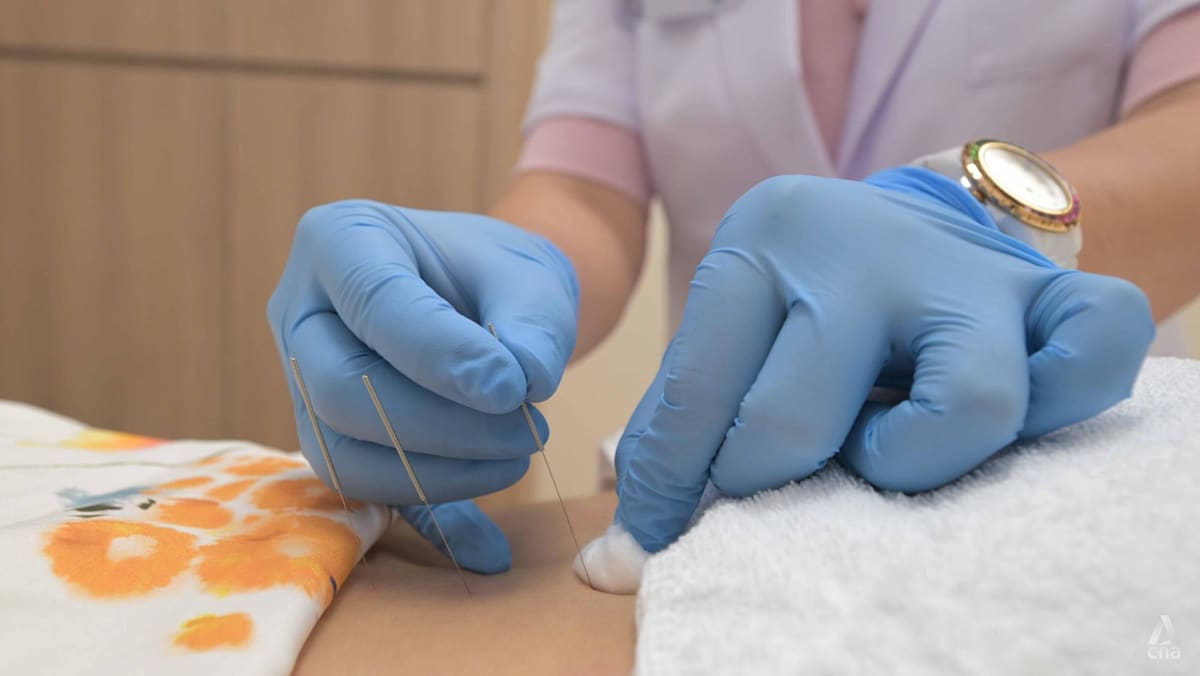
An acupuncture needle being removed in a demonstration at Khoo Teck Puat Hospital on Aug 21, 2026. (Photo: CNA/Lim Li Ting)
This audio is generated by an AI tool.
SINGAPORE: Five traditional Chinese medicine (TCM) providers have become the first in Singapore to receive accreditation under a new national programme aimed at raising standards and strengthening public confidence in the sector.
From Saturday (Oct 17), TCM service providers and practitioners can apply for accreditation under the voluntary TCM Accreditation Programme, which sets standards in areas such as patient safety, clinical governance, service quality and professional competence.
Announcing the initiatives at the opening ceremony of the 23rd World Congress of Chinese Medicine, Health Minister Ong Ye Kung said Singapore was taking a practical approach to integrating Western medicine and TCM, while ensuring that treatments are supported by rigorous evidence.
"The question is not whether one system is better than the other," said Mr Ong, who is also Coordinating Minister for Social Policies.
CNA Games Guess Word Crack the word, one row at a time Buzzword Create words using the given letters Mini Sudoku Tiny puzzle, mighty brain teaser Mini Crossword Small grid, big challenge Word Search Spot as many words as you can Show More Show Less "In modern healthcare systems, we explore how each can contribute its strengths, safely and effectively, so that we can complement them for the benefit of patients." FIVE TCM PROVIDERS ACCREDITED The five providers that have met the new accreditation standards are Kwong Wai Shiu TCM Centre in Serangoon, NTU Chinese Medicine, Singapore Chung Hwa Medical Institution Headquarters, Singapore Thong Chai Medical Institution Headquarters and Thomson Chinese Medicine in Novena. They will be granted the Accredited TCM Clinic status, said Mr Ong. The programme comprises two components: TCM Services Accreditation for service providers and TCM Practitioners Accreditation for individual practitioners. Service providers will be assessed on areas including governance, hygiene and infection control, equipment and TCM medications. Individual practitioners will be assessed on factors such as their educational qualifications, clinical experience and professional standing. The Academy of Chinese Medicine, Singapore has been appointed as the accrediting body for the programme. Mr Ong said the accreditation framework was developed with input from the TCM community, including through site visits and mock audits. Several providers have since strengthened their processes, governance and standards, he added. Accreditation is voluntary, and registered TCM practitioners and service providers can continue practising or operating regardless of whether they are accredited. Mr Ong said the aim was to establish accreditation as something "beyond licensing of practice". "It demonstrates a commitment to stronger governance, consistent standards and public confidence," he said. Accreditation could also create opportunities for practitioners and providers to work with the Ministry of Health (MOH) on future TCM care models and contribute to national healthcare initiatives. For instance, the Agency for Integrated Care will facilitate more collaborations between Active Ageing Centres and accredited TCM providers to bring TCM closer to the communities they serve. Kwong Wai Shiu TCM Centre and Singapore Chung Hwa Medical Institution have already started doing so, said Mr Ong. MOH is also studying a suggestion to allow accredited TCM practitioners to order X-rays as part of collaborative shared-care arrangements with general practitioner (GP) partners, he said. Currently, a TCM practitioner who suspects that a patient has a fracture cannot order an X-ray, and must instead advise the patient to visit an emergency department or refer the patient to a Western medicine doctor who can order one.
"In modern healthcare systems, we explore how each can contribute its strengths, safely and effectively, so that we can complement them for the benefit of patients."
FIVE TCM PROVIDERS ACCREDITED
The five providers that have met the new accreditation standards are Kwong Wai Shiu TCM Centre in Serangoon, NTU Chinese Medicine, Singapore Chung Hwa Medical Institution Headquarters, Singapore Thong Chai Medical Institution Headquarters and Thomson Chinese Medicine in Novena.
They will be granted the Accredited TCM Clinic status, said Mr Ong.
The programme comprises two components: TCM Services Accreditation for service providers and TCM Practitioners Accreditation for individual practitioners.
Service providers will be assessed on areas including governance, hygiene and infection control, equipment and TCM medications.
Individual practitioners will be assessed on factors such as their educational qualifications, clinical experience and professional standing.
The Academy of Chinese Medicine, Singapore has been appointed as the accrediting body for the programme.
Mr Ong said the accreditation framework was developed with input from the TCM community, including through site visits and mock audits.
Several providers have since strengthened their processes, governance and standards, he added.
Accreditation is voluntary, and registered TCM practitioners and service providers can continue practising or operating regardless of whether they are accredited.
Mr Ong said the aim was to establish accreditation as something "beyond licensing of practice". "It demonstrates a commitment to stronger governance, consistent standards and public confidence," he said.
Accreditation could also create opportunities for practitioners and providers to work with the Ministry of Health (MOH) on future TCM care models and contribute to national healthcare initiatives.
For instance, the Agency for Integrated Care will facilitate more collaborations between Active Ageing Centres and accredited TCM providers to bring TCM closer to the communities they serve.
Kwong Wai Shiu TCM Centre and Singapore Chung Hwa Medical Institution have already started doing so, said Mr Ong.
MOH is also studying a suggestion to allow accredited TCM practitioners to order X-rays as part of collaborative shared-care arrangements with general practitioner (GP) partners, he said.
Currently, a TCM practitioner who suspects that a patient has a fracture cannot order an X-ray, and must instead advise the patient to visit an emergency department or refer the patient to a Western medicine doctor who can order one.
MORE TCM TREATMENTS COULD BE OFFERED IN PUBLIC HOSPITALS
MOH will launch a second call for proposals under its TCM Integrative Sandbox initiative, with applications open from Nov 3, 2026 to Nov 2, 2029.
The initiative allows public healthcare institutions to test selected TCM treatments for specific conditions in public hospital settings, and determine whether the treatments are safe, clinically effective and cost-effective.
"Treatments that produce such positive results over a period of one to two years can be considered for adoption throughout our healthcare system, and become eligible for financial support," said Mr Ong.
Currently, only acupuncture for neck and lower back pain has gone through such an evaluation process and is offered and subsidised in public hospitals.
The sandbox, first launched in January 2025, received 18 proposals from public healthcare clusters, of which seven acupuncture projects were selected for trials.
The projects include using acupuncture for conditions including post-stroke rehabilitation, cancer-related supportive care for management of pain, insomnia, fatigue and gastrointestinal issues, migraine, knee osteoarthritis, female infertility and drug-resistant epilepsy.
The projects will be evaluated by various public hospitals, including Tan Tock Seng Hospital, National University Hospital, National Neuroscience Institute and National Cancer Centre Singapore, said Mr Ong.
Mr Ong said Singapore hopes to go further by supporting the use of Chinese proprietary medicines for purposes such as managing chronic diseases.
He also noted that the Memorial Sloan Kettering Cancer Center in New York and the National Cancer Centre Singapore have expressed an interest in collaborating on integrative medicine.
HEALTHEIR SG-TCM PROOF OF CONCEPT
MOH is also developing a proof-of-concept initiative to explore how TCM practitioners and GPs could work together under Healthier SG, Singapore's national preventive health strategy.
There is a natural connection between TCM and this preventive approach, said Mr Ong, noting that TCM practitioners guide patients on diet, exercise and lifestyle modifications.
"This is where there is a significant overlap between modern Western preventive medicine and the increasing realisation of the importance of social prescription," he said.
MOH received 30 proposals from practitioners following an invitation earlier this year and is shortlisting applications for further discussions.
The ministry aims to launch the Healthier SG-TCM Proof of Concept in the first half of 2027.
Mr Ong noted one in five adult Singaporeans reported having used TCM services, and nearly 40 per cent of them have sought both TCM and Western medicine for the same condition.
"Patients do not seek treatment according to the boundaries of our healthcare system," he said.
"The question before us is whether we leave it to patients, or whether the healthcare system helps patients navigate these choices safely and confidently."
Mr Ong stressed that integrating TCM into mainstream healthcare must not come at the expense of rigorous evaluation.
"We need to examine each use case in integrative medicine and adapt the methodology for building evidence," he said.
"Singapore offers a practical case study, where we respect the different traditions, explore the areas of confluence, build the evidence, uphold high standards and expand what works to improve care for patients," he said.
Get our pick of top stories and thought-provoking articles in your inbox
Stay updated with notifications for breaking news and our best stories
Join our channel for the top reads for the day on your preferred chat app
2026年8月21日,邱德拔医院正在进行针灸针拔除演示。(图片:CNA/林丽婷)
这段音频由人工智能工具生成。
新加坡:五家传统中医(TCM)机构成为新加坡首批获得认证的机构,该认证是根据一项旨在提高标准和增强公众对该行业信心的全新国家计划颁发的。
从周六(10 月 17 日)起,中医服务提供者和从业人员可以申请自愿性中医认证计划的认证,该计划在患者安全、临床治理、服务质量和专业能力等领域制定标准。
卫生部长王乙康在第23届世界中医药大会开幕式上宣布了这些举措,他表示新加坡正在采取务实的态度将西医和中医相结合,同时确保治疗方法有严格的证据支持。
“问题不在于哪个系统比另一个系统更好,”社会政策统筹部长王乙康先生说。
CNA游戏 猜词游戏 逐行破解单词 流行词游戏 用给定的字母组成单词 迷你数独 小小的谜题,强大的脑力挑战 迷你填字游戏 小方格,大挑战 单词搜索 尽可能多地找出单词 显示更多 显示更少 “在现代医疗保健系统中,我们探索如何安全有效地发挥每个人的优势,从而相互补充,造福患者。” 五家中医机构获得认证 五家符合新认证标准的机构分别是:实龙岗广伟肇中医中心、南洋理工大学中医学院、新加坡中华医学会总部、新加坡同济医学会总部和诺维娜汤申中医诊所。翁先生表示,他们将被授予“认证中医诊所”称号。该计划包含两个部分:中医服务机构认证(针对服务提供商)和中医从业人员认证(针对个体从业人员)。服务提供商的评估范围包括管理、卫生和感染控制、设备和中药等方面。个人执业者将根据其学历、临床经验和专业地位等因素接受评估。新加坡中医学院已被指定为该项目的认证机构。王先生表示,认证框架是在中医界的参与下制定的,包括实地考察和模拟审核。他还补充说,一些机构此后加强了其流程、管理和标准。认证是自愿的,注册的中医执业者和服务提供者无论是否获得认证,都可以继续执业或运营。王先生表示,认证的目标是使其“超越执业许可”。他说:“这体现了对更完善的管理、统一的标准和公众信任的承诺。”认证还可以为执业者和服务提供者创造机会,让他们与卫生部合作,共同开发未来的中医护理模式,并为国家医疗保健计划做出贡献。例如,综合护理机构将促进积极老龄化中心与获得认证的中医服务提供者之间的更多合作,使中医更贴近他们所服务的社区。王先生表示,广伟肇中医中心和新加坡中华医学院已经开始实施这项措施。他还说,卫生部正在研究一项建议,允许获得认证的中医师与全科医生合作,在共同诊疗安排下开具X光检查单。目前,中医师如果怀疑患者骨折,不能开具X光检查单,而必须建议患者前往急诊科就诊或转诊给可以开具X光检查单的西医。
“在现代医疗保健系统中,我们探索如何安全有效地发挥每个人的优势,以便相互补充,造福患者。”
五家获得认证的中医医疗机构
符合新认证标准的五家医疗机构分别是:实龙岗广伟修中医中心、南洋理工大学中医中心、新加坡中华医学院总部、新加坡同济医学院总部和诺维娜汤申中医中心。
王先生表示,他们将获得认可的中医诊所资格。
该计划包含两个部分:中医服务提供者认证和中医从业者认证。
服务提供商将从管理、卫生和感染控制、设备和中药等方面进行评估。
评估执业人员时,将考虑其教育资格、临床经验和专业地位等因素。
新加坡中医科学院已被指定为该课程的认证机构。
王先生表示,该认证框架是在中医界的参与下制定的,包括实地考察和模拟审核。
他还补充说,此后一些供应商加强了流程、管理和标准。
认证是自愿的,注册的中医从业人员和服务提供者无论是否获得认证,都可以继续执业或经营。
王先生表示,此举旨在将认证确立为“超越执业许可”的机制。“这体现了我们对加强治理、统一标准和公众信任的承诺,”他说道。
认证还可以为从业人员和医疗服务提供者创造机会,让他们与卫生部合作,制定未来的中医护理模式,并为国家医疗保健计划做出贡献。
例如,综合护理机构将促进积极老龄化中心与经认证的中医服务提供者之间的更多合作,使中医更贴近他们所服务的社区。
王先生表示,广伟修中医中心和新加坡中华医学研究所已经开始这样做了。
他还表示,卫生部正在研究一项建议,允许获得认证的中医从业人员与全科医生 (GP) 合作,在共享医疗安排中开具 X 光检查单。
目前,中医医师如果怀疑病人骨折,不能开具 X 光检查单,而必须建议病人去急诊科就诊,或者将病人转诊给可以开具 X 光检查单的西医医生。
公立医院或可提供更多中医治疗
卫生部将启动第二轮中医综合沙盒计划提案征集,申请将于 2026 年 11 月 3 日至 2029 年 11 月 2 日期间开放。
该计划允许公共医疗机构在公立医院环境中测试针对特定疾病的特定中医治疗方法,并确定这些治疗方法是否安全、临床有效且具有成本效益。
“如果某种疗法在一到两年内能产生如此积极的效果,就可以考虑在我们的医疗保健系统中推广,并有资格获得财政支持,”翁先生说。
目前,只有针对颈部和腰部疼痛的针灸疗法经过了这样的评估过程,并在公立医院提供和补贴。
该试验沙盒于 2025 年 1 月首次启动,共收到来自公共医疗保健集群的 18 个提案,其中 7 个针灸项目被选中进行试验。
这些项目包括使用针灸治疗中风后康复、癌症相关支持治疗(用于控制疼痛、失眠、疲劳和胃肠道问题)、偏头痛、膝关节骨关节炎、女性不孕症和耐药性癫痫等疾病。
王先生表示,这些项目将由包括陈笃生医院、新加坡国立大学医院、新加坡国立神经科学研究所和新加坡国立癌症中心在内的多家公立医院进行评估。
王先生表示,新加坡希望更进一步,支持使用中国专有药品来治疗慢性疾病等。
他还指出,纽约的纪念斯隆-凯特琳癌症中心和新加坡国家癌症中心都表示有兴趣在综合医学领域开展合作。
健康SG-TCM概念验证
卫生部也在制定一项概念验证计划,以探索中医从业者和全科医生如何在新加坡国家预防保健战略“更健康的新加坡”下合作。
王先生表示,中医与这种预防方法之间有着天然的联系,并指出中医从业者会指导患者进行饮食、运动和生活方式的改变。
他说:“现代西方预防医学与人们日益认识到社会处方的重要性之间存在着显著的重叠之处。”
卫生部在今年早些时候发出邀请后收到了 30 份来自从业人员的提案,目前正在筛选申请以进行进一步讨论。
该部计划于 2027 年上半年启动更健康的新加坡中医概念验证项目。
王先生指出,五分之一的新加坡成年人表示曾使用过中医服务,其中近 40% 的人曾因同一病症同时寻求过中医和西医治疗。
他说:“患者寻求治疗并不符合我们医疗体系的界限。”
“我们面临的问题是,是把选择权交给患者,还是医疗保健系统帮助患者安全、自信地做出这些选择。”
王先生强调,将中医融入主流医疗保健体系绝不能以牺牲严格的评估为代价。
他说:“我们需要研究整合医学中的每一个应用案例,并调整构建证据的方法。”
他说:“新加坡提供了一个实际的案例研究,我们尊重不同的传统,探索融合领域,积累证据,坚持高标准,并推广行之有效的方法,以改善患者的护理。”
订阅我们的邮件,即可获取精选热点新闻和引人深思的文章。
订阅通知,第一时间获取突发新闻和精彩报道。
加入我们的频道,即可在您常用的聊天应用上获取当日热门文章。