Heavy lifting: More seniors take up strength training to stay active举重训练:越来越多的老年人开始进行力量训练以保持活力。
Singapore seniors embrace strength training, with older adults lifting heavy to build mobility, confidence and functional strength. Read more at straitstimes.com.
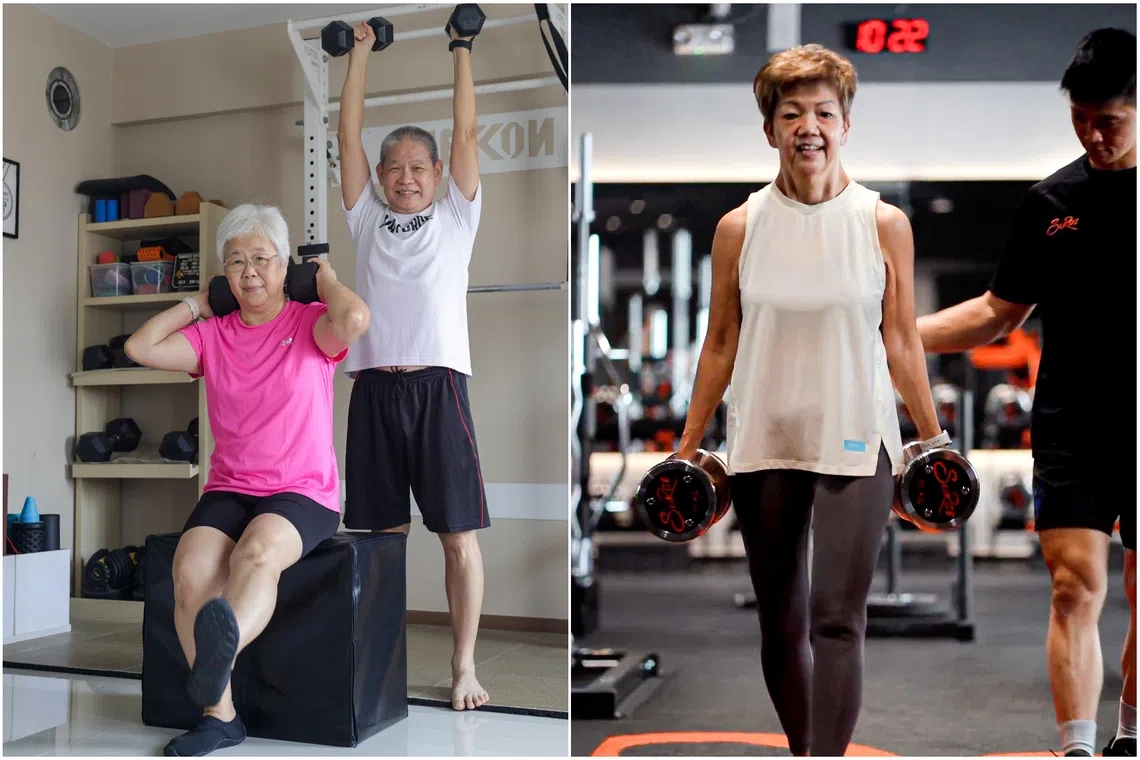
Alice Chia (right), and James Lo and his wife Ai Ling, are among a growing number of older adults lifting heavy today.
PHOTOS: JASEL POH, SURGE STRENGTH & RESULTS
Published Oct 17, 2026, 08:05 AM
Updated Oct 17, 2026, 11:28 AM
Older Singapore seniors are strength training to stay independent. Alice Chia, 72, improved from struggling with a 5kg rice bag to a 32kg farmer’s carry.
Gyms report more older clients. Stoic Strength says senior numbers rose 120% in four years, while Surge now has about 30 clients aged 60 or older.
Experts say strength work helps mobility, health and fall prevention. They warn seniors should start safely, increase weights slowly and check with doctors if they have health conditions.
SINGAPORE – Before Alice Chia started strength training in June 2024, she struggled to get up from a squat.
“I was breathless lifting a 5kg bag of rice,” says the 72-year-old homemaker.
The training sessions were a Mother’s Day present from her younger daughter, aged 38, who wanted her parents to be physically independent. Alice and her husband Philip, 73, shared the credits from her daughter’s package with Surge Strength & Results, a personal training gym. They have an elder daughter, 48.
“It was tough,” Alice says of her first session.
The couple later signed up for their own package and now train separately once a week with Khor Seong King, Surge’s senior personal trainer.
Today, the grandmother of one can do a 32kg farmer’s carry for one minute across three sets, as well as a 90-second dead hang.
The farmer’s carry is a whole-body exercise where one carries weights in each hand while walking for a predetermined duration or distance. In a dead hang, one hangs from a high bar with straight arms and dangles with feet off the ground.
Grocery shopping is a lot easier for her now, as are household chores that require her to kneel, something she could not do previously. The Chias live in a two-room flexi Housing Board flat in eastern Singapore and have no helper.
In recent years, some personal trainers have reported seeing more adults above 50 taking up strength training and showing the gains of lifting heavy like Alice.
Typically conducted one-to-one in a regular gym setting and customised to each client’s needs, these training sessions are different from popular senior-friendly ones that feature exercise machines using hydraulic or pneumatic technology that are gentler on joints.
Stoic Strength, a gym in the Central Business District, has seen a 120% rise in the number o f c lients in their 60s and 70s compared with four years ago. It charges $150 for an hour-long personal training session , with special rates for off-peak hours.
Many are introduced by their adult children and relatives, who are existing clients and concerned about the seniors’ loss of strength and muscle mass, says Daphne Loo, its head coach and owner. She also coaches them on nutrition to age well.
One of her clients, 71-year-old homemaker Lim Lean Ee, is even taking part in her first powerlifting competition after 1½ years of training (see other story).
Unlike younger people who take up strength training for a wedding or sporting event, or to achieve a muscular back or arms, seniors want functional strength, she notes.
“They want to regain mobility in joints where they have lost range,” adds Loo. “We also help them understand nutrition so they can ensure their health is taken care of in different ways.”
At Move Private Fitness, which opened in mid-2026 with two studios in Tanjong Pagar and River Valley, more than four in 10 new clients are aged 50 or older, says its co-founder C.J. Lee. It declined to reveal its fees.
Khor says Surge has about 30 clients aged 60 or older, compared with none in 2021. What motivates them is a desire to stay active so that they can continue to enjoy things like travelling and spending time with grandchildren, or simply carrying their own groceries home.
“Many also come to us because they realise that there is more to staying active than walking or doing cardio. They want to feel stronger and more capable in their daily lives and are starting to see the value of working specifically on strength,” Khor says.
According to a Straits Times article in July 2025, Sport Singapor e re ported that about 14,000 individuals aged 50 and up visited its 28 gyms at least once a week in the first half of 2025, without giving comparison figures.
Never too late to start
With Singapore officially a super-aged society in 2026 – 21.4% of Singapore citizens are aged 65 or older – the loss of physical strength has become a growing concern.
Local studies have found that 27% to 32% of older adults in the community have sarcopenia, an age-related loss of muscle mass and strength that can lead to frailty and falls. As people live longer, this adds to the burden on the healthcare system and lowers healthspan, the number of years one spends in good health.
People tend to stick to physical activities they are familiar with like walking or low-impact exercises, but these build cardiovascular health rather than muscular strength, says Neville Koh, a senior physiotherapist at Parkway Rehab @ Royal Square.
As the body ages and its systems become less efficient, gaining and keeping muscle gets harder, Koh explains.
So, progressively overloading the muscles is key to building strength. Going to the gym but lifting the same weights and doing the same routine all the time, on the other hand, gives diminishing returns.
“Having more strength will allow an elderly person to be more socially involved, preserve cognitive functions, manage a fall and live a more fruitful, pain-free and less restricted life,” he says.
Lifting heavy does not mean trying to outdo the resident gym bros, though. Khor says the resistance should provide enough challenge for clients as they get stronger.
“One of the biggest misconceptions is that older adults should automatically use light weights. Their age alone should not determine how much they can lift. We start at a level they can manage safely, then gradually increase the challenge as their strength and confidence improve,” he says.
“For someone who struggles to get up from a chair, for example, we might begin with a bodyweight sit-to-stand before gradually introducing resistance. Over time, the goal is to build strength that has a clear purpose in everyday life, whether that means carrying groceries, climbing stairs or travelling more comfortably.”
The senior citizens interviewed by ST speak frankly of having to get used to the soreness that comes with pushing themselves physically, especially in the beginning. Yet despite the fatigue, they show up, week after week.
Alice’s husband, Philip, quips that “we come here to suffer for our health”, but proudly shows before-and-after photos of his body’s transformation.
Philip Chia (left) with trainer Khor Seong King from Surge Strength & Results gym. PHOTO: SURGE STRENGTH & RESULTS
Philip Chia (left) with trainer Khor Seong King from Surge Strength & Results gym.
PHOTO: SURGE STRENGTH & RESULTS
One of the surprising benefits of strength training happened after he had a total knee replacement in September 2024, shortly after the couple had joined Surge.
He resumed training in December that year and later impressed his orthopaedic surgeon with how far he could bend his knee. He can now do a full squat at age 73, says the semi-retiree, who works in the air-conditioning industry.
Physiotherapist Koh advises those with chronic conditions to speak to their doctor before starting strenuous physical activities. They may also do an in-depth movement screening with an accredited physical therapist, who can recommend exercises or stretches to focus on to prevent injury before starting strength training.
Those hiring personal trainers should make sure they are experienced in handling elderly clients, he adds.
Growing stronger at home
Lo Ai Ling and her husband James have a mini-gym set up in their five-room flat. ST PHOTO: JASEL POH
Lo Ai Ling and her husband James have a mini-gym set up in their five-room flat.
Some seniors like James Lo, 71, and his wife Ai Ling, 68, work out at home.
Their five-room flat in western Singapore is kitted out with a mini-gym – there is a power rack, a barbell and plates of various sizes, as well as dumbbells and other exercise equipment on the padded floor.
Their two daughters, aged 39 and 40, who live with them, have been strength training for five to 10 years. Both work in the social services sector.
The Los also have a son, 35, who lives with his wife and children.
Their family started with bodyweight exercises during the Covid-19 pandemic in their previous flat.
They now strength train every Sund ay, taking turns to do exercises like squats, deadlifts, push-ups and TRX (bodyweight suspension training) pulls, as well as training their mobility and core. Younger daughter Chrystella is their unofficial trainer.
Ai Ling, who was diagnosed with womb cancer in late 2024 and spent most of the following year in treatment, does a modified version of some exercises, such as squats using her bodyweight instead of a barbell.
She can do a farmer’s carry using two 17.5kg dumbbells, walking five times from the living room to her bedroom and back, followed by another set of four rounds, and then a third set of three rounds.
James says: “I think the challenge is being consistent, but it’s easier when we do it together as a family. If we were on our own, we may not have continued.”
Besides building muscle, strength training has improved his stamina on the pickleball court, where he plays twice a week.
Ai Ling, who lost a lot of lower-body strength after cancer and fell a few times because of side effects associated with her chemotherapy medication, says she has regained about 70% of her streng th.
“Our bodies will age and may get sick, but our spirit must be renewed day by day,” she says.
A whiteboard detailing the couple and their daughters’ fitness regimens at home. ST PHOTO: JASEL POH
A whiteboard detailing the couple and their daughters’ fitness regimens at home.
Encouraged by their children, they have signed up for the upcoming AIA Hyrox Singapore race in late November in the relay mixed category. Their elder daughter and her former colleague make up the rest of the four-member team.
Ai Ling will do the 200m farmer’s carry with two 16kg kettlebells and a sled push of 102kg, while James will attempt the 1,000m SkiErg and 1,000m rowing. They must run 1km before each station and are now running twice a week for training .
Once a month, they visit a gym with Hyrox equipment to familiarise themselves with the race format.
The couple started an Instagram account at @jamesandai07 to document their journey and inspire others, which their younger daughter helps to manage.
She says: “They work out more on their own because of Hyrox, from once to three times a week. It’s an added motivation to work towards a challenging but concrete goal.”
James admits that he used to be able to do better than his elder daughter in some exercises, but now considers it a win if he can just keep pace.
“Age is a real issue, but we cannot just give up,” he says.
Stephanie Yeo is senior correspondent at The Straits Times’ Life section.
Health and well-being
谢爱玲(右)、罗詹姆斯和他的妻子爱玲,是如今越来越多举重物的老年人中的一部分。
照片:JASEL POH,SURGE STRENGTH & RESULTS
发布于 2026 年 10 月 17 日上午 8:05
更新于2026年10月17日上午11:28
新加坡的老年人正在通过力量训练来保持独立生活能力。72岁的Alice Chia女士,从以前费力地拎着5公斤重的米袋,进步到现在可以扛着32公斤的米袋做农夫行走了。
健身房报告称,老年顾客数量有所增加。Stoic Strength表示,四年内老年顾客数量增长了120%,而Surge目前约有30名60岁及以上的顾客。
专家表示,力量训练有助于提升行动能力、促进健康并预防跌倒。他们提醒老年人,应从安全的环境下开始,循序渐进地增加训练重量,如有健康问题,请咨询医生。
新加坡——在2024年6月开始力量训练之前,Alice Chia连从深蹲中站起来都很困难。
“我拎起一袋5公斤重的大米时都气喘吁吁,”这位72岁的家庭主妇说道。
这些训练课程是她38岁的小女儿送给她的母亲节礼物,女儿希望父母能够恢复身体的独立性。爱丽丝和她73岁的丈夫菲利普将女儿赠送的训练课程积分分享给了Surge Strength & Results这家私人健身工作室。他们还有一个48岁的大女儿。
“第一次训练很艰难,”爱丽丝说。
这对夫妇后来报名参加了他们自己的套餐,现在每周分别与 Surge 的高级私人教练 Khor Seong King 一起训练一次。
如今,这位祖母级人物可以连续三组完成 32 公斤的农夫行走,持续一分钟,还可以进行 90 秒的悬垂。
农夫行走是一项全身运动,练习者双手各持重物,行走一段预定的时间或距离。悬垂练习中,练习者双臂伸直,悬挂在高杆上,双脚离地。
现在她买菜轻松多了,做家务也方便多了,以前她根本做不了需要跪着做的家务。谢家住在新加坡东部一套两房式灵活组屋里,没有佣人。
近年来,一些私人教练表示,他们看到越来越多的 50 岁以上的成年人开始进行力量训练,并像爱丽丝一样展示了举重带来的益处。
这些训练课程通常在普通的健身房环境中进行一对一指导,并根据每位客户的需求进行定制,这与流行的适合老年人的训练课程不同,后者采用液压或气动技术的运动器械,对关节的冲击较小。
位于中央商务区的健身房 Stoic Strength,其60至70岁年龄段的顾客数量与四年前相比增长了120%。该健身房每小时的私人训练课程收费150美元,非高峰时段有特价优惠。
首席教练兼老板达芙妮·卢表示,许多顾客都是由他们的成年子女或亲戚介绍来的,这些人本身就是老顾客,并且很担心老年人体力和肌肉的流失。她还会指导他们如何通过营养来保持健康老龄化。
她的一位客户,71岁的家庭主妇林丽怡,经过一年半的训练,甚至即将参加她的第一场举重比赛(详见另一则报道)。
她指出,与年轻人为了婚礼或体育赛事,或者为了练出强壮的背部或手臂而进行力量训练不同,老年人追求的是功能性的力量。
“他们希望恢复失去活动范围的关节的活动能力,”卢补充道。“我们还会帮助他们了解营养知识,以便他们能够以不同的方式确保自身健康。”
Move Private Fitness于2026年中期开业,在丹戎巴葛和里弗谷设有两家工作室。其联合创始人CJ Lee表示,超过四成的新客户年龄在50岁或以上。该公司拒绝透露收费标准。
Khor表示,Surge目前有大约30位60岁或以上的客户,而2021年一位也没有。他们的动力是保持活跃,这样他们就可以继续享受旅行、与孙辈共度时光,或者仅仅是自己把买的菜拎回家等乐趣。
“很多人来找我们是因为他们意识到,保持活力不仅仅是散步或做有氧运动。他们希望在日常生活中感觉更强壮、更有能力,并且开始意识到专门进行力量训练的价值,”Khor说道。
根据《海峡时报》2025 年 7 月的一篇文章,新加坡体育理事会报告称,2025 年上半年,约有 14,000 名 50 岁及以上人士每周至少光顾其 28 家健身房一次,但没有提供对比数据。
开始永远不晚
新加坡将于 2026 年正式成为超老龄化社会——届时 21.4% 的新加坡公民年龄在 65 岁或以上——体力的下降已成为一个日益令人担忧的问题。
当地研究发现,社区中27%至32%的老年人患有肌少症,这是一种与年龄相关的肌肉量和力量下降,会导致身体虚弱和跌倒。随着人们寿命的延长,这加重了医疗保健系统的负担,并缩短了健康寿命,即一个人保持健康状态的年数。
百汇康复中心皇家广场分院的高级理疗师 Neville Koh 表示,人们往往坚持进行自己熟悉的体育活动,例如散步或低冲击运动,但这些活动增强的是心血管健康,而不是肌肉力量。
Koh解释说,随着年龄增长,身体各系统效率降低,增肌和保持肌肉变得越来越困难。
因此,循序渐进地增加肌肉负荷是增强力量的关键。相反,如果总是去健身房举同样的重量,做同样的训练,效果就会递减。
他说:“拥有更强的力量可以让老年人更多地参与社交活动,保持认知功能,应对跌倒,并过上更充实、更无痛、更少受限的生活。”
举重并不意味着要超越健身房里的那些健身达人。Khor表示,随着客户力量的增强,阻力应该为他们提供足够的挑战。
“人们最大的误解之一就是认为老年人就应该自动使用较轻的重量。年龄本身不应该决定他们能举起多重的重量。我们会从他们能够安全完成的重量开始,然后随着他们力量和信心的增强,逐步增加挑战难度,”他说。
“例如,对于起身困难的人,我们可以先从徒手坐站训练开始,然后再逐渐增加阻力。随着时间的推移,目标是增强力量,使其在日常生活中发挥明确的作用,无论是提重物、爬楼梯还是更舒适地出行。”
《海峡时报》采访的老年人坦言,他们必须适应高强度运动带来的酸痛感,尤其是在初期。尽管疲惫不堪,他们仍然每周坚持参加。
爱丽丝的丈夫菲利普打趣说“我们来这里是为了健康而受苦”,但他自豪地展示了自己身体变化的前后对比照片。
菲利普·谢(左)与来自Surge Strength & Results健身房的教练许成金合影。图片来源:SURGE STRENGTH & RESULTS
Philip Chia(左)与 Surge Strength & Results 健身房的教练 Khor Seong King 合影。
照片:SURGE 力量与成果
力量训练带来的一个意想不到的好处发生在他于 2024 年 9 月接受全膝关节置换手术之后,当时他和妻子刚刚加入 Surge。
他于当年12月恢复训练,后来他的膝盖弯曲幅度之大令他的骨科医生印象深刻。这位在空调行业工作的半退休人士说,他现在73岁了,可以做完整的深蹲。
理疗师Koh建议慢性病患者在开始剧烈运动前咨询医生。他们还可以接受认证理疗师的深入运动筛查,理疗师可以推荐一些练习或拉伸动作,以预防在开始力量训练前受伤。
他还补充说,聘请私人教练的人应该确保他们有照顾老年客户的经验。
在家变得更强壮
罗爱玲和她的丈夫詹姆斯在他们的五房式组屋里设置了一个小型健身房。(海峡时报照片:贾塞尔·波)
罗爱玲和她的丈夫詹姆斯在他们的五房式组屋里建了一个小型健身房。
一些老年人,例如 71 岁的 James Lo 和他 68 岁的妻子 Ai Ling,在家锻炼。
他们在新加坡西部的一套五房式组屋里配备了一个迷你健身房——有力量架、杠铃和各种尺寸的杠铃片,以及哑铃和其他健身器材,都摆放在铺有软垫的地板上。
他们的两个女儿,分别39岁和40岁,与他们同住,已经进行了5到10年的力量训练。她们都在社会服务部门工作。
洛斯夫妇还有一个35岁的儿子,和妻子孩子一起生活。
新冠疫情期间,他们一家人在之前的公寓里开始进行自重训练。
他们现在每周日都会进行力量训练,轮流做深蹲、硬拉、俯卧撑和TRX(自重悬挂训练)等练习,还会进行灵活性和核心力量训练。小女儿克里斯泰拉是他们的非正式教练。
艾玲于 2024 年底被诊断出患有子宫癌,并在接下来的一年中大部分时间都在接受治疗。她进行了一些改良版的锻炼,例如用自身体重而不是杠铃做深蹲。
她可以用两个 17.5 公斤的哑铃做农夫行走,从客厅走到卧室再走回来五次,然后做另一组四轮,再做第三组三轮。
詹姆斯说:“我认为最大的挑战在于坚持,但如果我们全家一起做就容易多了。如果我们各自为战,可能早就放弃了。”
除了增强肌肉力量外,力量训练还提高了他在匹克球场上的耐力,他每周在那里打两次球。
艾玲患癌后下肢力量大减,化疗药物的副作用也导致她摔倒了几次。她说,她现在已经恢复了大约 70% 的力量。
“我们的身体会衰老,也会生病,但我们的精神必须日复一日地更新,”她说。
一块白板详细记录了这对夫妇和他们女儿们在家里的健身计划。(海峡时报摄影:贾塞尔·波)
一块白板详细记录了这对夫妇和他们女儿们在家里的健身计划。
在孩子们的鼓励下,他们报名参加了11月下旬在新加坡举行的AIA Hyrox接力赛,参赛项目为混合组。他们的大女儿和她的前同事组成了这支四人队伍。
艾玲将进行200米农夫行走(负重两个16公斤的壶铃)和102公斤的雪橇推行,而詹姆斯将尝试1000米滑雪机和1000米划船。他们必须在每项测试前跑步1公里,目前每周进行两次跑步训练。
他们每月一次前往配备Hyrox设备的健身房,以熟悉比赛形式。
这对夫妇在 Instagram 上开设了账号 @jamesandai07,记录他们的生活历程并激励他人,他们的小女儿也帮忙管理这个账号。
她说:“因为有了Hyrox,他们现在每周会进行一到三次自主锻炼。这给了他们额外的动力去朝着一个具有挑战性但又切实可行的目标努力。”
詹姆斯承认,他以前在某些练习中能比他的大女儿做得更好,但现在如果能跟上她的步伐,他就觉得是一种胜利。
“年龄确实是个问题,但我们不能就此放弃,”他说。
Stephanie Yeo是《海峡时报》生活版的高级记者。
健康与福祉