From the navy to bullion trading: Start-up founder builds wealth through precious metals, discipline从海军到贵金属交易:创业者通过贵金属和自律积累财富
NUS undergraduate Ian Chan started precious metals trading company Big Bullion in December 2025. Read more at straitstimes.com.
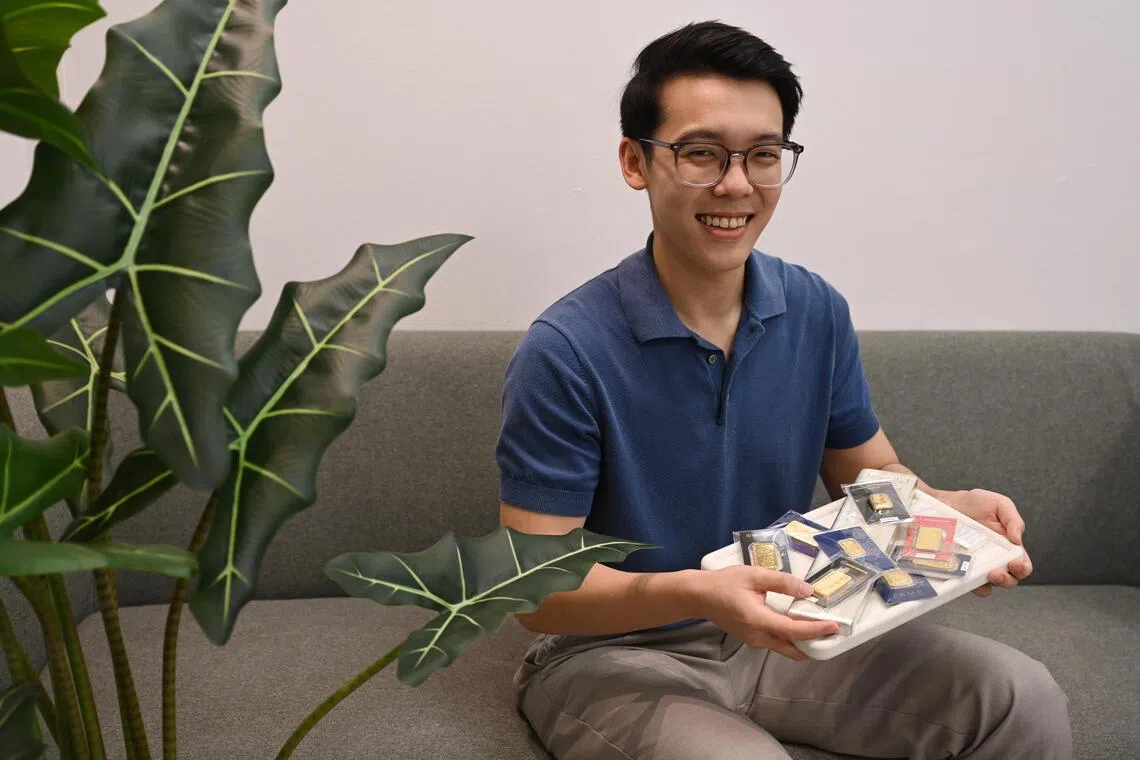
Ian Chan invested a significant portion of his personal savings and profits from previous investments to start precious metals trading company Big Bullion in December 2025, along with financial support from his family.
ST PHOTO: NG SOR LUAN
Published Oct 18, 2026, 05:00 AM
Updated Oct 18, 2026, 05:56 AM
SINGAPORE – Former naval officer Ian Chan enjoyed his time at sea, although he sometimes struggled with seasickness.
“I eventually decided not to continue along that path, which was a difficult decision because serving the nation was something I genuinely wanted to do,” he said.
The 25-year-old subsequently invested a significant portion of his personal savings and profits from previous investments to start precious metals trading company Big Bullion in December 2025, along with financial support from his family.
The company has generated about $1.5 million in revenue thus far, comprising $1.2 million from investment-grade gold and silver bullion and the remainder from buying back precious metals jewellery for refining.
Big Bullion is expected to become profitable by December 2026.
However, getting the business off the ground came with its own challenges, from establishing relationships with reliable suppliers, to sourcing gold and silver inventory, to developing hedging strategies to manage fluctuations in bullion prices.
“The experience has taught me the importance of managing business finances carefully, particularly cash flow and working capital,” said Chan.
The final-year student at NUS Business School added that he hopes to make investing in precious metals more accessible to younger Singaporeans through social media and educational content that explains how gold and silver pricing, premiums and buyback values work.
“Ultimately, our goal is not just to sell precious metals, but also to help customers better understand what they are buying, how pricing works and how physical gold and silver may fit into their broader financial plans,” he said.
Chan is engaged to his 25-year-old fiancee, who also helps him with his business.
Q: Do you invest? If so, what do you invest in and why?
Apart from precious metals, I also invest in a broad range of stocks, including exposure to the US market through indexes such as the S&P 500.
Equities give me exposure to businesses around the world and the potential for long-term capital growth.
I also believe liquidity is important. Cash gives me the flexibility to meet short-term needs, manage unexpected expenses and take advantage of opportunities without having to sell investments at an unfavourable time.
Q: What is your biggest or most valuable asset right now?
My business is one of my most valuable assets, alongside my gold and silver holdings. Building a business has also taught me that an asset’s value is not always immediately reflected in a bank balance. It can lie in the relationships, systems, knowledge and opportunities built over time.
Q: What is your approach to growing your money?
I believe younger investors with longer time horizons can generally consider taking more investment risk, provided they understand what they are investing in and can withstand potential losses.
At the same time, taking risk does not mean concentrating everything in one asset. Diversification is important because different assets behave differently under different market conditions.
Above all, I believe consistency matters. It is tempting to keep searching for the next big opportunity, but building wealth often comes down to investing regularly, controlling costs and allowing time for compounding to work.
Q: What was your first exposure to investing, and what was your first investment?
My first investment was at the end of national service, when I put about $200 into the S&P 500. It was a small amount, but it gave me a starting point.
Q: What has been your biggest financial mistake?
One area I could have managed better was my use of Singapore’s tax-advantaged savings schemes, particularly the Central Provident Fund and Supplementary Retirement Scheme (SRS), where additional contributions may have been appropriate for my circumstances.
The right CPF or SRS contribution depends on factors such as eligibility, tax bracket, liquidity needs and long-term plans, so it is not simply a matter of contributing as much as possible.
Q: What has been your best financial decision?
One of my best financial decisions has been consistently spending below my means and investing at least 20% of my income, even when it was tempting to spend more or pause investing.
I have dollar-cost averaged into investments over approximately seven years, including diversified US equities and precious metals. This has helped me develop discipline rather than trying to predict the perfect time to enter the market.
I have also been grateful that I learnt the importance of insurance planning early. Arranging appropriate coverage while younger helped me secure protection before potentially facing higher premiums or changes in insurability later on.
Q: Moneywise, what were your growing-up years like? How did they shape your approach to personal finance and investing?
My family emphasised delayed gratification: saving for a rainy day and understanding different asset classes, including equities, property, bonds, gold and CPF.
Growing up around entrepreneurs and business owners also influenced me. Seeing my parents and relatives run businesses showed me both the opportunities and the risks involved.
It also taught me that entrepreneurship requires accepting uncertainty and being prepared to take responsibility for your decisions.
Q: What was your childhood dream?
I wanted to be a rocket scientist. I was fascinated by space and the stars, and I enjoyed building things and learning about engineering.
Q: Did you take on any part-time jobs?
For the past four to five years, I have been juggling full-time university studies with work as a financial planner.
It was challenging to balance both commitments while maintaining relationships and making time for other responsibilities. I had to become more disciplined about planning my schedule and prioritising what mattered. I am also grateful to friends who helped me along the way with my studies.
Q: As a child, what did you save up for? What were your saving habits like and how have they changed?
I was fortunate to have home-cooked meals and support from my family, so I did not have many essential expenses to worry about as a child.
I generally saved the extra pocket money I received from my uncles and aunties, including money received during Chinese New Year, for future expenses.
After NS, one of the biggest things I spent my savings on was preparing for an Ironman triathlon. I had signed up during my NS years, and the training required substantial spending on swimming, cycling and running equipment.
Although it was a significant expense, it was meaningful to me. Committing to the race taught me about discipline and resilience – qualities that have carried over into investing and entrepreneurship.
Q: What was your most memorable encounter with money? When did you first realise that money was important?
One defining moment was paying the down payment for my Build-To-Order flat with my fiancee. I realised that nearly all of the down payment was funded by the gains from my investments.
That made the practical value of investing very real to me.
It was no longer just about watching numbers grow on a screen; it was about being able to provide for my future family and work towards major life goals with greater financial flexibility.
Q: What would you tell your younger self?
I would tell my younger self not to worry too much about the future. What we can control right now in the moment is working hard, experiencing and taking away as many lessons as possible, and to learn as much as we can about everything and stay curious at all times.
Q: Where is home for you?
I live in Pasir Ris.
Q: What do you drive?
I drive a Mercedes GLA 180.
Q: What was your most frivolous or guilty-pleasure purchase?
I bought a Rolex Submariner in the first or second year of my career, which turned out not to be the wisest decision because I realised I have a small wrist and the watch face is too large for it.
I ended up changing it for a smaller watch later.
Q: What does work-life balance mean to you?
I do not think balance necessarily means dividing every day equally between work and personal life. There will be periods when work requires more attention.
What matters is being deliberate about those trade-offs and ensuring that the people and priorities outside work are not continually pushed aside.
Q: What would your perfect day look like?
I would say that my perfect day would look like hitting some exercise, spending time with my fiancee, and getting some work done in the middle of the day. Plus, perhaps learning a new skill.
Q: What would you do if you suddenly had a windfall of millions?
I would probably go on a nice holiday.
Q: If you suddenly had just $100 to your name, what would you do with it?
I would get a good cup of coffee and get to work.
Timothy Goh is a business correspondent at The Straits Times. He covers commodities and currencies, with occasional forays into listed companies.
2025 年 12 月,Ian Chan 投入了相当一部分个人积蓄和之前投资的利润,并在家人的财政支持下创办了贵金属交易公司 Big Bullion。
圣徒照片:吴索銮
发布于 2026 年 10 月 18 日上午 5:00
更新于2026年10月18日 上午5:56
新加坡——前海军军官陈伊恩很享受他的海上时光,尽管他有时会晕船。
“我最终决定不再走这条路,这是一个艰难的决定,因为为国家服务是我真心想做的事情,”他说。
这位 25 岁的年轻人随后将自己相当一部分的积蓄和之前投资的利润投入到贵金属交易公司 Big Bullion 的创立中,并得到了家人的财政支持。
该公司迄今为止已创造了约 150 万美元的收入,其中 120 万美元来自投资级黄金和白银金条,其余部分来自回购贵金属首饰进行提炼。
Big Bullion预计将于2026年12月实现盈利。
然而,从与可靠的供应商建立关系,到采购黄金和白银库存,再到制定对冲策略以应对金银价格波动,这项业务的启动本身就面临着诸多挑战。
“这次经历让我明白了谨慎管理企业财务的重要性,尤其是现金流和营运资金,”陈先生说。
这位新加坡国立大学商学院的应届毕业生补充说,他希望通过社交媒体和教育内容,解释黄金和白银的定价、溢价和回购价值是如何运作的,从而使年轻的新加坡人更容易接触到贵金属投资。
“最终,我们的目标不仅是销售贵金属,还要帮助客户更好地了解他们购买的是什么,定价机制是如何运作的,以及实物黄金和白银如何融入他们更广泛的财务计划,”他说。
陈与他25岁的未婚妻订婚了,未婚妻也帮助他打理生意。
问:您进行投资吗?如果进行投资,您投资什么?为什么投资?
除了贵金属之外,我还投资于各种股票,包括通过标准普尔 500 指数等指数投资美国市场。
股票投资让我有机会接触世界各地的企业,并具有长期资本增长的潜力。
我也认为流动性很重要。现金让我能够灵活应对短期需求、处理意外支出,并在无需在不利时机出售投资的情况下抓住机遇。
问:你目前最大或最有价值的资产是什么?
我的事业是我最宝贵的资产之一,与我的黄金和白银储备并驾齐驱。创业也让我明白,资产的价值并非总是能立即体现在银行存款上。它也可能蕴藏在随着时间推移而建立的人脉关系、系统、知识和机遇之中。
问:您是如何实现财富增长的?
我认为,对于投资期限较长的年轻投资者来说,只要他们了解自己投资的对象并能承受潜在的损失,通常可以考虑承担更大的投资风险。
同时,承担风险并不意味着将所有资金集中于单一资产。分散投资至关重要,因为不同的资产在不同的市场环境下表现各异。
我认为最重要的是持之以恒。虽然不断寻找下一个重大投资机会的诱惑很大,但财富积累往往归根结底在于定期投资、控制成本,并让复利发挥作用。
问:您最初接触投资是什么时候?您的第一笔投资是什么?
我第一次投资是在服完兵役之后,当时我把大约 200 美元投入了标准普尔 500 指数。虽然金额不大,但这给了我一个起点。
问:你犯过的最大的财务错误是什么?
我本可以做得更好的一个方面是利用新加坡的税收优惠储蓄计划,特别是中央公积金和补充退休计划(SRS),根据我的情况,额外的供款可能是合适的。
合适的公积金或退休储蓄计划供款取决于资格、税级、流动性需求和长期计划等因素,因此并非只是尽可能多供款的问题。
问:你做过的最佳财务决定是什么?
我做出的最佳理财决定之一就是始终量入为出,并将至少 20% 的收入用于投资,即使在想要多花钱或停止投资的时候也是如此。
我采用平均成本法投资了大约七年,投资标的包括多元化的美国股票和贵金属。这帮助我培养了投资纪律,而不是试图预测入市的最佳时机。
我很庆幸自己早早认识到保险规划的重要性。年轻时就安排好合适的保险,让我能够在日后可能面临更高保费或保单资格变化之前,获得保障。
问:从金钱角度来看,你的成长经历是怎样的?它如何塑造了你对个人理财和投资的态度?
我的家庭强调延迟满足:未雨绸缪,了解不同的资产类别,包括股票、房地产、债券、黄金和公积金。
在企业家和企业主的熏陶下长大也对我产生了影响。看到我的父母和亲戚经营企业,让我既看到了机遇,也看到了风险。
它也让我明白,创业需要接受不确定性,并准备好为自己的决定承担责任。
问:你小时候的梦想是什么?
我曾梦想成为一名火箭科学家。我着迷于太空和星辰,喜欢动手制作东西,也喜欢学习工程学。
问:你有没有做过兼职?
过去四五年里,我一直在兼顾全日制大学学习和财务规划师的工作。
平衡学业和工作,同时还要维系人际关系并抽出时间处理其他事务,这确实很有挑战性。我必须更加自律地规划时间,并分清轻重缓急。我也非常感谢一路以来帮助过我的朋友们。
问:你小时候攒钱是为了买什么?你的储蓄习惯是怎样的?这些习惯发生了哪些变化?
我很幸运,小时候能吃到家常饭菜,还能得到家人的支持,所以没什么必需的开销需要担心。
我通常会把从叔叔阿姨那里得到的零花钱,包括春节期间收到的压岁钱,存起来以备将来之需。
退伍后,我把积蓄花在了备战铁人三项赛上,这笔开销相当可观。我在服役期间就报了名,训练需要大量资金购买游泳、自行车和跑步装备。
虽然这是一笔不小的开支,但对我而言意义非凡。参加比赛教会了我自律和坚韧——这些品质也一直伴随着我,并体现在我的投资和创业生涯中。
问:你与金钱之间印象最深刻的一次经历是什么?你是什么时候第一次意识到金钱的重要性?
一个意义非凡的时刻是和未婚妻一起支付我预购公寓的首付。我意识到,几乎全部首付都是用我的投资收益支付的。
这让我真切地感受到了投资的实际价值。
这不再仅仅是看着屏幕上的数字增长;而是能够为我未来的家庭提供保障,并以更大的财务灵活性去实现重大的人生目标。
问:你会对年轻的自己说什么?
我会告诉年轻的自己,不要过多担忧未来。我们现在能掌控的,就是努力工作,尽可能多地体验和汲取经验教训,尽可能多地学习各种知识,并始终保持好奇心。
问:对你来说,哪里才是家?
我住在巴西立。
问:你开什么车?
我开的是奔驰GLA 180。
问:你买过的最轻率或最让你感到愧疚的商品是什么?
我在职业生涯的第一年或第二年买了一块劳力士潜航者型手表,后来发现这并不是一个明智的决定,因为我意识到我的手腕很细,而这款手表的表盘对我来说太大了。
后来我还是换了一块小一点的手表。
问:你认为工作与生活平衡意味着什么?
我认为平衡并不一定意味着每天工作和生活要平均分配。总会有一些时期,工作需要投入更多精力。
重要的是要慎重考虑这些权衡取舍,并确保工作以外的人和事不会被不断忽视。
问:你理想中的一天是什么样的?
我理想中的一天应该是这样的:锻炼身体,和未婚妻共度时光,中午完成一些工作。另外,或许还能学习一项新技能。
问:如果你突然获得数百万美元的意外之财,你会怎么做?
我可能会去度个假。
问:如果你突然只有100美元,你会怎么花?
我会喝杯好咖啡,然后开始工作。
Timothy Goh是《海峡时报》的商业记者,主要报道大宗商品和货币,偶尔也关注上市公司。