Why you should talk to your child about drugs为什么你应该和孩子谈谈毒品问题
Singapore parents urged to talk to children, teens and youths about drugs as CNB warns of youth abuse, online misinformation and cannabis edibles. Read more at straitstimes.com.
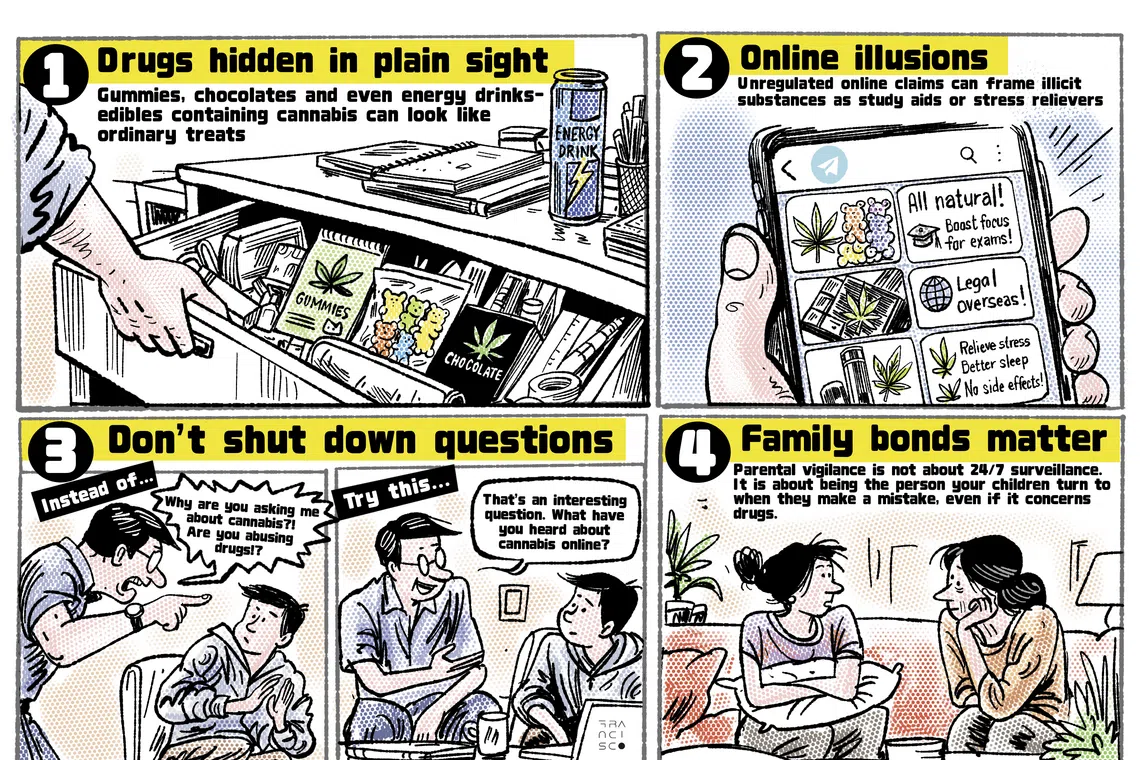
Youth drug abuse remains a concern, the Central Narcotics Bureau noted in its Singapore Drug Situation Report 2025.
ST ILLUSTRATION: MANNY FRANCISCO
Published Oct 18, 2026, 11:45 AM
Updated Oct 18, 2026, 11:45 AM
Parents in Singapore are warned that cannabis edibles and other drugs can reach youth online and through travel.
Experts say drugs are harmful, addictive and unpredictable; and stress, curiosity and online misinformation can push young people towards drug consumption.
Parents should start early, keep talking, listen without judgment, set clear limits and watch for warning signs as the drug scene keeps changing.
SINGAPORE – Roy, not his real name, was caught with sweets in his room.
A few years ago, his mother was cleaning his room when she discovered that her 15-year-old son had uncharacteristically hidden away a stash of gummies and lollipops.
Except that they were not the kiddy treats that Roy had no particular taste for. They were cannabis edibles.
Upon questioning, his mother found out that the Secondary 3 student had bought the candy, laced with the drug, during a recent family holiday in Bangkok.
Roy’s peers had introduced him to similar cannabis edibles, which sparked a curiosity to try them.
The teenager underwent outpatient drug rehabilitation for eight months at National Addictions Management Service (NAMS) at the Institute of Mental Health (IMH), says S.B. Viknesan, NAMS’ principal counsellor and Roy’s main counsellor.
Thailand became the first Asian country to decriminalise cannabis in June 2022. Although thousands of cannabis dispensaries sprung up to cater for its recreational use, in June 2025, the government made a U-turn, declaring that the drug could be used only for medicinal purposes .
While Singapore is known for its tough anti-drug policies, drug-related misinformation is easily found online, observers say. They add that drugs can be found in different guises, accessible through commonly used apps like Telegram and TikTok.
The good news, drug education experts say, is that parental vigilance and guidance play a big role in correcting misperceptions and preventing drug abuse by children and youth.
Myth: Cannabis edibles are safe to consume
Youth drug abuse remains a concern, the Central Narcotics Bureau (CNB) noted in its Singapore Drug Situation Report 2025.
In 2025, the youngest drug abuser arrested in Singapore was just 12 years old, and half of the new drug abusers arrested were below 30 years old, according to statistics from the report.
Methamphetamine or meth was the most commonly abused drug in 2025, followed by heroin and cannabis. Six in 10 new cannabis abusers arrested were below 30 years old.
A brief released by the World Health Organization (WHO) in August noted that there is consistent evidence that regular, heavy consumption of cannabis in adolescence and young adulthood is associated with adverse mental and psychosocial outcomes, such as poorer school performance, early school-leaving and cognitive impairment.
Viknesan, who is also a council member at the National Council Against Drug Abuse (NCADA), cautions that cannabis – also known as ganja, weed, marijuana or pot – is harmful and addictive, whether it is consumed through edibles or by smoking it.
When cannabis is mixed into energy drinks, chocolates, sweets, brownies or pastries, these edibles lack the pungent herbal smell of joints, where dried cannabis is smoked like cigarettes, he says.
Because cannabis edibles are so palatable, it is easy to underestimate their risks, he adds, cautioning that “consumption can lead to serious medical complications and, in some cases, may even be fatal”.
Consuming cannabis may also lead to delusions or hallucinations, putting users at a higher risk of mental illnesses like schizophrenia or other types of psychosis. Abuse of the drug can also lead to impaired brain development, especially during adolescence and early adulthood.
Cannabis edibles in the form of candy (right) lack the pungent, herbal scent of traditional cannabis joints (left). PHOTOS: ADOBE STOCK
Cannabis edibles in the form of candy (right) lack the pungent, herbal scent of traditional cannabis joints (left).
Myth: Illicit drugs help students cope with stress
Stress can be a motivating factor in drug experimentation, says Viknesan.
He has worked with drug abusers in their teens who faced stress at school and at home. They connected with strangers on social media, who introduced the adolescents to drugs.
Some of these strangers claimed that illicit drugs can help them deal with stress and mental health challenges such as depression or anxiety, or disorders like attention deficit hyperactivity disorder (ADHD), he adds.
Viknesan says: “Our youth population have multiple stressors in their life and some may adopt unhealthy habits to distract themselves and cope with their problems.
“I have come across young people – from secondary school to university levels – who took drugs thinking they could help with their studies, by helping them to stay attentive in class and complete their assignments. The online environment exposes youth to a great deal of misinformation about drugs.”
Stress can be a motivating factor in drug experimentation. PHOTO: ADOBE STOCK
Stress can be a motivating factor in drug experimentation.
Trying drugs just once carries significant risks.
“Illicit drugs are unregulated. You have no way of knowing what is actually in them; how potent they are; or what other substances they have been mixed with. This makes them extremely unpredictable and dangerous,” Viknesan says.
“Taking an illicit drug could mean unknowingly consuming toxic chemicals or a lethal dose, and the damage it causes your brain and body can be life-altering and permanent.”
Drugs hijack the brain’s reward system, producing intense feelings of pleasure that can feel real. But the brain adapts quickly, meaning one needs more of the drug to experience the same effect, he says.
“What starts as curiosity can spiral very quickly into dependency before the person even realises it.
“Because young people’s brains continue maturing until about age 25, drug consumption during this time interferes with critical growth, potentially causing changes to brain structure, impulse control, memory and emotional regulation,” he adds.
Different drugs have different effects.
Stimulants such as cocaine, meth and “ecstasy” can spike the heart rate and blood pressure, triggering a heart attack or stroke, even in healthy persons. In contrast, opioids like heroin can slow the heart rate to the point of death.
Don’t assume ‘my child will never try drugs’
Some young people in Singapore are buying drugs through messaging apps such as Telegram and WhatsApp, as well as social media platforms like TikTok, Instagram and Facebook, says Viknesan.
“It is vital to be aware of where one’s children are and what they are doing, because young people can and do order drugs online – easily and discreetly – using phones or computers, sometimes while at home or even out with their parents,” he says.
He says that vigilance is key for all families. “Parents shouldn’t operate on the assumption that ‘it could never happen to my child’. They should be aware that any child is susceptible to thinking about experimenting with drugs, drawn by curiosity and trends seen online,” Viknesan says.
CNB recently investigated drug-trafficking networks across multiple Telegram channels. Operations conducted in September led to the island-wide arrests of 39 suspected drug offenders . About half of them were below 30 years old.
Assistant commissioner Ng Khai Song, director of the intelligence division, said: “Drug traffickers should be under no illusion that online platforms will shield them from enforcement. Every online interaction leaves a trail.
“CNB actively monitors the online space, develops intelligence and acts decisively to detect and disrupt drug activities. Those involved will be traced and dealt with under the law.”
While news of youth offenders may cause a stir, there is reason for optimism. There is rising confidence surrounding the role of parents in preventative drug education in Singapore.
In the 2025 National Drug Perception Survey by NCADA , 94.2% of youth whose parents had spoken to them about drugs said this deterred them from abusing drugs, compared with 91.7% in 2023.
But how should parents engage with their children on this topic?
Zulhaqem Zulkifli is a DrugFreeSG Champion, appointed by the Inter-Ministry Committee on Drug Prevention for Youths. He works with young people and families.
The former volunteer para-counsellor with the Singapore Anti-Narcotics Association (SANA) urges parents: “Have the conversation before you need the conversation.”
Even before a child demonstrates curiosity about drugs, parents can use ordinary situations – such as a news story, a family trip overseas or something the child mentions from school – to address his or her questions; gently correct any misinformation; clearly convey family values and boundaries against drug-taking; and explain the consequences of drug use, he says.
Noting that curiosity comes naturally to children and adolescents, he advises: “Don’t punish the question.”
He paints this scenario: If an adolescent asks about cannabis, it could be because he or she saw it discussed on TikTok or because the teen knows he or she might come across it on vacation.
The teen might ask: “Why is cannabis so bad if it’s legal in other countries?” or “Why do some successful people take drugs?”
If the parental response is accusatory – “why are you asking?” or “are you taking drugs?” – the child learns quickly not to ask again.
Instead, he suggests an initial response before discussing the topic with the child. For instance, respond by saying: “That’s a fair question. What have you heard about it?”
“This allows the parent to understand the information environment the young person is actually living in,” Zulhaqem says.
He adds: “From engaging with young people, I think they are often interested in questions that adults sometimes avoid. Adults gain credibility when they are prepared to engage with difficult questions seriously, rather than interpreting such questions as evidence that a teenager is pro-drug.”
He also advises listening before reacting and avoiding harsh labels like “addict” or “drug abuser” if a child admits to curiosity about drugs. Rather than criticising the child’s friends or instilling fear – which often backfires by driving young people into secrecy – parents should keep communication open.
Zulhaqem says: “Don’t assume one conversation at age 12 will last until age 21.”
While young children can be supervised online and off, maintaining the same level of supervision is challenging as they enter their late teens. The parent-child relationship itself is a “protective factor” if young adults can confide in their parents, he says.
During this stage of life, he says, young people may also be more receptive to evaluating claims they encounter online. They understand that descriptions of illicit drugs as being “natural”, “legal”, “therapeutic” or “popular” do not mean these drugs are safe to consume, he says.
Viknesan, the counsellor, notes that there are a plethora of drug education resources for parents and children.
These include awareness-raising activities, educational workshops and talks, video competitions and first-hand drug recovery testimonials run by organisations such as CNB, NCADA, SANA, NAMS, We Care Community Services and others.
SANA even has a programme targeted at secondary school students in uniformed groups, which teaches them about drug abuse, and how to handle situations when they are tempted to experiment with drugs. Students attain a SANA badge after completing a series of activities.
The drug scene will evolve
While parents should educate themselves and their children about the harms caused by drugs, it is challenging to keep pace with the evolving drug scene, where new synthetic substances, delivery mechanisms and online narratives will periodically surface, according to Zulhaqem.
In Singapore, for instance, the authorities are concerned about psychoactive substances being administered through vapes, which are themselves illegal, he says.
Zulhaqem says: “Ultimately, parents don’t have to know the name of every new drug. They need to know their child.”
He suggests that parents take these steps.
They should get to know their teens’ friends and social environment, and understand what their children are hearing online.
They should also take notice of patterns of behaviour change, if any, which might suggest drug experimentation, such as withdrawing from long-term friends or an inexplicable need for cash.
Parents are encouraged to talk to their children early on and set clear boundaries.
“Make sure that, even if your child has made a serious mistake, you remain one of the first people he or she will call for help,” he says.
For advice on drug-related concerns, reach out to para-counsellors at the Singapore Anti-Narcotics Association on 6732-1122 or sana@sana.org.sg .
For substance abuse, the National Addictions Management Service offers professional counselling, with specialised programmes for adolescents and family support. Reach it on 6389-2000.
For suspected drug abuse, seek early intervention support from the Central Narcotics Bureau. Reach CNB on 1800-325-6666.
This article was written in partnership with the Central Narcotics Bureau.
Venessa Lee is a feature writer and senior correspondent at The Straits Times.
Central Narcotics Bureau
新加坡中央肃毒局在其《2025年新加坡毒品形势报告》中指出,青少年吸毒问题仍然令人担忧。
插图:曼尼·弗朗西斯科
发布于 2026 年 10 月 18 日上午 11:45
更新于2026年10月18日上午11:45
新加坡的家长们被警告,大麻食品和其他毒品可以通过网络和旅行等途径流入青少年手中。
专家表示,毒品有害、易上瘾且难以预测;压力、好奇心和网络上的错误信息可能会促使年轻人吸毒。
父母应该尽早开始,不断沟通,不加评判地倾听,设定明确的界限,并注意毒品环境不断变化带来的预警信号。
新加坡——罗伊(化名)被发现在房间里藏有糖果。
几年前,他的母亲在打扫他的房间时,发现她 15 岁的儿子一反常态地藏了一堆软糖和棒棒糖。
只不过,这些并不是罗伊不怎么喜欢的儿童零食,而是大麻食品。
经过询问,他的母亲得知,这名中三学生是在最近一次与家人在曼谷度假期间购买了掺有毒品的糖果。
罗伊的同龄人向他介绍了类似的含大麻食品,这引起了他的好奇心,让他想要尝试一下。
据国家成瘾管理服务中心 (NAMS) 的首席咨询师兼 Roy 的主要咨询师 SB Viknesan 称,这名青少年在心理卫生学院 (IMH) 的国家成瘾管理服务中心 (NAMS) 接受了 8 个月的门诊戒毒治疗。
泰国于 2022 年 6 月成为亚洲第一个将大麻合法化的国家。尽管成千上万的大麻药房如雨后春笋般涌现,以满足其娱乐用途,但 2025 年 6 月,政府却来了个 180 度大转弯,宣布该药物只能用于医疗用途。
观察人士指出,尽管新加坡以其严厉的禁毒政策而闻名,但与毒品相关的虚假信息却很容易在网上找到。他们补充说,毒品以各种形式出现,可以通过Telegram和TikTok等常用应用程序获取。
毒品教育专家表示,好消息是,父母的警惕和指导在纠正儿童和青少年对毒品的错误认知和预防毒品滥用方面发挥着重要作用。
误区:食用大麻制品是安全的。
新加坡中央肃毒局(CNB)在其《2025年新加坡毒品形势报告》中指出,青少年吸毒问题仍然令人担忧。
根据该报告的统计数据,到 2025 年,新加坡被捕的最年轻的吸毒者年仅 12 岁,而被捕的新吸毒者中有一半年龄在 30 岁以下。
2025年,甲基苯丙胺(冰毒)是最常被滥用的毒品,其次是海洛因和大麻。在被捕的新大麻滥用者中,十分之六的人年龄在30岁以下。
世界卫生组织 (WHO) 8 月发布的一份简报指出,有确凿证据表明,青少年和青年时期经常大量吸食大麻与不良的心理和社会心理后果有关,例如学业成绩下降、提前辍学和认知障碍。
维克内桑同时也是全国反毒品滥用委员会 (NCADA) 的理事会成员,他警告说,大麻(也称为 ganja、weed、marijuana 或 pot)无论是通过食用还是吸食,都是有害且令人上瘾的。
他说,当大麻混入能量饮料、巧克力、糖果、布朗尼蛋糕或糕点中时,这些食用产品缺乏大麻卷烟那种刺鼻的草药气味,而大麻卷烟是将干燥的大麻像香烟一样吸食的。
他补充说,由于大麻食品味道很好,很容易低估其风险,并警告说“食用大麻食品会导致严重的医疗并发症,在某些情况下甚至可能致命”。
吸食大麻也可能导致妄想或幻觉,使使用者更容易患上精神分裂症或其他类型的精神病等精神疾病。滥用大麻还会损害大脑发育,尤其是在青春期和成年早期。
糖果状的大麻食品(右图)缺乏传统大麻卷烟(左图)那种浓烈的草药味。图片来源:Adobe Stock
以糖果形式出现的食用大麻制品(右图)缺乏传统大麻卷烟(左图)那种刺鼻的草药香味。
误区:非法药物能帮助学生应对压力
维克内桑表示,压力可能是药物试验的一个驱动因素。
他曾帮助过一些十几岁的吸毒青少年,这些青少年在学校和家庭都面临着巨大的压力。他们通过社交媒体结识了陌生人,这些人将他们引入了毒品的世界。
他还补充说,其中一些陌生人声称,非法药物可以帮助他们应对压力和心理健康挑战,例如抑郁症或焦虑症,或者注意力缺陷多动障碍 (ADHD) 等疾病。
Viknesan 说:“我们的年轻人生活中有很多压力源,有些人可能会养成不健康的习惯来分散注意力,应对他们的问题。
“我遇到过一些年轻人——从中学生到大学生——他们吸毒,以为毒品可以帮助他们集中注意力上课、完成作业。网络环境让青少年接触到大量关于毒品的错误信息。”
压力可能是促使人们尝试毒品的因素之一。图片:Adobe Stock
压力可能是药物试验的驱动因素。
即使只尝试一次毒品也会带来重大风险。
“非法药物不受监管。你根本无法知道它们里面到底有什么成分;它们的效力有多强;或者它们还掺杂了哪些其他物质。这使得它们极其难以预测且危险,”维克内桑说道。
“服用非法药物可能意味着在不知情的情况下摄入有毒化学物质或致命剂量,它对大脑和身体造成的损害可能是终身的,甚至是永久性的。”
药物会劫持大脑的奖赏系统,产生强烈的、甚至感觉真实的快感。但他表示,大脑适应速度很快,这意味着需要服用更多药物才能达到相同的效果。
“好奇心可能会迅速演变成依赖,而人们甚至还没有意识到这一点。”
“因为年轻人的大脑会一直发育成熟到 25 岁左右,所以在此期间吸毒会干扰关键的生长发育,可能导致大脑结构、冲动控制、记忆和情绪调节发生变化,”他补充道。
不同的药物有不同的作用。
可卡因、冰毒和“摇头丸”等兴奋剂会使心率和血压飙升,即使是健康人也可能因此引发心脏病或中风。相反,海洛因等阿片类药物则会使心率减慢至死亡的程度。
不要想当然地认为“我的孩子永远不会尝试毒品”。
Viknesan表示,新加坡的一些年轻人正在通过Telegram和WhatsApp等即时通讯应用以及TikTok、Instagram和Facebook等社交媒体平台购买毒品。
他说:“了解自己的孩子在哪里、在做什么至关重要,因为年轻人可以而且确实会使用手机或电脑在网上订购毒品——既容易又隐秘——有时甚至在家中,有时甚至与父母外出时也是如此。”
他表示,保持警惕对所有家庭都至关重要。“家长不应该抱有‘这种事永远不会发生在我孩子身上’的侥幸心理。他们应该意识到,任何孩子都可能受到好奇心和网络上流行趋势的影响,萌生尝试毒品的想法。”维克内桑说道。
中央肃毒局近期对多个Telegram频道上的贩毒网络展开调查。9月份的行动在全岛范围内逮捕了39名涉嫌毒品犯罪的人员,其中约一半年龄在30岁以下。
情报部门主管吴凯松助理警监表示:“毒贩不应抱有任何幻想,认为网络平台可以保护他们免受执法部门的追捕。每一次网络互动都会留下痕迹。”
“中央缉毒局积极监控网络空间,收集情报,并果断采取行动侦查和打击毒品活动。涉案人员将被追查并依法处理。”
尽管青少年犯罪的消息可能会引起轩然大波,但仍有理由保持乐观。在新加坡,人们对家长在预防毒品犯罪教育中所扮演的角色越来越有信心。
2025 年 NCADA 全国毒品认知调查显示,94.2% 的青少年表示,父母曾与他们谈论过毒品,这阻止了他们滥用毒品,而 2023 年这一比例为 91.7%。
但家长应该如何与孩子谈论这个话题呢?
Zulhaqem Zulkifli 是 DrugFreeSG 的倡导者,由跨部门青少年禁毒委员会任命。他致力于为青少年及其家庭提供服务。
这位曾在新加坡反毒品协会 (SANA) 担任志愿者辅导员的人士敦促家长:“在需要谈话之前就进行谈话。”
他说,即使在孩子对毒品表现出好奇心之前,父母也可以利用普通的情境——例如新闻报道、家庭出国旅行或孩子在学校里提到的事情——来解答他们的疑问;温和地纠正任何错误信息;清楚地传达家庭价值观和反对吸毒的界限;并解释吸毒的后果。
他指出,好奇心是儿童和青少年与生俱来的,并建议:“不要惩罚提问。”
他描述了这样一种情景:如果一个青少年询问有关大麻的问题,可能是因为他/她在 TikTok 上看到了相关的讨论,或者因为他/她知道自己可能会在度假时接触到大麻。
青少年可能会问:“如果大麻在其他国家合法,为什么它在这里这么糟糕?”或者“为什么有些成功人士会吸毒?”
如果父母的回应是指责性的——“你为什么问这个?”或者“你是不是在吸毒?”——孩子很快就会学会不再问。
他建议,在与孩子讨论这个话题之前,可以先做出初步回应。例如,可以这样回应:“这个问题问得好。你听说过什么吗?”
“这可以让家长了解孩子实际所处的信息环境,”Zulhaqem 说。
他补充道:“通过与年轻人的交流,我认为他们往往对成年人有时会回避的问题很感兴趣。成年人如果能够认真对待这些棘手的问题,而不是将这些问题解读为青少年支持毒品的证据,就能赢得他们的信任。”
他还建议,如果孩子承认对毒品感兴趣,家长应该先倾听再做出反应,避免使用“瘾君子”或“吸毒者”等严厉的标签。与其批评孩子的朋友或散播恐惧(这样做往往会适得其反,让年轻人更加隐瞒),家长更应该保持沟通渠道畅通。
Zulhaqem 说:“不要以为 12 岁时的一次谈话会持续到 21 岁。”
虽然年幼的孩子无论线上线下都能得到监管,但随着他们进入青少年后期,要维持同样的监管力度就变得很有挑战性。他表示,如果年轻人能够向父母倾诉,那么亲子关系本身就是一种“保护因素”。
他表示,在这个人生阶段,年轻人可能更容易接受并评估他们在网上看到的各种说法。他们明白,将非法药物描述为“天然的”、“合法的”、“有疗效的”或“流行的”并不意味着这些药物可以安全服用。
咨询师维克内桑指出,有很多针对家长和儿童的毒品教育资源。
这些活动包括提高公众意识的活动、教育研讨会和讲座、视频比赛以及由中央麻醉品管制局 (CNB)、国家药物滥用控制局 (NCADA)、国家药物滥用控制局 (SANA)、国家药物滥用控制局 (NAMS)、We Care Community Services 等组织举办的第一手戒毒康复证词。
SANA甚至还针对中学生开设了一项制服团体课程,向他们讲解毒品滥用知识,以及如何在受到毒品诱惑时进行应对。学生完成一系列活动后即可获得SANA徽章。
毒品市场将会演变
祖尔哈克姆表示,虽然父母应该教育自己和孩子了解毒品造成的危害,但要跟上不断变化的毒品形势却是一项挑战,因为新的合成物质、输送机制和网络说法会不时出现。
他说,例如在新加坡,当局担心精神活性物质会通过电子烟摄入,而电子烟本身就是非法的。
祖尔哈克姆说:“归根结底,父母不需要知道每一种新药的名字。他们需要了解的是自己的孩子。”
他建议家长采取这些措施。
家长应该了解自己孩子的社交圈和朋友,了解孩子们在网上听到的内容。
他们还应该注意行为模式的变化(如果有的话),这可能表明吸毒行为,例如疏远长期朋友或莫名其妙地需要现金。
鼓励家长尽早与孩子沟通,并设定明确的界限。
“即使你的孩子犯了严重的错误,也要确保你仍然是他或她最先寻求帮助的人之一,”他说。
如需有关毒品相关问题的建议,请联系新加坡反毒品协会的辅导员,电话:6732-1122 或邮箱:sana@sana.org.sg。
针对药物滥用问题,国家成瘾管理服务中心提供专业咨询服务,并设有专门针对青少年和家庭支持的项目。联系电话:6389-2000。
如怀疑自己滥用毒品,请向中央肃毒局寻求早期干预支持。联系中央肃毒局请拨打1800-325-6666。
本文由中央肃毒局合作撰写。
Venessa Lee是《海峡时报》的特稿撰稿人和高级记者。
中央缉毒局