NUH offers precision brain stimulation to treat depression and anxiety新加坡国立大学医院提供精准脑刺激疗法来治疗抑郁症和焦虑症。
Personalised brain stimulation for depression and anxiety is now available in Singapore, with new pTMS services expanding at hospitals. Read more at straitstimes.com.
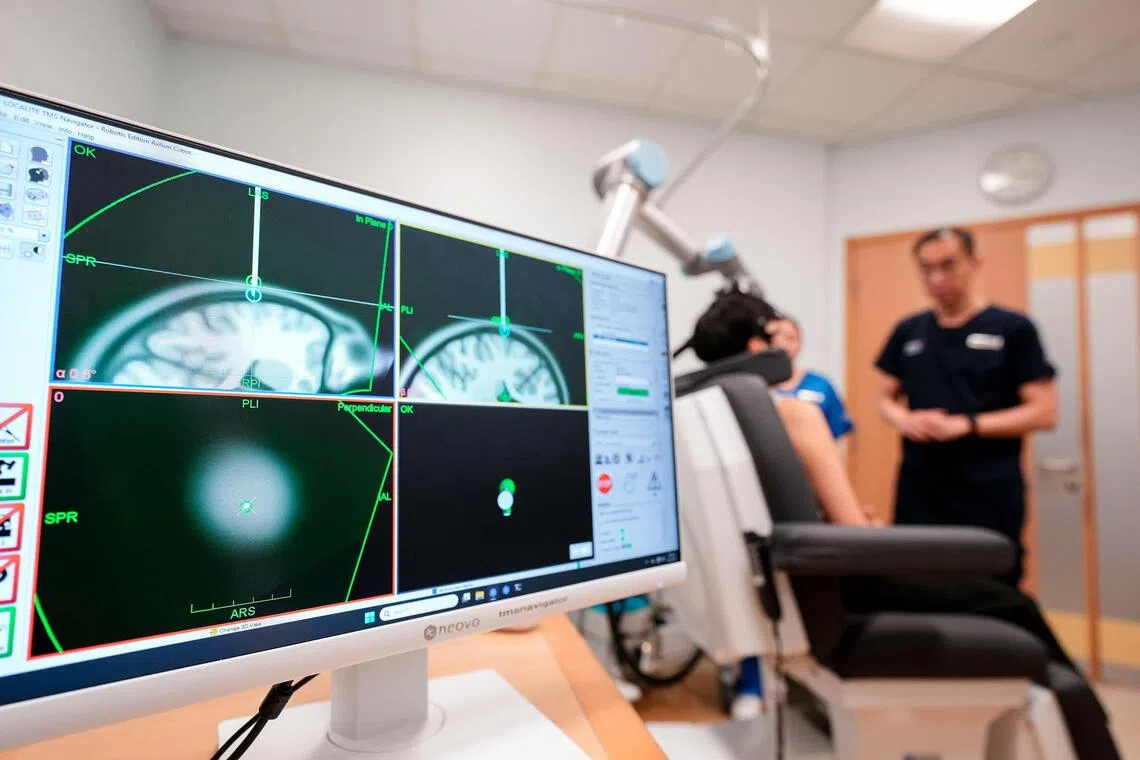
Known as personalised transcranial magnetic stimulation, the treatment uses functional magnetic resonance imaging (fMRI) scans.
Published Oct 19, 2026, 08:25 PM
Updated Oct 19, 2026, 08:25 PM
NUH has launched Singapore’s first personalised Transcranial Magnetic Stimulation service, using fMRI and AI to target brain circuits without surgery for depression and anxiety.
Patient Ms Chen, who has lived 20 years with severe OCD, said the trial brought “clarity” and a 35% symptom drop, while another participant’s score fell 78%.
pTMS is expanding in Singapore, with future plans for IMH, Sengkang General Hospital and KTPH; current treatment at NUH costs $15,000 and is not yet subsidised.
SINGAPORE – A targeted psychiatric treatment to stimulate brain circuitry down to the millimetre – without surgery – is now offered at the National University Hospital (NUH), likely making it the first service of its kind in South-east Asia.
Known as personalised transcranial magnetic stimulation (pTMS), the treatment uses functional magnetic resonance imaging (fMRI) scans, which track blood flow and oxygen levels in the brain, with the AI-powered algorithms to map brain circuits.
This allows magnetic pulses to be targeted at the networks driving mental health conditions.
It is currently offered as a clinical service at NUH and the private Alvernia Psychological Health Centre, and will be expanded to other public hospitals.
While pTMS is approved in Singapore for treatment-resistant depression and anxiety, researchers at NUH have also seen promising trial results when they applied the technology to severe obsessive-compulsive disorder (OCD).
So it can also be offered, on a case-by-case basis, for patients who have exhausted standard OCD treatments.
Standard TMS, introduced in Singapore slightly more than a decade ago for treatment-resistant depression, is available at certain locations in Singapore. IMH extended the treatment to OCD in 2022.
There is no brain mapping in standard TMS, which uses approximate target locations, stimulating the same spot in every patient.
Even so, standard TMS has a promising 21% response rate and a 17% remission rate, based on an IMH study that evaluated 58 patients with treatment-resistant depression treated between 2018 and 2023.
Another report on standard TMS has since been published in Frontiers in Psychiatry on Oct 12, showing that the cohort at KTPH who were treated in an outpatient setting achieved a 68% response rate and a 57% remission rate.
Although patient complexity and treatment protocols differed between the IMH and KTPH studies, both demonstrated that standard TMS is effective.
As for pTMS, a study done at IMH showed that 70% of the 21 participants with treatment-resistant depression responded within a month of receiving treatment.
NUH launched pTMS in early 2026 for those with depression and anxiety. It is currently unsubsidised, so patients need to pay $15,000 to undergo the sessions. So far, several patients have been treated, including one who flew in from Hong Kong and another from Bangladesh.
‘Waking up from a dream’
A patient, identified only as Chen, had lived with debilitating OCD for around 20 years until pTMS brought her relief. Medications and cognitive behavioural therapy over the years had done little to help her condition.
She was diagnosed with OCD in 2007 when she was studying in the United Kingdom. Her condition manifested not as repetitive physical habits, but as intense mental compulsions.
“I couldn’t control my compulsion. I had to get things just right,” said the 49-year-old. “I would perform the compulsion, get physically exhausted and then fall into depression.”
Her OCD demanded so much of her that she often forgot to eat or sleep – she once spent 72 hours without sleep while working as an architect in the UK. It led to her taking breaks from university and from work, with the longest lasting a few years.
By the time she returned to Singapore in 2019, she was far too familiar with the side effects of her medications, which included emotional blunting, brain fog and cold sweats, as well as muscle twitching that disrupted her sleep.
In early 2026, not long after going under the care of Tor Phern Chern, a senior consultant at the psychological medicine department at NUH, she joined his pTMS trial for individuals with severe, treatment-resistant OCD, and saw a 35% symptom reduction a month after the treatment.
In the pTMS for OCD trial, Tor partnered with Thomas Yeo, deputy head of the Centre for Translational Magnetic Resonance Research at NUS Medicine, to identify the specific brain circuits linked to her condition.
“By combining brain imaging with computational modelling, we are able to better understand how each patient’s symptoms are reflected in their brain circuitry, and translate that insight into targeted treatment,” Yeo said.
Chen has so far completed 16 booster pTMS sessions, following 40 sessions over five days in the trial. Each pTMS session lasts around nine minutes.
When the impact came gradually, it was clear. “It was like a sense of regaining clarity, almost like waking up from a dream and not feeling groggy,” Chen said.
“I became much more aware of my behavioural patterns. Sometimes, I can see triggers. I might not be able to stop the compulsion, but I can identify them.”
It brought emotional clarity to her relationship with her husband.
“At least now I realised that I am not angry at him for trying to look after me. Now I understand that it was just a reaction to somebody who interrupted (my) compulsion,” she said.
“It was very hard to get along with people when you’re in the middle of a cycle of compulsion because people would try to interrupt it, and they are usually met with my displeasure or ire.”
Tor said it was clear that the treatment worked for her. “We did eight sessions a day... It took about a month to (see results), but it was just unbelievable. She could talk coherently... understand what the symptoms were for the first time.”
The other participant in the pTMS trial saw even better results. Her symptom scores fell by 78% by the end of the treatment week and by 100% six weeks later.
“Being able to reach the circuits that deep brain stimulation targets, without surgery and in a single week of treatment, is what makes these early results so encouraging,” said Tor.
Tor and Yeo will be starting a new study that aims to recruit 30 patients to look at how brain networks and symptoms change during pTMS in individuals with depression who also experience anxiety.
NUH and Alvernia Psychological Health Centre are partnering with B1Neuro to offer pTMS.
B1Neuro is a spin-off from the National University of Singapore founded by Yeo and partners, including Tor, that focuses on fMRI-guided precision neuromodulation treatments and a neurotargeting service.
It handles the complex brain mapping before pTMS takes place.
Its breakthrough brain-mapping algorithm developed by Yeo and Ruby Kong, which powers pTMS, is already being used by researchers around the world.
B1Neuro is also exploring regional collaborations.
In Singapore, pTMS is set to expand to IMH, Sengkang General Hospital, and KTPH through a National Healthcare Innovation Centre grant, said Tor, the grant’s principal investigator.
KTPH plans to start pTMS for treatment-resistant depression in the coming months, said Tay Yi Hang, a consultant at the hospital’s psychiatry department. She said KTPH has used standard TMS to treat about 50 patients with depression since 2022, and five patients with OCD since 2025.
For these patients who have seen little relief from medications and therapy, pTMS gives hope. OCD, in particular, is one of the hardest mental health conditions to treat, as the only medicines approved for it belong to a single drug class, serotonin reuptake inhibitors, and 40% to 60% of patients do not respond adequately to them.
“If medications and therapy don’t work, and counselling doesn’t work, the next step is literally deep brain stimulation,” Tor said.
“It’s the same treatment you use for Parkinson’s disease, where you plant electrodes to stimulate deep parts of the brain... It turns out most people don’t really want to have brain surgery.”
With her trial completed and her symptoms lighter, Chen is now looking at long-term options to maintain her recovery.
“Very often, with mental health, people sort of expect you to get better or get cured. So initially, there was a huge struggle for me to explain to my parents that there’s no real cure. It’s only how well you can manage it.”
“In the last three years or so, I think my parents have also tried not to push me to get better. So that was a bit of a relief for me.”
National Mindline: 1771 (24 hours) / 6669-1771 (via WhatsApp)
Samaritans of Singapore: 1-767 (24 hours) / 9151-1767 (24 hours CareText via WhatsApp)
Singapore Association for Mental Health: 1800-283-7019
Silver Ribbon Singapore: 6386-1928
Chat, Centre of Excellence for Youth Mental Health: 6493-6500/1
Women’s Helpline (Aware): 1800-777-5555 (weekdays, 10am to 6pm)
The Seniors Helpline: 1800-555-5555 (weekdays, 9am to 5pm)
Tinkle Friend (for primary school-age children): 1800-2744-788
Mindfull Community HQ (for caregivers, families and persons in recovery): 6460-4400 (weekdays, 9am to 5pm)
Touchline (Counselling): 1800-377-2252
Touch Care Line (for caregivers): 6804-6555
Counselling and Care Centre: 6536-6366
We Care Community Services: 3165-8017
Shan You Counselling Centre: 6741-9293
Clarity Singapore: 6757-7990
Care Corner Counselling Centre: 6353-1180
chat.mentalhealth.sg
carey.carecorner.org.sg (for those aged 13 to 25)
limitless.sg/talk (for those aged 12 to 25)
IMH/Institute of Mental Health
National University Hospital
这种疗法被称为个性化经颅磁刺激,它利用功能磁共振成像(fMRI)扫描。
发布于 2026 年 10 月 19 日晚上 8:25
更新于2026年10月19日晚上8:25
新加坡国立大学医院推出了新加坡首个个性化经颅磁刺激服务,利用功能磁共振成像和人工智能技术,无需手术即可针对大脑回路治疗抑郁症和焦虑症。
患有严重强迫症 20 年的陈女士表示,试验带来了“清晰的认识”,症状减轻了 35%,而另一位参与者的评分下降了 78%。
pTMS 在新加坡正在推广,未来计划在心理卫生学院 (IMH)、盛港综合医院和加德满都医院 (KTPH) 开展;目前在新加坡国立大学医院 (NUH) 的治疗费用为 15,000 美元,且尚未获得补贴。
新加坡——新加坡国立大学医院 (NUH) 现在提供一种无需手术即可精确刺激大脑回路(精确到毫米级)的定向精神治疗,这很可能使其成为东南亚首例此类服务。
这种疗法被称为个性化经颅磁刺激(pTMS),它利用功能磁共振成像(fMRI)扫描来追踪大脑中的血流和氧气水平,并结合人工智能算法来绘制大脑回路图。
这样就可以将磁脉冲定向作用于导致精神健康状况的神经网络。
目前,新加坡国立大学医院和私立的阿尔维尼亚心理健康中心提供这项临床服务,未来将推广到其他公立医院。
虽然 pTMS 在新加坡已被批准用于治疗难治性抑郁症和焦虑症,但新加坡国立大学医院的研究人员在将该技术应用于严重强迫症 (OCD) 时也看到了令人鼓舞的试验结果。
因此,对于已经用尽标准强迫症治疗方法的患者,也可以根据具体情况提供这种疗法。
标准经颅磁刺激(TMS)疗法十多年前引入新加坡,用于治疗难治性抑郁症,目前在新加坡部分地区提供该疗法。2022年,新加坡心理卫生学院(IMH)将该疗法扩展至强迫症的治疗。
标准 TMS 中没有脑部定位,它使用近似的目标位置,刺激每个患者的同一位置。
即便如此,根据 IMH 的一项研究,标准 TMS 的有效率达到了令人鼓舞的 21%,缓解率达到了 17%。该研究评估了 2018 年至 2023 年间接受治疗的 58 名难治性抑郁症患者。
10 月 12 日,《精神病学前沿》杂志发表了另一份关于标准 TMS 的报告,显示 KTPH 门诊治疗组的患者达到了 68% 的反应率和 57% 的缓解率。
尽管 IMH 和 KTPH 研究的患者复杂程度和治疗方案有所不同,但两项研究都表明标准 TMS 是有效的。
至于 pTMS,IMH 进行的一项研究表明,21 名患有难治性抑郁症的参与者中有 70% 在接受治疗一个月内有反应。
新加坡国立大学医院(NUH)于2026年初推出经颅磁刺激(pTMS)疗法,用于治疗抑郁症和焦虑症。该疗法目前不享受政府补贴,患者需自费15,000新元接受治疗。迄今为止,已有数名患者接受了治疗,其中包括一位从香港前来就诊的患者和一位来自孟加拉国的患者。
“从梦中醒来”
一位化名陈的患者,患有严重的强迫症长达20年之久,直到经颅磁刺激(pTMS)才使她摆脱了痛苦。多年来,药物治疗和认知行为疗法对她的病情收效甚微。
2007年她在英国留学期间被诊断出患有强迫症。她的病情并非表现为重复性的身体习惯,而是表现为强烈的精神强迫行为。
“我无法控制自己的强迫行为。我必须把所有事情都做到完美,”这位49岁的男子说道。“我会强迫自己去做这件事,然后筋疲力尽,最后陷入抑郁。”
她的强迫症对她要求极高,以至于她经常忘记吃饭睡觉——她曾在英国担任建筑师期间连续72小时没有睡觉。这导致她不得不中断学业和工作,最长的一次持续了几年。
到 2019 年她回到新加坡时,她已经非常熟悉自己药物的副作用了,包括情感麻木、脑雾、盗汗以及扰乱睡眠的肌肉抽搐。
2026 年初,在接受新加坡国立大学医院心理医学系高级顾问 Tor Phern Chern 的治疗后不久,她参加了 Tor Phern Chern 针对重度难治性强迫症患者的 pTMS 试验,并在治疗一个月后症状减轻了 35%。
在针对强迫症的 pTMS 试验中,Tor 与新加坡国立大学医学院转化磁共振研究中心副主任 Thomas Yeo 合作,确定了与她的病情相关的特定脑回路。
Yeo表示:“通过将脑成像与计算建模相结合,我们能够更好地了解每个患者的症状是如何反映在其大脑回路中的,并将这种见解转化为有针对性的治疗。”
在为期五天的试验中,陈医生已接受了40次经颅磁刺激(pTMS)治疗,目前她已完成16次加强治疗。每次pTMS治疗持续约9分钟。
当这种影响逐渐显现时,感觉就清晰多了。“就像重新获得清醒的感觉,几乎就像从梦中醒来,不再感到昏昏沉沉,”陈说。
“我开始更加清楚地意识到自己的行为模式。有时,我能看到诱因。我可能无法阻止强迫行为,但我可以识别它们。”
它让她和丈夫之间的关系变得更加清晰明了。
“至少现在我明白了,我并不生他的气,因为他想照顾我。现在我明白,那只是对打断我强迫行为的一种反应,”她说。
“当你深陷强迫症的恶性循环中时,很难与人相处,因为人们会试图打断你的行为,而他们通常会遭到我的不满或愤怒。”
托尔说,很明显,这种疗法对她有效。“我们每天做八次疗程……大约一个月后才看到效果,但效果简直令人难以置信。她能条理清晰地说话……第一次明白了自己的症状是什么。”
另一位参与 pTMS 试验的受试者取得了更好的效果。治疗一周结束时,她的症状评分下降了 78%,六周后下降了 100%。
Tor表示:“能够在不进行手术的情况下,仅用一周的治疗时间就能达到深部脑刺激所针对的神经回路,这正是这些早期结果如此令人鼓舞的原因。”
Tor 和 Yeo 将开始一项新的研究,旨在招募 30 名患者,观察在患有抑郁症和焦虑症的个体中,经颅磁刺激 (pTMS) 期间大脑网络和症状的变化。
新加坡国立大学医院和阿尔维尼亚心理健康中心正与 B1Neuro 合作提供 pTMS 治疗。
B1Neuro 是由 Yeo 和 Tor 等合作伙伴从新加坡国立大学衍生出来的一家公司,专注于 fMRI 引导的精准神经调控治疗和神经靶向服务。
它在进行 pTMS 之前处理复杂的脑部映射。
由 Yeo 和 Ruby Kong 开发的突破性脑图谱算法是 pTMS 的核心,目前已被世界各地的研究人员使用。
B1Neuro 也在探索区域合作。
该项目的主要负责人 Tor 表示,在新加坡,pTMS 将通过国家医疗创新中心的拨款扩展到心理卫生学院 (IMH)、盛港综合医院和加德满都医院 (KTPH)。
吉隆坡中央医院(KTPH)精神科顾问医师郑怡姮表示,该院计划在未来几个月内开始使用经颅磁刺激(pTMS)治疗难治性抑郁症。她指出,自2022年以来,KTPH已使用标准经颅磁刺激(TMS)治疗了约50名抑郁症患者,并自2025年以来治疗了5名强迫症患者。
对于那些药物和治疗效果甚微的患者而言,经颅磁刺激(pTMS)带来了希望。强迫症尤其难以治疗,因为目前获批的药物仅属于单一药物类别——选择性血清素再摄取抑制剂(SSRIs),而40%至60%的患者对这类药物反应不佳。
“如果药物和治疗无效,咨询也无效,下一步就是进行深部脑刺激,”托尔说。
“这和治疗帕金森病的方法一样,都是在大脑深处植入电极来刺激大脑……结果发现,大多数人其实并不想接受脑部手术。”
陈女士的治疗已经结束,症状也有所减轻,她现在正在考虑长期治疗方案以维持康复。
“很多时候,人们在面对心理健康问题时,都希望你能好起来或者痊愈。所以一开始,我很难向父母解释,心理健康问题并没有真正的治愈方法,只能靠自己更好地应对。”
“在过去的三年左右时间里,我觉得我的父母也尽量不去催我康复。这让我感到有些轻松。”
全国热线:1771(24 小时)/6669-1771(通过 WhatsApp)
新加坡撒玛利亚会:1-767(24小时)/ 9151-1767(24小时通过WhatsApp发送短信)
新加坡心理健康协会:1800-283-7019
新加坡银丝带:6386-1928
聊天,青少年心理健康卓越中心:6493-6500/1
妇女帮助热线(Aware):1800-777-5555(工作日,上午10点至下午6点)
长者热线:1800-555-5555(工作日,上午9点至下午5点)
Tinkle Friend(面向小学生):1800-2744-788
正念社区总部(面向照顾者、家属和康复人士):6460-4400(工作日,上午 9 点至下午 5 点)
咨询热线:1800-377-2252
关爱热线(面向护理人员):6804-6555
咨询关怀中心:6536-6366
我们关爱社区服务:3165-8017
山友辅导中心:6741-9293
新加坡 Clarity:6757-7990
关爱角落咨询中心:6353-1180
chat.mentalhealth.sg
carey.carecorner.org.sg(面向13至25岁人群)
limitless.sg/talk(面向12至25岁人群)
心理健康研究所/心理卫生学院
国立大学医院