'Still have to work no matter what': Food delivery riders torn between health and income during haze“无论如何都得工作”:雾霾期间外卖骑手在健康和收入之间左右为难
Food delivery riders say they have not been penalised for delays during the haze, but some worry that slower deliveries could affect their earnings.
Food delivery riders say they have not been penalised for delays during the haze, but some worry that slower deliveries could affect their earnings.
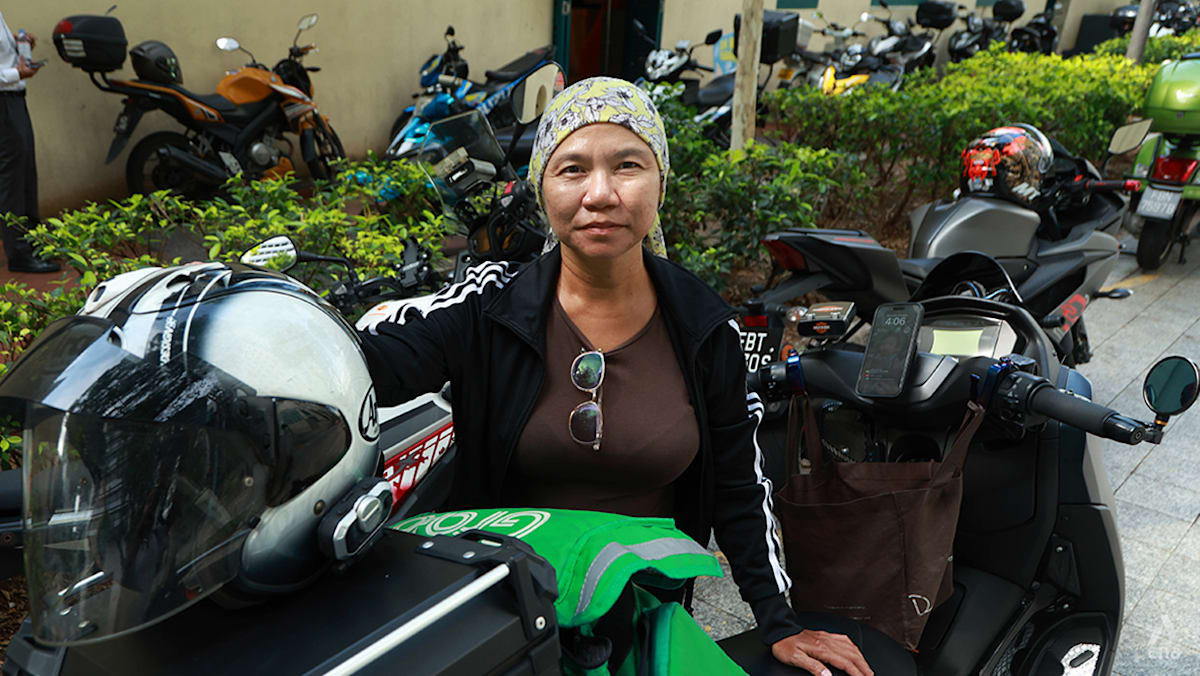
Ms Suhada Abdullah is among the food delivery riders who face a difficult choice between protecting their health and earning a living as air quality deteriorates. (Photo: CNA/Raj Nadarajan)
This audio is generated by an AI tool.
SINGAPORE: Despite battling a persistent cough, food delivery rider Suhada Abdullah continues to spend 10 to 14 hours a day making deliveries on her motorcycle amid the haze.
The single mother of five, who delivers for GrabFood, relies on her earnings to support her family and pay for essential expenses, including housing, groceries and motorcycle-related costs.
"We still have to work no matter what," the 52-year-old said.
Like Ms Suhada, some food delivery riders face a difficult choice between protecting their health and earning a living as air quality deteriorates.
Despite government calls for precautions against haze-related health risks and support measures introduced by delivery platforms, taking time off can mean losing much-needed income for riders who depend on daily deliveries.
GrabFood rider Shawn Lim experienced this trade-off first-hand, when a cold forced him to take a day off during the haze.
He told CNA on Tuesday (Oct 20) that despite improved air quality and clearer skies in recent days, working conditions have changed little.
"It’s cleared up, which means I’m coughing less, but the air quality is still unhealthy," said the 35-year-old, who has been wearing a snood, a tube-shaped scarf, to protect himself from the haze.
RIDERS WORRY ABOUT MISSING INCENTIVE TARGETS
At a press conference last Friday, Acting Minister for Manpower Jasmin Lau said platform workers should not be penalised for delivery delays during the haze.
This includes penalties imposed through incentive schemes, reduced job allocations or pay deductions, she said, adding that platform operators have been reminded of their duty to protect workers from haze-related health risks.
Some riders CNA spoke to said they have not been penalised for slower deliveries during the haze, but are worried about how the conditions could affect their earnings.
For Ms Suhada, longer trips and inconveniently sequenced orders have made it harder to meet incentive targets, even though she has not been penalised for delivery delays.
Rather than push herself when unwell, she said she would try to meet her targets another day. "If I cannot hit (the target), then I have no choice. Tomorrow, try to do it again," she said.
Another Grab delivery rider Evan Gan said the haze could slow him down while making deliveries by bicycle, affecting his earnings under the incentive-based system.
"Maybe you would earn a bit less," said the 30-year-old.
GrabFood rider Siti Muhaini is concerned she might have to work longer hours to make up for lost earnings.
"I'm definitely worried about missing my targets as our earnings are dependent on them," said the mother of seven.
Ms Siti said she often feels breathless while making deliveries on her bicycle, even when wearing an N95 mask. Reduced visibility at night could also slow her deliveries, she added.
In response to CNA’s queries, delivery platforms such as Grab and Foodpanda said rider health and safety remain a priority.
"We do not penalise them for choosing to log off during the haze, nor do we penalise them for the time taken to complete an order," said a Grab spokesperson.
"Safety on the road always supersedes speed. We want to ensure riders never feel pressured to work or rush, especially when visibility and environmental conditions are less than ideal."
Meanwhile, Foodpanda said its “delivery partner availability remains stable”, despite an increase in orders as more customers choose to have their meals and groceries delivered to minimise time spent outdoors.
The platform has also introduced a special haze support incentive to provide riders with additional earnings during this period.
“Delivery partners can also manage their schedules flexibly by adjusting their working hours or taking breaks at any time,” said a spokesperson.
“Features such as 'excused breaks' enable them to take short, regular breaks between orders during a session while continuing to enjoy applicable incentives.”
CNA Games Guess Word Crack the word, one row at a time Buzzword Create words using the given letters Mini Sudoku Tiny puzzle, mighty brain teaser Mini Crossword Small grid, big challenge Word Search Spot as many words as you can Show More Show Less
A delivery rider wearing a mask makes a turn along Toa Payoh Lorong 8, Oct 16, 2026. (Photo: CNA/Wallace Woon)
PLATFORMS ROLL OUT HAZE SUPPORT MEASURES
Besides allowing workers to adjust their schedules, platform operators have introduced other measures to protect them, including issuing air quality alerts and advisories urging those who feel unwell to seek medical attention. They have also partnered with the National Delivery Champions Association (NDCA) to distribute N95 masks to workers.
Other logistics companies have rolled out similar initiatives to protect their workers.
Beyond providing masks, J&T Express said personnel are encouraged to limit prolonged outdoor activities when air quality is poor and take breaks indoors as needed.
Those who are unwell can also inform their supervisors, who can arrange for rest and appropriate support.
Lalamove said its driver partners “have full control over whether, when, and how long they work, and can choose which orders to accept”.
"We do not assign orders to driver partners or require them to commit to fixed shifts or working hours. During the haze, we’ve encouraged them to use that flexibility to take breaks, rest when they need to and reduce their time on the road," said the Lalamove spokesperson.
The company also provides weekly haze advisories and updates, reminding its workers to check haze conditions before heading out, stay hydrated and rest indoors where possible.
CNA has reached out to the NDCA for comment on the impact of the haze on workers' health, work flexibility and support measures.
A delivery rider wearing a mask riding through Jurong West Street 61 on Oct 18, 2026. (Photo: CNA/Syamil Sapari)
HEALTH CONCERNS PERSIST DESPITE PRECAUTIONS
While N95 masks have been made available to delivery riders, some said wearing them for long periods can be uncomfortable, particularly when travelling on two wheels.
One platform worker, who wanted to be known only as Ms Nora, said wearing an N95 mask while making deliveries is not ideal.
"It's practical, but of course, not actually what we'd prefer to do because of the heat,” said the 32-year-old, who is concerned about the potential long-term health effects of repeated exposure to the haze.
"It may not affect us significantly right now, but we don't know how this level of exposure will affect our health in the long run.”
For other workers, the more immediate concern is having to continue working despite feeling unwell.
An 18-year-old student, who gave his name only as Suhairie, said he will continue making deliveries despite feeling slightly unwell amid the haze because he needs the income.
"For me, I will just continue working because I have got bills to pay," he said.
Get our pick of top stories and thought-provoking articles in your inbox
Stay updated with notifications for breaking news and our best stories
Join our channel for the top reads for the day on your preferred chat app
外卖骑手表示,雾霾期间的延误并未受到处罚,但一些人担心送货速度减慢可能会影响他们的收入。
随着空气质量恶化,苏哈达·阿卜杜拉女士和其他外卖骑手一样,面临着在保护自身健康和维持生计之间艰难抉择的困境。(图片:CNA/Raj Nadarajan)
这段音频是由人工智能工具生成的。
新加坡:尽管咳嗽不止,外卖员苏哈达·阿卜杜拉仍然每天骑着摩托车在雾霾中送餐 10 到 14 个小时。
这位独自抚养五个孩子的单身母亲在 GrabFood 送餐,依靠自己的收入养家糊口,并支付包括住房、食品杂货和摩托车相关费用在内的基本开支。
“无论如何,我们还是得工作,”这位52岁的男子说道。
和苏哈达女士一样,随着空气质量恶化,一些外卖骑手面临着在保护自身健康和谋生之间做出艰难的选择。
尽管政府呼吁采取预防措施应对雾霾相关的健康风险,并且外卖平台也推出了支持措施,但对于依赖每日送货的骑手来说,休息一段时间可能意味着失去急需的收入。
GrabFood 送餐员 Shawn Lim 就亲身经历了这种权衡,当时他因为感冒不得不在雾霾期间休息一天。
他周二(10月20日)告诉亚洲新闻台,尽管最近几天空气质量有所改善,天空也更加晴朗,但工作条件几乎没有变化。
“情况有所好转,这意味着我的咳嗽减少了,但空气质量仍然不健康,”这位35岁的男子说道。他一直戴着围脖(一种管状围巾)来保护自己免受雾霾的侵害。
骑手们担心无法完成奖励目标
上周五,人力部代理部长刘嘉敏在新闻发布会上表示,不应因雾霾期间送货延误而惩罚平台工人。
她表示,这包括通过激励计划、减少工作分配或扣减工资等方式施加的惩罚,并补充说,已提醒平台运营商有责任保护工人免受雾霾相关的健康风险。
CNA采访的一些骑手表示,他们在雾霾期间送货速度变慢并没有受到处罚,但他们担心这种情况可能会影响他们的收入。
对于苏哈达女士来说,更长的行程和不方便的订单顺序使她更难达到激励目标,尽管她没有因为交货延迟而受到惩罚。
她说,与其带病勉强自己,不如改天再尝试完成目标。“如果我达不到目标,那就别无选择,明天再试一次吧。”她说道。
另一位 Grab 外卖员 Evan Gan 表示,雾霾可能会减慢他骑自行车送餐的速度,从而影响他在激励制度下的收入。
“也许你的收入会少一些,”这位30岁的男子说道。
GrabFood 送餐员 Siti Muhaini 担心她可能不得不延长工作时间来弥补损失的收入。
这位七个孩子的母亲说:“我非常担心无法完成目标,因为我们的收入取决于这些目标。”
西蒂女士说,即使戴着N95口罩,骑自行车送货时她也经常感到气喘吁吁。她还补充说,夜间能见度降低也会减慢她的送货速度。
针对 CNA 的询问,Grab 和 Foodpanda 等外卖平台表示,骑手的健康和安全仍然是首要考虑因素。
Grab 发言人表示:“我们不会因为他们在雾霾期间选择下线而惩罚他们,也不会因为他们完成订单所花费的时间而惩罚他们。”
“道路安全永远高于速度。我们希望确保骑行者永远不会感到工作或赶时间的压力,尤其是在能见度和环境条件不太理想的情况下。”
与此同时,Foodpanda 表示,尽管订单量有所增加,因为越来越多的顾客选择送货上门以减少外出时间,但其“配送合作伙伴的可用性仍然保持稳定”。
该平台还推出了一项特殊的雾霾支援奖励计划,旨在为骑手们在此期间提供额外的收入。
一位发言人表示:“配送合作伙伴还可以灵活安排自己的时间,随时调整工作时间或休息。”
“诸如‘允许休息’之类的功能使他们能够在工作期间的订单间隙进行短暂的、规律的休息,同时继续享受相应的奖励。”
CNA游戏 猜词游戏 逐行破解单词 流行词游戏 用给定的字母组成单词 迷你数独 小小谜题,挑战你的大脑 迷你填字游戏 小方格,大挑战 单词搜索 尽可能多地找出单词 显示更多 显示更少
2026年10月16日,一名戴着口罩的外卖骑手在Toa Payoh Lorong 8转弯。(图片:CNA/Wallace Woon)
各平台推出防霾措施
除了允许配送员调整工作时间外,平台运营商还采取了其他措施保护他们,包括发布空气质量警报和建议,敦促感到不适的人及时就医。他们还与全国配送冠军协会(NDCA)合作,向配送员分发N95口罩。
其他物流公司也推出了类似的举措来保护员工。
除了提供口罩外,J&T Express 还表示,鼓励员工在空气质量较差时减少长时间的户外活动,并根据需要到室内休息。
身体不适者也可告知主管,主管可安排休息和适当的支持。
Lalamove 表示,其司机合作伙伴“完全可以自主决定是否工作、何时工作、工作时长,并可以选择接受哪些订单”。
Lalamove发言人表示:“我们不会给司机伙伴分配订单,也不会要求他们承诺固定的轮班或工作时间。在雾霾期间,我们鼓励他们利用这种灵活性,在需要时休息,减少在路上的时间。”
该公司还会每周发布雾霾预警和最新消息,提醒员工在外出前查看雾霾情况,保持水分充足,并尽可能在室内休息。
CNA已联系NDCA,就雾霾对工人健康、工作灵活性和支持措施的影响征求意见。
2026年10月18日,一名戴着口罩的外卖骑手骑车经过裕廊西61街。(图片:CNA/Syamil Sapari)
尽管采取了预防措施,健康问题依然存在
虽然已经向送货骑手提供了 N95 口罩,但一些人表示长时间佩戴会感到不舒服,尤其是在骑两轮车的时候。
一位名叫诺拉的平台工作人员表示,在送货时佩戴 N95 口罩并不理想。
“这很实际,但当然,由于天气炎热,这并不是我们真正想做的,”这位 32 岁的男子说道,他担心反复暴露在雾霾中可能会对健康造成长期影响。
“虽然现在可能不会对我们造成太大影响,但我们不知道这种程度的接触从长远来看会对我们的健康产生怎样的影响。”
对于其他工人来说,更紧迫的问题是即使身体不适也必须继续工作。
一位名叫苏海里(Suhairie)的18岁学生表示,尽管雾霾中他感觉身体有些不适,但他仍会继续送货,因为他需要这份收入。
“对我来说,我还是会继续工作,因为我得付账单,”他说。
订阅我们的邮件,即可获取精选热点新闻和引人深思的文章。
订阅通知,第一时间获取突发新闻和精彩报道。
加入我们的频道,即可在您常用的聊天应用上获取当日热门文章。