TCM physician, musician, rail engineer: Three S’poreans who made a mid-career switch into tech中医、音乐家、铁路工程师:三位新加坡人中年转行进入科技行业
Learn how these Singaporeans did a career change from TCM, music and rail engineering into AI roles at Microsoft, Temus and PwC. Read more at straitstimes.com.
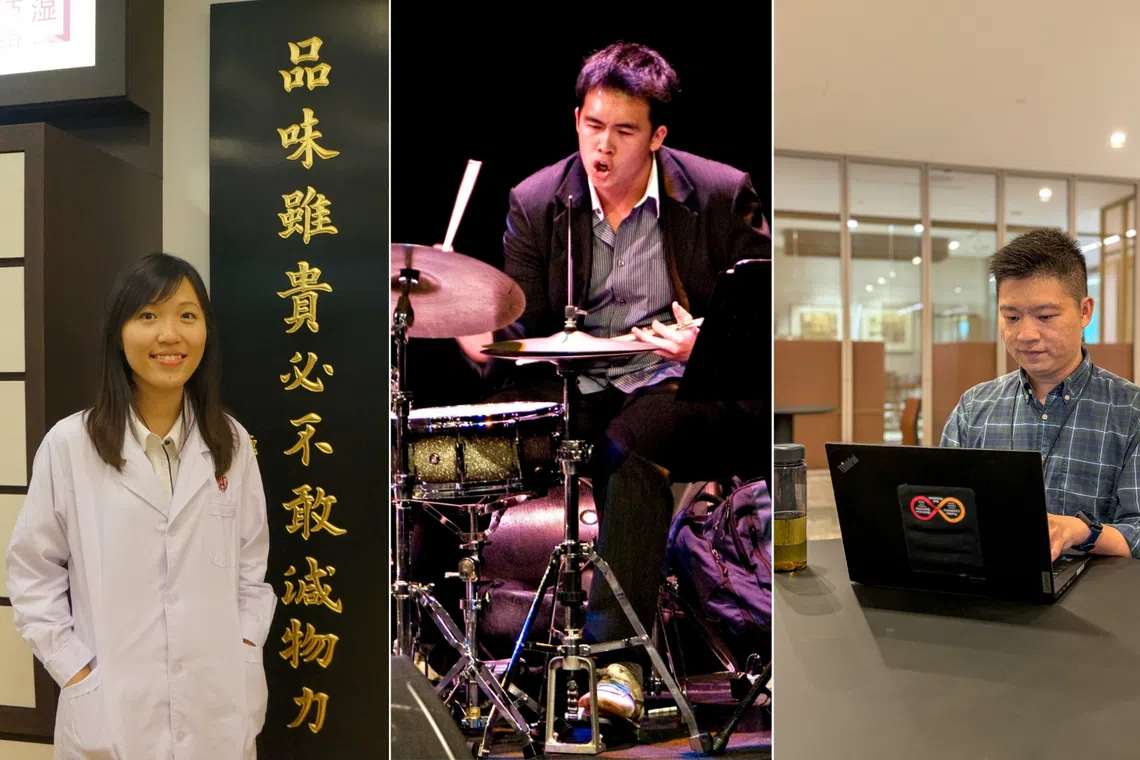
These individuals say the right programmes and people helped them make the move, and their non-tech backgrounds are proving an asset on the job
(From left) Ang Jun Jia, Soh Wen Ming and Woo Jia Jian made mid-career moves into technology from Traditional Chinese Medicine, music and rail engineering respectively.
PHOTOS: PETER CHUA (CENTRE), AND COURTESY OF ANG JUN JIA AND WOO JIA JIAN
Published Oct 21, 2026, 04:00 AM
When Soh Wen Ming’s daughter said she was bored and wanted to play a video game, he asked her to build one herself.
The former musician, now a senior software developer, turned to the AI assistant he developed, which coached the eight-year-old into building her own game from scratch.
“Now she doesn’t even want to play iPad games anymore. She just wants to make them,” says 43-year-old Soh.
Grocery shopping has become easier too. Every two weeks, an automated assistant reviews the household’s needs, fills a RedMart cart and pings his wife for final approval.
Soh says such moments are proof that his mid-career pivot into technology has yielded far more than just a new profession. It has transformed how he approaches learning and problem-solving at work – and at home.
He is among a growing number of professionals joining Singapore’s tech sector, a workforce that includes both fresh entrants and mid-career switchers.
At home, Soh turns AI into a teaching tool – nudging his daughters to build and experiment. PHOTO: COURTESY OF SOH WEN MING
At home, Soh turns AI into a teaching tool – nudging his daughters to build and experiment.
PHOTO: COURTESY OF SOH WEN MING
According to the Infocomm Media Development Authority (IMDA), the number of tech professionals grew by 3.8 per cent to 222,200 in 2025 , up from 214,000 the year before.
Tech jobs also continue to offer strong wage outcomes. In 2025, the median monthly wage for Singapore Citizens and Permanent Residents in tech roles was $8,000 – 60 per cent higher than the $5,000 median across all occupations.
As Singapore steps up efforts to drive AI adoption across enterprises and equip its workforce with the skills needed for an AI-driven economy, the Singapore Economic Development Board (EDB) is working with leading global companies and enterprises to deepen their AI capabilities here.
Beyond attracting investments, EDB works closely with companies to create good jobs and grow Singapore’s pool of AI talent. This includes supporting companies as they build teams with specialised AI expertise, and encouraging industry partnerships and training opportunities that help Singaporeans develop in-demand skills.
Two other Singaporeans took similar routes as Soh: Ang Jun Jia, a former Traditional Chinese Medicine (TCM) physician now helping Microsoft’s clients adopt the latest tech and AI tools; and Woo Jia Jian, a former rail engineer who manages generative AI projects at PwC today.
None has a computer science background. Each took a calculated leap into a new technology role.
Balancing family, stability and a move into tech
Soh had spent most of his working life in music, first as a professional session musician performing with some of the biggest artistes in South-east Asia, then managing about 20 performers at So Drama! Entertainment.
The music manager role was, he says, “as close to an iron rice bowl as possible”. But something else had been quietly pulling at him.
“It wasn’t really that I hated the job; it was just that I knew I really, really wanted to do programming,” he says.
He first became curious about programming while running a food and beverage business, where he saw vendors pitching software to manage operations. Years later at So Drama!, he taught himself Python to automate spreadsheets.
But with a mortgage and two young daughters then aged five and two, turning that early interest into a career was a decision he had to weigh carefully.
The turning point came when he spotted Temus’ four-month Step IT Up programme on LinkedIn in 2023.
Soh (centre) receiving his certificate after completing Temus’ four-month Step IT Up programme, the leap that took him from music management into software development. PHOTO: TEMUS
Soh (centre) receiving his certificate after completing Temus’ four-month Step IT Up programme, the leap that took him from music management into software development.
Supported by IMDA’s Company-Led Training programme, Step IT Up offers participants an accelerated pathway into the tech sector. It follows a Place-and-Train model, where participants are hired from the outset before undergoing structured instructor-led and on-the-job training.
Soh and his fellow trainees also received a monthly stipend during the four-month programme.
Close to 80 Singaporean career-switchers have since been placed in technology roles through the programme, with a 100 per cent placement rate.
Today, Soh is a senior software developer at Temus, leading a team that builds and maintains a student app used daily by thousands at one of Singapore’s largest universities. He also develops AI-powered internal tools to help colleagues work more efficiently.
Much of his work involves helping non-technical users communicate their exacting specifications in a syntax the engineers are familiar with.
“In the end, all businesses, even technology ones, are people businesses. And they are built on empathy,” he says. “If you understand your subject well enough to speak with confidence, and have empathy for the people you are serving, that is really powerful.”
And his test for mastering a new technical concept is simple. He says: “If I can’t explain it to my children, then I don’t really know it yet.”
Growth of Singapore tech jobs beyond the sector
Singapore’s technology workforce is growing, but the more significant shift may be where those jobs are appearing.
Of the 222,200 tech professionals in Singapore recorded in 2025, almost 60 per cent – 130,900 – worked outside the information and communications sector, compared with 91,300 within it.
It reflects a broader change in the economy. Banks, manufacturers, logistics firms, healthcare providers and professional services companies increasingly need people who can work with software, data and AI, even if technology is not their core business.
The numbers on Singapore’s digital economy tell a similar story. It generated $144.1 billion in value added in 2025, equivalent to 19.3 per cent of GDP, with more than two-thirds coming from sectors outside information and communications.
AI could widen that demand further as more companies develop AI capabilities of their own, setting up dedicated units known as AI Centres of Excellence, where staff develop and test in-house AI solutions to meet business goals. Close to 100 have been established across Singapore, spanning sectors from finance to manufacturing.
Says senior vice-president and co-head for Digital Industry Singapore under the Singapore Economic Development Board (EDB), Jinyong Low: “As technology becomes more deeply embedded across industries, companies will increasingly need people who can combine strong technical capabilities with industry knowledge.”
EDB works with companies to set up and scale key operations in Singapore, bringing new functions and jobs here as they invest and grow.
Working alongside partners such as the Infocomm Media Development Authority and Enterprise Singapore, EDB also supports workforce initiatives that help Singaporeans to build the skills to move into these roles, whether as fresh entrants or mid-career switchers.
“For workers, moving into tech doesn’t mean starting from scratch. Their previous industry experience and knowledge can be an advantage, enabling them to apply technology to solve real-world business challenges and create greater impact,” Low says.
Find out how Singapore develops a diverse talent pool.
Turning an unexpected opportunity into a tech career
Long before she designed AI training programmes, Ang was a TCM physician, attending to patients and working through symptoms to identify the root cause of an ailment.
Nearly a decade on, she finds herself applying the same clinical patience to solve clients’ business problems.
Before stepping into skilling and training, Ang (right) cut her teeth as a technical account manager, helping Microsoft clients get more out of their tech. PHOTO: COURTESY OF ANG JUN JIA
Before stepping into skilling and training, Ang (right) cut her teeth as a technical account manager, helping Microsoft clients get more out of their tech.
PHOTO: COURTESY OF ANG JUN JIA
The 39-year-old skilling lead at Microsoft Operations works with organisations in Singapore and Vietnam to design programmes that help their workforce adopt AI tools such as Copilot. As with her former patients, Ang first tries to understand the underlying problem the client wants to solve.
“Some customers will just tell me, ‘Hey, I want my whole organisation to be AI trained’,” Ang says. “I listen to understand the business challenge they’re trying to address, and then bring together the right people, programmes and resources to help them achieve their goals.”
Ang graduated from Nanyang Technological University in 2011 with a double degree in biomedical sciences and Chinese medicine.
In 2015, she left her practice to pursue a full-time masters in business administration at the National University of Singapore, hoping to combine her clinical training with business skills and move into healthcare management.
A Microsoft internship the following year instead set her on a different path. Walking into a tech multinational without a computer science background was, in her words, daunting.
“Coming from healthcare, I always felt like I was the smallest fry in the room and that I would not have a voice,” she says. Her manager and teammates felt otherwise.
“They challenged me in a very positive way and helped me understand that my perspectives are still of value. I was brought in for a different perspective,” she says. “The bigger risk was that if I didn’t try, I would never know.”
Ang (left) during a discussion with peers from India and Japan under Code; Without Barriers, Microsoft’s initiative to bring women into – or back into – tech. PHOTO: COURTESY OF ANG JUN JIA
Ang (left) during a discussion with peers from India and Japan under Code; Without Barriers, Microsoft’s initiative to bring women into – or back into – tech.
Ang later joined the founding team behind Code; Without Barriers, a Microsoft initiative that ran for about five years from 2020, offering training, mentorship and job pathways for women entering or returning to tech.
“Those conversations reminded me that there is no single path to a successful career. Some people move quickly, while others take detours, pause to care for loved ones, or choose a different route entirely,” she says.
“What mattered most was not where they started, but their willingness to take that next step forward.”
Keeping pace with a fast-changing tech career
Woo’s career detour took him from rail engineering into data science. But getting into the field was only the beginning.
At 29, the then-rail engineer became curious about data science after seeing it being used to predict equipment failures.
“It was very interesting to see how the domain of AI and data science could benefit a totally different industry like the rail industry,” he recalls.
In 2018, he resigned from his job and signed up for a data science course. Two short internships followed before he joined the Inland Revenue Authority of Singapore (IRAS) as a data analyst in 2019.
It still took time to feel he belonged in the field after the career change. A turning point came while conducting generative AI workshops for other non-technical colleagues at IRAS. Concepts that were new and useful to them had become second nature to him, and the experience made him realise how much he had learnt.
“That’s where I had this inkling that maybe, you know, I could really do this,” he says.
By late 2023, Woo wanted to deepen his skills as generative AI gathered pace. He stepped away from work to enrol in a one-year Master of IT in Business.
From predicting rail equipment failures to running generative AI workshops, Woo now trains others at PwC in the tools he once learnt from scratch. PHOTO: COURTESY OF WOO JIA JIAN
After preparing financially for the year of study, Woo saw the decision as an investment in his future.
Today, the 37-year-old is a manager at PwC’s AI Hub, where he builds generative AI solutions for clients. Launched in Singapore in 2025 with support from EDB, the AI Hub focuses on developing homegrown AI capabilities and solutions for clients across sectors.
Even now, he says, imposter syndrome can surface from time to time, but experience has taught him not to let it define what he is capable of.
“In this day and age, there’s really nothing that we cannot learn, at least in terms of technical knowledge, as long as you are willing to put in the hours,” he adds.
Learn how EDB is attracting investments in growth industries that create good opportunities for the local workforce.
这些人表示,合适的项目和人脉帮助他们实现了转型,而且他们非技术背景在工作中也成为了优势。
(从左至右)Ang Jun Jia、Soh Wen Ming 和 Woo Jia Jian 分别从传统中医、音乐和铁路工程领域转行到科技领域。
照片:蔡彼得(中),由Ang Jun Jia和Woo Jia Jian提供
发布于 2026 年 10 月 21 日 上午 4:00
苏文明的女儿说她感到无聊,想玩电子游戏,于是他让她自己做一个。
这位前音乐家,现在是一名高级软件开发人员,他求助于自己开发的AI助手,该助手指导这位八岁女孩从零开始构建自己的游戏。
“现在她连玩 iPad 游戏都不想玩了,她只想自己制作游戏,”43 岁的 Soh 说。
买菜也变得更轻松了。每两周,一个自动化助手会查看家里的需求,把商品装满RedMart的购物车,然后通知他的妻子最终确认。
Soh表示,这些时刻证明,他职业生涯中期转型进入科技领域,带给他的远不止一份新工作。它彻底改变了他在工作和生活中学习和解决问题的方式。
他是越来越多加入新加坡科技行业的专业人士之一,该行业既包括应届毕业生,也包括中年转行者。
在家中,苏文明将人工智能转化为教学工具,鼓励女儿们动手实践和进行实验。图片:苏文明提供
在家中,Soh 将人工智能变成了一种教学工具——鼓励他的女儿们去搭建和实验。
照片:由苏文明提供
根据新加坡资讯通信媒体发展局(IMDA)的数据,到2025年,科技专业人员数量将增长3.8%,达到222,200人,高于前一年的214,000人。
科技类工作也持续提供丰厚的薪资待遇。预计到2025年,新加坡公民和永久居民从事科技工作的月薪中位数将达到8000新元,比所有职业的月薪中位数5000新元高出60%。
随着新加坡加大力度推动企业采用人工智能技术,并为劳动力提供人工智能驱动型经济所需的技能,新加坡经济发展局 (EDB) 正与全球领先的公司和企业合作,以深化其在新加坡的人工智能能力。
除了吸引投资,新加坡经济发展局还与企业紧密合作,创造优质就业机会,并壮大新加坡的人工智能人才队伍。这包括支持企业组建具备专业人工智能技能的团队,鼓励行业合作和培训机会,帮助新加坡人掌握市场所需的技能。
另外两位新加坡人也走了和 Soh 类似的道路:Ang Jun Jia,一位前中医,现在帮助微软的客户采用最新的技术和人工智能工具;以及 Woo Jia Jian,一位前铁路工程师,如今在普华永道管理生成式人工智能项目。
他们都没有计算机科学背景。每个人都经过深思熟虑,毅然投身于全新的技术领域。
平衡家庭、稳定和投身科技行业
Soh 的大部分职业生涯都奉献给了音乐,他先是作为专业的伴奏乐手与东南亚一些最大的艺术家合作演出,然后管理着 So Drama! Entertainment 的大约 20 名表演者。
他说,音乐经纪人这份工作“简直就是个金饭碗”。但除此之外,还有别的事情在悄悄地牵动着他。
“其实我并不是讨厌那份工作;只是我知道我真的、真的想从事编程工作,”他说。
他最初对编程产生兴趣是在经营一家餐饮企业时,当时他看到供应商推销用于管理运营的软件。几年后,在 So Drama! 公司,他自学了 Python 语言,实现了电子表格的自动化。
但当时他背负着房贷,还有两个年幼的女儿,一个五岁,一个两岁,所以将早年的兴趣发展成事业,对他来说是一个需要仔细权衡的决定。
转折点出现在 2023 年,当时他在 LinkedIn 上看到了 Temus 的为期四个月的 Step IT Up 计划。
Soh(图中)在完成Temus为期四个月的Step IT Up课程后领取证书,该课程帮助他从音乐管理领域转型到软件开发领域。照片:TEMUS
Soh(中)在完成 Temus 为期四个月的 Step IT Up 课程后领取了证书,该课程使他从音乐管理领域跃升至软件开发领域。
在新加坡资讯通信媒体发展局(IMDA)的企业主导培训计划的支持下,“Step IT Up”项目为参与者提供了一条快速进入科技行业的途径。该项目采用“先就业后培训”模式,参与者在项目开始前即被录用,之后接受结构化的讲师指导和在职培训。
在为期四个月的培训计划期间,Soh 和他的其他学员每月还会收到津贴。
该计划已帮助近 80 名新加坡职业转型者找到了技术岗位,就业率达 100%。
如今,Soh是Temus公司的高级软件开发人员,领导着一个团队,负责构建和维护一款学生应用程序,该程序每天被新加坡一所规模最大的大学中的数千名学生使用。他还开发人工智能驱动的内部工具,以帮助同事提高工作效率。
他的大部分工作是帮助非技术用户用工程师熟悉的语法来表达他们严格的规范。
“归根结底,所有企业,即使是科技企业,都是以人为本的企业。它们都建立在同理心之上,”他说道。“如果你对自己的业务足够了解,能够自信地表达,并且对你服务的对象感同身受,那将非常强大。”
他检验自己是否掌握一项新技术概念的标准很简单。他说:“如果我不能给我的孩子们解释清楚,那就说明我还没有真正掌握它。”
新加坡科技行业以外的就业增长
新加坡的科技从业人员正在增长,但更重要的变化可能是这些工作岗位的出现地点。
据统计,到 2025 年,新加坡将有 222,200 名科技专业人士,其中近 60%(130,900 人)在信息和通信行业之外工作,而从事该行业工作的只有 91,300 人。
这反映了经济领域更广泛的变革。银行、制造商、物流公司、医疗保健机构和专业服务公司越来越需要能够运用软件、数据和人工智能的人才,即使技术并非其核心业务。
新加坡数字经济的数据也印证了这一点。到2025年,新加坡数字经济的增加值将达到1441亿美元,相当于国内生产总值的19.3%,其中超过三分之二来自信息和通信以外的行业。
随着越来越多的公司发展自身的人工智能能力,并设立专门的人工智能卓越中心,人工智能可能会进一步扩大对人工智能的需求。这些中心的员工负责开发和测试内部人工智能解决方案,以满足业务目标。新加坡已建立了近百个此类中心,涵盖从金融到制造业等各个行业。
新加坡经济发展局 (EDB) 新加坡数字产业高级副总裁兼联席主管刘金勇表示:“随着技术在各行各业的深入应用,企业将越来越需要能够将强大的技术能力与行业知识相结合的人才。”
新加坡经济发展局与各公司合作,在新加坡设立和扩大关键业务,随着这些公司投资和发展,为新加坡带来新的职能和就业机会。
新加坡经济发展局与新加坡资讯通信媒体发展局和新加坡企业发展局等合作伙伴携手,支持各项劳动力计划,帮助新加坡人培养技能,从而胜任这些职位,无论是应届毕业生还是职业中期转型者。
“对于员工来说,转行进入科技行业并不意味着要从零开始。他们之前的行业经验和知识可以成为优势,使他们能够运用技术来解决现实世界的商业挑战,并创造更大的影响力,”Low说道。
了解新加坡如何培养多元化人才库。
将意想不到的机会转化为科技职业生涯
在设计人工智能培训程序之前,Ang 曾是一名中医医生,她为病人诊治,通过分析症状来找出疾病的根本原因。
近十年过去了,她发现自己仍然运用着同样的耐心来解决客户的业务问题。
在投身技能培训领域之前,Ang(右)曾担任技术客户经理,帮助微软客户更好地利用其技术,积累了丰富的经验。照片:Ang Jun Jia 提供
在进入技能培训领域之前,Ang(右)曾担任技术客户经理,帮助微软客户更好地利用他们的技术,从而积累了丰富的经验。
照片:由 ANG JIA 提供
这位39岁的微软运营部门技能培训主管与新加坡和越南的机构合作,设计项目帮助他们的员工采用诸如Copilot之类的AI工具。就像她对待以前的病人一样,Ang首先会尝试理解客户想要解决的根本问题。
“有些客户会直接告诉我,‘嘿,我希望我的整个组织都能接受人工智能训练’,”Ang说道。“我会认真倾听,了解他们想要解决的业务挑战,然后整合合适的人员、项目和资源,帮助他们实现目标。”
Ang 于 2011 年毕业于南洋理工大学,获得生物医学科学和中医双学位。
2015 年,她离开诊所,前往新加坡国立大学攻读全日制工商管理硕士学位,希望将临床培训与商业技能相结合,进入医疗保健管理领域。
第二年在微软的实习经历却让她走上了另一条道路。用她自己的话说,没有计算机科学背景就进入一家科技跨国公司,这让她感到畏惧。
“我之前在医疗行业工作,总觉得自己是团队里最不起眼的一员,没有发言权,”她说。但她的经理和同事却不这么认为。
“他们以一种非常积极的方式挑战了我,并帮助我理解我的观点仍然有价值。他们请我来提供不同的视角,”她说。“更大的风险在于,如果我不去尝试,我就永远不会知道结果。”
Ang(左)正在与来自印度和日本的同行们就“代码无障碍”(Code; Without Barriers)项目进行讨论,该项目是微软旨在帮助女性进入或重返科技行业的倡议。照片由Ang Jun Jia提供。
Ang(左)在与来自印度和日本的同行进行讨论时,参与了“Code; Without Barriers”项目,这是微软为吸引女性进入或重返科技领域而发起的一项倡议。
后来,Ang 加入了 Code; Without Barriers 的创始团队,这是一个微软发起的计划,从 2020 年开始运行了大约五年,为进入或重返科技行业的女性提供培训、指导和就业途径。
“那些谈话让我意识到,通往成功职业生涯的道路不止一条。有些人进展迅速,而有些人则会绕道而行,有些人会停下来照顾亲人,还有些人则会选择完全不同的道路,”她说。
“最重要的不是他们从哪里起步,而是他们是否愿意迈出下一步。”
跟上快速变化的科技职业发展步伐
伍的职业生涯经历了一番波折,从铁路工程转行到了数据科学领域。但进入这个领域仅仅是个开始。
29 岁时,这位当时的铁路工程师在看到数据科学被用于预测设备故障后,对数据科学产生了兴趣。
他回忆说:“看到人工智能和数据科学领域如何能够使铁路行业这样完全不同的行业受益,这非常有趣。”
2018年,他辞去了工作,报名参加了数据科学课程。之后他做了两份短期实习,并于2019年加入新加坡税务局(IRAS)担任数据分析师。
转行之后,他仍然需要一段时间才能真正融入这个领域。转折点出现在他为新加坡国立高等研究院(IRAS)其他非技术背景的同事举办生成式人工智能研讨会期间。对他们来说新颖而有用的概念,对他来说却已驾轻就熟,这段经历让他意识到自己学到了多少东西。
“那时我隐约觉得,也许我真的能做到这件事,”他说。
到2023年底,随着生成式人工智能的快速发展,Woo希望进一步提升自己的技能。他暂时离开工作岗位,攻读为期一年的商业信息技术硕士学位。
从预测铁路设备故障到举办生成式人工智能研讨会,伍家健现在在普华永道培训其他人使用他曾经从零开始学习的工具。图片:伍家健提供
在为一年的学习做好经济准备后,Woo 将此决定视为对未来的投资。
现年37岁的他目前是普华永道人工智能中心的一名经理,负责为客户构建生成式人工智能解决方案。该人工智能中心于2025年在新加坡成立,并得到了新加坡经济发展局的支持,致力于为各行各业的客户开发本土人工智能能力和解决方案。
他说,即使现在,冒名顶替综合症也会不时出现,但经验告诉他不要让它定义自己的能力。
“在这个时代,只要你愿意投入时间,就没有什么我们学不到的东西,至少在技术知识方面是这样,”他补充道。
了解经济发展局如何吸引投资进入增长型产业,从而为当地劳动力创造良好的就业机会。