Builders in S’pore take steps to protect workers from haze as some projects face delays新加坡建筑商采取措施保护工人免受雾霾影响,部分项目面临延期。
Singapore builders reduce workers’ haze exposure as projects face delays and firms prepare claims for time extensions. Read more at straitstimes.com.
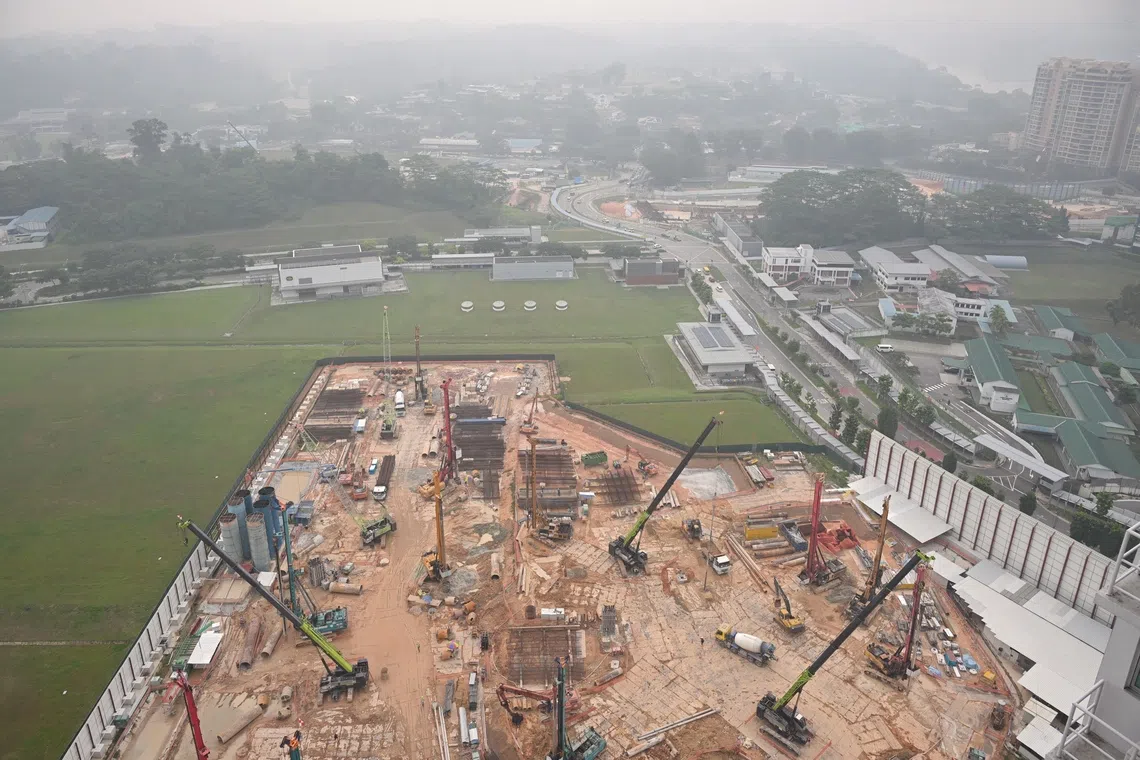
Work on a number of construction projects has slowed since early September, when Singapore’s air quality first entered the PSI’s “unhealthy” range.
ST PHOTO: KUA CHEE SIONG
Published Oct 21, 2026, 01:00 PM
Updated Oct 21, 2026, 01:00 PM
Singapore builders are slowing outdoor work and using safety measures as haze cuts productivity. PSI may reach hazardous levels above “300”.
Some builders are starting haze delay notices under BCA’s 2023 guidance. Claims need PSI above 200 and proof that safety steps slowed work.
SCAL wants clearer guidance for weather delays, including haze and heat. Contractors warn of losses if the haze lasts, while BCA says it is monitoring the sector.
SINGAPORE - Builders are taking steps to reduce workers’ exposure to unhealthy levels of haze, even as they prepare to make claims for haze-related work delays.
Work on a number of construction projects has slowed since early September, when Singapore’s air quality first entered the Pollutant Standards Index’s (PSI) “unhealthy” range of 101 to 200, said construction lawyer Kelvin Aw.
Some builders have cut outdoor work hours, avoided crane deployment when visibility was poor, allowed more rest breaks and shifted workers to doing more indoor work to catch up with the project timetable, he added.
To help workers cope, Kajima Overseas Asia has conducted worker awareness briefings, increased the number of water coolers, installed misting fans and additional sheltered rest areas and also increased rest periods during severe haze conditions.
In addition, the contractor also identified susceptible workers with early symptoms of haze-related illness and conducted site audits to ensure subcontractors complied with all its mitigation measures.
Two ongoing public sector projects have suffered slower work progress as a result, it said.
Hi-Tek Construction corporate safety manager Raymond Lee added that it has reduced outdoor work when the 24-hour PSI is between 101 and 200.
He said supervisors also ensure that workers are hydrated and take rest breaks in sheltered areas, and check on their workers three times a day to monitor their health.
Singapore has endured almost six weeks of hazy conditions this year so far . On several days in October, the PSI entered the “very unhealthy” range of 201 to 300.
In 2023, the Building and Construction Authority (BCA) issued guidelines on how construction firms involved in public sector projects can get time extensions due to haze-related delays.
Several firms have begun giving notice in recent weeks to register these delays - the first step towards making such claims, noted Aw, who is advising clients on several construction projects, including two that are filing such notices .
BCA’s guidelines have been incorporated in a number of public sector construction contracts.
But Aw said that success rates of applications for additional time in previous years have been modest, as some builders cannot prove the delays.
BCA guidelines state that firms can seek approval for a 0.5 working day extension if the PSI is more than 200 for at least 3 hours, but less than 5 hours. Builders must also prove that haze mitigation measures affected productivity.
If the PSI is more than 200 for at least five hours, and productivity-related work delays are proven, then the recommended extension of time is one working day.
Kajima has not yet applied for a time extension for its two projects despite productivity having taken a hit, as it has not met the contract conditions under which it can do so.
“The contract for one project requires a national directive by the authorities to stop all work. For the other project, the prevailing air quality must be classified as hazardous, or PSI of more than 300 and all outdoor activities must have ceased,” said Mr Haja Kamaludeen, Kajima’s general manager (contracts).
He called on the authorities to standardise the conditions under which time extensions are claimable, and for the BCA’s guidance to be applied to all contracts.
With climate change contributing to increasingly unpredictable weather patterns, Singapore Contractors Association Limited (SCAL) said it hopes to work with government agencies to develop clearer guidance on the assessment of weather-related delays in construction projects, including the impact of severe haze and extreme heat.
SCAL president Lee Kay Chai pointed out that an extension of time does not automatically confer a right to recover additional overheads or other costs.
As such, he hopes to clarify and address wider issues faced by the industry, including the practical assessment of weather-related productivity impacts and the treatment of associated costs across different contractual arrangements.
In addition to the BCA guidance, clearer and more consistent assessment criteria would help contractors and superintending officers, which decide whether claims are awarded, to better evaluate such situations, Lee said.
This would also reduce the time and resources spent on substantiating and assessing individual claims, while ensuring that project delays are assessed fairly and consistently, he added.
Aw suggested that the 2023 BCA guidelines specify how much additional time to give but does not deal with the question of the additional costs of haze safety measures.
“A similar formula-based guidance for both time and costs would be useful,” he said.
Aw also pointed out that the current guidance applies only to public sector projects based on the government’s standard contract form, while private sector projects are not covered.
“Although the BCA has good reason not to do so, extending the guidance to private sector projects could provide parties with certainty, reduce disputes and allow builders the ability to price the risk upfront, given that the BCA guidance is already in place,” he said.
“For instance, the contract could simply state that parties agree to refer to the latest BCA guidance for assessment,” Aw added.
BCA said in response to ST’s query on its guidelines that it is “closely monitoring the impact of haze on the construction sector.”
Its spokesman said the agency it is aware of feedback on the claims process for time extensions, and “will continue to engage the industry, including SCAL, to ensure our guidelines remain relevant and responsive to evolving project site conditions.”
Additional reporting by Ang Qing
BCA/Building and Construction Authority
自 9 月初新加坡空气质量首次进入 PSI 的“不健康”范围以来,许多建筑项目的施工进度已经放缓。
《海峡时报》摄影:郭志雄
发布于2026年10月21日下午1点
更新于2026年10月21日下午1点
由于雾霾影响生产力,新加坡建筑商正在放慢户外施工速度并采取安全措施。PSI值可能超过300,达到危险水平。
根据新加坡建设局 (BCA) 2023 年的指导意见,一些建筑商开始提交因雾霾导致工期延误的通知。索赔需要证明空气压力超过 200 PSI,并且安全措施确实延缓了工期。
SCAL希望政府能就天气原因造成的延误(包括雾霾和高温)提供更明确的指导。承包商警告称,如果雾霾持续,将会造成损失,而BCA表示正在密切关注该行业的情况。
新加坡——建筑商们正在采取措施减少工人接触有害浓度的雾霾,同时准备就雾霾造成的工期延误提出索赔。
建筑律师 Kelvin Aw 表示,自 9 月初新加坡空气质量首次进入污染物标准指数 (PSI) 101 至 200 的“不健康”范围以来,许多建筑项目的进展已经放缓。
他还补充说,一些建筑商减少了户外工作时间,在能见度差的情况下避免使用起重机,增加了休息时间,并将工人转移到室内进行更多工作,以赶上项目进度。
为了帮助工人应对,鹿岛海外亚洲公司开展了工人意识简报会,增加了饮水机的数量,安装了喷雾风扇和额外的遮蔽休息区,并在严重雾霾天气下增加了休息时间。
此外,承包商还确定了出现与雾霾相关的疾病早期症状的易感工人,并进行了现场审核,以确保分包商遵守其所有缓解措施。
报告称,因此,两个正在进行的公共部门项目进展速度放缓。
Hi-Tek Construction 公司安全经理 Raymond Lee 补充说,当 24 小时 PSI 值在 101 到 200 之间时,公司会减少户外作业。
他说,主管还会确保工人们补充水分,并在有遮蔽的区域休息,并且每天三次检查工人的健康状况。
今年以来,新加坡已经经历了近六周的雾霾天气。10月份有好几天,空气污染指数(PSI)都达到了201到300的“非常不健康”级别。
2023年,建设局(BCA)发布了指导方针,说明参与公共部门项目的建筑公司如何因雾霾造成的延误而获得工期延长。
最近几周,一些公司开始发出通知,登记这些延误——这是提出此类索赔的第一步。Aw 指出,他正在为多个建筑项目提供咨询,其中包括两个正在提交此类通知的项目。
BCA的指导方针已被纳入多个公共部门建设合同中。
但 Aw 表示,往年申请延期的成功率并不高,因为有些建筑商无法证明延误的原因。
新加坡建设局(BCA)指南规定,如果空气污染指数(PSI)超过200且持续时间至少3小时但不足5小时,企业可以申请延长0.5个工作日。此外,建筑商还必须证明雾霾缓解措施影响了生产效率。
如果 PSI 超过 200 且持续至少 5 小时,并且证实存在与生产力相关的工期延误,则建议延长工期 1 个工作日。
尽管生产力受到了影响,但鹿岛建设尚未为其两个项目申请延期,因为它还没有满足合同中允许其申请延期的条件。
“其中一个项目的合同要求政府部门下达国家指令,停止所有工作。而另一个项目的合同则要求当时的空气质量被评为有害,即PSI值超过300,并且所有户外活动都必须停止,”鹿岛建设公司(Kajima)合同总经理哈贾·卡马鲁丁先生(Haja Kamaludeen)说道。
他呼吁有关部门规范申请延期的条件,并将建筑控制局的指导意见应用于所有合同。
由于气候变化导致天气模式越来越难以预测,新加坡建筑商协会有限公司(SCAL)表示,希望与政府机构合作,制定更清晰的指导方针,以评估建筑项目中与天气相关的延误,包括严重雾霾和极端高温的影响。
SCAL总裁李凯才指出,延期并不意味着自动赋予收回额外管理费用或其他成本的权利。
因此,他希望澄清和解决该行业面临的更广泛的问题,包括对天气相关生产力影响的实际评估以及在不同合同安排中相关成本的处理。
李表示,除了 BCA 的指导外,更清晰、更一致的评估标准将有助于承包商和监理人员更好地评估此类情况,因为他们决定是否批准索赔。
他还补充说,这将减少用于证实和评估个别索赔的时间和资源,同时确保对项目延误进行公平一致的评估。
Aw 建议 2023 年 BCA 指南应明确规定给予多少额外时间,但并未涉及雾霾安全措施的额外成本问题。
他说:“如果能有类似的基于公式的时间和成本指导,那就太好了。”
Aw 还指出,目前的指导意见仅适用于根据政府标准合同格式制定的公共部门项目,而私营部门项目则不在涵盖范围内。
“尽管建设局有充分的理由不这样做,但考虑到建设局的指导方针已经到位,将指导方针扩展到私营部门项目可以为各方提供确定性,减少纠纷,并让建筑商能够提前对风险进行定价,”他说。
“例如,合同可以简单地规定双方同意参考最新的建筑规范指南进行评估,”Aw补充道。
新加坡建设局 (BCA) 在回应《海峡时报》关于其指导方针的询问时表示,它“正在密切关注雾霾对建筑业的影响”。
该机构发言人表示,他们已经注意到有关工期延长索赔流程的反馈,“并将继续与包括SCAL在内的业界人士进行沟通,以确保我们的指导方针与不断变化的项目现场条件保持相关性和响应性。”
昂青补充报道
建设局/建筑管理局