Far from fringe: How Israel’s mainstream parties vote with the far right远非边缘:以色列主流政党如何与极右翼政党投票一致
Al Jazeera analysed how every party in the Knesset voted on the most consequential measures affecting Palestinians.
Al Jazeera analysed how every party in the Knesset voted on the most consequential measures affecting Palestinians.
Israelis head to the polls on October 27 in the first election since the genocide in Gaza and the wars on Lebanon and Iran, a vote widely seen as a referendum on Prime Minister Benjamin Netanyahu’s rule.
Since the start of the war on Gaza in October 2023, Israel’s parliament, known as the Knesset, has passed or advanced a wave of laws and motions affecting Palestinians, from rejecting their statehood and backing annexation of the occupied West Bank to cutting off the aid they receive.
Israel’s Jewish-led opposition casts itself as the alternative to Netanyahu’s right-wing government, but when it comes to Palestinians, the two often vote as one .
What do left and right mean in Israel?
Left and right are the most common way of mapping where parties stand on a political spectrum. The left generally favours more state spending and is more liberal on immigration and minority rights. The right generally favours lower taxes, tighter borders and a cohesive national identity.
In Israel, the labels work differently. They are defined less by economics than by the conflict with Palestinians. Broadly, the left has been associated with territorial compromise and negotiations, and the right with opposing a Palestinian state and supporting the growth of illegal settlements.
Israel’s political spectrum as a whole has shifted right, with once-fringe positions on Palestinians now very much the mainstream view. According to Palestinian political analyst Ehab Jabareen , much of Jewish Israeli politics now works from “assumptions that would have been treated as right-wing a generation ago”.
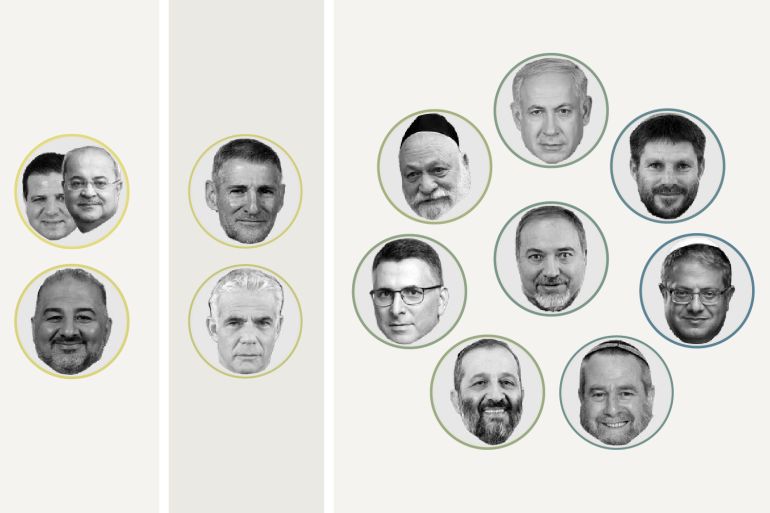
The chart below shows generally where each party sits on that spectrum today.
Israel’s parties and coalitions, explained
No party has ever won an outright majority in Israel’s Knesset.
To govern, a prime minister needs at least 61 of its 120 seats, which means building a coalition of smaller parties, often with competing demands. That gives small parties outsized leverage: if one walks out, the government can fall.
Netanyahu’s outgoing coalition
After the November 2022 election, Netanyahu’s right-wing Likud, the largest party with 32 seats, formed a 64-seat coalition. Its partners were two ultra-Orthodox parties, Shas and United Torah Judaism, and the far-right Religious Zionism alliance, a joint list of the Religious Zionism and Otzma Yehudit parties. It was Israel’s most right-wing government to date.
The far-right leaders are among the most powerful figures in government. Bezalel Smotrich, head of Religious Zionism, is finance minister and also holds authority over civilian affairs in the occupied West Bank, including settlement planning.
Israeli Finance Minister Bezalel Smotrich holds a map that shows the E1 settlement project during a news conference near the illegal Israeli settlement of Maale Adumim, in the occupied West Bank, August 14, 2025 [Ohad Zwigenberg/AP]
Itamar Ben-Gvir, head of Otzma Yehudit, is national security minister, in charge of the police. He and Smotrich have both pushed for annexation and settlement expansion, and both have used the threat of quitting to shape government policy.
Israel’s far-right National Security Minister Itamar Ben-Gvir speaks during a session as Israel’s parliament passes a law making the death penalty a default sentence for Palestinians convicted in military courts of deadly attacks, at the Knesset, Israel’s parliament in Jerusalem, March 30, 2026 [Oren Ben Hakoon/Reuters]
The coalition has shifted repeatedly since. Benny Gantz’s National Unity alliance joined after the October 7, 2023 attacks by Hamas and left in June 2024, and Gideon Sa’ar’s New Hope joined that September. Ben-Gvir’s Otzma Yehudit quit over a “ceasefire” in Gaza in January 2025 and returned two months later. In July 2025, United Torah Judaism (UTJ) walked out over a stalled bill to exempt ultra-Orthodox men from military service. Shas, another party representing ultra-Orthodox voters, withdrew its ministers at the same time, but stayed in the coalition.
When parliament dissolved in July ahead of the October 27 election, the coalition held 60 seats: Likud (32), Shas (11), Otzma Yehudit (7), Religious Zionism (6) and New Hope (4).
Opposition in Israel does not mean left. Yesh Atid, led by Yair Lapid, was the largest party in the outgoing Knesset, with 24 seats. Benny Gantz’s Blue and White was second. Both are centrist and have campaigned against a judicial overhaul proposed by Netanyahu and his coalition of religious and nationalist partners.
Yisrael Beiteinu, led by Avigdor Lieberman, is secular and right wing. Lieberman is a former Netanyahu ally who opposes draft exemptions for ultra-Orthodox men.
Labor, now part of the Democrats, is the only Jewish party in the outgoing Knesset that openly backs a two-state solution to the Israel-Palestine conflict.
The Arab-led parties, which represent Palestinian citizens of Israel, differ in ideology but share opposition to the occupation. Ra’am, led by Mansour Abbas, made history in 2021 as the first Arab party to enter an Israeli government. Hadash-Ta’al, led by Ayman Odeh and Ahmad Tibi, has never joined one. It is running in this election as part of the Joint List, alongside Balad.
How has each party voted?
Al Jazeera analysed the 10 most consequential Knesset votes affecting Palestinians between July 2024 and March 2026.
In Israel, a bill must pass three votes in the Knesset to become law. Most votes need only a simple majority of members present, and parties often stay away on purpose, either to deny a bill legitimacy or to avoid going on record. As a result, some votes in this analysis involve only a fraction of the 120-seat parliament. Some bills passed by wide margins, while others scraped through by a handful of votes.
What the data shows is that the left barely exists. The only consistent opposition came from the Arab-led parties and the four-seat Democrats, which together held 14 of the 120 seats in the last Knesset.
The results are shown in the graphic below, with a summary of the key votes beneath it.
‘No’ to Palestinian statehood
In February 2024, the Knesset backed a cabinet statement against unilateral recognition of a Palestinian state by 99 votes to 11.
The coalition, Yisrael Beiteinu and most members of Yesh Atid and National Unity – led by Gantz and comprising members of his Blue and White and Sa’ar’s New Hope party – voted in favour. Labor boycotted the vote, while only the Arab-led parties voted against.
The pattern repeated five months later. In July 2024, a resolution calling a Palestinian state an “existential danger” passed 68 to nine. National Unity, which by then had lost Sa’ar’s New Hope faction, joined the coalition and Yisrael Beiteinu in favour, Yesh Atid and Labor stayed away, and again only the Arab-led parties voted against.
Ahead of the election, the Jerusalem News Syndicate asked Israeli politicians from across the political spectrum, “Does your party support the establishment of a Palestinian state?” Every politician featured said “no”.
The Knesset’s votes reflect the public that elects it. Israelis’ view of Palestinian statehood had been declining for a decade, and it hardened sharply after October 7.
In spring 2023, 35 percent of Israelis told the Pew Research Center that Israel and a Palestinian state could coexist peacefully, down from 50 percent in 2013. By 2024, months after the attack, that had fallen to 26 percent. It reached 21 percent in 2025 and 17 percent in 2026, the first time a majority of Israelis have explicitly said coexistence is impossible.
On annexation of the occupied West Bank
In July 2025, a nonbinding declaration calling for the annexation of the occupied West Bank, including the Jordan Valley, passed 71 to 13. Yesh Atid and National Unity boycotted it. Labor joined the Arab-led parties in voting against the measure.
When annexation came to an actual bill, the lines blurred further. On October 22, 2025, during a United States vice-presidential visit, a bill that would apply Israeli law to the occupied West Bank passed in a preliminary reading by a single vote, 25 to 24:
For: Religious Zionism, Otzma Yehudit and Yisrael Beiteinu
Split: United Torah Judaism, 4 to 3
Absent: Shas and New Hope
Against: Yesh Atid, Labor and the Arab-led parties
Likud officially opposed the bill, with only lawmaker Yuli Edelstein voting for it. Had UTJ’s four votes in favour gone the other way, the bill would have failed.
The ban on UNRWA , the United Nations Relief and Works Agency for Palestine Refugees, drew the widest support of any binding law in the analysis.
Set up by the UN General Assembly in 1949 after the Nakba – or “catastrophe”, an Arabic word referring to the ethnic cleansing of Palestine in 1948 – UNRWA provides schools, healthcare, food aid and other basic services to nearly six million registered Palestinian refugees in Gaza, the occupied West Bank, including East Jerusalem, Jordan, Lebanon and Syria.
In October 2024, the first of two bills barring the agency from operating in territory Israel considers sovereign, including occupied East Jerusalem, passed 92 to 10. The second, cutting off all state contact with UNRWA, passed 87 to nine. Both laws took effect in January 2025, despite warnings from the UN and Western governments that they would cripple aid operations.
Netanyahu’s ruling coalition, Yisrael Beiteinu, Yesh Atid and National Unity all voted in favour, as did the Labor members of parliament who were present. The Arab-led parties were the only ones to vote against.
The election may change who governs Israel, but not necessarily how its parliament votes on Palestinians, especially as the electorate itself moves further right.
半岛电视台分析了以色列议会各党派在影响巴勒斯坦人的最重要措施上的投票情况。
以色列将于 10 月 27 日举行大选,这是自加沙种族灭绝以及与黎巴嫩和伊朗的战争以来的首次选举,此次投票被广泛视为对总理本雅明·内塔尼亚胡统治的全民公投。
自 2023 年 10 月加沙战争开始以来,以色列议会(又称以色列议会)通过或推进了一系列影响巴勒斯坦人的法律和动议,从拒绝承认巴勒斯坦人的建国地位、支持吞并被占领的西岸地区,到切断对巴勒斯坦人的援助。
以色列犹太人领导的反对派将自己标榜为内塔尼亚胡右翼政府的替代选择,但在巴勒斯坦问题上,两者往往投票一致。
在以色列,左派和右派分别代表什么?
左翼和右翼是划分政党政治立场最常用的方法。左翼通常支持增加国家支出,在移民和少数族裔权利方面持更开放的态度。右翼则通常支持降低税收、加强边境管制和维护国家认同的凝聚力。
在以色列,这些标签的作用有所不同。它们的划分更多地取决于与巴勒斯坦人的冲突,而非经济因素。总体而言,左翼与领土妥协和谈判联系在一起,而右翼则反对巴勒斯坦建国并支持非法定居点的扩张。
以色列的政治光谱整体上已经右倾,曾经的边缘立场如今已成为主流观点。巴勒斯坦政治分析家伊哈卜·贾巴林指出,如今以色列犹太人的许多政治主张都基于“上一代人会被视为右翼的假设”。
下图大致显示了各党派目前在该光谱上的位置。
以色列各政党和联盟的解释
以色列议会历史上从未有任何政党赢得过绝对多数席位。
总理要执政,至少需要赢得120个议席中的61个,这意味着他需要组建一个由小党组成的联合政府,而这些小党往往有着相互冲突的诉求。这使得小党拥有巨大的影响力:任何一个小党退出,政府都可能垮台。
内塔尼亚胡即将卸任的联合政府
2022年11月大选后,内塔尼亚胡领导的右翼利库德集团(拥有32个席位,是当时最大的政党)组建了一个拥有64个席位的联合政府。其盟友包括两个极端正统派政党——沙斯党和联合托拉犹太教党,以及极右翼的宗教犹太复国主义联盟(由宗教犹太复国主义党和奥兹玛·耶胡迪特党联合组成)。这是以色列迄今为止最右翼的政府。
极右翼领导人是政府中最有权势的人物之一。宗教犹太复国主义领导人贝扎莱尔·斯莫特里奇担任财政部长,同时还掌管被占领的西岸地区的民事事务,包括定居点规划。
2025年8月14日,以色列财政部长贝扎莱尔·斯莫特里奇在被占领的约旦河西岸非法以色列定居点马阿勒阿杜明附近举行的新闻发布会上,手持一张显示E1定居点项目的地图。[奥哈德·兹维根贝格/美联社]
奥兹玛·耶胡迪特党领袖伊塔马尔·本-格维尔担任国家安全部长,主管警察事务。他和斯莫特里奇都曾力主吞并和扩张定居点,并且都曾以辞职相威胁来左右政府政策。
2026年3月30日,以色列极右翼国家安全部长伊塔马尔·本-格维尔在耶路撒冷以色列议会(克内塞特)的一次会议上发表讲话,以色列议会通过了一项法律,规定对在军事法庭被判犯有致命袭击罪的巴勒斯坦人,死刑是默认刑罚。[奥伦·本·哈孔/路透社]
此后,该联盟几经更迭。本尼·甘茨领导的“民族团结联盟”在2023年10月7日哈马斯发动袭击后加入,并于2024年6月退出;吉迪恩·萨尔领导的“新希望联盟”于同年9月加入。本·格维尔领导的“奥兹玛·耶胡迪特联盟”因加沙地带的“停火”于2025年1月退出,两个月后又重新加入。2025年7月,联合托拉犹太教党(UTJ)因一项旨在豁免极端正统派男性兵役的法案搁浅而退出联盟。另一个代表极端正统派选民的政党沙斯党同时撤回了其部长,但仍留在联盟内。
在 10 月 27 日大选前夕,议会于 7 月解散,当时执政联盟拥有 60 个席位:利库德集团(32 席)、沙斯党(11 席)、奥兹玛·耶胡迪特党(7 席)、宗教犹太复国主义党(6 席)和新希望党(4 席)。
在以色列,反对派并不等同于左翼。由亚伊尔·拉皮德领导的“未来党”是即将卸任的以色列议会中最大的政党,拥有24个席位。本尼·甘茨领导的“蓝白党”位居第二。这两个政党都属于中间派,并反对内塔尼亚胡及其宗教和民族主义盟友联盟提出的司法改革方案。
由阿维格多·利伯曼领导的以色列家园党是一个世俗的右翼政党。利伯曼曾是内塔尼亚胡的盟友,他反对给予极端正统派男性兵役豁免权。
工党(现已并入民主党)是即将卸任的以色列议会中唯一公开支持以巴两国方案解决以色列-巴勒斯坦冲突的犹太政党。
代表以色列巴勒斯坦公民的阿拉伯政党虽然意识形态各异,但都反对占领。由曼苏尔·阿巴斯领导的拉姆党在2021年创造了历史,成为第一个进入以色列政府的阿拉伯政党。由艾曼·奥德和艾哈迈德·蒂比领导的哈达什-塔阿勒党则从未加入过任何政府。此次选举,该党与巴拉德党一起,作为联合名单的一部分参选。
各党派的投票情况如何?
半岛电视台分析了 2024 年 7 月至 2026 年 3 月期间对巴勒斯坦人影响最大的 10 次以色列议会投票。
在以色列,一项法案必须在议会(Knesset)获得三轮投票通过才能成为法律。大多数投票只需出席议员的简单多数即可通过,而各政党常常故意缺席,要么是为了否定法案的合法性,要么是为了避免公开表态。因此,本次分析中的一些投票仅涉及120个议席中的一小部分议员。有些法案以较大优势获得通过,而有些法案则仅以微弱优势险胜。
数据显示,左翼势力几乎不存在。唯一持续的反对派来自阿拉伯人主导的政党和拥有四个席位的民主党,这两个政党在上届以色列议会中共占据了120个席位中的14个。
结果如下图所示,图下方附有关键投票的摘要。
反对巴勒斯坦建国
2024 年 2 月,以色列议会以 99 票赞成、11 票反对通过了一项反对单方面承认巴勒斯坦国的内阁声明。
由甘茨领导的联合政府、以色列家园党以及“未来党”和“民族团结党”(包括甘茨领导的蓝白党和萨尔领导的新希望党成员)的大多数成员都投了赞成票。工党抵制了投票,只有阿拉伯人领导的政党投了反对票。
五个月后,同样的模式再次出现。2024年7月,一项将巴勒斯坦建国称为“生存威胁”的决议以68票赞成、9票反对获得通过。当时已失去萨尔领导的“新希望”派系的“民族团结党”加入了该决议的联合政府,以色列家园党投了赞成票,“未来党”和工党则投了反对票,而只有阿拉伯政党投了反对票。
在大选前,《耶路撒冷新闻社》向来自以色列各政治派别的政客询问:“你们的政党是否支持建立巴勒斯坦国?”所有受访的政客都回答“否”。
以色列议会的投票结果反映了选民的意愿。以色列人对巴勒斯坦建国的看法在过去十年中一直在下降,10月7日之后更是急剧恶化。
2023年春季,皮尤研究中心的一项调查显示,35%的以色列人认为以色列和巴勒斯坦国可以和平共处,低于2013年的50%。到2024年,也就是袭击事件发生几个月后,这一比例下降到26%。2025年降至21%,2026年进一步降至17%,这是以色列人首次明确表示和平共处是不可能的。
关于吞并被占领的西岸
2025年7月,一项呼吁吞并包括约旦河谷在内的被占领西岸地区的不具约束力的宣言以71票赞成、13票反对获得通过。未来党和民族团结党抵制了该宣言的通过。工党则与阿拉伯政党一道投了反对票。
当吞并问题最终诉诸法律条文时,界限变得更加模糊。2025年10月22日,在美国副总统访问期间,一项将以色列法律适用于被占领的西岸地区的法案在初步审议中以25票赞成、24票反对获得通过。
致:宗教犹太复国主义、奥兹玛·耶胡迪特和以色列贝特努
分裂:联合托拉犹太教,4比3
缺席:Shas 和新希望
反对派:未来党、工党和阿拉伯主导的政党
利库德集团正式反对该法案,只有议员尤利·埃德尔斯坦投了赞成票。如果联合托拉斯犹太教派的四张赞成票也投反对票,该法案就会被否决。
分析显示,对联合国近东巴勒斯坦难民救济和工程处(近东救济工程处)的禁令获得了所有具有约束力的法律中最广泛的支持。
联合国近东救济工程处(近东救济工程处)由联合国大会于 1949 年在“灾难日”(Nakba,阿拉伯语,指 1948 年巴勒斯坦的种族清洗)之后设立,为加沙、被占领的西岸(包括东耶路撒冷)、约旦、黎巴嫩和叙利亚近 600 万登记在册的巴勒斯坦难民提供学校、医疗保健、粮食援助和其他基本服务。
2024年10月,两项禁止近东救济工程处在以色列视为主权领土(包括被占领的东耶路撒冷)开展工作的法案中的第一项以92票赞成、10票反对获得通过。第二项法案切断了以色列与近东救济工程处的一切国家联系,以87票赞成、9票反对获得通过。尽管联合国和西方国家政府警告称,这两项法案将严重削弱援助行动,但它们仍于2025年1月生效。
内塔尼亚胡领导的执政联盟——以色列家园党、未来党和民族团结党——全部投了赞成票,出席会议的工党议员也投了赞成票。只有阿拉伯政党投了反对票。
这次选举可能会改变以色列的执政者,但未必会改变以色列议会在巴勒斯坦问题上的投票方式,尤其是在选民本身的政治立场日益右倾的情况下。