'Don't worry, I'm here': How video calls keep incarcerated parents anchored in their children’s lives“别担心,我在这里”:视频通话如何让身陷囹圄的父母与孩子的生活保持联系
Under the Project Hope initiative, parents behind bars are able to keep up-to-date about their school-going children's lives through quarterly video calls.
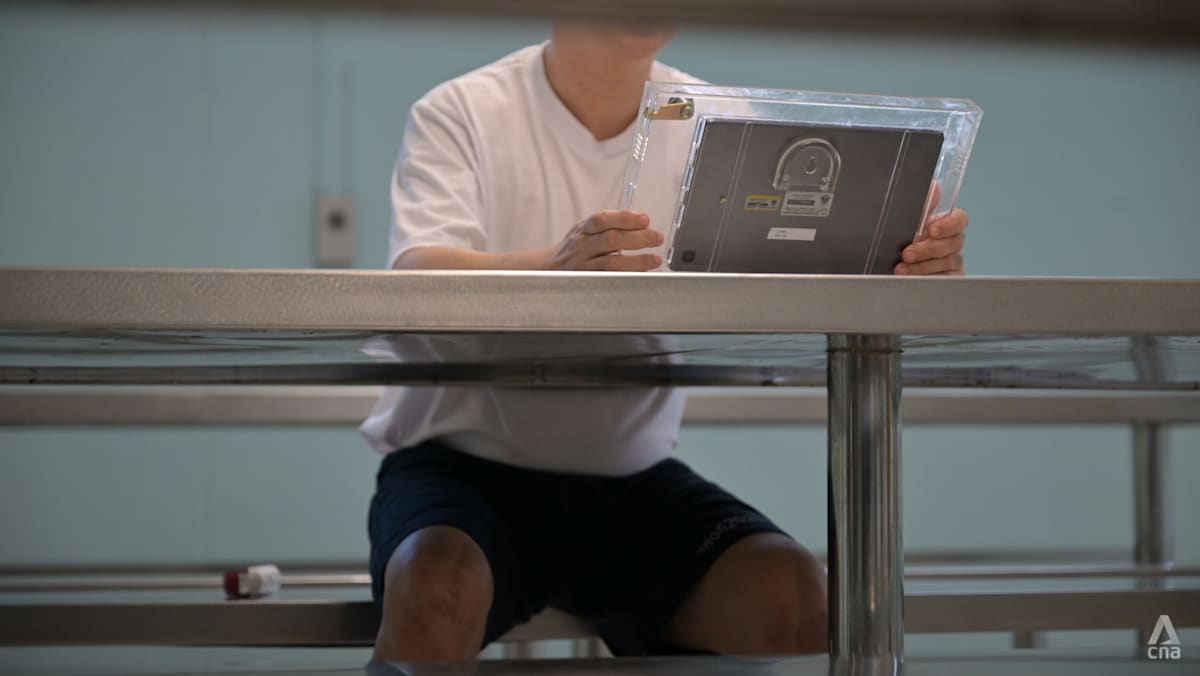
Under the Project Hope initiative, parents behind bars are able to keep up-to-date about their school-going children's lives through quarterly video calls.
Fai (not his real name) speaking to his daughter during a video call at Changi Prison Complex on Oct 22, 2026. (Photo: CNA/Raydza Rahman)
This audio is generated by an AI tool.
SINGAPORE: Clutching a tablet in a nondescript room, 46-year-old Fai (not his real name) waited eagerly for his daughter to appear on the Zoom call.
It had been about three months since he last saw his 15-year-old daughter. When the connection finally came through, his eyes lit up and he smiled.
But a slight technical glitch delayed their reunion. Seeing this, an officer at Changi Prison Complex stepped in, took the tablet away to resolve the issue, and handed it back to the inmate.
The conversation finally began: his daughter speaking from her school, and him from behind prison walls.
For the next hour, the screen became a bridge between their two worlds – made possible by an initiative piloted by the Singapore Prison Service (SPS) and schools to keep incarcerated parents anchored in their children’s education through quarterly video calls.
Since its launch in 2022, the pilot, Project Hope, has helped 134 inmates stay involved in their school-going children's lives.
A total of 186 children and 79 schools are involved, while SPS is in talks with another 88 schools about the initiative, said correctional rehabilitation specialist Yi Shuqin from SPS' family and peer intervention branch.
The programme comes amid efforts to strengthen family bonds during incarceration.
In a parliamentary reply in July, the Ministry of Social and Family Development (MSF) highlighted the importance of family support in helping ex-offenders reintegrate into society and remain offence-free.
Studies have shown that parental incarceration can affect children negatively.
An MSF study conducted with the National Council of Social Service on the longer-term effects of incarceration on children found that those whose parents were involved in the criminal justice system were more likely to commit crime compared to those without such exposure.
About one in five incarcerated parents had at least one child who committed crime, according to another 2017 study by SPS.
For Fai, these issues weigh on his mind as he does his time at Changi Prison.
Speaking to reporters on Thursday (Oct 22) after his hour-long call, Fai expressed concern about the risks faced by children of incarcerated parents and his desire to remain present in his two children's lives despite being behind bars.
He worries particularly about their teenage years, when the absence of a parent could leave them feeling that they have no one to turn to.
"If parents are not around … they are alone at home, wandering around, looking for friends," he said.
With his wife working, Fai hopes the video calls will allow him to continue guiding and supporting his children even while he is physically apart from them.
"Although I'm not around, I can still give her moral support", so that she does not feel lost in her teenage years, he said.
PREPARING FOR A LIFE BEHIND BARS
Fai began serving his sentence in June last year after being convicted of fraud and sentenced to 10 years and four weeks' jail.
He had spent about five years preparing his two children, now aged 17 and 15, for his absence, starting during the COVID-19 pandemic.
"I tell them daddy is going away for a while. A while means I never tell how long. So I prep them. I tell them what to do," he said.
Although his children accepted that he would be leaving, they were curious about why.
Fai decided to be upfront about his imprisonment rather than tell them a "white lie", knowing his sentence was too long to conceal the truth.
"They are 14, 16 that time. I think they should know where I'm going," he said.
"Basically, I have no secret with them. I just tell them, my sentence is 10 years, four weeks. Better to let them know. If not they will be asking, 'Daddy, when are you going out?' They don't know when, it will be a question mark to them."
Two months before entering prison, he began leaving notes for his children with instructions on doing laundry, choosing detergents and helping their mother with household chores such as vacuuming and cleaning the toilet.
These were tasks he had typically handled, along with cooking for the family.
"I'm very close to my family. I always cook for them, wash clothes for them. Everything also I do because I pamper them," he said.
THE FIRST VIDEO CALL
By their third video call on Thursday, conversation flowed easily between Fai and his daughter, moving from schoolwork and exam results to the haze and cooking.
But their first call in May, about three months after he joined Project Hope, had been markedly different.
His daughter was initially shy and reserved, opening up only after he gradually encouraged her to talk. The months without her father had been difficult, Fai said.
"We were … very close. So when I'm not around, she's a bit sad. There's no father figure to her."
His wife had written to him about their daughter spending too much time on her phone instead of revising her schoolwork.
Fai believed she was troubled by his absence.
But after they began connecting through Project Hope, he noticed a marked change. She took his advice and started studying more diligently.
During Thursday's call, she shared her recent exam results and told him how she had worked hard and sought help from her older brother in certain subjects.
Their conversation then turned to the haze. She told him conditions had improved and asked whether he could "see the sky now".
They also talked about cooking, something Fai had often done for the family before his imprisonment, preparing dishes ranging from black pepper rice to curry chicken.
He brought up the macaroni goreng his daughter had written to him about making, though she felt something was missing from the dish.
His children had tried cooking at home since he left, Fai later told reporters, but the food never quite tasted the same.
"I think the father's touch is not there. They miss my cooking."
While it is still years until his release, when that day comes, Fai wants to apologise to his children and tell them how much he has missed them.
"I will talk to them (say) I'm sorry, I miss you all … I will not leave them again, will not (make) any mistake anymore.
"Once is enough for my kids to suffer. Enough," he said.
He knows he will have missed significant milestones, including his children's N-Level examinations, but hopes to be present for those still to come.
"I miss … their teenager milestones. I don't want to miss the next milestone."
MORE THAN JUST A CHAT
An SPS study that examined family interventions in correctional settings found that such interventions could improve parent-child communication and parenting skills, while reducing parental stress and behavioural problems among children.
While more research is needed to establish a causal link, the study suggested that such improvements could help reduce reoffending by strengthening parenting and family interactions .
Correctional rehabilitation specialist Yi Shuqin from the Singapore Prison Service's family and peer intervention branch speaking to the media at Changi Prison Complex on Oct 22, 2026. (Photo: CNA/Raydza Rahman)
Behind each Project Hope video call is considerable preparation, said SPS' Ms Yi.
Specialists typically coordinate with school counsellors or student welfare officers to arrange sessions, while also helping incarcerated parents plan what to discuss with their children.
Bringing a school on board may at times take months, as SPS must first explain the initiative and secure support from the relevant parties and school management.
There are also more delicate challenges.
Some caregivers may resist the calls, while certain children may not be ready to reconnect with their incarcerated parents. "It has to be preceded with a lot of sensitivity, a lot of deliberation, a lot of care because we also cannot push them," Ms Yi said.
Officers also work with parents to help them express care and concern for their children. "Not every parent comes in confident and ready to engage their children … Maybe the relationship could have been strained to begin with," she said.
In-house counsellors can help inmates navigate difficult conversations, including explaining to their children why they are in prison.
For the children, calls are conducted in school to provide a safe environment. An adult must also be present to support them during and after the conversation.
With Project Hope, inmate parents can continue playing an active role in their children's lives by staying updated on what was happening at school, said Ms Yi.
"It really reminds them that when they are out, there is someone who's waiting for them, and that they are actually a role model to their children. So their children are actually an important source of motivation for them."
She has heard feedback from parents that the calls encourage them to be more mindful about their behaviour in prison and avoid committing offences that could delay their release and reunion with their families.
"We have really seen how it strengthens their parental identity and this identity in turn really strengthens their commitment for change," Ms Yi said.
While quarterly calls "may feel insufficient", they are meant to complement existing channels - such as 20- to 30-minute physical or virtual visits, she added.
In a July parliamentary reply, MSF said 68 per cent of inmates received either virtual or face-to-face visits from family members in 2025. Inmates can also communicate through e-letters, phone calls and family programmes.
Ms Yi noted that some children particularly value having an hour alone with their incarcerated parent, rather than sharing shorter visits with other family members - an experience Fai shared.
During regular visits, he would have only about 10 minutes each with his wife, son and daughter. "I cannot share more. It's very hard. So once I got (in) this programme, I can share more," he said.
The longer calls have given him time to offer his daughter guidance, including tips on tackling maths questions.
Throughout Thursday's video call, Fai repeatedly encouraged his daughter to keep working hard, reassuring her that her studies will improve.
Though separated by prison walls, the call allowed him to tell her: "Don't worry, I'm here."
Get our pick of top stories and thought-provoking articles in your inbox
Stay updated with notifications for breaking news and our best stories
Join our channel for the top reads for the day on your preferred chat app
在“希望工程”计划下,狱中的父母可以通过每季度一次的视频通话了解在校子女的生活情况。
2026年10月22日,Fai(化名)在樟宜监狱综合大楼通过视频通话与女儿交谈。(图片:CNA/Raydza Rahman)
这段音频是由人工智能工具生成的。
新加坡:在一个普通的房间里,46岁的费伊(化名)手拿平板电脑,焦急地等待着女儿出现在Zoom视频通话中。
他已经大约三个月没见到他15岁的女儿了。当电话终于接通时,他的眼睛亮了起来,脸上露出了笑容。
但一个小小的技术故障耽误了他们的重逢。樟宜监狱的一名狱警见状,立即介入,拿走平板电脑解决问题后,又将其交还给了囚犯。
对话终于开始了:他的女儿在学校里讲话,而他则在监狱的高墙之内。
在接下来的一个小时里,屏幕成为了连接他们两个世界的桥梁——这得益于新加坡监狱署 (SPS) 和学校共同发起的一项倡议,旨在通过每季度一次的视频通话,让被监禁的父母能够参与到孩子的教育中来。
自 2022 年启动以来,“希望工程”试点项目已帮助 134 名服刑人员参与到他们上学子女的生活中。
新加坡监狱管理局家庭和同伴干预部门的矫正康复专家易淑琴表示,共有 186 名儿童和 79 所学校参与了这项计划,同时,新加坡监狱管理局正在与另外 88 所学校就该计划进行洽谈。
该计划旨在加强服刑人员与家人之间的联系。
在7月份的议会答复中,社会及家庭发展部(MSF)强调了家庭支持对于帮助刑满释放人员重新融入社会并保持不再犯罪的重要性。
研究表明,父母入狱会对孩子产生负面影响。
无国界医生与国家社会服务理事会合作开展的一项关于监禁对儿童长期影响的研究发现,与没有接触过刑事司法系统的儿童相比,父母曾卷入刑事司法系统的儿童更有可能犯罪。
根据 SPS 在 2017 年进行的另一项研究,大约五分之一的被监禁父母至少有一个孩子犯了罪。
对于费伊来说,这些问题一直萦绕在他的心头,因为他正在樟宜监狱服刑。
周四(10 月 22 日),在与记者进行了一小时的通话后,费伊对被监禁父母的孩子面临的风险表示担忧,并表达了尽管身陷囹圄,仍希望留在两个孩子身边的愿望。
他尤其担心孩子们的青少年时期,因为父母的缺席可能会让他们感到孤立无援。
他说:“如果父母不在身边……孩子们就会独自在家,四处游荡,寻找朋友。”
由于妻子要工作,费希望通过视频通话,即使与孩子们身处异地,也能继续指导和支持他们。
他说:“虽然我不在她身边,但我仍然可以给她精神上的支持”,这样她就不会在青少年时期感到迷茫。
为狱中生活做好准备
费伊因诈骗罪被判处 10 年零 4 周监禁,并于去年 6 月开始服刑。
从 COVID-19 疫情期间开始,他花了大约五年时间让他的两个孩子(现在分别是 17 岁和 15 岁)为他的离开做好准备。
“我告诉他们爸爸要离开一段时间。所谓一段时间,我从不说具体多久。所以我提前跟他们打好心理准备,告诉他们该怎么做,”他说。
虽然他的孩子们接受了他即将离开的事实,但他们很好奇他离开的原因。
Fai 决定坦白自己的入狱经历,而不是对他们说“善意的谎言”,因为他知道自己的刑期太长,无法隐瞒真相。
“他们当时才14、16岁。我觉得他们应该知道我要去哪里,”他说。
“基本上,我跟他们之间没什么秘密。我直接告诉他们,我的刑期是十年零四周。最好让他们知道。不然他们会问,‘爸爸,你什么时候出狱?’他们不知道,对他们来说,这永远都是个问号。”
在入狱前两个月,他开始给孩子们留下纸条,指导他们如何洗衣服、选择洗涤剂,以及帮助他们的母亲做家务,例如吸尘和清洁厕所。
这些都是他平时负责的任务,包括为家人做饭。
“我和家人关系非常亲密。我总是给他们做饭、洗衣服。我做所有的事情,都是因为我想宠爱他们,”他说。
第一次视频通话
周四,费伊和女儿进行了第三次视频通话,两人之间的谈话非常顺利,话题从学校作业和考试成绩聊到了雾霾和做饭。
但在他加入“希望工程”大约三个月后的五月份,他们的第一次通话却截然不同。
他的女儿起初害羞内向,直到他慢慢鼓励她开口说话,她才逐渐敞开心扉。费伊说,没有父亲的这几个月对她来说很艰难。
“我们关系非常亲密。所以当我不在她身边时,她会有点难过。她缺少父亲的角色。”
他的妻子曾写信告诉他,他们的女儿花太多时间玩手机,而不是复习功课。
费伊认为她因为他的缺席而感到不安。
但自从他们通过“希望工程”项目建立联系后,他注意到她发生了显著的变化。她听从了他的建议,开始更加努力地学习。
在周四的通话中,她分享了自己最近的考试成绩,并告诉他自己是如何努力学习,以及在某些科目上向哥哥寻求帮助的。
他们的谈话随后转向了雾霾。她告诉他情况已经好转,并问他现在是否“能看到天空了”。
他们还谈到了烹饪,这是费伊在入狱前经常为家人烹饪的菜肴,从黑胡椒饭到咖喱鸡,不一而足。
他提起女儿写信告诉他要做的炒通心粉,尽管女儿觉得这道菜还缺少些什么。
费伊后来告诉记者,自从他离开后,他的孩子们也尝试在家做饭,但饭菜的味道总是和以前不一样。
“我觉得父亲的功力没有传承下去了。他们很想念我做的饭菜。”
虽然距离他获释还有数年时间,但当那一天到来时,费伊想要向他的孩子们道歉,并告诉他们他有多么想念他们。
“我会跟他们说,对不起,我很想念你们……我不会再离开他们了,不会再犯任何错误了。”
“一次就够我的孩子受苦了,够了。”他说。
他知道自己将会错过一些重要的里程碑,包括孩子们的N水准考试,但他希望能够陪伴孩子们度过未来更重要的时刻。
“我错过了……他们青少年时期的重要时刻。我不想错过下一个重要时刻。”
不仅仅是聊天
SPS 的一项研究调查了矫正机构中的家庭干预措施,发现此类干预措施可以改善亲子沟通和育儿技能,同时减少父母的压力和儿童的行为问题。
虽然还需要更多研究来确定因果关系,但该研究表明,此类改进可以通过加强父母教养和家庭互动来帮助减少再犯罪。
2026年10月22日,新加坡监狱署家庭及同伴干预部门的矫正康复专家易淑琴在樟宜监狱综合大楼接受媒体采访。(图片:CNA/Raydza Rahman)
SPS的易女士表示,每一次“希望工程”视频通话背后都凝聚着大量的准备工作。
专家通常会与学校辅导员或学生福利官员协调安排会面,同时帮助被监禁的父母计划与孩子讨论哪些内容。
让学校参与进来有时可能需要几个月的时间,因为 SPS 必须首先解释这项计划,并获得相关各方和学校管理层的支持。
此外,还有一些更为棘手的挑战。
有些监护人可能会抗拒这些电话,而有些孩子可能还没有准备好与狱中的父母重新建立联系。“这需要非常谨慎、深思熟虑和细致的照顾,因为我们也不能强迫他们,”易女士说。
警员还会与家长合作,帮助他们表达对孩子的关爱和关心。“并非每位家长都能自信地与孩子沟通……或许他们之间的关系一开始就比较紧张,”她说。
监狱内部的辅导员可以帮助服刑人员应对棘手的对话,包括向他们的孩子解释他们为什么在监狱服刑。
为了确保儿童的安全,通话将在学校进行。通话期间和通话结束后,必须有成年人在场支持他们。
易女士表示,通过“希望工程”,服刑人员的父母可以继续积极参与孩子的成长,了解孩子在学校的近况。
“这真的能让他们意识到,当他们外出时,有人在等着他们,而且他们实际上是孩子的榜样。所以,他们的孩子实际上是他们重要的动力来源。”
她从一些家长那里了解到,这些电话鼓励孩子们更加注意自己在监狱里的行为,避免犯下可能延迟他们获释和与家人团聚的罪行。
“我们已经看到,这确实增强了他们的父母身份认同感,而这种身份认同感反过来又增强了他们对变革的决心,”易女士说。
她补充说,虽然每季度一次的电话会议“可能感觉不够”,但它们旨在补充现有的渠道,例如 20 到 30 分钟的现场或虚拟访问。
无国界医生组织在7月份的议会答复中表示,到2025年,68%的囚犯将获得家人的线上或线下探访。囚犯还可以通过电子信件、电话和家庭项目与家人沟通。
易女士指出,有些孩子特别珍惜与被监禁的父母单独相处的一小时,而不是与其他家庭成员进行较短的探视——费也有过类似的经历。
在每次探望家人时,他每次只能和妻子、儿子、女儿各待大约十分钟。“我不能分享更多。这太难了。所以自从我参加了这个项目,我就可以分享更多了。”他说。
更长的通话时间让他有时间指导女儿,包括如何解决数学问题。
在周四的视频通话中,费伊反复鼓励女儿继续努力学习,并向她保证她的学习成绩会有所提高。
尽管隔着监狱的高墙,但通过电话,他可以告诉她:“别担心,我在这里。”
订阅我们的邮件,即可获取精选热点新闻和引人深思的文章。
订阅通知,第一时间获取突发新闻和精彩报道。
加入我们的频道,即可在您常用的聊天应用上获取当日热门文章。