Cable capacity emerges as bottleneck for AI data centres, Nexans says耐克森公司称,电缆容量成为人工智能数据中心的瓶颈。
Oct 22 (Reuters) - Cable production capacity is emerging as a bottleneck for AI-driven data centre construction, Nexans' finance chief said, as demand rises faster than the industry's ability to expand manufacturing capacity.
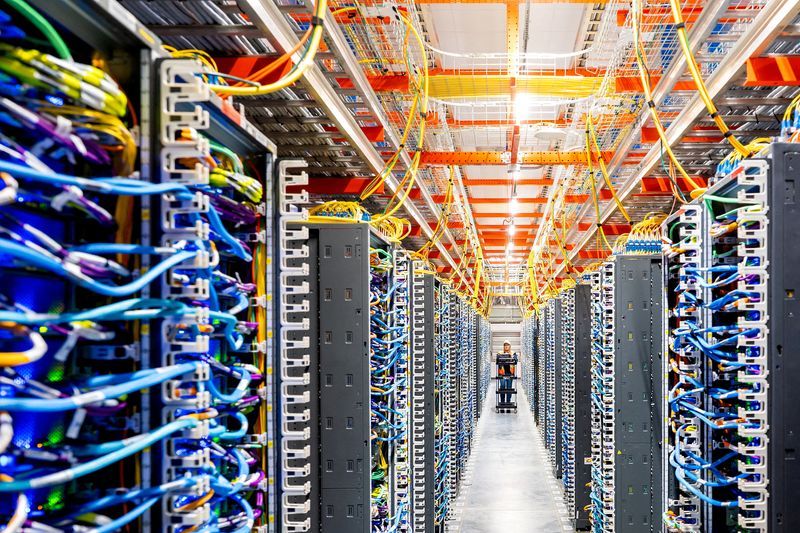
FILE PHOTO: A technician works at an Amazon Web Services AI data center in New Carlisle, Indiana, U.S., October 2, 2025. REUTERS/Noah Berger for AWS/File Photo
Oct 22 (Reuters) - Cable production capacity is emerging as a bottleneck for AI-driven data centre construction, Nexans' finance chief said, as demand rises faster than the industry's ability to expand manufacturing capacity.
Global cable capacity is tight and building a new cross-linked polyethylene (XLPE) cable production line, known in the industry as a CV line, takes around three years, limiting how quickly suppliers can respond to demand, Nexans CFO Vincent Piquet told Reuters.
"Things can't move quickly and the people building these data centres are in a great hurry," Piquet said.
Data centres require large amounts of low- and medium-voltage cable to connect power infrastructure, with larger facilities consuming proportionately more medium-voltage cable.
The strain on power infrastructure is already delaying some projects. In September, Oracle issued a force majeure notice to a Blue Owl unit developing a large data centre in New Mexico, citing potential difficulties securing sufficient power for the site.
Piquet said grid constraints, while slowing some projects, were also supporting demand for Nexans' products and allowing the company to be more selective when allocating capacity.
French distribution network operator Enedis has moved from annual procurement agreements to contracts lasting six or seven years in order to secure cable supply, he said.
While Europe generally faces fewer grid-connection challenges than the United States and benefits from stronger electricity networks in some northern countries, Piquet said lengthy regulatory processes were delaying certain projects.
He said he did not expect demand linked to artificial intelligence to slow, although Europe's data-centre expansion was likely to be less pronounced than in the United States because private investment capacity was smaller and public funding played a larger role.
(Reporting by Mathias de Rozario in Gdansk; Editing by Matt Scuffham)
Thank you for your report!
SkyeChip collaborates with Japan's SAIMEMORY on next-generation AI memory technology
Proposed export curbs target advanced solar technologies
Soccer-Police to deploy live facial recognition technology at Chelsea-Spurs game
资料照片:2025年10月2日,一名技术人员在美国印第安纳州新卡莱尔的亚马逊网络服务(AWS)人工智能数据中心工作。(路透社/Noah Berger for AWS/资料照片)
10 月 22 日(路透社)——耐克森公司首席财务官表示,电缆产能正成为人工智能驱动的数据中心建设的瓶颈,因为需求增长速度超过了行业扩大制造能力的速度。
耐克森首席财务官文森特·皮奎特告诉路透社,全球电缆产能紧张,建造一条新的交联聚乙烯(XLPE)电缆生产线(业内称为CV生产线)大约需要三年时间,这限制了供应商响应需求的速度。
皮奎特说:“事情进展不能太快,而建造这些数据中心的人们却非常着急。”
数据中心需要大量的低压和中压电缆来连接电力基础设施,规模较大的设施消耗的中压电缆比例也更高。
电力基础设施紧张已经导致一些项目延期。9月份,甲骨文公司向其旗下Blue Owl公司位于新墨西哥州的一个大型数据中心开发项目发出不可抗力通知,理由是该数据中心可能难以获得充足的电力供应。
Piquet 表示,电网限制虽然减缓了一些项目的进度,但也支撑了对 Nexans 产品的需求,并使该公司在分配产能时能够更加有选择性。
他说,为了确保电缆供应,法国配电网络运营商 Enedis 已将年度采购协议改为签订六至七年的合同。
皮凯特表示,虽然欧洲在电网连接方面通常比美国面临的挑战要少,并且一些北方国家的电力网络也更加强大,但冗长的监管程序正在延误某些项目。
他表示,他不认为与人工智能相关的需求会放缓,尽管欧洲的数据中心扩张可能不如美国那么明显,因为私人投资能力较小,公共资金发挥了更大的作用。
(马蒂亚斯·德·罗萨里奥在格但斯克报道;马特·斯库夫汉姆编辑)
感谢您的报告!
SkyeChip与日本SAIMEMORY合作开发下一代AI存储技术
拟议的出口限制措施针对先进太阳能技术
足球警察将在切尔西对阵热刺的比赛中部署实时人脸识别技术