No industry background, no shop, no Plan B: How three Sentul sisters built Pattushastra, Malaysia’s pioneer of Kanjivaram silk sarees没有行业背景,没有店铺,也没有备选方案:三姐妹如何创立马来西亚康吉瓦拉姆丝绸纱丽的先驱品牌 Pattushastra
PETALING JAYA, Oct 22 — There was no business plan. There were no industry contacts and no family trade to inherit. The only capital was what three sisters had personally...
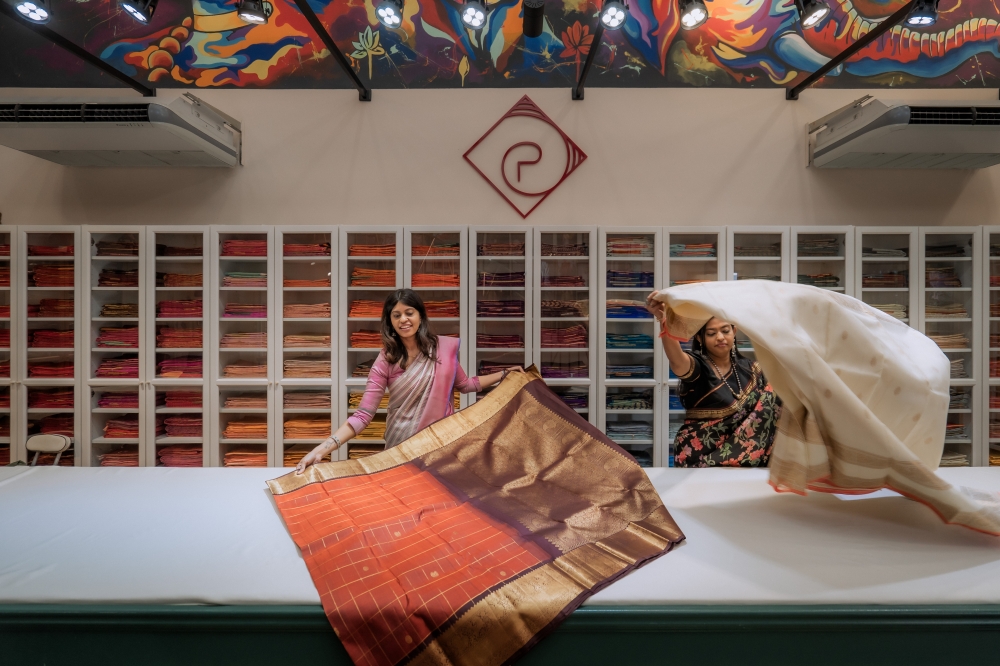
Pattushastra, founded by sisters Suvitha, Jeevitha, and Kavitha Rajasingam, began with limited resources and no industry connections in 2012, driven by consumer frustration over inaccessible quality Kanjivaram sarees.
Initially operating from their home, the business grew through strategic partnerships with master weavers and a commitment to genuine craftsmanship rather than mass production.
Over 14 years, the company expanded its customer base beyond local markets, reaching diverse demographics across Malaysia, Singapore, Australia, and Canada, while maintaining its focus on artisanal quality.
Looking forward, the sisters aim to establish Pattushastra as a global brand synonymous with significant occasions, reflecting their long-term vision anchored in building meaningful relationships with artisans and clients.
PETALING JAYA, Oct 22 — There was no business plan. There were no industry contacts and no family trade to inherit. The only capital was what three sisters had personally saved.
When Suvitha Rajasingam and Jeevitha Rajasingam registered Pattushastra on August 23, 2012, with their elder sister Kavitha Rajasingam behind them, they were, by their own account, simply three sisters from Sentul who had grown frustrated trying to buy a decent saree.
“We are sisters from Sentul — born and bred there — with absolutely no connection to the textile industry and no family background in business,” Jeevitha said.
Their father was a consultant for roadworks; their mother was a homemaker.
“Every part of Pattushastra — from its identity and collections to its relationships with weavers and clients • was imagined, learned and built by us from scratch, one step at a time.”
In those early days, Kavitha played a quieter but crucial role. She supported the venture from the background and served as an advisor while her younger sisters found their footing.
Today, Suvitha and Jeevitha run the business day to day.
The problem that started it
The idea did not begin as a business idea at all. It began as consumer frustration.
While preparing for Kavitha’s wedding, the sisters found it near impossible to source authentic, reasonably priced Kanjivaram silk sarees. Their search eventually took them across the border to Singapore, where they hit the same wall.
“When we were shopping for our elder sister’s wedding, we just couldn’t find genuine Kanjivaram sarees at a fair price — not here, and not even in Singapore,” Suvitha said.
“Being raised in a middle-income family should never mean compromising on quality.”
That conviction, that genuine craftsmanship shouldn’t be gatekept by price, became in effect the company’s founding thesis.
Bootstrapped, literally from home
There was no seed funding, no shop lot and no storefront to start.
“We could not afford a shop, so Pattushastra began from home,” Jeevitha says.
For more than a year, the sisters ran the business entirely out of their house. They secured their first rented shop lot in 2014, two years after registration.
The next leap came in 2021, in the middle of the pandemic, when the sisters decided to move into a space of their own: what they now call their Pattushastra boutique in Seksyen 11, Petaling Jaya.
It was a significant bet to make during one of the most volatile periods for retail in recent memory.
But it reflected a business built on long-term conviction rather than short-term timing.
Growth without a growth-at-all-costs mindset
What makes Pattushastra’s trajectory notable isn’t just the bootstrapped origin story. It’s what the sisters chose not to do along the way.
By their own admission, there were moments when following the wider market, with cheaper, faster, mass-produced sarees, would have been the easier commercial path.
“We even tried to follow the direction of the market,” Suvitha said.
“But we gave up, because we simply could not do it.”
Instead, the business scaled by going deeper rather than wider. It built direct relationships with three master weavers who each oversee 50 to 80 looms for Kanjivaram silk, alongside weaving units in West Bengal and Varanasi for its broader artisan collections.
One of its West Bengal partners is an NGO in Calcutta that trains and employs women from underprivileged backgrounds.
The relationship doubles as social impact, though the sisters rarely frame it in those terms themselves.
A customer base that outgrew its original market
Fourteen years on, the numbers the sisters are willing to put on the business remain deliberately vague.
They say they’ve never tracked total sales, though they estimate the figure at “thousands” of sarees.
What has scaled more visibly is the customer base itself. It began as a niche, local Indian clientele and now reaches Malay and Chinese customers domestically, as well as buyers as far afield as Singapore, Australia and Canada.
The age range has widened too, from senior citizens to Gen Z. That is an unusual spread for a heritage retail category typically assumed to skew narrowly toward a single generation.
Looking ahead, the sisters describe ambitions that sound less like a retail expansion plan and more like a positioning goal.
They want Pattushastra to be the name the market defaults to for significant occasions, and eventually, to take that positioning global.
“We aspire to take Pattushastra into the global market, carrying our artisans’ stories with us,” Jeevitha said.
The business started with three sisters, no capital and no industry playbook. Its horizon now is considerably longer than the one they set out with in 2012, and they are building it, as they tell it, one relationship and one saree at a time.
Mexico town keeps Day of the Dead tradition alive, one sheet of paper at a time
German feminist magazine Emma to close after nearly 50 years amid changing times
From village gardens to global recognition: Nur Shazwani honoured by UN for rural farming work
Police bust alleged sex trafficking syndicate exploiting children, generating RM450,000 monthly
Viral Porsche road bully jailed five days, fined RM10,000 for dangerous driving
MCMC warns against sharing Kuching school violence footage involving teen, cautions of legal action
Pattushastra 由 Suvitha、Jeevitha 和 Kavitha Rajasingam 三姐妹于 2012 年创立,当时资源有限,也没有任何行业人脉,其创立的动力源于消费者对难以获得高质量 Kanjivaram 纱丽的不满。
公司最初在家中运营,通过与织布大师建立战略合作伙伴关系,并致力于真正的工艺而非大规模生产,不断发展壮大。
14 年来,该公司不断拓展客户群体,从本地市场扩展到马来西亚、新加坡、澳大利亚和加拿大等地的不同人群,同时始终专注于手工品质。
展望未来,姐妹俩的目标是将 Pattushastra 打造成一个与重要场合紧密相连的全球品牌,这体现了她们的长期愿景,即与工匠和客户建立有意义的关系。
八打灵再也,10月22日讯——她们没有商业计划,没有行业人脉,也没有可以继承的家族生意。唯一的启动资金是三姐妹的个人积蓄。
2012 年 8 月 23 日,苏维塔·拉贾辛加姆 (Suvitha Rajasingam) 和吉维塔·拉贾辛加姆 (Jeevitha Rajasingam) 在姐姐卡维塔·拉贾辛加姆 (Kavitha Rajasingam) 的带领下注册成立了 Pattushastra 公司。据她们自己所说,她们只是来自森图尔 (Sentul) 的三姐妹,因为买不到一件像样的纱丽而感到沮丧。
“我们是来自森图尔的姐妹——在那里出生长大——与纺织业没有任何关系,家族也没有任何经商背景,”吉维塔说。
他们的父亲是道路工程顾问,母亲是家庭主妇。
“从品牌形象和产品系列到与织工和客户的关系,Pattushastra 的每一个部分都是我们从零开始,一步一步地构思、学习和构建的。”
在创业初期,卡维塔扮演着一个较为低调但至关重要的角色。她默默支持着这项事业,并在妹妹们站稳脚跟的过程中担任顾问。
如今,苏维塔和吉维塔负责公司的日常运营。
引发这个问题的原因
这个想法最初根本不是出于商业目的,而是源于消费者的不满。
在筹备卡维塔的婚礼时,姐妹俩发现几乎不可能找到正宗且价格合理的康吉瓦拉姆丝绸纱丽。她们最终将目光投向了新加坡,却依然一无所获。
“我们为姐姐的婚礼置办行头时,根本找不到价格合理的正宗康吉瓦拉姆纱丽——在这里找不到,甚至在新加坡也找不到,”苏维塔说。
“出身中等收入家庭绝不意味着要在质量上妥协。”
这种信念,即真正的精湛工艺不应该被价格所限制,实际上成为了公司的创立理念。
完全靠自己,从家里起步
创业之初,公司没有启动资金,没有店面,也没有厂房。
“我们买不起店面,所以 Pattushastra 就是从家里开始的,”Jeevitha 说。
一年多以来,姐妹俩完全在家中经营这家公司。直到注册成立两年后的2014年,她们才租到了第一间店面。
下一个飞跃发生在 2021 年,正值疫情期间,姐妹俩决定搬进属于自己的空间:她们现在称之为位于八打灵再也第 11 区的 Pattushastra 精品店。
在零售业近年来最动荡的时期之一,这是一笔意义重大的投资。
但这反映出一家企业秉持着长期信念而非短期时机的理念。
增长不应抱有不惜一切代价追求增长的心态。
《帕图沙斯特拉》的成功之路之所以引人注目,不仅仅是因为它白手起家的起源故事,更在于姐妹俩一路走来所选择放弃的那些事情。
他们自己也承认,有些时候,顺应更广泛的市场,生产更便宜、更快捷、批量生产的纱丽,会是更容易的商业道路。
“我们甚至尝试顺应市场走向,”苏维塔说。
但我们放弃了,因为我们根本做不到。
相反,这家公司并没有盲目扩张,而是通过深耕细作实现了规模化发展。它与三位织造大师建立了直接合作关系,这三位大师每人负责管理50到80台织机,生产康吉瓦拉姆丝绸;此外,它还在西孟加拉邦和瓦拉纳西设有织造厂,生产更广泛的手工艺品系列。
其在西孟加拉邦的合作伙伴之一是加尔各答的一家非政府组织,该组织为来自贫困背景的妇女提供培训和就业机会。
这段关系也具有社会影响,尽管姐妹俩很少从这个角度来看待它。
客户群已超出其原有市场规模
十四年过去了,姐妹俩愿意为公司设定的数字仍然故意含糊其辞。
他们表示从未统计过总销量,但估计纱丽的销量有“数千件”。
更显著增长的是客户群体本身。最初,它只面向本地的印度客户,现在不仅覆盖马来西亚国内的马来西亚和中国客户,还远销新加坡、澳大利亚和加拿大等地。
顾客的年龄范围也扩大了,从老年人到Z世代都有。对于一个通常被认为主要面向单一世代的传统零售类别来说,这种年龄分布实属罕见。
展望未来,姐妹俩描述的雄心壮志与其说是零售扩张计划,不如说是市场定位目标。
他们希望 Pattushastra 成为市场上在重要场合的首选品牌,并最终将这一地位推向全球。
“我们渴望将《帕图沙斯特拉》推向全球市场,并将我们工匠的故事带出去,”吉维塔说道。
这家公司由三姐妹创立,她们没有资金,也没有行业经验。如今,它的视野比2012年创业之初要长远得多,正如她们所说,她们正一步一个脚印地建立起自己的事业,一次只经营一段关系,一件只做一件纱丽。
墨西哥小镇用一张张纸延续着亡灵节的传统。
德国女权主义杂志《艾玛》在创刊近50年后,因时代变迁而停刊。
从乡村菜园到全球认可:努尔·沙兹瓦尼因其农村农业工作荣获联合国表彰
警方捣毁一个涉嫌性交易团伙,该团伙剥削儿童,每月非法获利高达45万令吉。
因危险驾驶被网友热议的保时捷路霸被判入狱五天,罚款1万令吉
马来西亚通讯及多媒体委员会(MCMC)警告民众不要传播古晋校园暴力事件中涉及青少年的视频,并警告可能面临法律诉讼。