S’pore to tap biomethane as fossil gas replacement from 2028 in new pilot: Gan Kim Yong新加坡将从2028年起在新试点项目中利用生物甲烷替代化石天然气:颜金勇
It was one of a series of initiatives to cut emissions from power, industry sectors announced on Oct 23. Read more at straitstimes.com.
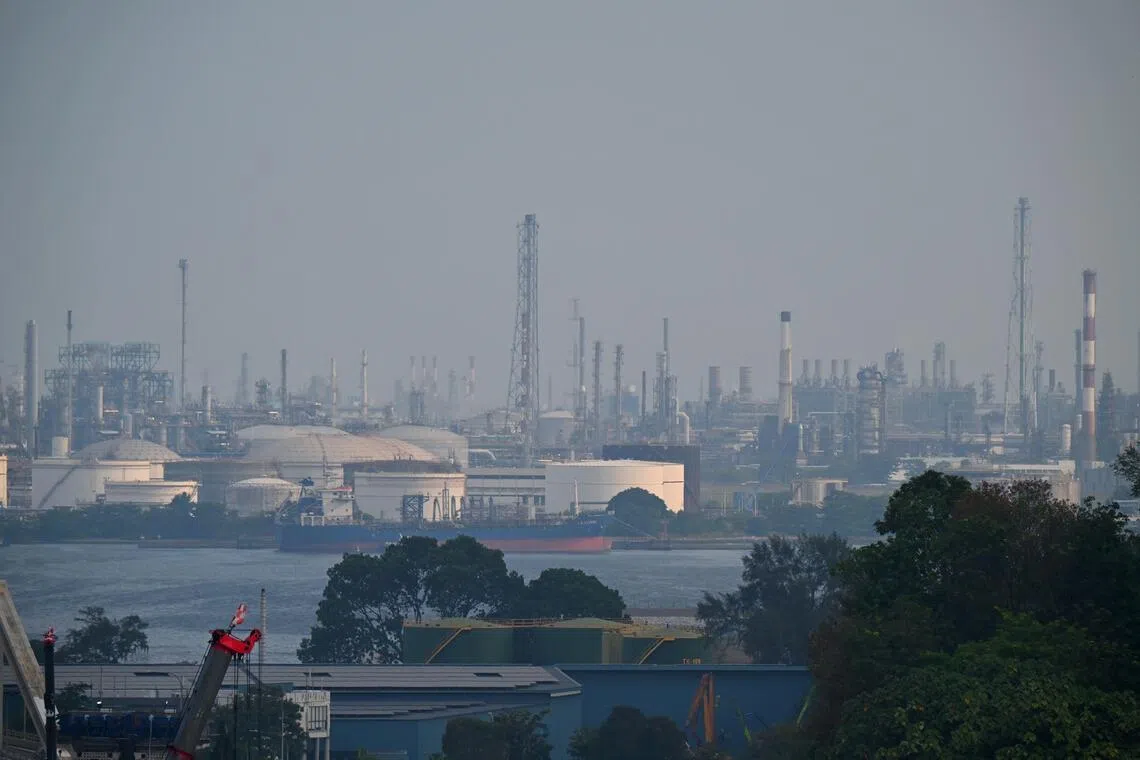
Singapore’s industries account for around 65% of the country’s emissions, including emissions from the electricity that they use.
Published Oct 23, 2026, 10:00 AM
Updated Oct 23, 2026, 10:01 AM
SINGAPORE – By 2028, Singapore could start to use biomethane, considered a lower-carbon option than the fossil gas the country traditionally uses, to help keep its lights on.
Deputy Prime Minister Gan Kim Yong announced on Oct 23 that three power generation companies - Keppel Energy, Sembcorp Utilities and Tuas Power Generation - have been appointed as aggregators to import and supply biomethane under a pilot.
The natural gas that is now used to generate 95 per cent of Singapore’s electricity comes from fossil fuels. But b iomethane, which has a similar composition to it, is produced from organic materials such as food waste, agricultural waste, animal manure and sewage sludge.
This is why biomethane is sometimes considered a “renewable fuel”. Another advantage is that it can also be used within the existing natural gas infrastructure without costly retrofits.
The announcement was made by DPM Gan at the inaugural Singapore Industry Decarbonisation Forum.The event was hosted by the Economic Development Board (EDB) in partnership with the Agency for Science, Technology and Research (A*STAR) and the Advanced Energy and Decarbonisation Office.
The office is Singapore’s national platform for coordinating and supporting the research, development, and demonstration of technologies to support Singapore’s decarbonisation goals.
During the event, a series of initiatives to help Singapore cut its carbon footprint was announced. Other than the biomethane import pilot, other announcements include a $143 million funding initiative to advance industrial decarbonisation.
Singapore aims to have its planet-warming emissions come down to net-zero by 2050.
Meeting this target will involve getting the more emissions-intensive sectors - including the power and industrial sectors - to reduce their carbon footprint. The new initiatives could help lower emissions from the power and industry sectors.
“Our industries account for around 65% of our emissions , including emissions from the electricity that they use ,” said DPM Gan. “We cannot achieve net-zero by 2050 without reducing these emissions significantly.
He added that Singapore must also keep these industries competitive while decarbonising them.
To this end, investments made into lower-carbon technologies would involve researchers working closely with industry to develop solutions that meet its needs, prove that these can be scaled, and enable companies to deploy them.
On the power front, the generation companies will import biomethane of up to 300MW from regional and international sources under the pilot. This can meet the needs of around 600,000 HDB households.
The biomethane gas, or biomethane-derived electricity, will supply data centres and industrial manufacturers in Singapore. These are usually large emitters.
The Economic Development Board (EDB) said the biomethane initiative, which will run for 15 years, i s the first of its kind in South-east Asia.
The appointment of the three firms is part of a regulatory sandbox, first announced in October 2025 , to test out the commercial, regulatory and operational arrangements needed for biomethane imports. A regulatory sandbox is a controlled environment where firms can test new innovations under the supervision of a regulator.
The outcomes can help to shape the framework for the wider adoption of biomethane in the future, EDB added.
Reducing emissions from industry
The Republic is also committing $143 million to support the development and commercialisation of low-carbon technologies for industries, said DPM Gan, who is also the Minister for Trade and Industry (Trade).
Industrial activities that produce plenty of emissions include petrochemical production, refining and fuel combustion. There are currently few commercial solutions that can help bring down emissions from these activities.
EDB said the new Industry Decarbonisation Funding Initiative will focus on solutions in three areas.
These are carbon capture, which refers to the removal of carbon from tailpipe emissions instead of releasing it into the atmosphere , and carbon utilisation. This refers to taking the captured carbon and then using it in other process or turning into other products, such as concrete .
The third area entails other novel and emerging decarbonisation technologies, such as solutions to store carbon and ways to reduce non-carbon dioxide greenhouse gas emissions from industrial processes.
Of the $143 million, up to $100 million will be set aside for research and development initiated by companies, including start-ups and technology providers.
This effort, dubbed the Decarbonisation Research for Industry, Ventures and Enterprise (DRIVE), aims to spur partnerships between companies and research institutions, ensuring that studies done in these areas can have real-world outcomes.
The government will co-fund up to 75% of qualify project costs and applications are open on Oct 23.
Separately, a national facility that will allow companies to test and scale emerging low-carbon technologies for industrial use also broke ground at Jurong Island on Oct 23.
Its first users will be Amogy, IHI Corporation and Metha8 — firms that are developing novel technologies spanning carbon utilisation and low-carbon hydrogen.
The $62 million Low-Carbon Technology Translational Testbed will provide modular and configurable facilities to support the development and testing of carbon utilisation and hydrogen technologies under industry-relevant conditions.
Companies can access shared infrastructure, utilities, permits and licences to set up pilots, and move faster from technology development to testing and scale-up.
The facility will be hosted at the A*STAR ISCE2.
By working with A*STAR, Amogy will work on producing hydrogen from ammonia, IHI on converting carbon dioxide into sustainable aviation fuel and Metha8 on an integrated system that converts methanol to power, said DPM Gan.
“Promising technologies that work in the lab must still prove they can operate reliably under demanding industrial conditions,” said A*STAR’s assistant chief executive of the Science & Engineering Research Council Lim Keng Hui.
“LCT3 gives researchers and companies the infrastructure and operating environment to do this without building a facility from scratch.”
Chin Hui Shan is a journalist covering the environment beat at The Straits Times.
Ministry of Trade and Industry
Technology and research
新加坡的工业排放约占该国排放量的 65%,其中包括工业企业所用电力产生的排放。
发布于2026年10月23日上午10:00
更新于2026年10月23日上午10:01
新加坡——到 2028 年,新加坡可能开始使用生物甲烷,这种能源被认为比该国传统使用的化石天然气碳排放量更低,有助于维持电力供应。
副总理颜金勇于10月23日宣布,吉宝能源、胜科电力和图阿斯发电三家发电公司已被指定为生物甲烷进口和供应的聚合商,作为试点项目的一部分。
新加坡目前95%的电力都来自化石燃料,而天然气则与化石燃料发电。但生物甲烷的成分与之类似,它是由食物垃圾、农业废弃物、动物粪便和污水污泥等有机物制成的。
因此,生物甲烷有时被视为一种“可再生燃料”。另一个优点是,它无需昂贵的改造即可在现有的天然气基础设施中使用。
该消息由副总理颜金勇在首届新加坡工业脱碳论坛上宣布。此次论坛由新加坡经济发展局 (EDB) 与新加坡科技研究局 (A*STAR) 和先进能源与脱碳办公室合作举办。
该办公室是新加坡的国家平台,负责协调和支持相关技术的研究、开发和示范,以支持新加坡的脱碳目标。
活动期间,新加坡宣布了一系列旨在减少碳排放的举措。除生物甲烷进口试点项目外,其他宣布的举措还包括一项1.43亿美元的资金计划,用于推进工业脱碳。
新加坡的目标是到 2050 年将其导致全球变暖的温室气体排放量降至净零。
要实现这一目标,就需要促使包括电力和工业部门在内的高排放行业减少碳足迹。新举措有望帮助降低电力和工业部门的碳排放。
“我们的工业排放约占全国排放量的65%,其中包括工业用电产生的排放,”副总理颜金勇表示。“如果不大幅减少这些排放,我们就无法在2050年之前实现净零排放。”
他还补充说,新加坡在实现这些产业脱碳的同时,也必须保持这些产业的竞争力。
为此,对低碳技术的投资将涉及研究人员与行业密切合作,开发满足其需求的解决方案,证明这些解决方案可以规模化,并使公司能够部署这些解决方案。
在电力方面,根据试点计划,发电公司将从区域和国际渠道进口高达300兆瓦的生物甲烷。这可以满足约60万户组屋家庭的需求。
生物甲烷气体或生物甲烷衍生的电力将供应给新加坡的数据中心和工业制造商。这些企业通常是大型排放源。
经济发展局(EDB)表示,这项生物甲烷计划将持续15年,是东南亚首个此类计划。
此次任命这三家公司是监管沙盒计划的一部分,该计划于2025年10月首次公布,旨在测试生物甲烷进口所需的商业、监管和运营安排。监管沙盒是一个受控环境,企业可以在监管机构的监督下测试新的创新技术。
经济发展局补充说,这些成果有助于构建未来更广泛采用生物甲烷的框架。
减少工业排放
副总理兼贸易及工业部长颜金勇表示,新加坡还将投入 1.43 亿美元,用于支持工业低碳技术的开发和商业化。
产生大量排放的工业活动包括石油化工生产、炼油和燃料燃烧。目前,能够帮助减少这些活动排放的商业解决方案寥寥无几。
新加坡经济发展局表示,新的产业脱碳融资计划将重点关注三个领域的解决方案。
这些技术包括碳捕获和碳利用。碳捕获是指从汽车尾气排放中去除碳,而不是将其排放到大气中;碳利用是指将捕获的碳用于其他工艺或转化为其他产品,例如混凝土。
第三个领域涉及其他新型和新兴的脱碳技术,例如碳储存解决方案和减少工业过程中非二氧化碳温室气体排放的方法。
在1.43亿美元中,高达1亿美元将拨给企业(包括初创企业和技术提供商)开展研发活动。
这项名为“工业、风险投资和企业脱碳研究 (DRIVE)”的计划旨在促进公司与研究机构之间的合作,确保这些领域的研究能够产生实际成果。
政府将共同资助符合条件的项目成本的75%,申请将于10月23日开放。
此外,10 月 23 日,裕廊岛也破土动工兴建一座国家级设施,该设施将允许企业测试和扩大新兴低碳技术在工业领域的应用。
其首批用户将是 Amogy、IHI Corporation 和 Metha8——这些公司正在开发涵盖碳利用和低碳氢的新技术。
耗资 6200 万美元的低碳技术转化试验平台将提供模块化和可配置的设施,以支持在与行业相关的条件下开发和测试碳利用和氢能技术。
企业可以利用共享的基础设施、公用设施、许可证和执照来开展试点项目,并更快地从技术开发过渡到测试和规模化。
该设施将设在 A*STAR ISCE2。
副总理颜金勇表示,Amogy 将与 A*STAR 合作,致力于利用氨生产氢气;IHI 将与 A*STAR 合作,致力于将二氧化碳转化为可持续航空燃料;Metha8 将与 A*STAR 合作,致力于开发将甲醇转化为电力的综合系统。
“在实验室中行之有效的有前景的技术,仍然必须证明它们能够在严苛的工业条件下可靠运行,”新加坡科技研究局科学与工程研究理事会助理首席执行官林景辉表示。
“LCT3 为研究人员和公司提供了开展这项工作所需的基础设施和运营环境,而无需从头开始建设设施。”
Chin Hui Shan是《海峡时报》负责环境报道的记者。
贸易和工业部
技术与研究