High Court orders car dealer to pay rival $300k after failed suit over Ferrari deal高等法院裁定,在法拉利交易诉讼失败后,汽车经销商须向竞争对手支付30万美元。
Ferrari dealer dispute in High Court ends with $300,000 counterclaim award and dismissed damages claim Read more at straitstimes.com.
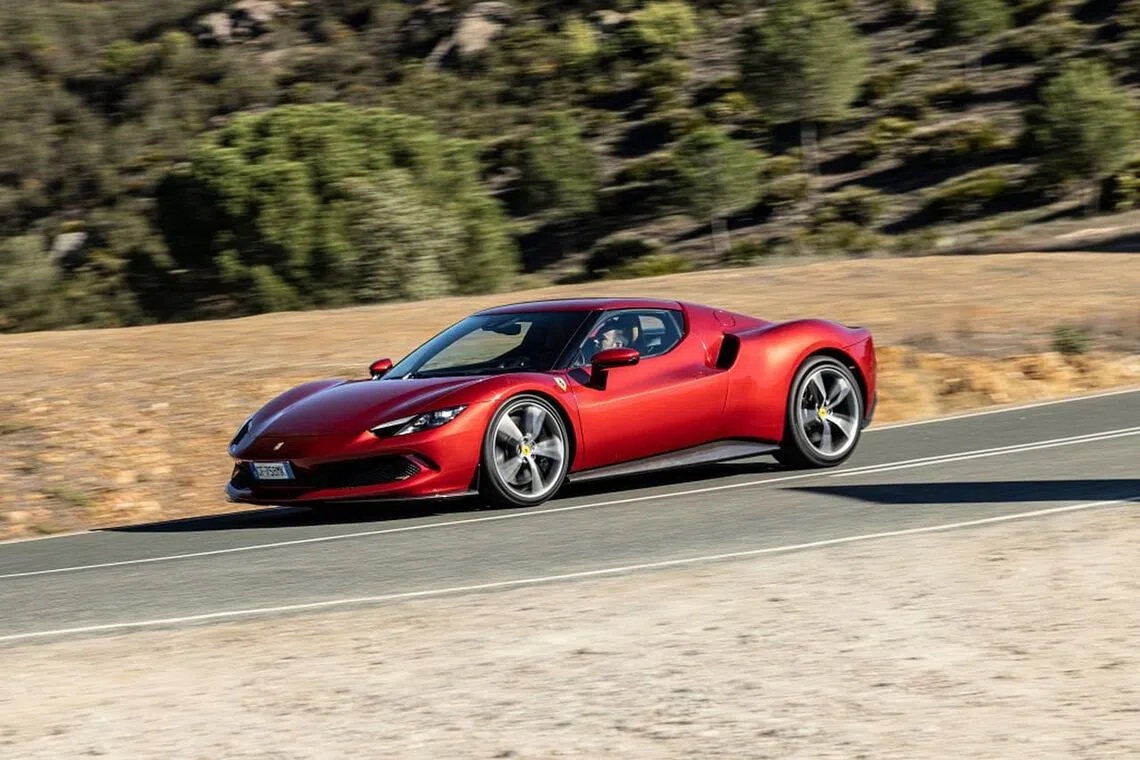
The dispute involved a Ferrari 296 GTB plug-in hybrid (pictured), as well as other luxury cars including Lamborghinis and a Bentley.
Published Oct 23, 2026, 02:25 PM
Updated Oct 23, 2026, 04:19 PM
High Court found Ong falsely claimed a $920,000 Ferrari buyer, but Wu won no damages because he could not prove his losses.
Wu must pay Ong $300,000 over an aborted Lamborghini deal, while Ong still owes Wu $250,000 under a separate Ferrari sales agreement.
Justice Kristy Tan said Ong’s stance was unreasonable and urged both sides to “act fairly and sensibly” in the dispute over luxury cars.
SINGAPORE – A car dealer was found by the High Court to have falsely claimed he had found a $920,000 buyer for a Ferrari, but he still escaped paying damages because the man who sued him failed to prove his losses.
In an unusual twist, the claimant, Wu Chong, the sole proprietor of Allmotoring.sg, was ordered to pay the defendant, Ong Bee Hong, the sole proprietor of Trusty Leasing, $300,000 in a counter-claim arising from a separate dispute over an aborted Lamborghini transaction.
This was despite the fact that Ong still owes Wu $250,000 under the Ferrari sales agreement.
Justice Kristy Tan, in a written judgment on Oct 22, described Ong’s refusal to allow the $250,000 to be deducted from the award as unreasonable, and urged him and his lawyers to “act fairly and sensibly”.
The dispute involved a Ferrari 296 GTB plug-in hybrid, as well as other luxury cars, including Lamborghinis and a Bentley.
Wu had a 20 % stake in the Ferrari. The remaining 80 % belonged to a man identified in court documents as Toh Wee Keong.
Toh wanted to sell the car in January 2025 and asked Wu to market it, initially targeting a price of $980,000.
Wu also approached Ong to help find a buyer, saying the desired price was between $920,000 and $980,000.
On or around Jan 15, 2025, Ong told Wu that he had found a buyer for $920,000, although this was not true.
Wu then provided documents and prepared sales paperwork for the transaction. The documents recorded a sale from Allmotoring to Trusty for $250,000 for the car body only.
This agreed price between dealers for an unregistered car excludes taxes such as the additional registration fee .
A second agreement recorded a sale from Trusty to Orizon Motorcycles for $260,000, also for the car body only.
The Ferrari was delivered on Jan 27, 2025, to a house in Jalan Tani.
Wu said he believed it was the ultimate buyer’s residence and felt pressured by Ong’s requests to deliver the car there. The property was, in fact, the home of Lim Soon Heng Terence, Orizon’s sole director and shareholder.
The car was later registered in the name of Ong’s girlfriend Pee Hwee Kim on Feb 11, 2025, with a $348,000 hire-purchase loan.
Ong told the court the Ferrari was actually his. He used Pee’s name because he had previously been bankrupt and it was easier to obtain financing that way. He added that he paid the loan instalments.
In October 2025, Pee sold the Ferrari to Atoll Discovery for $878,000. After the loan was redeemed, $557,946.62 in net proceeds went to Pee.
She transferred $400,000 to Ong and retained the remaining $157,946.62 to partly offset a personal loan of $180,000 that Ong owed her.
Wu later sued Ong, Lim and Pee, alleging deceit, misrepresentation, conversion, conspiracy and unjust enrichment.
Justice Tan found that Ong had falsely claimed in January 2025 that he had found a buyer willing to pay $920,000 for the Ferrari.
She found that Ong made the claim to get Wu to act on it, and that Wu had relied on it when handing over documents and transferring the car.
But she dismissed Wu’s claims because he could not establish the loss required to obtain damages.
He did not identify any other potential buyer who would have paid at least $920,000, nor did he provide sufficient evidence to establish what the Ferrari would have been worth had the alleged wrongdoing not occurred.
Justice Tan noted that even Ong and Pee had eventually sold the car for $878,000.
The judge cited a Court of Appeal reminder that a claimant must prove both the existence and amount of damage.
Otherwise, even a claim that might otherwise have succeeded could fail, and the claimant could find that, after incurring legal costs, “the game has not been worth the candle”.
In the lawsuit, Ong had counter-claimed for $300,000 paid to Wu as a deposit for an orange Lamborghini Urus in a transaction that was later aborted.
Wu argued that the sum had been offset by money Ong owed him from other vehicle transactions involving another Lamborghini and a Bentley, but the judge found that Wu had not established the alleged set-offs.
Ong therefore succeeded in his counter-claim for the full $300,000.
However, the judge noted that both men accepted that the $250,000 Ferrari sales agreement was genuine and legally binding. Ong consequently remained legally obliged to pay Wu that sum.
Tan asked Ong’s lawyer whether the $250,000 could be deducted from the $300,000 award, leaving Ong with a net recovery of $50,000. Ong refused, arguing that Wu had neither claimed the Ferrari purchase price nor pleaded that it should be set off against the counter-claim .
The judge conceded: “Nevertheless, however unreasonable I may consider Ong’s position, I cannot say that it is legally wrong.”
She added that she was constrained by the cases the parties had put before her and ordered Wu to pay the full $300,000.
“This outcome is not wholly satisfactory in that it does not tie up the loose end of Ong’s outstanding obligation to pay Wu $250,000 under the $250,000 sales agreement,” she noted.
She added that nothing stopped Ong from honouring that obligation, even without a court order expressly enforcing it, including by taking it into account when deciding how much of the judgment debt to enforce.
“I exhort Ong to, and Ong’s counsel to do better in advising him to act fairly and sensibly in this regard,” she said.
Wu’s claims were dismissed in full. He was represented by Phoenix Law Corp , while Ong, Lim and Pee were represented by Nine Yards Chambers.
这场纠纷涉及一辆法拉利 296 GTB 插电式混合动力车(如图),以及其他豪华汽车,包括兰博基尼和宾利。
发布于 2026 年 10 月 23 日下午 2:25
更新于2026年10月23日下午4:19
高等法院认定翁某虚假声称自己是价值 92 万美元的法拉利买家,但吴某未能获得赔偿,因为他无法证明自己的损失。
吴先生因一笔失败的兰博基尼交易必须向翁先生支付 30 万美元,而翁先生还根据另一份法拉利销售协议欠吴先生 25 万美元。
法官克里斯蒂·谭表示,翁的立场不合理,并敦促双方在豪华车纠纷中“公平、理智地行事”。
新加坡——高等法院裁定,一名汽车经销商谎称已为一辆法拉利找到一位价值 92 万美元的买家,但他最终仍无需支付赔偿金,因为起诉他的男子未能证明自己的损失。
出人意料的是,原告吴冲(Allmotoring.sg 的唯一所有者)被勒令向被告王碧红(Trusty Leasing 的唯一所有者)支付 30 万美元,这是一起因兰博基尼交易失败而引起的反诉。
尽管根据法拉利销售协议,翁仍欠吴 25 万美元。
10 月 22 日,克里斯蒂·谭法官在一份书面判决中表示,翁拒绝从赔偿金中扣除 25 万美元是不合理的,并敦促他和他的律师“公平、明智地行事”。
这场纠纷涉及一辆法拉利 296 GTB 插电式混合动力车,以及其他豪华汽车,包括兰博基尼和宾利。
吴某持有法拉利公司20%的股份。剩余的80%股份属于法庭文件中被确认为杜伟强(Toh Wee Keong)的男子。
Toh 希望在 2025 年 1 月出售这辆车,并请 Wu 负责销售,最初的目标价格为 980,000 美元。
吴先生还联系了翁先生,请他帮忙寻找买家,并表示理想的价格在 92 万至 98 万美元之间。
2025 年 1 月 15 日左右,翁告诉吴,他找到了一个买家,售价为 92 万美元,但这并非事实。
吴先生随后提供了相关文件并准备了交易所需的销售单据。单据记录显示,Allmotoring公司以25万美元的价格将车身出售给了Trusty公司。
经销商之间商定的未注册车辆价格不包括税费,例如额外的注册费。
第二份协议记录了 Trusty 以 26 万美元的价格将汽车车身出售给 Orizon Motorcycles。
2025年1月27日,这辆法拉利被送到了 Jalan Tani 的一户人家。
吴先生表示,他当时以为那是最终买家的住所,并因翁先生要求将车送到那里而感到压力。但事实上,这处房产是Orizon公司唯一董事兼股东林顺兴(Lim Soon Heng Terence)的住所。
2025 年 2 月 11 日,这辆车以 Ong 的女友 Pee Hwee Kim 的名义登记,并获得了 348,000 美元的分期付款贷款。
Ong向法庭辩称,那辆法拉利实际上是他的。他之所以使用Pee的名字,是因为他之前破产过,这样更容易获得贷款。他还补充说,他已经按时偿还了贷款。
2025 年 10 月,皮将这辆法拉利以 878,000 美元的价格卖给了 Atoll Discovery。贷款偿还后,皮获得了 557,946.62 美元的净收益。
她向翁转账 40 万美元,并保留了剩余的 157,946.62 美元,以部分抵消翁欠她的 18 万美元个人贷款。
吴后来起诉翁、林和皮,指控他们欺诈、虚假陈述、侵占、共谋和不当得利。
谭法官认定翁某在 2025 年 1 月谎称他找到了一位愿意以 92 万美元购买法拉利的买家。
她发现翁提出这一主张是为了让吴采取行动,而吴在移交文件和过户汽车时也依赖于此。
但她驳回了吴的诉讼请求,因为他无法证明获得赔偿所需的损失。
他既没有指出其他愿意支付至少 92 万美元的潜在买家,也没有提供足够的证据来证明,如果没有发生所谓的违法行为,这辆法拉利的价值会是多少。
谭法官指出,即使是翁和皮最终也以 878,000 美元的价格将这辆车卖掉了。
法官援引上诉法院的判例,指出索赔人必须证明损害的存在和程度。
否则,即使原本可能成功的索赔也可能失败,索赔人可能会发现,在承担了诉讼费用之后,“这场游戏得不偿失”。
在诉讼中,翁反诉吴,要求其支付 30 万美元作为购买一辆橙色兰博基尼 Urus 的定金,但该交易后来被取消了。
吴辩称,这笔款项已被翁欠他的其他车辆交易款项抵消,这些交易涉及另一辆兰博基尼和一辆宾利,但法官认为吴未能证明所谓的抵销。
因此,翁的反诉请求获得成功,赔偿金额为 30 万美元。
然而,法官指出,双方均承认那份价值25万美元的法拉利销售协议真实有效且具有法律约束力。因此,翁仍须依法向吴支付该款项。
谭询问翁的律师,能否从30万美元的赔偿金中扣除25万美元,使翁最终净得5万美元。翁拒绝了,理由是吴既没有要求赔偿法拉利的购买价款,也没有提出用这笔钱来抵扣反诉金额。
法官承认:“然而,尽管我认为翁的立场很不合理,但我不能说它在法律上是错误的。”
她补充说,她受到双方当事人提交的案件的限制,并命令吴某支付全部 30 万美元。
她指出:“这个结果并不完全令人满意,因为它没有解决翁先生根据 25 万美元销售协议向吴先生支付 25 万美元的未偿债务问题。”
她补充说,即使没有法院明确强制执行的命令,也没有任何东西能阻止翁履行这一义务,包括在决定执行多少判决债务时将其考虑在内。
“我敦促翁先生及其律师在建议他在这方面采取公平合理的行动时做得更好,”她说。
吴先生的诉讼请求被全部驳回。他的代理律师是凤凰律师事务所,而翁先生、林先生和皮先生的代理律师是九码律师事务所。