More kindergarten children to learn healthy digital habits in pre-schools under IMDA programme新加坡资讯通信媒体发展局(IMDA)计划将让更多幼儿园儿童在学前教育阶段学习健康的数字习惯。
Lessons will cover setting boundaries, reporting inappropriate content, and asking parents for help. Read more at straitstimes.com.
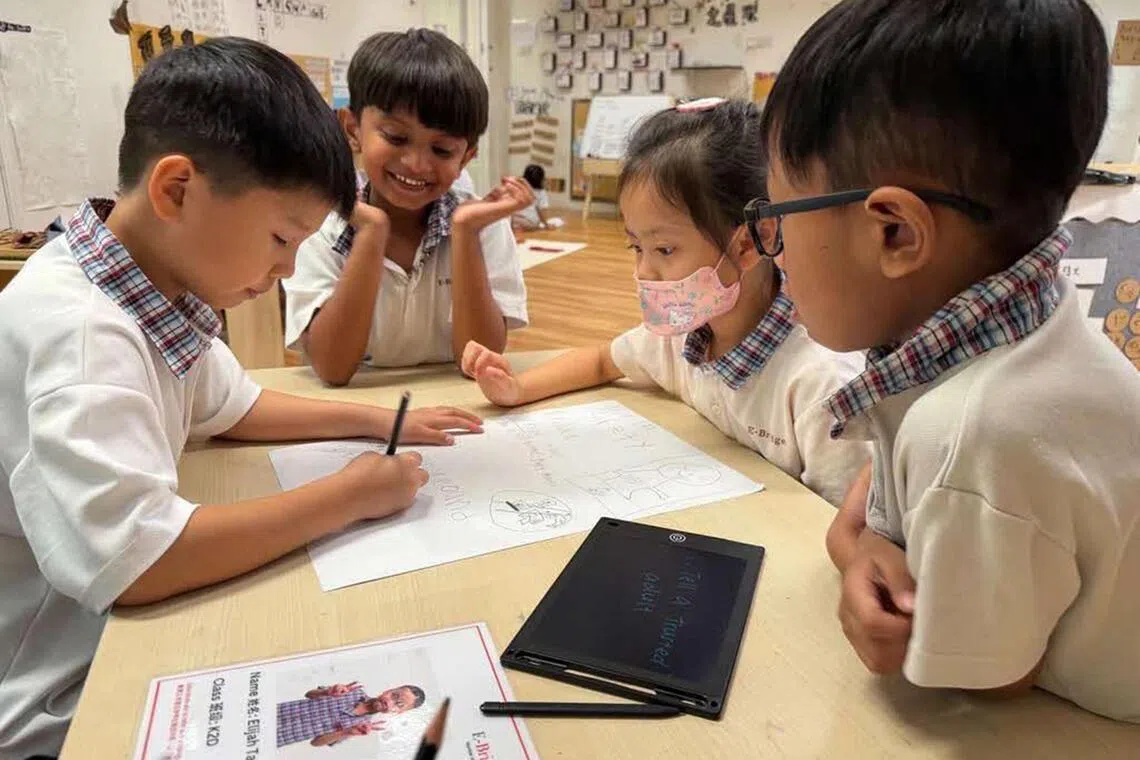
Kindergarten children at E-Bridge Pre-School brainstorming and creating a poster to encourage and advocate online safety.
PHOTO: E-BRIDGE PRE-SCHOOL
Published Oct 24, 2026, 03:30 PM
Updated Oct 24, 2026, 03:30 PM
Singapore pre-schools will teach more children healthy digital habits, using stories, role play and games to build online safety before they get their own devices.
The IMDA piloted the programme with over 100 K2 pupils at E-Bridge, and Skool4Kidz and E-Bridge are now rolling it out to thousands more children.
Lessons cover setting boundaries, thinking before acting, reporting inappropriate content and asking trusted adults for help, with parents saying the early start also helps at home.
SINGAPORE - A circle of five-year-olds at a pre-school were given cartoon printouts depicting an angry man shouting , and asked a simple question: How does this picture make you feel?
Some kids expressed nervousness and discomfort, while others expressed confusion. The children were being taught to recognise the discomfort they feel when they viewed inappropriate content online , and to approach a trusted adult for help.
The cartoon printouts were shown in lieu of actual images online.
This exercise is part of a new initiative by the Infocomm Media Development Authority (IMDA) to help children learn healthy digital habits .
F irst piloted in April 2026 with over 100 K2 pupils at E-Bridge pre-school centres, the scheme will now be expanded to benefit more pre-school children.
A mindmap of a brainstorming session where Kindergarten children from E-Bridge Pre-School were introduced to online safety. Credits should be made out to 'E-bridge Pre-School'.
Rahayu Mahzam, Minister of State for Digital Development and Information, said the IMDA plans to partner with the Early Childhood Development Agency (ECDA) to onboard more pre-school operators in 2027.
She made this announcement at th e launch of th e Digital for Life (DfL) festival , held at VivoCity on Oct 24. President Tharman Shanmugaratnam, patron of the DfL movement, also attended the event, hosted by Minister for Digital Development and Information, Josephine Teo.
Held across two weekends, the festival will offer interactive experiences for visitors to build digital skills. Next weekend’s edition will be held at Heartbeat@Bedok, from Oct 31 to Nov 1.
Skool4Kidz has already introduced the lessons to 800 K2 children across 35 of its centres in September 2026. E-Bridge will roll it out across all 30 of its centres in December, reaching nearly 3,000 K1 and K2 children.
The lessons on healthy digital habits cover four key areas - setting boundaries, thinking before acting, reporting inappropriate content, and leaning on parental support.
For example, children will be taught to direct friends to get help, and engage in healthy non-screen habits like jogging and visiting the library.
Such activities for pre-schoolers are part of IMDA’s broader Screen Smart From The Start movement launched in May 2026 to help families foster healthy digital habits.
President Tharman Shanmugaratnam (centre) with Minister for Digital Development and Information Josephine Teo (left) and Minister of State for Digital Development and Information Rahayu Mahzam (fourth from left) touring the exhibitions at the Digital for Life Festival, on Oct 24. ST PHOTO: AZMI ATHNI
President Tharman Shanmugaratnam (centre) with Minister for Digital Development and Information Josephine Teo (left) and Minister of State for Digital Development and Information Rahayu Mahzam (fourth from left) touring the exhibitions at the Digital for Life Festival, on Oct 24.
ST PHOTO: AZMI ATHNI
Eng Zeng Ting, centre leader at Skool4Kidz said many of their lessons on online safety are not done on screens. They involve story-telling, role play, and games.
“Limited screen time does not mean no exposure. Young children see phones and tablets around them every day... Like road safety, these habits are best learnt before children need them,” said Eng.
Alice Tay, the director for learning at E-Bridge Pre-School, explained that the lessons teach device usage in the same practical way teachers introduce other tools, like how to use scissors safely for crafts.
A Celebration of Learning event at an E-Bridge pre-school centre, where parents were shared the IMDA materials used to teach their children of online safety and usage limits. PHOTO: E-BRIDGE PRE-SCHOOL
A Celebration of Learning event at an E-Bridge pre-school centre, where parents were shared the IMDA materials used to teach their children of online safety and usage limits.
“Because digital tools are very complex, it is even more important to help them understand their purpose and safety guidelines early on,” she said.
Tay added that many parents have said they intend to give their children handphones at Primary 1, for safety and communication reasons. As such, they expressed gratitude that the school is teaching them healthy digital habits early.
Elina Er, 36, a finance manager whose K2 daughter attends the E-Bridge centre in Edgedale Plains, told ST that the classroom discussions have made its way into the family living room. These include lessons which reinforce what is taught at home, such as not using devices during mealtimes.
She said she appreciates that the children are also taught to approach an adult if they encounter content that makes them uncomfortable.
“Social media exposes children to a wide range of content, and they can stumble upon inappropriate material even when they are not actively searching for it,” she said. The rapid rise of artificial intelligence (AI) has also found its way into pre-school chatter.
Hasmidah Abdul Hamid’s five-year-old son, also a K2 pupil at E-Bridge's Edgedale Plains centre, is now able to spot most AI-generated images because of what he has learnt in cl a ss.
(From left) Hasmidah Abdul Hamid, 36, a preschool educator, Nael Aqeef Muhammad Fazwan, 6, Noah Aryan Muhammad Fazwan, 2, and Muhammad Fazwan Idris, 36, an accounts manager, on Oct 24. ST PHOTO: AZMI ATHNI
(From left) Hasmidah Abdul Hamid, 36, a preschool educator, Nael Aqeef Muhammad Fazwan, 6, Noah Aryan Muhammad Fazwan, 2, and Muhammad Fazwan Idris, 36, an accounts manager, on Oct 24.
“Even for us adults, it's so difficult to differentiate between the real and the fake. So it’s nice that the school starts them early on this, which also gives us the opportunity to speak to the children about it at home,” said the 36-year-old pre-school educator.
She added that the school’s lessons on respecting screentime limits would help in the future, especially when the family decides to give him his first handphone.
She recalls a particularly impactful lesson for her family, which involved the children coming up with an agreement on how much screentime they could have. T he parents then signed off on the agreement in school.
“We don’t know how to introduce him to the concept of being online. So having the school being the one to talk about it first, allows me to continue the conversations with him at home,” said Hasmidah.
Elisha Tushara is a correspondent at The Straits Times, specialising in Singapore’s education landscape.
IMDA/Infocomm Media Development Authority
E-Bridge 幼儿园的孩子们正在集思广益,制作海报来鼓励和倡导网络安全。
照片:E-BRIDGE 幼儿园
发布于2026年10月24日下午3:30
更新于2026年10月24日下午3:30
新加坡的幼儿园将通过故事、角色扮演和游戏等方式,在孩子们拥有自己的电子设备之前,培养他们健康的数字习惯,帮助他们建立网络安全意识。
新加坡资讯通信媒体发展局 (IMDA) 在 E-Bridge 对 100 多名 K2 学生进行了试点项目,现在 Skool4Kidz 和 E-Bridge 正在将该项目推广到成千上万的儿童。
课程内容包括设定界限、三思而后行、举报不当内容以及向值得信赖的成年人寻求帮助,家长们表示,早点开始学习对在家学习也很有帮助。
新加坡——幼儿园里一群五岁的孩子围坐在一起,拿到了一幅卡通画,画中一个愤怒的男人正在大喊大叫。老师问了他们一个简单的问题:这幅画让你感觉如何?
一些孩子表现出紧张和不适,而另一些孩子则感到困惑。孩子们正在接受教育,学习如何识别在网上看到不适宜内容时产生的不适感,并向信任的成年人寻求帮助。
网上显示的是卡通印刷品,而不是实际图片。
这项活动是新加坡资讯通信媒体发展局(IMDA)为帮助儿童养成健康的数字习惯而推出的一项新举措的一部分。
该计划于 2026 年 4 月首次在 E-Bridge 学前中心的 100 多名 K2 学生中进行试点,现在将扩大范围,使更多学龄前儿童受益。
这是一张思维导图,展示了E-Bridge幼儿园小朋友们在课堂上学习网络安全知识的头脑风暴过程。图片版权归“E-Bridge幼儿园”所有。
数字发展与信息部政务部长拉哈尤·马赫扎姆表示,IMDA计划与幼儿培育署(ECDA)合作,在2027年引入更多学前教育机构。
她在 10 月 24 日于怡丰城举行的“数字生活 (DfL)”节启动仪式上宣布了这一消息。作为“数字生活”运动的赞助人,总统尚达曼也出席了此次活动,活动由数字发展及新闻部长杨莉明主持。
该节日将持续两个周末,为游客提供互动体验,帮助他们提升数字技能。下周末的活动将于10月31日至11月1日在Heartbeat@Bedok举行。
Skool4Kidz 已于 2026 年 9 月在其 35 个中心为 800 名 K2 儿童引入了这些课程。E-Bridge 将于 12 月在其所有 30 个中心推广这些课程,惠及近 3000 名 K1 和 K2 儿童。
关于健康数字习惯的课程涵盖四个关键领域——设定界限、三思而后行、举报不当内容以及依靠父母的支持。
例如,孩子们将被教导引导朋友寻求帮助,并养成健康的非屏幕习惯,如慢跑和去图书馆。
此类针对学龄前儿童的活动是新加坡资讯通信媒体发展局 (IMDA) 于 2026 年 5 月启动的“从小培养孩子使用智能屏幕”运动的一部分,旨在帮助家庭培养健康的数字习惯。
10月24日,尚达曼总统(中)与数码发展及新闻部长杨莉明(左)及数码发展及新闻部政务部长拉哈尤·马扎姆(左四)一同参观“数码生活节”展览。(海峡时报摄影:阿兹米·阿特尼)
10 月 24 日,尚达曼总统(中)与数码发展及新闻部长杨莉明(左)和数码发展及新闻部政务部长拉哈尤·马赫扎姆(左四)参观了“数码生活节”的展览。
ST 摄影:AZMI ATHNI
Skool4Kidz中心负责人Eng Zeng Ting表示,他们很多关于网络安全的课程都不是在屏幕上进行的,而是通过讲故事、角色扮演和游戏等方式进行。
“限制屏幕时间并不意味着完全不接触。幼儿每天都能看到手机和平板电脑……就像道路安全一样,这些习惯最好在孩子需要它们之前就培养起来,”Eng说道。
E-Bridge 幼儿园的学习主管 Alice Tay 解释说,课程教授设备使用方法的方式与教师介绍其他工具(例如如何安全地使用剪刀进行手工制作)的方式相同。
在E-Bridge幼儿园举办的“学习庆祝”活动中,家长们了解了新加坡资讯通信媒体发展局(IMDA)提供的用于教导孩子网络安全和使用限制的资料。照片:E-BRIDGE幼儿园
在 E-Bridge 幼儿园举办的“学习庆祝”活动中,家长们分享了 IMDA 提供的教材,用于教导他们的孩子网络安全和使用限制。
“因为数字工具非常复杂,所以帮助他们尽早了解其用途和安全准则就显得尤为重要,”她说。
Tay补充说,许多家长表示,出于安全和通讯方面的考虑,他们打算在孩子小学一年级就给他们配备手机。因此,他们对学校从小培养孩子健康的数字习惯表示感谢。
36岁的财务经理艾琳娜·厄尔(Elina Er)告诉《海峡时报》,她上幼儿园小班(K2)的女儿在埃奇代尔平原(Edgedale Plains)的E-Bridge中心就读,课堂上的讨论已经延伸到了家里的客厅。这些讨论包括一些巩固家庭教育内容的课程,例如吃饭时不要使用电子设备。
她说,她很赞赏学校教导孩子们,如果遇到让他们感到不舒服的内容,应该向成年人寻求帮助。
“社交媒体让孩子们接触到各种各样的内容,即使他们并非主动搜索,也可能无意中看到不适宜的内容,”她说道。人工智能(AI)的迅速崛起也已经渗透到学龄前儿童的谈话中。
Hasmidah Abdul Hamid 的五岁儿子也是 E-Bridge Edgedale Plains 中心的 K2 学生,由于在课堂上学到的知识,他现在能够识别出大多数人工智能生成的图像。
(左起)10 月 24 日,36 岁的学前教育工作者 Hasmidah Abdul Hamid、6 岁的 Nael Aqeef Muhammad Fazwan、2 岁的 Noah Aryan Muhammad Fazwan 和 36 岁的客户经理 Muhammad Fazwan Idris。ST 照片:AZMI ATHNI
(左起)10 月 24 日,36 岁的学前教育工作者哈斯米达·阿卜杜勒·哈米德 (Hasmidah Abdul Hamid)、6 岁的奈尔·阿吉夫·穆罕默德·法兹万 (Nael Aqeef Muhammad Fazwan)、2 岁的诺亚·雅利安·穆罕默德·法兹万 (Noah Aryan Muhammad Fazwan) 和 36 岁的客户经理穆罕默德·法兹万·伊德里斯 (Muhammad Fazwan Idris)。
“即使对我们成年人来说,也很难区分真假。所以学校从小就开始教孩子们这些很好,这也让我们有机会在家里和孩子们谈论这些,”这位36岁的学前教育工作者说道。
她补充说,学校关于尊重屏幕时间限制的课程将来会有所帮助,尤其是在家人决定给他第一部手机的时候。
她回忆起一次对她家影响尤为深远的经历:孩子们就每天的屏幕时间达成一致,然后家长们在学校签字确认。
“我们不知道该如何向他介绍上网的概念。所以,由学校先来谈论这个话题,让我可以在家继续和他交流,”哈斯米达说道。
Elisha Tushara 是《海峡时报》的记者,专门报道新加坡的教育领域。
新加坡资讯通信媒体发展局/IMDA