Is indoor air safer? 7 things to know and ways to stay protected in this prolonged haze season室内空气更安全吗?在持续的雾霾季节里,你需要了解的7件事以及保护自己的方法
A test reveals worse air quality indoors than outside, while product testing shows that some expired masks still filter particles effectively. Talking Point finds out from experts why neither finding tells the whole story.
新闻视频
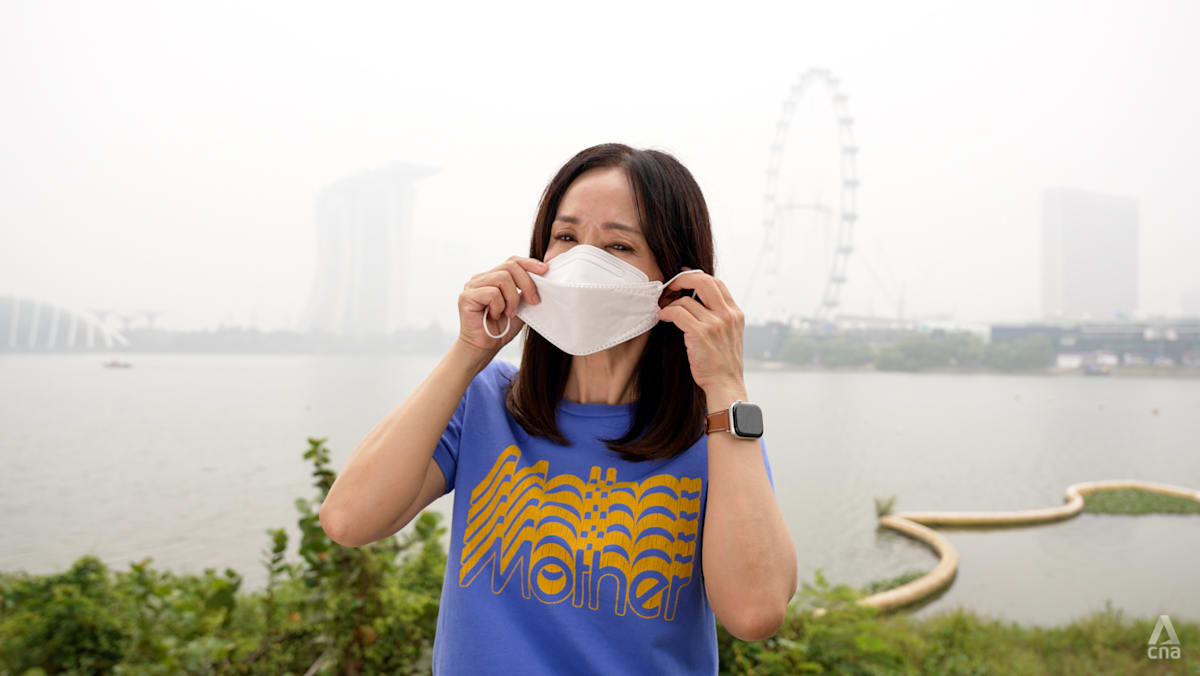
A test reveals worse air quality indoors than outside, while product testing shows that some expired masks still filter particles effectively. Talking Point finds out from experts why neither finding tells the whole story.
Talking Point host Diana Ser looks at some of the best ways to protect against the haze.
This audio is generated by an AI tool.
SINGAPORE: Staying indoors with the windows shut may seem the safest way to escape the haze. But just how much cleaner is the air in your home?
When CNA’s Talking Point tested the air quality in a fifth-floor flat whose windows had been closed for an hour, the PM2.5 reading of 187 micrograms per cubic metre was higher than the level outdoors, which was 169.
The finding comes as Singapore grapples with its worst haze episode since 2015, with 20 consecutive days of unhealthy air recorded as at Oct 24, surpassing the 15-day streak in 2015.
As the haze persists, there is public concern about prolonged exposure to PM2.5, the predominant pollutant during periods of transboundary haze.
CNA Games Guess Word Crack the word, one row at a time Buzzword Create words using the given letters Mini Sudoku Tiny puzzle, mighty brain teaser Mini Crossword Small grid, big challenge Word Search Spot as many words as you can Show More Show Less
Blocks of Housing and Development Board flats shrouded in haze amid one of the longest haze episodes in Singapore.
PM2.5 particles, which are roughly 30 times smaller than the width of a human hair, can penetrate deep into the lungs and cause inflammation.
Prolonged exposure has been linked to increased risk of a stroke and lung cancer, among other things, highlighted respiratory physician Steve Yang from The Respiratory Practice.
So, viewers have written to Talking Point to ask how best to protect themselves. Does air-conditioning help? Do expired N95 masks still offer protection? And which air quality standards should they rely on?
Programme host Diana Ser met the experts to look at seven things that Singaporeans should know during this haze season.
1. WHAT IS YOUR INDOOR AIR QUALITY LIKE?
In the first flat Ser visited, where the air quality was worse than outdoors, the windows were open in the morning before the resident closed them.
“It’s entirely possible that the windows were closed … (when) the PM2.5 levels were higher, thereby trapping the polluted air,” said Nanyang Technological University (NTU) assistant professor Leonard Ng, who used a professional-grade air quality monitor to record the measurements.
In a 15th-floor flat in the same block, where the windows were also closed for an hour, the reading was lower at 149 but still elevated. When they opened the windows, it climbed to 301 as the haze worsened.
As there is stronger airflow on a high floor, haze particles get blown indoors faster even as these homes are less exposed to traffic emissions, said Ng. “If the air quality is poor outside, it’ll be poor inside as well.”
He advised opening the windows at home only when the outdoor air quality “isn’t that bad”.
2. HOW MUCH CAN AIR-CON OR AIR PURIFIERS HELP?
When the air-con in one bedroom in the 15th-floor flat was run for 10 minutes, the PM2.5 reading dropped from 131.6 to 109.8, which was still in the elevated band.
While most air-con units have built-in filters that remove some airborne particles, they are not designed to “fully clean your air”, said Ng.
When an air purifier was run for an hour in the living room, however, the PM2.5 reading dropped to 40.7, within the normal band.
While the tests were conducted under different conditions and with different durations, the findings suggest that the air-con is no substitute for an air purifier.
Leonard Ng, from Nanyang Technological University’s School of Materials Science and Engineering, discussing indoor air quality with Ser.
For those considering an air purifier, Ng advised choosing one based on room size — by checking its clean air delivery rate, which measures the volume of clean air produced and thus the purifier’s effectiveness in that space.
While high-efficiency particulate air filters will capture fine airborne particles, they are not essential, he added. A regular filter rated for removal of PM2.5 particles can also be used.
He also recommended running the air purifier for an extended period with the doors and windows closed, while keeping its vents unobstructed.
3. CAN EXPIRED N95 MASKS STILL BE USED?
One Talking Point viewer asked whether his N95 masks that expired in 2017 could still offer him protection.
Ser sent two of them to ST Engineering’s mask production facility, along with other commonly used masks. There, the company tested how effective each mask was in filtering out airborne particles, including those similar in size to PM2.5.
The viewer’s masks achieved 99 per cent filtration efficiency, exceeding the 95 per cent requirement for N95 masks. By contrast, another N95 mask that expired in 2022 was at 93 per cent, below the required standard.
ST Engineering’s head of respiratory protection, Jerome Lee, said manufacturers may design masks that exceed filtration requirements to take account of deterioration over time. Masks stored in cool, dry conditions may also retain their filtration capability even years after expiry.
But he advised against using expired masks, as their performance can no longer be guaranteed and the amount of degradation “isn’t something you can observe using your naked eye”.
Talking Point also found that a surgical mask filtered out 67 per cent of the test particles, compared with 95 per cent for a KF94 mask and 98 per cent for new N95 masks.
Ser finding out the results of the mask tests from Jerome Lee, ST Engineering’s head of respiratory protection.
Even an efficient mask offers less protection, however, if it does not fit snugly, Lee cautioned. Surgical masks, in particular, are not designed to be sealed tight.
He recommended discarding masks with damaged straps, deteriorated nose pads or other signs of wear.
4. WHY DO DIFFERENT WEBSITES HAVE DIFFERENT READINGS?
Some viewers asked why air quality readings on the National Environment Agency (NEA) website differed from those on international websites.
Ser compared a one-hour PM2.5 reading of 164 on the NEA website with a reading of 214 on the World Air Quality Index (AQI) website. “That’s quite a disparity. Why is that so?” she asked.
A PM2.5 reading of 164 on the haze.gov.sg website.
By comparison, a PM2.5 reading of 214 on the aqicn.org website.
Natasha Jamali, principal scientific officer in the NEA’s environmental quality monitoring department, said some third-party websites use different data sources, including the NEA’s readings as well as low-cost sensor data from individuals and private organisations.
These sensors may not be calibrated as frequently as NEA’s analysers, and their readings can be affected by humidity and temperature. “More data may not necessarily be better because it depends on the quality of these data sources,” she said.
Calculations based on the AQI, developed by the United States Environmental Protection Agency, are also different from Singapore’s method of calculating PM2.5 readings, so the numbers are “not directly comparable”, she added.
As for how to use the NEA readings, she advised looking at the one-hour PM2.5 reading for the most recent indication of air quality before heading out or not.
The 24-hour Pollutant Standards Index, meanwhile, indicates the overall air quality over the past day. It measures six pollutants including PM2.5 and is used for health advisories and planning activities.
For next-day activities, Singaporeans can refer to the NEA’s air quality forecast, which also takes into account weather conditions and regional haze.
5. WHAT IS THE IMPACT OF EXERCISING OUTDOORS?
Despite the lingering haze, some people are exercising outdoors. One runner told Talking Point he came from an ActiveSG gym where all the treadmills were occupied. Another said: “I don’t like running on treadmills.”
A cardiopulmonary exercise test showed how much more PM2.5 particles they could be inhaling outdoors.
Riding an exercise bike at mild intensity, Ser breathed in about 50 per cent more air per minute than at rest. This rose during moderate exercise to three times her baseline and to six times with maximal exertion.
Ser exercising at different intensities during the cardiopulmonary exercise test.
Senior consultant cardiologist Peter Ting at the Harley Street Heart and Vascular Centre said athletes could breathe in 10 to 20 times more air during vigorous exercise.
His fellow doctor, Yang, estimated that Ser would have inhaled about 1.7 micrograms of PM2.5 per minute at rest and about 7 micrograms during intense exercise if she were outdoors, based on the PM2.5 reading at the time.
PM2.5 exposure can increase the risk of heart attack, particularly among the elderly and those with existing lung and heart conditions. “After about an hour,” Ting warned, “the risk already starts to go up.”
He advised those exercising outdoors to check the one-hour PM2.5 reading, reduce workout intensity and duration and avoid busy roads, where traffic adds to the pollution.
Yang said he would move exercise indoors once air quality reaches the unhealthy range — while continuing to monitor the PM2.5 reading as there could be indoor air pollution.
6. WHEN WILL THE HAZE END?
Singaporeans can expect some relief by mid-November, according to NTU climate researcher Wang Jingyu.
The assistant professor said the arrival of the northeast monsoon will change the prevailing winds; smoke from forest fires in Indonesia will no longer be carried to Singapore.
But there is a secondary haze season, typically from March to May, when hot and dry conditions can increase the risk of wildfires in the region, he highlighted.
Wang Jingyu, an assistant professor from NTU’s National Institute of Education, discussing the haze outlook with Ser.
7. COULD IT GET WORSE IN FUTURE?
Wang said scientists also expect future climate conditions to “be more El Nino-like”. This could reduce rainfall in Southeast Asia “significantly” and make forest fires harder to extinguish, increasing the likelihood of a similar haze episode recurring.
Whether it could get worse, however, also depends on countermeasures to control the haze. The Association of Southeast Asian Nations has created a roadmap aimed at achieving a haze-free region by 2030. Strengthening enforcement is one of the strategies.
In recent days, the NEA issued notices to 10 companies in Indonesia under the Transboundary Haze Pollution Act, followed by notices to 10 Singapore-based firms for the first time under the law.
Singapore has also offered Indonesia assistance with its firefighting efforts and in cloud seeding. For now, Singaporeans can only look ahead to the winds to change.
Watch this episode of Talking Point here . The programme airs on Channel 5 on Thursdays at 9.30pm.
CNA's best current affairs documentaries with a deeper look at issues affecting Asia, sent to your inbox weekly.
Get our pick of top stories and thought-provoking articles in your inbox
Stay updated with notifications for breaking news and our best stories
Join our channel for the top reads for the day on your preferred chat app
一项测试显示室内空气质量比室外更差,而产品测试表明,一些过期口罩仍然能有效过滤颗粒物。本期《谈话要点》节目采访了专家,探讨为何这两项发现都不能说明全部问题。
《谈话要点》节目主持人戴安娜·瑟尔探讨了一些抵御雾霾的最佳方法。
这段音频由人工智能工具生成。
新加坡:待在室内,紧闭门窗,似乎是躲避雾霾最安全的方法。但你家里的空气究竟能干净多少呢?
当亚洲新闻台的《谈话要点》栏目对一间五楼公寓的空气质量进行测试时,该公寓的窗户已经关闭了一个小时,结果显示PM2.5读数为每立方米187微克,高于室外的169微克。
新加坡正遭受自 2015 年以来最严重的雾霾天气,截至 10 月 24 日,已连续 20 天空气质量不健康,超过了 2015 年的 15 天。
随着雾霾持续,公众开始关注长期暴露于 PM2.5 的问题,PM2.5 是跨境雾霾期间的主要污染物。
CNA游戏 猜词游戏 逐行破解单词 流行词游戏 用给定的字母组成单词 迷你数独 小小谜题,挑战你的大脑 迷你填字游戏 小方格,大挑战 单词搜索 尽可能多地找出单词 显示更多 显示更少
新加坡遭遇了有史以来持续时间最长的雾霾天气之一,多栋建屋发展局组屋笼罩在雾霾之中。
PM2.5颗粒比人类头发的宽度小约30倍,可以深入肺部并引起炎症。
呼吸科医生史蒂夫·杨(Steve Yang)指出,长期接触有害物质会增加中风和肺癌等疾病的风险。
因此,观众们纷纷致信《谈话要点》节目,询问如何才能最好地保护自己。空调有用吗?过期的N95口罩还能提供防护吗?他们应该参考哪些空气质量标准?
节目主持人 Diana Ser 与专家们会面,探讨了新加坡人在雾霾季节应该了解的七件事。
1. 您的室内空气质量如何?
Ser参观的第一套公寓里,空气质量比室外还差,早上住户会把窗户打开,然后再关上。
“很有可能当时窗户是关着的……(当时)PM2.5 浓度较高,从而导致污染空气滞留在室内,”南洋理工大学 (NTU) 助理教授 Leonard Ng 说,他使用专业级空气质量监测仪记录了测量结果。
在同一栋楼的15楼公寓里,窗户也关闭了一个小时,读数虽然较低,为149,但仍然偏高。当他们打开窗户后,随着雾霾加剧,读数攀升至301。
吴先生表示,由于高层空气流通更强,即使这些房屋较少受到交通尾气的影响,雾霾颗粒也会更快地被吹入室内。“如果室外空气质量差,室内空气质量也会很差。”
他建议只有在室外空气质量“不太差”的情况下才打开家里的窗户。
2. 空调或空气净化器能起到多大作用?
当15楼公寓一间卧室的空调运行10分钟后,PM2.5读数从131.6降至109.8,但仍处于较高水平。
吴先生表示,虽然大多数空调机组都内置了过滤器,可以去除一些空气中的颗粒物,但它们并非旨在“完全净化空气”。
然而,当在客厅里运行空气净化器一小时后,PM2.5 读数降至 40.7,处于正常范围内。
虽然测试是在不同的条件下进行的,持续时间也不同,但结果表明,空调不能替代空气净化器。
来自南洋理工大学材料科学与工程学院的 Leonard Ng 与 Ser 讨论了室内空气质量。
对于那些正在考虑购买空气净化器的人,Ng建议根据房间大小来选择——通过检查其洁净空气输出率,该指标衡量的是产生的洁净空气量,从而衡量净化器在该空间中的有效性。
他补充说,虽然高效空气微粒过滤器可以捕捉空气中的细颗粒物,但并非必需品。使用能够去除PM2.5颗粒的普通过滤器也可以。
他还建议在关闭门窗的情况下长时间运行空气净化器,同时保持通风口畅通。
3. 过期的N95口罩还能继续使用吗?
一位《谈话要点》节目的观众询问,他2017年过期的N95口罩是否还能提供防护。
Ser将其中两款口罩连同其他常用口罩一起送往新加坡科技工程公司的口罩生产工厂。该公司在那里测试了每款口罩过滤空气中颗粒物(包括与PM2.5大小相近的颗粒物)的有效性。
该款口罩的过滤效率达到99%,超过了N95口罩95%的要求。相比之下,另一款2022年过期的N95口罩的过滤效率仅为93%,低于标准要求。
新加坡科技工程公司呼吸防护部门负责人李杰罗姆表示,制造商可能会设计出过滤性能高于标准的口罩,以应对口罩随时间推移而发生的性能下降。此外,储存在阴凉干燥环境中的口罩,即使在过期数年后,也可能仍能保持其过滤性能。
但他建议不要使用过期的口罩,因为它们的性能无法再得到保证,而且劣化程度“不是用肉眼就能观察到的”。
Talking Point 还发现,外科口罩可以过滤掉 67% 的测试颗粒,而 KF94 口罩可以过滤掉 95%,新型 N95 口罩可以过滤掉 98%。
Ser 从新加坡科技工程公司呼吸防护主管 Jerome Lee 那里得知了口罩测试的结果。
李医生提醒说,即使是高效口罩,如果佩戴不贴合面部,防护效果也会降低。特别是医用外科口罩,其设计目的并非完全密封。
他建议丢弃带子损坏、鼻托老化或其他磨损迹象的口罩。
4. 为什么不同的网站有不同的解读?
一些观众询问为什么国家环境局 (NEA) 网站上的空气质量读数与国际网站上的读数不同。
Ser将新加坡国家环境局网站上显示的PM2.5一小时读数164与世界空气质量指数(AQI)网站上显示的读数214进行了比较。“这差距太大了。这是为什么呢?”她问道。
haze.gov.sg 网站上的 PM2.5 读数为 164。
相比之下,aqicn.org 网站上的 PM2.5 读数为 214。
国家环境局环境质量监测部门首席科学官娜塔莎·贾马利表示,一些第三方网站使用不同的数据源,包括国家环境局的读数以及来自个人和私人组织的低成本传感器数据。
这些传感器的校准频率可能不如新加坡国家环境局(NEA)的分析仪,而且它们的读数会受到湿度和温度的影响。“数据越多并不一定越好,因为这取决于数据源的质量,”她说道。
她补充说,根据美国环境保护署制定的空气质量指数 (AQI) 进行的计算方法也与新加坡计算 PM2.5 读数的方法不同,因此这些数字“不能直接比较”。
至于如何使用国家环境局的读数,她建议在出门前查看一小时 PM2.5 读数,以获得最新的空气质量指标。
同时,24小时污染物标准指数反映了过去一天的整体空气质量。它测量包括PM2.5在内的六种污染物,并用于发布健康建议和规划活动。
对于第二天的活动安排,新加坡人可以参考国家环境局的空气质量预报,该预报还会考虑天气状况和区域雾霾情况。
5. 户外运动的影响是什么?
尽管雾霾尚未完全消散,仍有一些人在户外锻炼。一位跑步者告诉《Talking Point》节目,他刚从ActiveSG健身房出来,那里的跑步机都满了。另一位跑步者说:“我不喜欢在跑步机上跑步。”
心肺运动测试表明,他们在户外可能会吸入比室内多得多的 PM2.5 颗粒物。
Ser以中等强度骑健身车时,每分钟吸入的空气量比静息状态多约50%。中等强度运动时,这一数值上升至基线水平的三倍,而最大强度运动时则上升至六倍。
在心肺运动试验中,受试者以不同的强度进行锻炼。
哈利街心脏和血管中心的资深顾问心脏病专家彼得·丁表示,运动员在剧烈运动期间吸入的空气量可能是普通人的 10 到 20 倍。
他的同事杨医生根据当时的 PM2.5 读数估计,如果 Ser 在户外,她在休息时每分钟会吸入约 1.7 微克 PM2.5,在剧烈运动时每分钟会吸入约 7 微克 PM2.5。
PM2.5暴露会增加心脏病发作的风险,尤其对老年人和已有肺部或心脏疾病的人群更为严重。“大约一小时后,”丁警告说,“风险就开始上升了。”
他建议户外运动者查看一小时 PM2.5 读数,降低运动强度和持续时间,并避开交通繁忙的道路,因为交通会加剧污染。
杨表示,一旦空气质量达到不健康范围,他将把锻炼转移到室内——同时继续监测 PM2.5 读数,因为室内可能存在空气污染。
6. 雾霾何时才能结束?
南洋理工大学气候研究员王景宇表示,新加坡人有望在11月中旬迎来一些缓解。
这位助理教授表示,东北季风的到来将改变盛行风向;来自印度尼西亚森林火灾的烟雾将不再飘到新加坡。
但他强调,还有一个次要的雾霾季节,通常在 3 月到 5 月之间,此时炎热干燥的天气会增加该地区发生野火的风险。
台大国立教育学院助理教授王景宇与Ser讨论雾霾前景。
7. 未来情况会更糟吗?
王教授表示,科学家们还预计未来的气候条件将“更像厄尔尼诺现象”。这可能会“显著”减少东南亚的降雨量,使森林火灾更难扑灭,从而增加类似雾霾事件再次发生的可能性。
然而,情况是否会恶化,也取决于控制雾霾的应对措施。东盟制定了一项路线图,旨在到2030年实现该地区无雾霾的目标。加强执法是其中一项战略。
近日,新加坡国家环境局根据《跨境烟霾污染法》向印尼的 10 家公司发出通知,随后又首次根据该法向新加坡的 10 家公司发出通知。
新加坡也已向印尼提供灭火和人工增雨方面的援助。目前,新加坡人只能期盼风向转变。
点击此处观看本期《谈话要点》节目。该节目每周四晚9点30分在第五频道播出。
每周将 CNA 精选的、深入探讨影响亚洲问题的时事纪录片发送到您的邮箱。
订阅我们的邮件,即可获取精选热点新闻和引人深思的文章。
订阅通知,第一时间获取突发新闻和精彩报道。
加入我们的频道,即可在您常用的聊天应用上获取当日热门文章。