WP’s position seems to shift with the ‘political winds’, PAP must take the wider view: PM Wong黄循财总理表示,工人党的立场似乎会随着“政治风向”而改变,人民行动党必须从更广阔的视角看待问题。
Read more at straitstimes.com.
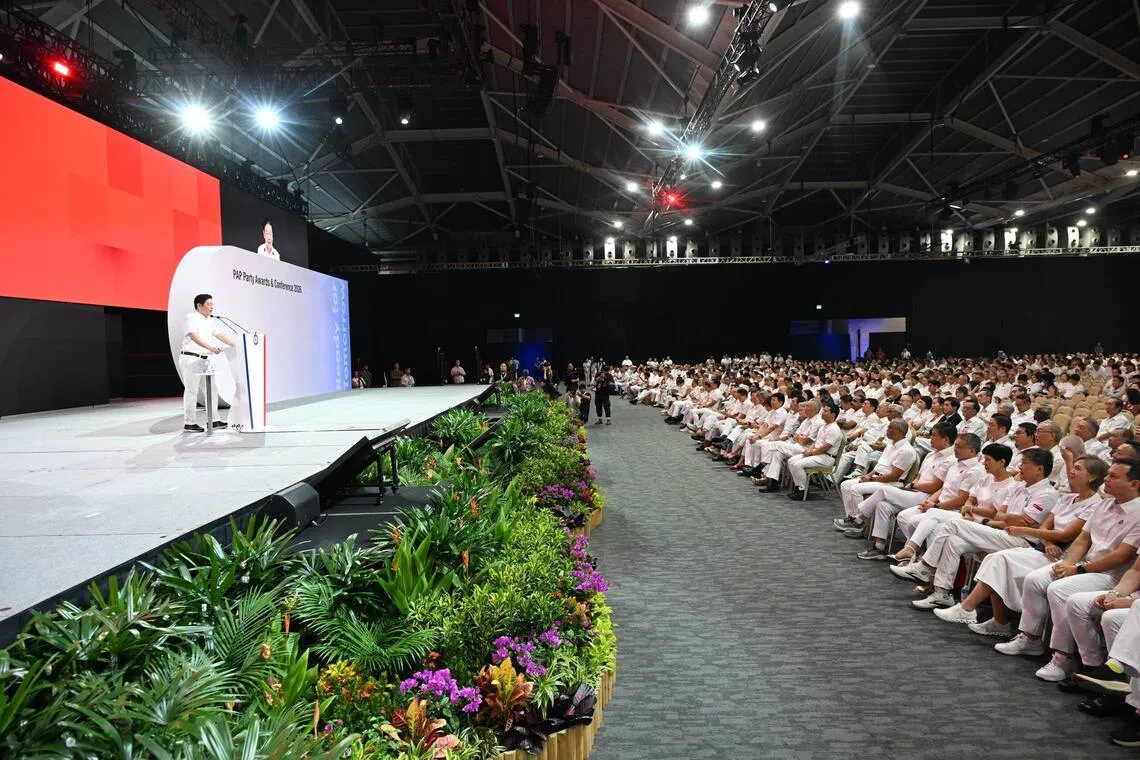
Prime Minister Lawrence Wong giving his speech during the PAP Awards and Conference at Singapore Expo on Oct 25.
ST PHOTO: AZMI ATHNI
Published Oct 25, 2026, 11:30 AM
Updated Oct 25, 2026, 11:30 AM
SINGAPORE – The Workers’ Party has not always taken consistent or coherent positions on policy, said Prime Minister Lawrence Wong on Oct 25.
Instead, the opposition party has taken different positions at different times, depending on the concerns of the day, or what it believes will be popular, PM Wong told the PAP’s cadres at the party’s biennial conference at Singapore Expo.
These positions do not always add up to a coherent approach that takes account of the trade-offs and longer-term consequences, he said.
The PAP’s approach is different, and as the governing party it must take a wider and longer-term view, he said.
He raised two examples: housing and foreign manpower.
On housing, PM Wong said the WP had in 2019 argued that the Government should build fewer new flats.
Then, Housing Board flat resale prices were falling.
Later, when the Covid-19 pandemic struck, construction was disrupted and there was a shortfall of new flats.
By 2023, the WP was criticising the Government for not building enough flats, PM Wong said.
“Yet there was no acknowledgement of what it had advocated just a few years earlier.”
Now the housing situation has stabilised, but the Government still needs to build more new flats to meet the needs of different groups of Singaporeans including singles, he added.
At the same time, it wants to protect and grow green spaces.
Every new development involves difficult choices, PM Wong added, and when it considers sites like Sunset Way or Gillman Barracks, it has to weigh these competing demands carefully.
The two sites were discussed in Parliament in August, after MPs from both the PAP and WP raised concerns from residents about the selection of these green spaces for redevelopment into housing.
“There is no option that will satisfy everyone. But we must make a choice. And we will choose what best serves Singapore’s wider and longer-term interests.”
On foreign manpower, PM Wong said when the PAP tightened foreign worker policies in 2012, the WP called for greater flexibility across industries.
Later during the debate on population policy, amid concerns over the population projections of 6.9 million, the WP proposed zero growth in the foreign workforce, he said.
More recently, when small and medium-sized enterprises faced manpower shortages, the WP called for easing of foreign worker quotas, he added.
“You can see how their position seems to shift with the political winds. But foreign manpower policy cannot simply shift back and forth with the pressures of the moment,” he said.
Any change has wider consequences and even relatively small adjustments to work permit and S Pass rules can lead to substantial increases in foreign worker numbers across the economy, he added.
It is easier to argue for a particular position when one does not have to reconcile all the competing demands, or take responsibility for the outcome, said PM Wong.
This is part of opposition politics. But as the governing party, the PAP must consider the wider picture, he said.
“We cannot simply tell everyone what they want to hear, or promise everyone what they hope to get.”
Governing is different, and the PAP cannot just offer what sounds attractive today, he added.
“We have to make difficult choices that will stand the test of time.”
The party must also guard against populism – the temptation to offer simplistic solutions instead of confronting difficult realities.
“Above all, we must never allow our politics to become so divided that we lose the ability to work together for the good of Singapore,” he said.
He pointed to global developments where traditional political parties have lost ground and the political centre has weakened, and protests have erupted on the streets.
There are no easy answers to these problems, yet there is always the temptation to offer quick fixes, he added, but these do not solve the underlying problems.
“So the frustrations persist. Trust in institutions weakens. Politics becomes more polarised,” he said.
Then it becomes harder to find common ground, build consensus and make the difficult decisions needed for the common good, PM Wong said.
Singaporeans also worry about their livelihoods and their children’s futures – and these are real concerns which the PAP must take seriously, he added.
The Government must keep opportunities open, address the pressures Singaporeans face, and sustain their confidence in the future.
Tackling politically difficult issues head on
Sometimes, the challenge is not about balancing competing interests, PM Wong said.
It is about confronting an issue that would be much easier, politically, to leave alone.
PM Wong raised the example of updating political salaries, which he announced in Parliament in September.
Then, he said political office-holders will get a one-off pay increase of up to 9%, as the Government had accepted the recommendations of a committee convened in December 2025 to review political salaries.
The PAP knew there would be strong reactions, PM Wong said.
The politically convenient option would have been to avoid the issue altogether.
But the PAP could not keep putting off a decision that matters for Singapore’s ability to build a strong political leadership team for the future, he said.
“So I decided to address the issue openly in Parliament, explain our decision, and take responsibility for it,” he said.
Summing up his points, PM Wong said housing, manpower and political salaries are very different issues.
But the PAP’s approach is guided by the same principles – it listens carefully, explains the trade-offs honestly, and makes the call, he said.
“And we take responsibility for the consequences,” he added.
The party cannot shy away from difficult decisions just because they are unpopular, nor tell people what they want to hear today, only to leave others to deal with the consequences tomorrow, he said.
Because postponing difficult decisions does not make the problems disappear.
“We simply pass them on to those who come after us – and we often leave them with harder choices later.
“So, comrades, we must always have the courage to act. Act not just for Singaporeans today, but also for our children and grandchildren who will inherit the Singapore we build.”
10月25日,总理黄循财在新加坡博览中心举行的PAP颁奖典礼暨大会上发表讲话。
ST 摄影:AZMI ATHNI
发布于2026年10月25日上午11:30
更新于2026年10月25日上午11:30
新加坡——总理黄循财于10月25日表示,工人党在政策问题上并非一直采取一致或连贯的立场。
黄循财总理在新加坡博览中心举行的人民行动党两年一度的大会上告诉该党干部,反对党会根据当时的形势或它认为会受欢迎的事情,在不同的时期采取不同的立场。
他表示,这些立场并不总是能形成一个连贯一致的方法,能够考虑到权衡利弊和长期后果。
他说,人民行动党的做法不同,作为执政党,它必须采取更广泛、更长远的视角。
他举了两个例子:住房和外国劳动力。
关于住房问题,黄英贤总理表示,工人党曾在2019年主张政府应该减少新建组屋的数量。
当时,组屋转售价格开始下跌。
后来,新冠疫情爆发,建筑业受到干扰,新公寓供应短缺。
黄之锋总理表示,到2023年,工人党将批评政府没有建造足够的组屋。
“然而,它却丝毫没有承认自己几年前所倡导的理念。”
他补充说,目前住房形势已经稳定,但政府仍需建造更多新组屋,以满足包括单身人士在内的不同新加坡群体的需求。
与此同时,它也希望保护和发展绿地。
黄英贤总理补充说,每一项新的发展都涉及艰难的选择,在考虑日落大道或吉尔曼军营等地块时,必须仔细权衡这些相互冲突的需求。
8 月份,国会讨论了这两个地点,此前人民行动党和工人党的议员们都表达了居民对选择这些绿地改建成住宅的担忧。
“没有哪个选项能让所有人满意。但我们必须做出选择。我们将选择最符合新加坡更广泛、更长远利益的选项。”
关于外籍劳工问题,黄英贤总理表示,2012年人民行动党收紧外籍劳工政策时,工人党呼吁各行业给予更大的灵活性。
他说,后来在人口政策辩论中,由于对 690 万的人口预测表示担忧,工人党提议外国劳动力零增长。
他补充说,最近,当中小企业面临人力短缺时,工人党呼吁放宽外籍劳工配额。
“你可以看出他们的立场似乎会随着政治风向而改变。但对外劳动力政策不能仅仅因为一时的压力而来回摇摆,”他说。
他补充说,任何改变都会产生更广泛的影响,即使对工作许可和S准证规则进行相对较小的调整,也可能导致整个经济中外国工人数量大幅增加。
黄总理表示,如果不必协调所有相互冲突的要求,也不必承担结果的责任,那么就更容易为某个立场辩护。
这是反对党政治的一部分。但他表示,作为执政党,人民行动党必须考虑更广阔的形势。
“我们不能简单地告诉每个人他们想听的话,也不能向每个人承诺他们希望得到的东西。”
他补充说,执政是不一样的,人民行动党不能仅仅提供今天听起来有吸引力的东西。
“我们必须做出经得起时间考验的艰难抉择。”
该党还必须警惕民粹主义——即不愿面对困难现实,而倾向于提供简单化的解决方案。
“最重要的是,我们绝不能让新加坡的政治分裂到如此地步,以至于我们丧失了为了新加坡的利益而共同努力的能力,”他说。
他指出,在全球范围内,传统政党的影响力有所下降,政治中心力量削弱,街头爆发了抗议活动。
他补充说,这些问题没有简单的答案,但人们总是忍不住想要提供快速的解决方案,但这并不能解决根本问题。
“因此,不满情绪持续存在。人们对机构的信任度下降。政治变得更加两极分化,”他说。
黄循财总理表示,这样一来,就更难找到共同点、达成共识,也更难做出对公共利益至关重要的艰难决定。
他还补充说,新加坡人也担心自己的生计和孩子的未来——这些都是人民行动党必须认真对待的真正担忧。
政府必须保持机会开放,解决新加坡人面临的压力,并维持他们对未来的信心。
直面政治难题
黄循财总理表示,有时候,挑战不在于平衡相互冲突的利益。
这是关乎直面一个在政治上很容易被搁置的问题。
黄循财总理举了更新政治人物薪酬的例子,他已于9月在国会宣布了这一决定。
然后,他表示,政治官员将获得一次性加薪,最高可达 9%,因为政府已经接受了 2025 年 12 月成立的审查政治薪酬委员会的建议。
黄循财总理表示,人民行动党早就预料到会引发强烈反响。
从政治角度来看,最便捷的做法是完全回避这个问题。
但他表示,人民行动党不能再拖延这项对新加坡未来能否建立强大的政治领导团队至关重要的决定了。
“所以我决定在议会公开讨论这个问题,解释我们的决定,并承担相应的责任,”他说。
黄总理总结道,住房、人力和政治薪酬是非常不同的问题。
但他表示,人民行动党的做法遵循同样的原则——认真倾听,诚实地解释利弊,然后做出决定。
“我们会承担由此产生的后果,”他补充道。
他说,该党不能因为某些艰难的决定不受欢迎就回避这些决定,也不能为了迎合人们的喜好而今天说些他们想听的话,明天却把后果留给其他人去承担。
因为推迟艰难的决定并不能让问题消失。
“我们只是把这些问题留给后来者——而我们常常给他们留下更艰难的选择。
“所以,同志们,我们必须始终有勇气行动。不仅要为今天的新加坡人行动,也要为我们的子孙后代行动,他们将继承我们共同建设的新加坡。”