PAP party leadership renewal rests on co-option next, with four spots to fill on top committee人民行动党领导层的更迭接下来将取决于增补程序,最高委员会将有四个空缺席位需要填补。
Read more at straitstimes.com.
新闻视频
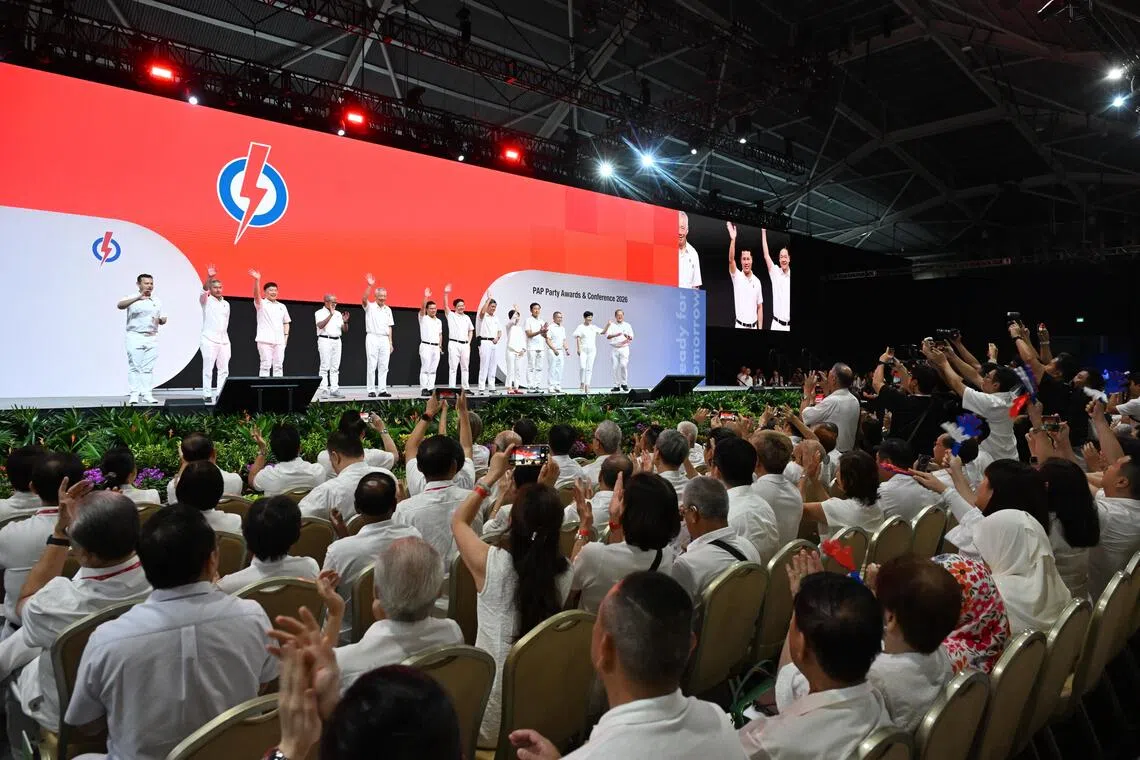
PAP’s 39th central executive committee, including (from left) Zaqy Mohamad, Vivian Balakrishnan, Chee Hong Tat, Masagos Zulkifli, Lee Hsien Loong, Desmond Lee, Lawrence Wong, Chan Chun Sing, Grace Fu, Ong Ye Kung, Edwin Tong, Indranee Rajah and Tan See Leng, at the PAP Awards and Conference at Singapore Expo on Oct 25.
ST PHOTO: AZMI ATHNI
Published Oct 25, 2026, 11:00 PM
Updated Oct 25, 2026, 11:00 PM
SINGAPORE – The PAP’s cadres on Oct 25 returned a largely unchanged line-up to the party’s top leadership body, leaving co-option as the next step to bring in fresh blood.
It is a route commonly used in the past to introduce new leaders who do not yet have enough sway within the party to secure a seat directly to the committee.
The frontrunners for inclusion this time round are ministers Jeffrey Siow and Jasmin Lau, the only two first-term MPs included on a list of 19 candidates put up for cadres to consider.
Making room for them could mean re-allocating seats which the party has for its past few elections reserved for the labour movement, its candidates in opposition-held wards, and other senior party figures.
Cadres at Sunday’s biennial party conference re-elected 12 members to the ruling party’s central executive committee (CEC), which then co-opted the two next highest vote-getters for a total of 14.
This leaves four slots left for the committee to co-opt members to reach its maximum size of 18.
Precedent suggests that the CEC will now move to co-opt first-term ministers to facilitate renewal which Prime Minister Lawrence Wong has flagged as a priority.
PM Wong, who is the party’s secretary-general, said a day before the election that he hoped to work with a team that has a mix of experienced and fresh perspectives on the CEC. At the party convention in 2025, he had said he hopes to see the next generation of PAP leaders emerge by the next general election, due by 2030.
If the CEC co-opts both Siow and Lau, as well as labour chief Ng Chee Meng and a candidate from an opposition-held ward, as it has typically done, all four seats would be filled.
This would mean no room for the heads of internal party bodies or other backbenchers.
While Siow and Lau were not voted in, it is not surprising that the two new ministers, who were recently promoted at a July Cabinet reshuffle, missed out on seats this way.
Both are former senior civil servants not yet well known to the wider party after having made their political debut just last year.
Analysts said their inclusion on the list already marks them out as bright sparks and puts expectations on them to lead the party’s newer cohort of politicians.
The situation also has precedent. In the past, former public servants who later became prominent politicians have also entered the party’s top leadership through co-option first rather than the vote.
Most recently, two from the 2015 batch of new MPs also entered the CEC in their first term: Ong Ye Kung and Ng Chee Meng.
Ong was co-opted after the party election in 2016, while Ng was elected at the next one in 2018.
Ng, as labour chief, was co-opted at party elections while he was out of Parliament between 2020 and 2025. Ong, meanwhile, has entered the CEC through the ballot at every party election since 2018. Both now sit in PM Wong’s Cabinet.
Over the past few elections, the CEC has used co-option to give at least one seat to leaders from the labour movement, and another to a candidate from the party’s teams in opposition-held wards.
It has also historically co-opted other senior party figures, including backbench MPs and the heads of its various internal bureaus or outreach wings.
The previous CEC co-opted two NTUC leaders: Ng, and Desmond Choo, who is the labour movement’s deputy secretary-general.
The CEC could cut this down to one slot to make room for renewal.
Ng, as labour chief, is the most likely choice to be co-opted. The NTUC secretary-general has traditionally had a seat on the PAP’s CEC, and Ng was also reappointed as Minister in the Prime Minister’s Office after the July Cabinet reshuffle.
The previous committee also included Lam Pin Min, who contested Sengkang GRC in 2020 and 2025. Giving a seat to Lam or another opposition-ward candidate from the last election would fill the last of the four spots.
Who takes the four seats is usually announced after the CEC meets for the first time, a few weeks after the vote.
Whether one or two new ministers are co-opted now, the next party election in 2028 is key.
It will likely be the last internal election before the GE due by 2030, and hence the last chance for any new MPs to solidify themselves in the party leadership before the polls.
Singapore politicians
人民行动党第39届中央执行委员会成员(从左至右)Zaqy Mohamad、Vivian Balakrishnan、Chee Hong Tat、Masagos Zulkifli、Lee Hsien Loong、Desmond Lee、Lawrence Wong、Chan Chun Sing、Grace Fu、Ong Ye Kung、Edwin Tong、Indranee Rajah和Tan See Leng于10月25日在新加坡博览中心出席人民行动党颁奖典礼和会议。
ST 摄影:AZMI ATHNI
发布于2026年10月25日晚上11:00
更新于2026年10月25日晚上11:00
新加坡——10月25日,人民行动党干部基本维持了党最高领导机构的现有阵容,下一步将通过吸纳新成员来注入新鲜血液。
这是过去常用的途径,用来推选那些在党内影响力不足以直接进入委员会的新领导人。
此次入选的热门人选是部长萧正祥和刘嘉玲,他们是仅有的两位首次当选的国会议员,名单上共有 19 位候选人,供干部考虑。
为他们腾出空间可能意味着重新分配该党在过去几届选举中为劳工运动、反对党控制选区的候选人和其他高级党员保留的席位。
在周日举行的两年一度的党代会上,干部们重新选举了12名成员进入执政党的中央执行委员会(CEC),然后中央执行委员会又吸纳了得票数排名第二和第三的两名候选人,总共14名成员。
这样一来,委员会还剩下四个名额可以增选成员,以达到18人的上限。
先例表明,中央执行委员会现在将着手吸纳第一任期部长,以促进总理黄循财已将其列为优先事项的更新换代。
人民行动党秘书长黄循财总理在选举前一天表示,他希望与一支经验丰富且充满活力的中央执行委员会团队合作。在2025年的党代会上,他曾表示希望在2030年下届大选前看到人民行动党新一代领导人的涌现。
如果中央选举委员会像往常一样,吸纳萧正树、刘晓明、劳工主席黄志明以及一位来自反对党控制选区的候选人,那么所有四个席位都将得到填补。
这意味着党内各机构负责人或其他后座议员将没有席位。
虽然萧和刘没有通过投票当选,但这两位在7月份内阁改组中最近获得晋升的新部长以这种方式错失席位并不令人意外。
两人都是前高级公务员,去年才首次涉足政坛,因此在党内还不太为人所知。
分析人士表示,他们入选该名单本身就表明他们是政坛新星,人们期望他们能够领导该党的新一代政治家。
这种情况并非史无前例。过去,一些后来成为知名政治人物的前公务员,也往往是通过内部提拔而非选举的方式进入党内高层领导的。
最近,2015 年新当选的国会议员中有两位在第一任期内进入了中央执行委员会:王乙康和黄志明。
Ong在2016年党内选举后被吸纳,而Ng在2018年的下一次选举中当选。
吴清源作为劳工部长,在2020年至2025年他离开国会期间,通过政党选举被增选进入中央执行委员会。与此同时,王乙康自2018年以来,每次政党选举都通过投票进入中央执行委员会。两人现在都在黄英贤总理的内阁中任职。
在过去的几届选举中,中央选举委员会利用委任权,至少给劳工运动的领导人一个席位,给反对党控制选区的党内候选人另一个席位。
历史上,该党还曾拉拢其他高级党内人士,包括后座议员和各内部部门或外联部门的负责人。
上届中央执行委员会吸纳了两名全国职工总会领导人:吴先生和全国职工总会副秘书长朱先生。
CEC可能会将名额减少到一个,以便为续签腾出空间。
作为劳工部长,黄永康最有可能被增选。这位全国职工总会秘书长历来都是人民行动党中央执行委员会的成员,而且在7月份的内阁改组中,黄永康还被重新任命为总理公署部长。
上一届委员会成员还包括蓝彬明,他曾于 2020 年和 2025 年竞选盛港集选区议员。如果将席位分配给蓝彬明或上届选举中其他反对党候选人,则四个席位中的最后一个将空缺。
通常情况下,在中央执行委员会第一次会议召开后,也就是投票后的几周内,会宣布谁将获得这四个席位。
现在增选一名还是两名新部长,2028 年的下届党内选举至关重要。
这很可能是 2030 年大选前的最后一次党内选举,因此也是新当选的议员在大选前巩固自己在党内领导地位的最后机会。
新加坡政治家